Category: Grow your own food


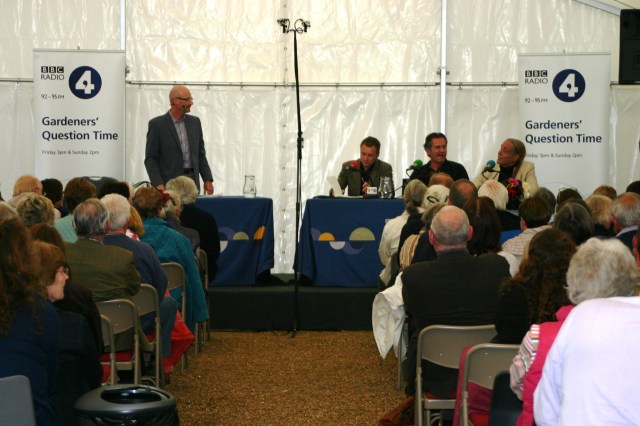
The GQT Panel doing their stuff

The GQT Panel doing their stuff

200 eager gardeners packed the marquee at Gressenhall Farm & Workhouse Museum, Norfolk yesterday. Rather than post my own article answering gardeners’ questions I thought I’d devote this week’s GQT to a report on the real thing!

Well, it turned out to be a fascinating event, especially watching the ‘well oiled machine’ that is GQT in operation. Celebrating its 65th year of broadcasting this year the programme, as chairman Peter Gibbs said, ‘has become a national institution’ attracting some 2.5 million listeners a week. Pleading with the audience not to blame him for the recent weather (for non Brits he’s a well-known TV and Radio weather forecaster as well as a keen gardener), he recalled his time in Norfolk and visiting the Museum with a young family about 15 years ago. He went on to chair not one but two editions of the programme (I’ll give you broadcast dates later). And we were not disappointed with either the range and quality of the questions or the depth and humour of the Panel’s answers.

Earlier I had been involved in a ‘pre recording’ session with some fellow gardeners and the original Museum curator, Bridget Yates. Matthew Wilson and Bob Flowerdew, two of the panelists quizzed us on the history of the place and some of the more recent developments in the gardens. I was mightily impressed with the professionalism of the production team and the two panelists who seemed to conjure an interesting and relevant discussion from the barest of facts – you’ll have to listen in for the full version!

The GQT Team at Gressenhall- from left: Matthew Wilson, Chris Beardshaw, Peter Gibbs, James Wong and Bob Flowerdew

The GQT Team at Gressenhall- from left: Matthew Wilson, Chris Beardshaw, Peter Gibbs, James Wong and Bob Flowerdew

After this I was pleased to have the opportunity of interviewing Matthew Wilson myself, for the online newspaper ‘The Breckland View’. A well known Garden Designer and Director of an historic plant nursery in London, Matthew talked about his (positive) impressions of the Museum gardens and we went on to talk about growing food at home. Matthew believes this is important, not only for the freshness and flavour of the home-grown produce, but as a way for people to ‘reconnect’ with nature in an increasingly ‘virtual’ world. Though his own garden is small, he tries to ensure that his young children are able to experience nature and growing things close up. He seems to be undecided on the ‘GM or not GM’ debate, as frustrated as me on the apparent lack of ‘hard’ evidence to help us decide how to proceed with the urgent business of ‘feeding the world’, though he feels we can still achieve improvements in crops from some of the older techniques of selection and breeding.

The Question time proper featured a dazzling array of questions. The panelists – serial Chelsea gold – winning medallist Chris Beardshaw and ‘new wave’ botanist James Wong  joined Matthew on stage for the first session  – seemed effortless in their answers to questions as diverse as:

  • whether the museum’s collection of historic gardening books and other material is still relevant (a resounding ‘yes’ from all to that one),
  • trying to explain why one poor gardener could only produce some ‘micro rhubarb’ (pencil thin stalks 10 centimetres long) – the ‘answer lies in the soil’ it would seem, specifically the lack of rich, organic matter and the right position, according to Matthew
  • what kinds of veg could be grown in a wet and dismal summer – James came up with some interesting oriental varieties that in a normal hot dry summer would bolt, but in a more dim and damp period would turn out just right
  • selecting some ‘exotic’ but hardy plants for a patio. Chris initially shocked his audience with a suggestion of ‘black negligee and stockings’, but quickly added that these were references to some interesting plants – sorry, the names have eluded me after the initial image he created…!

And I can confirm that, as the programme repeatedly states, the panel were not privy to the questions before they were asked! The audience was very receptive to the ongoing banter and humour between the panelists and seemed to maintain their enthusiasm right through a second session (where James was substituted by well-known Norfolk organic gardener Bob Flowerdew). Chairman Gibbs praised our fortitude and two hours later it was all over! It had been an enjoyable evening and one where gardening colleagues were welcomed from far and wide the gardening Team from Peckover House, Wisbech and Master Gardeners from King’s Lynn being some of the furthest travelled.

The first programme should be broadcast at 3pm on Friday 5th July (repeated Sunday 7th July 2pm) and the second (from a more anonymous ‘Norfolk’ location this one) on the 23rd/25th August. So, tune in to BBC Radio 4 at these times (or try it online via www.bbc.co.uk, on their ‘i player’ or ‘listen again’ facility if you can’t listen ‘live’).

And for anyone within striking distance of Gressenhall this weekend, the Museum has a special interest day on Sunday focused on gardens and gardening, so why not pop along and meet me at the Master Gardener stall, visit the many other attractions on offer and see the gardens, which I must say are looking splendid (but then again I would say that)!

Thanks to Kings Lynn Community Allotment for the photographs

Old School Gardener

If you’ve enjoyed reading this post and others on this blog, why not comment and join others by signing up for automatic updates via email (see side bar, above right ) or through an RSS feed (see top of page)?


PicPost: Urban Farm

Shipping container greenhouse – urban farm unit by Damien Chivialle

What goes on underneath the greenhouse (heating?)?

Does the whole thing rotate on the turntable its standing on?

 Close up of strong wind break netting

Close up of strong wind break netting

No, not a reference to too many sprouts, but a serious question from L. Onerf in Somerset:

‘Vegetables are not growing well in my windy garden, but I am reluctant to plant windbreaks of trees or hedges, as they will create shade and take moisture from the soil. What alternatives are there?’

If you want to avoid the costs of installing a fence/trellis with openings to allow the wind to percolate through at an acceptable speed, I think the answer lies in putting in a screen of synthetic wind break material, obtainable from most garden centres or online. The strength and quality of this varies and some is fairly costly, but a 1.5- 1.8 metre high wind break around your plot would give dramatic results. I found a 50 metre x 2 metre roll of knitted net on offer online for around £170 or much the same on Ebay for about £40, and £13 for a 10 metre length. Make sure the posts are anchored firmly in the ground (corner posts may need to be reinforced and they should ideally be bedded in concrete), as the netting takes a tremendous strain in high winds.

On the subject of vegetable or kitchen gardens, is yours laid out for maximum efficiency and growing space?

Traditionally vegetables were grown in large plots, often 6-9 metres wide and as long as the garden allowed. The vegetables were arranged with a lot of wasted space between rows. Today we know that vegetables can be grown far closer together without any adverse effects; indeed, there is a a trend towards abandoning rows and growing vegetables with equal spacing between the plants in each direction, in blocks or patches.

Narrow beds in the Kitchen Garden at Old school Garden

Narrow beds in the Kitchen Garden at Old School Garden

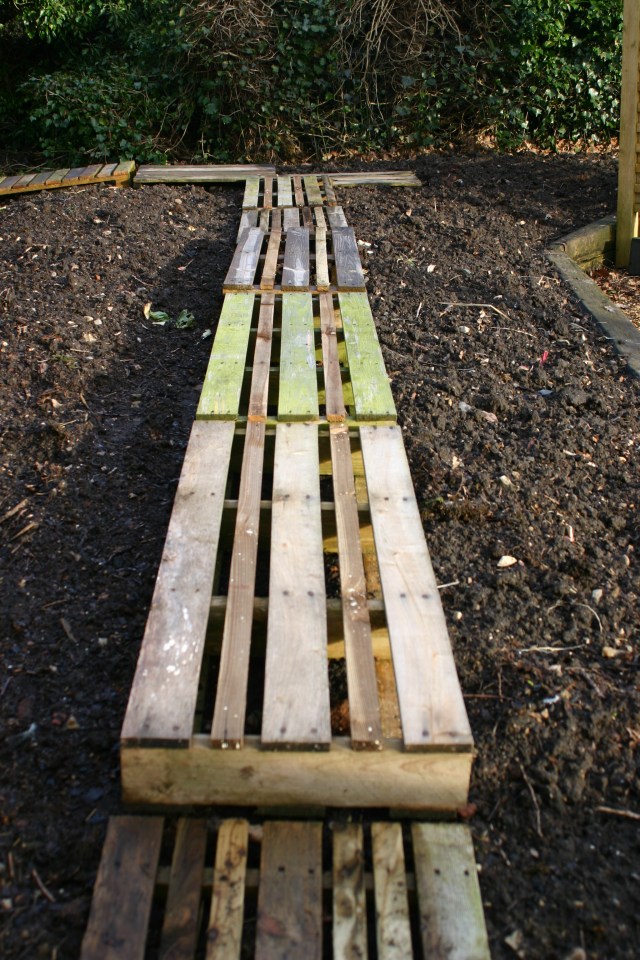
This compactness lends itself to smaller, narrower beds, say 0.9 – 1.5m wide, which can be any length you like. These narrower beds are easier to manage from either side (so avoiding walking on the bed itself and opening up the possibility and benefits of ‘no dig’ cultivation) and the denser planting also helps to crowd out weeds. here at Old School Garden, my kitchen garden ahs been laid out along these lines, though I still have a one large bed which I’ve effectively split into two by creating a ‘boardwalk’ path out of old pallets.

New boardwalk made of old wooden pallets

Boardwalk made of old wooden pallets, used to split a large veg bed into two

Do you have any gardening questions I might help you with? If so, please email me: nbold@btinternet.com

Old School Gardener

If you’ve enjoyed reading this post and others on this blog, why not comment and join others by signing up for automatic updates via email (see side bar, above right ) or through an RSS feed (see top of page)?

PicPost: Bale Out

A great idea for a temporary cold frame, using simple materials. From Growveg

Heritage Veg- keeping the old varieties going

Heritage Veg- keeping the old varieties going

I had an interesting delivery in the post yesterday. It was from Garden Organic, the UK charity that promotes organic gardening. Some of you may recall that I’m a volunteer with the ‘Master Gardener’ programme they jointly run in Norfolk and a few other places, providing advice, information and support to people starting to grow their own food. More recently I became a ‘Master Composter’ doing the same thing but focused on recycling green waste into a useful gardening product. Well, it seems that this has enabled me to have free membership of the ‘Heritage Seed Library’ (HSL) run by Garden Organic at their base near Coventry.

seeds in handThe HSL aims to conserve and make available vegetable varieties that are not widely accessible. It does this by maintaining a collection of vegetables from the UK and Northern Europe that are not readily available in seed catalogues. Some of these varieties were commercially available once but have now disappeared from catalogues and seed lists. Others have never been offered in catalogues but have been developed by gardeners and passed on through the generations until they were donated to the HSL. There are also some varieties that have a special local significance. Many have a story to tell, and HSL collects not only the seed, but also information on their characteristics, methods of use, origins, and what this can tell us about our gardening and culinary heritage. Just flipping through their current catalogue is a journey into the past with varieties carrying evocative names like:

Navy Bean Edmund – a variety of bean first cultivated to sustain Australian forces during WWII and which is the kind used to create ‘baked beans’.

Long Blood Red– an American Beetroot described by Vilmorin in ‘The Vegetable Garden’ (1885) as an ‘American variety with a long, slender, deeply buried root..good, productive, and well-coloured kind’ – a member of HSL describes it as having ‘the best flavour, wonderful for picking’.

Maltese plum – a variety of tomato donated by someone whose friend acquired the seeds on holiday in Malta! Trusses are borne on leaf spurs, so unlike many other varieties you don’t grow it as a cordon or remove the side shoots. This is a late variety that produces a heavy crop of firm, red plum type tomatoes ideal for stuffing.

What varieties of Veg do you grow?

Which varieties of Veg do you grow?

The HSL is not a gene bank, so does not preserve the seeds in cold storage, but grow them and make them available to other gardeners so that they remain alive and able to adapt to new conditions. Any new characteristics then have a good chance of being spotted and made use of. The HSL was created in response to the loss of old vegetable varieties that occurred following European legislation designed to counteract the activities of some unscrupulous seed companies. After the commercialisation  of seeds in the 19th century the traditional practice of farmers and gardeners exchanging seeds declined. European law says that only seed that is listed on a National List (and ultimately the EU Common Catalogue) can be marketed. To be on the list a variety must go through a series of tests, part of which is about ensuring consistency between generations. The tests both cost money and were impractical for many smaller seed companies, so many varieties started to disappear, especially those that are inherently highly variable.

With the costs incurred in breeding and maintaining a variety, a large, profitable market is needed by commercial seed companies. This means that they often decide against maintaining varieties suitable for ‘niche markets’, e.g. gardeners, in favour of those more acceptable to large-scale growers. The varieties available are therefore more likely to ripen at the same time to make harvesting with machinery easier, tough enough to withstand travel and handling in supermarkets, and familiar in visual characteristics so that they are acceptable to the average shopper. Flavour often takes a back seat.

The HSL runs a membership scheme to help to distribute seeds and counteract the costs of the EU legislation. Members pay an annual fee which goes towards the costs of collecting, growing, storing and distributing the seed. HSL produce articles on seed saving, research and the latest developments on the international seed scene in ‘ The Organic Way’, the Garden Organic members’ magazine. Every winter they also send out a Catalogue covering a portion of the collection- members can choose up to six packets  containing a few seeds of different varieties to try out for themselves. HSL is also active in promoting seed exchanges around the country.

The HSL currently looks after 800 varieties of Heritage Veg seeds

The HSL currently looks after 800 varieties of Heritage Veg seeds

Currently HSL looks after over 800 types of seed from open-pollinated varieties (not F1 hybrids), of which around 200 are detailed in their Seed Catalogue. As well as research on the varieties and testing of previously untried varieties that come in from time to time, HSL grow some of the seed used at Garden Organic’s HQ. More seed is grown by Seed Guardians – special members who volunteer their resources to look after and bulk up selected varieties. These are then available for distribution to HSL members.

The collection is still expanding. Every year HSL receive samples of vegetable seed that gardeners have been looking after and keeping alive. They ask a lot of questions about each one to determine its place in our culture and then conduct our trials on it, taking notes and making assessments throughout its growing life to find out as much as possible about it. This gives HSL the opportunity to ensure that it is different to anything else they are looking after, not obviously diseased, has not crossed (and is not a hybrid) and is something gardeners would be interested in growing. If HSL decide it is something they should be keeping they add it to the collection, so there’s always something new coming in. You can find out more about the HSL and download a seed saving guide at their website- see link below.

This is my first exploration of ‘Heritage Veg’ and the inclusion of a small sample of Greek Squash seed will give me a chance to sample an unusual variety for myself – if I can find the room for it in the kitchen garden, that is!

Taylor's SeedsCo-incidentally, last week I was also involved in another aspect of ‘Heritage Seeds’, the opening of a special exhibition at Gressenhall Farm and Workhouse museum, Norfolk. Next to the Museum’s Cherry Tree Cottage Garden (which is designed to be a re-creation of a typical Norfolk cottage garden of the 1930’s), a new space is devoted to displaying various interesting objects from one of Norfolk’s historic seed merchants. R. & A. Taylor, whose Seed Shop in King’s Lynn once provided a wide range of seeds and other ‘horticultural sundries’ to the County’s gardeners.

Over two years of research culminated in the official opening of the new display last week. This captures something of the seed shop as it would have been in the 1930’s and is also home to a significant collection of objects and other material donated to the Museum by the Taylor family in 1982. The present curator, Megan Dennis, and founder curator, Bridget Yates, also wanted the new display to provide a new focus for the museum’s gardening collections. The display was officially opened by James and Bob Taylor, who worked with their father in the family business in Norfolk Street, Kings Lynn. It was a happy day and the new display provides a fascinating range of objects and information for all ages.

I particularly like the material about School Gardening as it used to be carried out in the 1920’s – a solid part of the curriculum, but with a strict gender bias that is true in some households today: the boys grow the vegetables and the girls tend the flowers!

Sources and further information:

Garden Organic Heritage Seed Library and link to pdf on Seed Saving

The Breckland View– article on the Seed Shop display and background

Gressenhall Farm & Workhouse Museum

Master Gardener

Home composting

Old School Gardener

If you’ve enjoyed reading this post and others on this blog, why not comment and join others by signing up for automatic updates via email (see side bar, above right ) or through an RSS feed (see top of page)?

The Kitchen Garden in Old School Garden- my attempt to create something productive and also pleasant to look at.

The Kitchen Garden in Old School Garden- my attempt to create something productive and also pleasant to look at.

This week’s ‘snippet on style’ looks at Productive Gardens- those where the emphasis is on growing food.

The layout of productive gardens tends to be orderly, with geometric beds separated by paths for ease of maintenance and access. Beds are often a maximum of 1.5 metres wide along two parallel sides to prevent the need for walking on the soil. Materials can vary but are often utilitarian rather than ornamental (unless the garden is intended as an ornamental kitchen garden or French ‘potager’). Concrete slabs, brick paths or even compacted earth are common  surfaces. Planting varies seasonally and may rotate to reduce the risks of pests and diseases and to avoid sapping the soil by growing the same crops each year. Other features of productive gardens include:

  • raised beds

  • wide paths

  • rustic obelisks

  • planting in rows or blocks

  • simple if any decoration and with a practical angle- e.g. ornamental bird scarers

71977_10151553299256970_1641852360_n

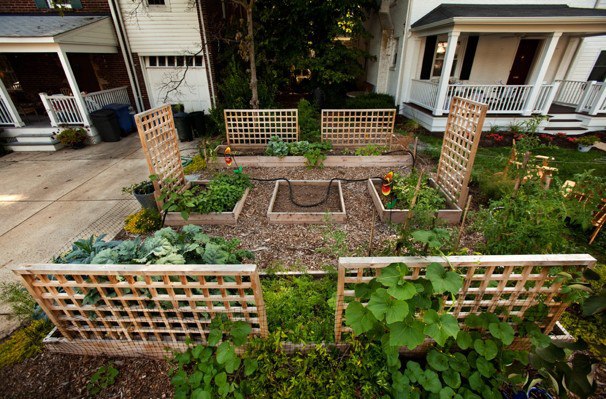
Here’s an example of a productive garden shared between two neighbours.Communal food growing also takes place at larger scales, for whole neighbourhoods in shared beds or in long established ‘allotments’ where each tenant gardens their own plot.

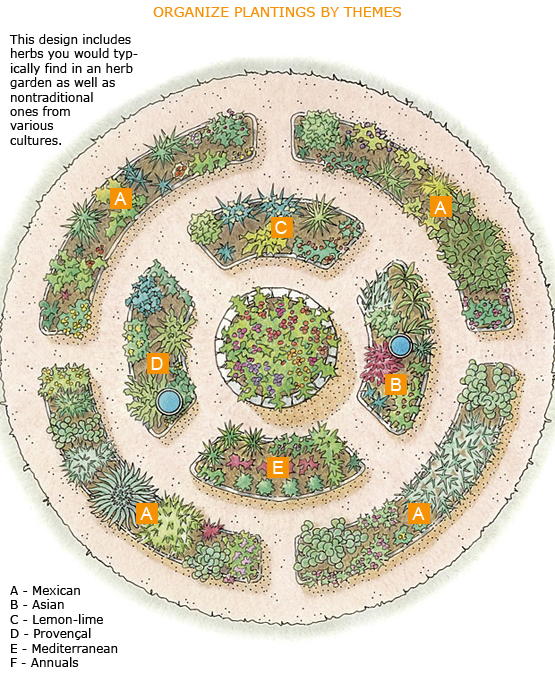
If you're a keen cook and you have the space, you may want to create a special herb garden like this- or if not just find a sunny spot for a few fragrant favourites!

If you’re a keen cook and you have the space, you may want to create a special herb garden like this – or if not just find a sunny spot for a few fragrant favourites!

Let me know what you think makes a Productive style garden, and if you have some pictures I’d love to see them!

Links/ further information:

Garden Organic

RHS Campaign for School Gardening

Food for Life- school gardening

Growing communities

Space for food growing- free guide

Vertical veg

RHS- grow your own food

Food growing case studies – pdf

Other posts in the series:

Japanese Gardens

Country Gardens

Modernist Gardens

Formal Gardens

Mediterranean Gardens

Cottage gardens

Old School Gardener

If you’ve enjoyed reading this post and others on this blog, why not comment and join others by signing up for automatic updates via email (see side bar, above right ) or through an RSS feed (see top of page)?

PicPost: Beet this

IMG_5641

Looking towards the Terrace and Orchard at Old School Garden

To Walter Degrasse

Dear Walter,

Well, old friend, the morning has started under a veil of mist in Old School Garden, but it hopefully will lift later and we can have more of that elusive sunshine!

It’s been a very busy time in the garden and in my other gardening activities. They say that May is the busiest month in the garden, and so far I’d have to agree. In the last few weeks plants have started to catch up with the ‘slow seasons’ and there is a wonderful fresh greenness around and in the countryside beyond. I tend to wait until the end of May before putting out any tender plants and as a result, my greenhouse and cold frame are bursting with plants at various stages of growth. Hopefully I can move things on over the next couple of weeks so that I can make way for tomatoes and cucumbers (new seedlings kindly supplied by my friend Steve) in the greenhouse.


The Kitchen Garden is starting to fill out and every bed is now full with something (though the new Asparagus I planted last autumn is a ‘no show’ – maybe it drowned in all the winter wet or perhaps it’s just not strong enough to break the surface yet – there’s certainly Asparagus on sale locally). You remember I tried sowing carrots in modular pots last year and they were more or less a failure? I’d hoped that was due to the weather. Touch wood – those I sowed earlier this year and which I’ve now planted out, seem to have established well and are growing away. I invested in some outdoor polypipe as an experiment in building a structure to cover these with mesh (as a protection against Carrot Root Fly) and the result is looking like its doing a good job. I did a very simple job of slotting the pipe into some pipe brackets I’d fixed to wooden spacers screwed to the insides of my wooden raised bed and the new roof seems to be holding its curved shape quite well, though some roof – line reinforcement (perhaps with another length of pipe) may be required to ensure the structure survives the windiest weather. The Parsnip I sowed a couple of weeks ago in this bed also seems to have germinated, so I shall thin those shortly.

I’ve also tried a new design for the support of my Mangetout, creating a sort of angled arc which has 12 healthy plants at its foot ready to clamber their way up the netted structure (they grow to about 4 feet so I didn’t need anything very tall).


You remember that I planted my potatoes (well almost all of them) on 5th April, because that was deemed to be a beneficial date on the lunar calendar? Well, I haven’t got any way of making a scientific comparison, but these are now looking healthy, are well above ground and ready for ‘earthing up’. The reserve tubers which I put into a shadier spot a few weeks later have not yet broken through.

Early potatoes up and looking good

Early potatoes up and looking good

We’ve seen the return of ground elder – an annual event despite what seems like constant weeding. So I’ve been out doing a regular hour or two of hand weeding to try to systematically work my way around the borders, and with the recent rain and the addition of rotted wood chips to the soil, this is a very enjoyable and rewarding activity. It’s just lovely working your way through the soil, carefully ‘mining’ for the roots of the elder and gently easing it out of the ground – ‘just like archaeology’, as Deborah says! Though the flower borders are looking a bit like a wireless station at present (because of all the canes and string I’ve put out to support some of the bigger perennials), the new growth is gradually covering these and the garden is taking on a fuller look. I must keep on with the weeding!

With the lateness of spring the Tulips are still with us and they are making some very pleasant combinations with other plants in the garden. I’ve shown a few examples here.


Have you noticed any snail and slug activity yet? I’ve been very surprised that there seems to be very little obvious damage to Old School Garden as yet (compared to last year when it was disastrous). I did put down some pellets a few weeks ago, especially on the containers with Hostas in them and I’m very pleased that the new leaf growth appears to have virtually no signs of damage at all  – maybe these pellets did the job of killing off the young snails and slugs, though even so I haven’t seen many corpses around, so I’m thinking that maybe the very harsh winter weather did a good job in killing off those slugs and snails that would have normally over wintered. The Courtyard  looks good as a result, with the vine coming into to leaf and garlanding the walls and some new colour coming soon from some Sweet Williams I put into the containers alongside the Hostas.


On the wider front, I’ve continued to work with the children at my local Primary School, and as you may have seen in a recent article, I’m enjoying working on various projects with a group of 7 children on Friday afternoons. Yesterday at the School’s annual Fete, we managed to sell all of the hanging baskets that the children had planted up, so making around £40 profit that can go back into gardening activities. This event was also an opportunity to promote the Master Gardener and Master Composter schemes I’m involved with. A colleague, Jane and I manned the stalls for the afternoon, making  paper pots and sowing Nasturtium seeds with the youngsters, showing them the wormery and the worms doing their job as well as offering quizzes and advice and information on food growing and composting to the many adults who came over to see us. Over the next couple of weeks, the Friday gardening group will be finishing off some vertical planters they’re making out of wooden pallets and thanks to a kind donation of plants from a local nursery – woman these will make a lovely, colourful feature in the play ground. I’ll do a separate article on this project once they’re finished.

Today I’m off the Suffolk to inspect a community – run woodland which has applied  to be awarded a ‘Green Flag’ as a mark of excellence. You may recall that this scheme has been operating for a good number of years and is fast becoming the national benchmark for parks and open spaces in England. I’ve been a judge for about 5 years now and every year I get to visit a couple of really interesting and usually very well presented and run open spaces. I’ve been out to judge one woodland in North Norfolk last week and today’s trip will complete my quota for this year. I’ll write an article about Green Flag and the two sites tomorrow, so keep a look out!

Well, that’s just about brought you up to date with Old School Garden for another month.


Thanks for sending me the pictures of your lovely garden, where I see your herbaceous borders are starting to fill out like mine. And I was particularly impressed with your creations using pallets! The new ‘pallet shed’ looks wonderful and the fact that you managed to make it for almost nothing (given the price of sheds these days) is great. My post on pallets seems to have gone down a storm and is still receiving many visitors every day including from the USA and around the world! I’ve come across a couple of other, novel uses of these and will post the pictures shortly. I managed to obtain a few additional pallets for free from the local Garden Centre and I’m currently thinking about what else I can use them for. I’m certainly going to use some as a sort of raised bed edging where I need to consolidate some soil and support the wooden frame up which I’m training a fan cherry and plum. I’ve cut some pallets in half and will sink these, like fences, into the ground as barriers to keep the soil in (maybe using landscaping fabric inside to contain the soil). I’ll let you know how I get on and post some pictures.

Oh, and some great news, The Radio 4 programme ‘Gardener’s Question Time’ is coming to Gressenhall Farm and Workhouse Museum at the end of June, so this will be a great opportunity to introduce those attending to the gardens and promote the place a bit too, especially as there is a gardening event at the Museum the week after! Stay in touch.

All the best for now,

Old School Gardener

Other posts in this series:

Dear Walter….letter from Old School Garden, 18th April May 2013

Dear Walter….letter from Old School Garden, 11th March 2013

Dear Walter… letter from Old School Garden: 15th February 2013

If you’ve enjoyed reading this post and others on this blog, why not comment and join others by signing up for automatic updates via email (see side bar, above right ) or through an RSS feed (see top of page)?

plum

‘We have two plum trees that both blossom, but a lot of the fruit drop before they are fully formed – why is this?’

So ask a Mr. and Mrs. Howard Hughes from Surbiton, Surrey.

Well, the likely reason is a lack of calcium, as this is vital when the stones are being formed. Many sandy soils are low in Calcium, so if you have this sort of soil, this might explain the problem. If there is insufficient Calcium to go round, some fruit will drop off before they have fully formed. To remedy this try a dressing of Lime over the whole area during the winter and then in the spring a mulch around the trees with well-rotted manure or compost should also help.

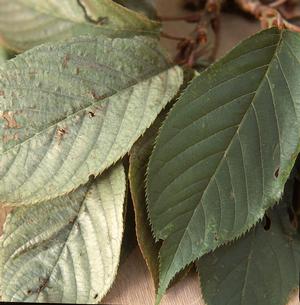
Whilst we’re dealing with plums another problem you might come across is the leaves developing a silvery sheen and the tree looking sick. This is most probably a sign of ‘silver leaf’ – a disease which requires all of the infected and dead wood to be burned before the middle of July. If you accidentally cut into healthy wood, cover the cut with a wound sealant.  To improve the general health of the tree apply a general fertiliser such as Fish, Blood and Bone in February /March.

Silver Leaf- infected leaves (left) compared to healthy

Silver Leaf- infected leaves (left) compared to healthy

Old School Gardener

If you’ve enjoyed reading this post and others on this blog, why not comment and also join some other people and sign up for automatic updates via email (see side bar, above right ) or through an RSS feed (see top of page)?
PicPost: Stair in disbelief

Finding Nature

Nature Connectedness Research Blog by Prof. Miles Richardson

Norfolk Green Care Network

Connecting People with Nature

Discover WordPress

A daily selection of the best content published on WordPress, collected for you by humans who love to read.

Susan Rushton

Celebrating gardens, photography and a creative life

Unlocking Landscapes

Writing, photography and more by Daniel Greenwood

Alphabet Ravine

Lydia Rae Bush Poetry

TIME GENTS

Australian Pub Project, Established 2013

Vanha Talo Suomi

The Journey from Finnish Rintamamiestalo to Arboretum & Gardens

Marigolds and Gin

Because even in chaos, there’s always gin and a good story …

Bits & Tidbits

RANDOM BITS & MORE TIDBITS

Rambling in the Garden

.....and nurturing my soul

The Interpretation Game

Cultural Heritage and the Digital Economy

pbmGarden

Sense of place, purpose, rejuvenation and joy

SISSINGHURST GARDEN

Notes from the Gardeners...

Deep Green Permaculture

Connecting People to Nature, Empowering People to Live Sustainably

BloominBootiful

A girl and her garden :)