Category: Great Gardens


IMG_7887

Thanks for reading this, my 1000th post on Old School Garden. I’ll do a fuller review of my blogging experience on my first anniversary on 17th December. But for now I hope that you enjoy my review of an interesting garden in Portugal.

A little off the beaten track in one of Lisbon’s northern suburbs (Lumiar), sit the Gardens of Monteiro Mor (this translates as ‘the High Huntsman of the Royal House’ refering to one of the former grand residents).They come with not one, but two bonuses – small, but fascinating museums, one focusing on Portuguese Theatre and the other Costume.

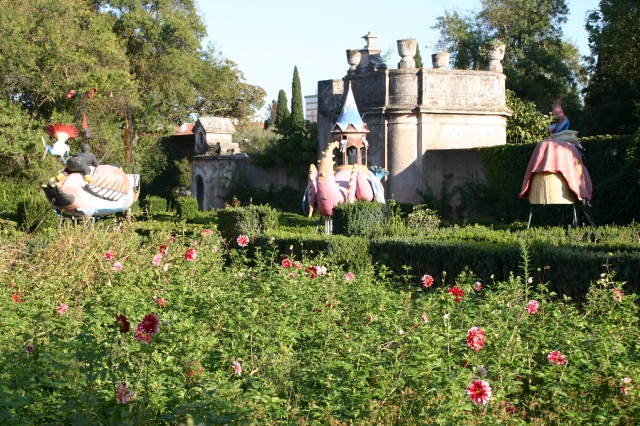
The surrounding gardens are a very engaging mix of formal, botanical display and wilder woodland walks – all very pleasant on a warm autumn day. And there are a number of curious sculptures to see en route too, along meandering paths and steps which take you to a variety of water features and through glades of mixed, mature trees and shrubs.

Interestingly, a communal food growing area seems to have been created on the edge of the parkland, and we also were lucky enough to see a wide range of flowers on display when we visited.

The museums, housed in two former grand houses a few paces from each other, are very well laid out. The Theatre Museum comes stocked with a huge array of printed and pictorial material along with theatre models, sculpture and theatrical props (including some lovely puppets and larger costume displays).

No need for much in the way of interpretation here as the visual richness speaks for itself!

The Costume Museum is an altogether more restrained affair, with displays of clothes and accessories from different periods set off wonderfully in the elegantly decorated rooms of the former palace. Varied lighting levels and effects and a nicely uncluttered feel all contributed to a beautiful wander though time.

This became especially interesting when we reached the 1960’s and more recent displays, which brought back some long-lost memories!

This was a visit well worth the subway ride from central Lisbon, the ‘one for all’ ticket being very good value.

Old School Gardener

IMG_7828 After a stroll through Estrela Gardens in Lisbon we found  our way to somewhere new to us – the English Cemetery just over the road. What a discovery- a quiet, green and fascinating space where a wide range of graves and monuments records the long association of the English with Portugal. The website of the Anglican Church in Lisbon describes it’s past:

‘Part of the Treaty of 1654 negotiated between Cromwell and King João IV of Portugal stipulated that English subjects living in Portugal should have a plot allotted to them “fit for the burial of their dead” in the Lisbon area. Due to opposition from the Inquisition, nothing was done about this until the early eighteenth century and it was only in 1717 that Consul Poyntz was able to report back to London that he had leased a suitable plot near the City “for the burial of our dead”. It became known as St. George’s Cemetery. From those early beginnings until the present day non- Roman Catholic British Nationals have had a traditional privilege of burial at St. George’s; practising Roman Catholics are now also admitted.  

It is an historic site for many reasons and an interesting one too. Probably the most famous British person buried there is the novelist Henry Fielding; he came to Lisbon to try and recover from health problems but actually died on 8th October 1754. No-one knows exactly where he was buried, but a monument to him in the form of a raised tomb was erected by public subscription in 1830. Later on in the Peninsular War Portuguese soldiers acting under orders from Marshal Beresford forced open the door in order to inter the remains of Brigadier General Coleman; legend has it that many other British soldiers were buried there during this period but have no marked graves. From the twentieth century there are rows of Commonwealth War Graves, commemorating servicemen who happened to die in the Lisbon area during World War II. These are but three examples, a wander round confirms that the remains of many interesting people from all walks of life and different nationalities have been interred at St. George’s for almost three hundred years.

In the second half of the nineteenth century many trees and shrubs were planted in the cemetery, some of which survive to this day. It makes it a peaceful, verdant spot, a walled oasis covering several acres in the middle of Portugal’s busy capital.’

Here is my record of our visit in late October 2013.


Old School Gardener

PicPost: Blickling at Christmas

We’ve just returned from a seasonal trip to our local ‘stately home’ – Blickling Hall. The gardens are all wrapped up for the winter, but the Jacobean house and immediate grounds were magical- Christmas trees alight, beautiful flower arrangements, volunteers in period costume, crafts for sale and bands playing carols. December it is and the Christmas mood begins….

Old School Gardener

IMG_6950

Our last, late summer visit to a west country garden, Killerton, did not disappoint. We enjoyed a very informative tour in a golf buggy and strolled around the grounds on a sunny afternoon. Lying just outside Exeter, Killerton is a massive estate and we had a little trouble actually finding the entrance (road signs and sat nav conspired against us!). Nevertheless we had a warm welcome.

Killerton is notable as the ‘home given away’. It’s last private owner,  Sir Richard Acland did just this with the whole estate of over 2,500 hectares (including 20 farms and 200-plus cottages), one of the largest acquired by the National Trust. Acland held a strong belief in the common ownership of land and was a founder member of the British Common Wealth Party, formed in 1942 to oppose the wartime coalition and to advocate a co-operative form of socialism, in contrast to the state-led approach of the Labour Party. However, the group never achieved an electoral break through and Acland joined the Labour Party in 1945. He was also one of the founders of the Campaign for Nuclear Disarmament (CND).

The original gardens at Killerton were designed in the late 18th century by John Veitch, one of the leading landscape designers of the time. It features rhododendrons, magnolias, herbaceous borders and rare trees surrounded by rolling Devon countryside. Many of the trees and the views of the surrounding countryside are very impressive – here are some pictures.

The grounds also house – typically for the 19th century – an Ice House and a curious Summer House which is of a rather gothic design and features a strange assortment of decorative materials – including animal bones, hides and fir cones! Here’s a second set of pictures.

However, the ‘parterres’ or mixed herbaceous borders, full of late summer colour when we visited, stand out as my most significant memory of Killerton. These were designed by the late 19th century gardener, garden writer and designer William Robinson. They have some classic plant combinations and bold drifts, typical of the mixed herbaceous borders coming into vogue around this time, and which have been influential in English garden design up to the present day. This area features a central path and secondary paths with Coade stone urns as focal points. The layout of the borders is perhaps curious given Robinson’s advocacy of  ‘wild gardens’ – a more naturalistic approach to garden design. But even these semi formal designs, with their ‘loose planting’, were seen as revolutionary.  Apparently, Killerton’s head gardener at the time said:

‘it of course spoilt the park, starting as it does and ending nowhere, I got into bad odour condemning it’.

Robinson’s ideas about ‘wild gardening’ spurred the movement that evolved into the English cottage garden, a parallel to the search for honest simplicity and vernacular style of the British Arts and Crafts movement. Robinson is credited as an early practitioner of the mixed herbaceous border of hardy perennial plants, a ‘naturalistic’ look in stark contrast to the high Victorian ‘pattern garden’ of planted-out bedding schemes. Here is a gallery that, hopefully captures the best of these glorious borders.

Further information:

National Trust website

William Robinson- Wikipedia

Old School Gardener

PicPost: Amazing

Maze Gardens at Ruspoli Castle Northern Lazio, Italy

Garden Museum: Visits Programme 2014

lavendar

New programme just announced!

  1. Suffolk Study Day with Tom Hoblyn – Re-Scheduled for Spring 2014

  2. A Garden of Surprises at Burghley House, 12/03/14

  3. Design Study Day with Cleve West, 07/04/14

  4. Syde and Frampton Manor Gardens and Pan Global Plants, 25/06/14

  5. Longstock Park Water Garden & Houghton Lodge, Hants, 14/05/14

  6. Walking London Squares with Todd-Longstaffe-Gowan, 22/05/14

  7. Traditional Splendour in Cambridgeshire gardens, 05/06/14

  8. The Old Rectory with Dan Pearson and Rockcliffe House, Glouc,02/07/14

Old School Gardener

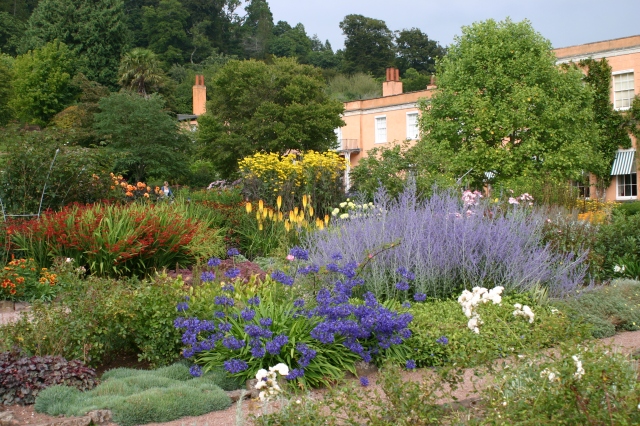
IMG_6879Quite a contrast with the previous Cornish garden visit to Glendurgan, Trelissick (yes another ‘tre’) was all about late summer colour. A mixture of woodland planting and smaller borders and walled gardens full of herbaceous perennials (including some beautiful exotics), this is another wonderful coastal garden in the damp and mild south west, between Falmouth and Truro.

This ‘Technicolour’ treat was a wonderful last garden visit on our summer trip to Cornwall, though we managed one more garden (Devonian this time) before heading back home. Here are some close-ups of the variety of blooms on show when we visited Trelissick towards the end of August.

I was most impressed with the overflowing border nestling towards the bottom of the grass – lined valley close to the entrance. A billowing display of colourful masses of flowers and foliage, the Cotinus coggygria (I think it might have been the variety ‘Grace’) looking especially vivid as a low sun caught its large leaves of reds – purples. Here is a gallery to show you what I mean.

The Fal valley with smaller creeks and inlets branching off on either side is reached via wooded slopes with oaks and beeches overhanging the mudflats of the tidal creeks. The King Harry Ferry below Trelissick is the only connection across the water to the Roseland peninsular on the other side of the estuary.

In about 1750 a modest two-storey villa was built at Trelissick on the foundations of an earlier building. This house was remodelled in 1825 by Peter Frederick Robinson who added the columned portico which rises to the height of the south front. Robinson’s patron was Thomas Daniell whose father had bought the estate in 1800 with the fortune he inherited from tin-mining interests. Thomas Daniell planted much of the woodland along the shores of the estuary and the carriage drives he laid out in the park are now shady woodland walks. Between 1844 and 1913 the estate was owned by the Gilbert family who made great improvements to the grounds. They planted ornamental woodlands and some of the huge holm oaks and conifers in the garden. The wonderful garden seen today was largely created by Mr and Mrs Ronald Copeland after Mrs Copeland inherited Trelissick in 1937.

This has been in the ownership of the National Trust since 1955 when it was donated by Ida Copeland  following the death of her son Geoffrey. Many of the species that flourish in the mild Cornish air, including the rhododendrons and azaleas (such a feature of the garden, but not in bloom when we visited), were planted by the Copelands including hydrangeas and camellias, flowering cherries, and exotics such as the Ginkgo and various species of palm. They also ensured that the blossoms they nurtured had a wider, if unknowing audience. Ronald Copeland was chairman and later managing director of his family’s business, the Spode china factory, and flowers grown at Trelissick were used as models for those painted on the pottery produced at the works.

The garden is noted for its rare shrubs (it holds the national collections of Photinias and Azaras) and features a large park, woodland walks, views over the Fal estuary and Falmouth – there are ‘peep hole’ glimpses of water punching through the sloping woodland canopy that surrounds the extensive park path system.  After a pleasant afternoon break in the courtyard restaurant (though we were joined by some cream tea loving wasps) we took a leisurely drive onward to re-enter Devon on our way back to East Anglia.

Here are some images of this wider, parkland setting, which,along with the rest of the place, is kept in tip-top condition, a credit to the garden team.

Sources: Wikipedia and Tour UK

Further information: National Trust website

Why not take a look at my other articles on West Country Gardens – click on the ‘category’ on the right

Old School Gardener

IMG_6850Very much a garden for the plant enthusiast, I think, particularly if you’re into sub tropical ferns and sun loving agaves. When we visited in mid August the three valleys that make up this garden were bathed in warm sunshine and there was the sound of children’s laughter from the Maze and play spots. The valleys tip out into the Helford river where the hamlet of Durgan (now a series of holiday lets run by the National Trust), looks across the wide, slow running estuary that leads to Falmouth a little further up stream.

There’s also much of interest here for those that love inspiring landscapes, featuring variations in foliage shape, size and tint coupled with the different masses and forms of the many exotic trees and shrubs. This is a well crafted garden that makes the most of its situation, with breathtaking valley-side paths that give glimpses of interesting trees, features and of course that maze.

Despite being busy when we visited, the garden’s enclosed volume seemed to capture sound and, rather like a cathedral, gave back softened echoes that settle the soul.

Glendurgan Garden was laid out by Alfred Fox in the 1820s and 1830s, with the famous Cherry Laurel Maze being created in 1833. In 1962 Glendurgan Garden was given to the National Trust by Cuthbert and Philip Fox. Key features are the giant rhubarb plants in the jungle-like lower valley and spiky arid plants basking in the sunny upper slopes. There’s also a seat made out of an upturend boat, several tulip-trees and ponds. I gather that the Trust have introduced some colour into the gardens, where spaces naturally fall between the more major planting, but this is principally of spring and early summer wild flowers, long gone by the time of our visit. We must return at another season…

Further Information: National Trust Website

Old School Gardener

If you’ve enjoyed reading this post and others on this blog, why not comment and join others by signing up for automatic updates via email (see side bar, above right ) or through an RSS feed (see top of page)?

Brigid Jackson's avatararistonorganic

There are a few wonderful gardeners where I live. One such gardener is Maxi Burger. Maxi took over this verge a few years ago and has turned it into something we can be proud of. Her hard work is evident, with the wonderful display that greets residents and passers-by.

View original post

One of the sloping beds

One of the sloping beds

My previous article on Trengwainton covered the wider gardens and grounds as well as some historical background. Today I want to focus on the extensive walled gardens, built by previous owner, Rose Price. This is said to follow the dimensions of Noah’s Ark- though why, I’m not sure.

It also seems to have been created as a response to the period of persistently cooler weather known as the ‘Maunder Minimum’ (or otherwise known as the ‘prolonged sunspot minimum’). This period- starting in about 1645 and continuing to about 1715 – was when  sunspots became exceedingly rare. The term was named after the 19th Century solar astronomer Edward D. Maunder who studied how sunspot latitudes changed with time. The Maunder Minimum coincided with the middle—and coldest part—of the ‘Little Ice Age’, during which Europe and North America were subjected to bitterly cold winters. recent research has established a causal link between low sunspot activity and cold winters.

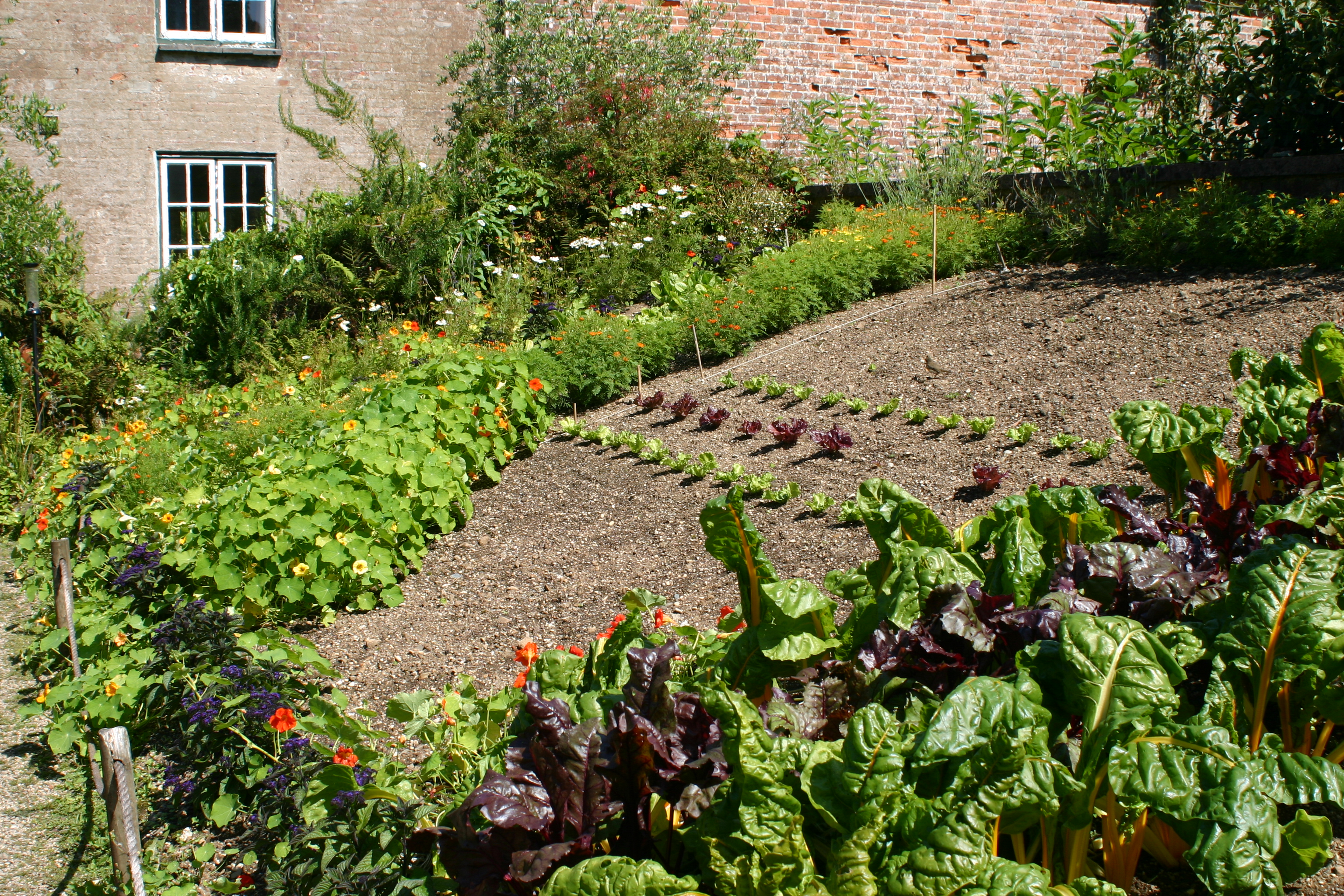
The surrounding garden wall prevented warm air from escaping from the garden on cool nights, thereby allowing frost-sensitive fruit trees to survive, despite the cooling climate. The walled garden is also interesting for its use of sloping beds – orientated to take advantage of the sunny aspect and so aiding the warming of the soil and creating beneficial growing conditions. 

The gardens – there are separate walled enclosures rather than one large expanse – are both a fascinating horticultural legacy and also a modern-day guide to good food and flower growing. There are demonstration plots and little corners showing different sorts of container growing, raised beds, nectar – rich flowers, a DIY device for creating liquid plant food etc. A wide range of food is still grown here as well as beautiful ‘cottage garden’ style flower borders, orchards and a demonstration plot conjuring up the ‘Dig for Victory’ campaign of the second World War. And while we were there the Gardens sported a delightful display of home-made ‘fairytale’ characters which amused and enchanted the young children who were eager to discover the next character on their way round!

This slideshow requires JavaScript.

Related article: West Country Gardens: Hydrangea Heaven at Trengwainton

Finding Nature

Nature Connectedness Research Blog by Prof. Miles Richardson

Norfolk Green Care Network

Connecting People with Nature

Discover WordPress

A daily selection of the best content published on WordPress, collected for you by humans who love to read.

Susan Rushton

Celebrating gardens, photography and a creative life

Unlocking Landscapes

Writing, photography and more by Daniel Greenwood

Alphabet Ravine

Lydia Rae Bush Poetry

TIME GENTS

Australian Pub Project, Established 2013

Vanha Talo Suomi

The Journey from Finnish Rintamamiestalo to Arboretum & Gardens

Marigolds and Gin

Because even in chaos, there’s always gin and a good story …

Bits & Tidbits

RANDOM BITS & MORE TIDBITS

Rambling in the Garden

.....and nurturing my soul

The Interpretation Game

Cultural Heritage and the Digital Economy

pbmGarden

Sense of place, purpose, rejuvenation and joy

SISSINGHURST GARDEN

Notes from the Gardeners...

Deep Green Permaculture

Connecting People to Nature, Empowering People to Live Sustainably

BloominBootiful

A girl and her garden :)