Category: Great Gardens

Dordogne, France
Old School Gardener
Our 2014 September visit to Portugal featured some interesting new places, including three wonderful gardens. The first I’m featuring was a visit to the home of wealthy ex pat Brits when it was established over a century ago. Monserrate sits in the mountains north-west of Lisbon in the regal suburb of Sintra.
The website which covers many of the Sintra garden gems describes Monserrate gardens and its palace as:
‘..one of the most beautiful architectural and landscape Romantic creations in Portugal… unique representatives of 19th century eclecticism.The Palace combines gothic and Indian influences as well as Moorish suggestions together with exotic and plant motifs which are harmoniously extended to the exterior. The gardens have received species from all corners of the world, which were planted according to their geographical origin. The front lawn of the Palace provides a well-deserved rest, while discovering one of the richest Portuguese botanical gardens.’
It was built in 1858 for Sir Francis Cook, an English baronet who had amassed a fortune as a trader and textile baron and was created Visconde de Monserrate by King Luis. Cook turned to an English architect, James Knowles jr. for the house design. He took inspiration from the many countries Cook had dealings with and also the flamboyantly oriental Royal Pavilion in Brighton, England, built for the Prince Regent, later Goeorge IV over 50 years earlier. I loved the round tower and proportions of the palac, the use of reflected light under the wide eaves with subtle creamy and terracotta hues to create a lovely warm glow. The rich decoration is a generally successful blending of eastern, moorish and gothic revival styles. Here are some pics of the house….
Cook hired William Nevil as Botanical expert and landscaper. The project was completed within 5 years and was Cook’s summer residence. The entire estate was put up for sale in the 1920s by Cook’s great-grandson, and after many years of neglect was purchased by the state in 1949. Since then it has been open to the public as a national monument.
The English influence emanates throughout the gardens which have a romantic feel, especially as you wind your way along rough paths through shaded glades with waterfalls, pockets of sunlight and mock ruins, and eventually up to the rather more manicured lawn (the first laid in Portugal) that stretches away from the house down to the grounds. These also include specialist and exotic gardens with non-native plants from Cook’s personal collection. Here are some pics of the gardens and grounds…
The Monserrate Palace is the smallest of Sintra’s three palaces but it is by far the most decorative – and beautiful- and certainly captivated me, as did the winding and varied gardens – especially the Mexican Garden, some pics of which follow…
It has taken 20 years to restore the gardens and the result was recognised in 2013 when they were voted the winner of the European Garden Awards in the category for “Historical parks”. In 1995 the park was recognised by the UNESCO as a World Heritage Site as a part of several palaces and parks in Sintra. The citation for its latest award says:
‘Light and shadow, exotic and rare plants, winding paths and breath-taking views, but even new garden sections, such as the rose garden that was opened in the year 2011 by the Prince of Wales, make a visit to Monserrate, in spite of the many other wonderful parks in Portugal, a unique, fascinating and therefore “prize worthy” event.’
Old School Gardener
We visited the Portland Japanese Garden as part of the 2014 Garden Bloggers Fling. I wouldn’t put Japanese gardens at the top of my list of favorite gardening styles. However, I’m very glad I was able to spend some time in this tranquil place.
Trees of the Pacific Northwest tower over the entrance to the Portland Japanese Garden.
The Portland Japanese Garden is actually five different gardens on 5.5 acres surrounded by protected woods. While the gardens are traditional, trees native to the Pacific Northwest are also included so as to blend in with the natural surroundings. This creates a larger sense of scale than is generally found in this type of garden.
The five gardens are the Flat Garden, the Strolling Pond Garden, the Natural Garden, and the Tea Garden. Throughout, stone and water matter just as much as the plants.
The Strolling Pond and Natural Gardens were the ones I…
View original post 210 more words
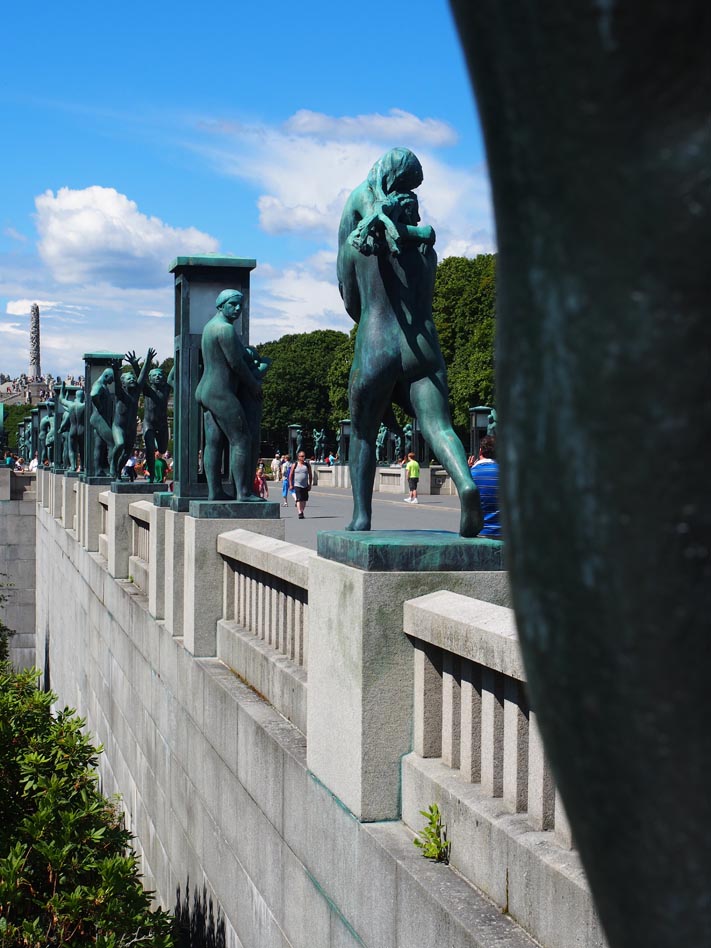
I visited the Vigeland Park last summer. It is the world’s largest sculpture park made by a single artist, and is one of Norway’s most popular tourist attractions.
The unique sculpture park is Gustav Vigeland’s lifework with more than 200 sculptures in bronze, granite and wrought iron. Vigeland was also in charge of the design and architectural layout of the park. The Vigeland Park was mainly completed between 1939 and 1949.
Kawachi Fuji Garden, Japan
Old School Gardener
As promised for the third in my week’s posts celebrating my 500th post we go down to Hertfordshire to explore Tom Stuart-Smith’s garden designs at his own home and the home of his sister. The family home at Serge Hill is surrounded by mature planting. The new gardens designed by T S-S are within its grounds. When these gardens open they are very popular with thousands of visitors making an appearance. It looks very busy and taking photos is difficult as the gardens are only open for one day each year as part of the National Garden Scheme, so people find it in the famous Yellow Book. The friendly herd of Guernsey calves greeted every visitor. We wandered through the gardens around the house which had been there a long time but the influence of T S-S can be seen.
In the gardens at Tom’s and his…
View original post 203 more words
I’ve been writing about my recent trip to Andalucia, and in my last post covered the day we spent in Granada and especially the palaces of the Generalife and Alhambra. One of the powerful impressions of this visit was how water can be used to enhance a particular feeling or ambience of a space, so I took a couple of short videos to demonstrate this. The first is from the Generalife and is of a series of fountains in a fairly narrow court or garden. The feeling I get is of an active space, one which you’re encouraged to move through, onwards to the palace…. would you agree?
The second sound is of the Patio of the Myrtles in the Alhambra’s Nasrid Palace; a simpler, larger space where the barest burble of water adds to the restful atmosphere, and as I said in my previous post, the space is almost like an ‘outdoor cathedral’ in the way that sound is softened… enjoy…
Old School Gardener
Congratulations to Malc on his 500th post!
To celebrate reaching 500 posts in my Greenbenchramblings adventures I thought I would create a week of posts about my favourite garden designers, Piet Oudolf and Tom Stuart-Smith. I have featured examples of their gardens several times already but these are special gardens. The Piet Oudolf garden here is his latest creation in Somerset and the Tom Stuart-Smith gardens are his own garden and the one he designed for his sister who lives just yards away.
The garden, called the Oudolf Field sits within the grounds of the Hauser and Wirth Gallery in the Somerset village of Bruton. This 1.5 acre garden was only planted this year so we visited in its very early stages. The garden is better described as a perennial meadow than his usual tall prairie. The plants are generally shorter so that more of each border and the garden as a whole can be seen at…
View original post 243 more words

Our recent visit to Portugal included a longer trip 1 hour north from Lisbon to a fascinating park (it is too big to be called a garden)- in fact it is billed as the biggest oriental park in Europe, stretching to around 35 hectares.