Category: Great Gardens


Picpost: Great Garden @ Howick Hall

“The gardens at Howick are deliberately aimed at garden lovers with the extensive grounds offering a wide variety of plants throughout the year and are open from early February until mid November.

The season starts in early February with the ‘Snowdrop Festival’. In late March/April there are spectacular drifts of daffodils to be seen throughout the grounds.  In April/May the Woodland Garden is particularly lovely with rhododendrons, camellias and magnolias, and the tulips also appear in the wild flower meadows in May.   The formal gardens, including the herbaceous borders and terraces in front of the Hall, come into their own from June onwards. The Bog Garden lasts from June to September and is mostly planted with unusual herbaceous material grown from seed collected in the wild, which will be of particular interest to dedicated plantsmen. The late season brings brilliant autumn colour in late September through to mid November.

Howick Hall Gardens has been rated by the BBC Gardener’s World Magazine as one of the top 5 coastal gardens in the country and rated the Independent Magazine as ‘one of the Best 10 Gardens to visit this spring'”

Source: Howick Hall website

PicPost: Fire Station

Photo from The Exotic Garden, Norwich

PicPost: Vanishing point

Photo from The Exotic Garden, Norwich

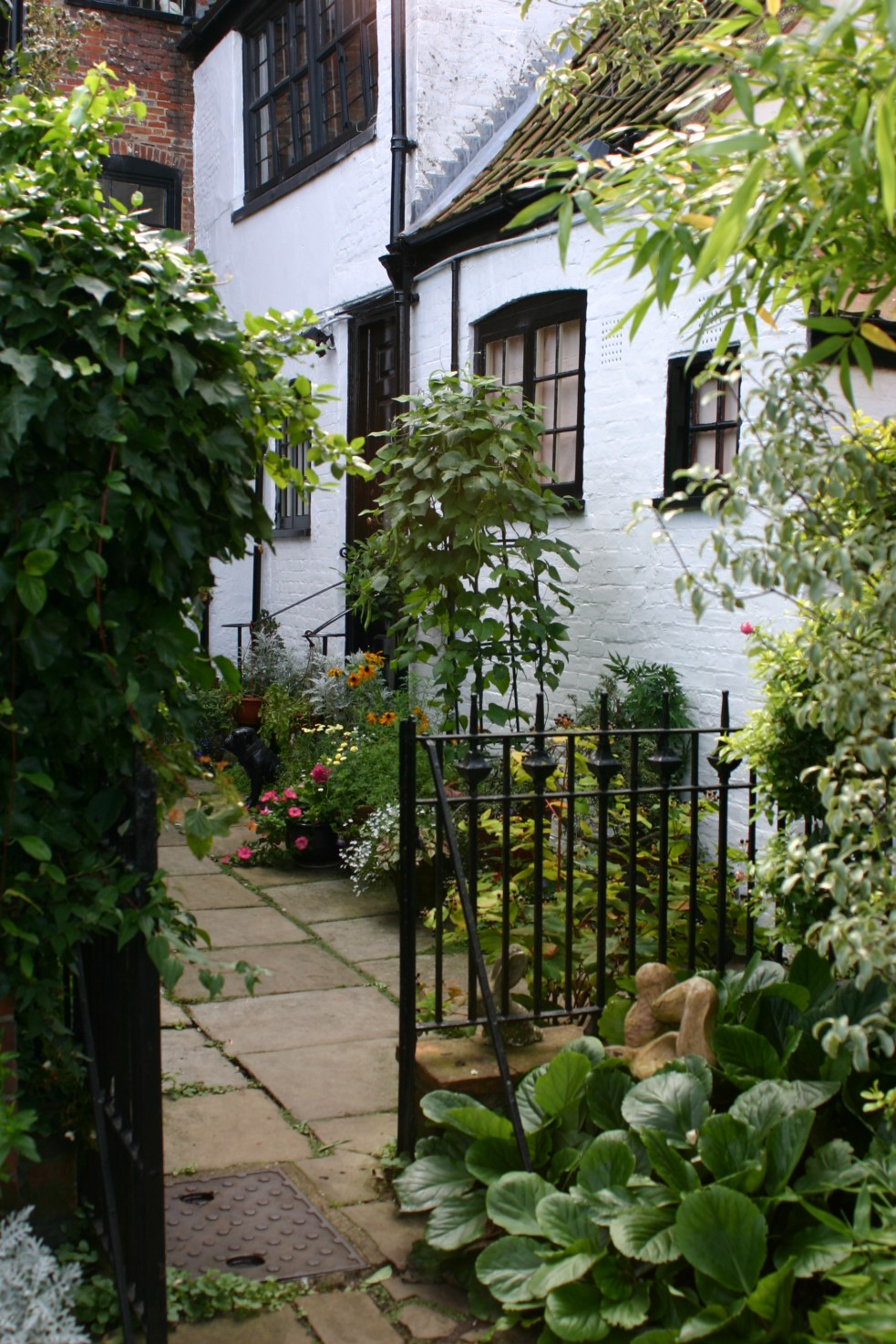
PicPost: Great Garden @ Elm Hill, Norwich

‘Our Norwich Shop is situated in one of the oldest parts of the city. We are housed in a beautiful Tudor building in the ancient cobbled street of Elm Hill. The original elm tree is long gone but the shop stands opposite a lovely plane tree which stands in its place. At the rear of the shop is a peaceful garden thought to have been designed by the late Gertrude Jekyll

We have two large Georgian glass windows which are always stuffed with bears, and shelves upon shelves of bears created by talented artists and all the top manufacturers.

Even on the coldest and dampest of days there is a warm glow from the windows onto the cobbles in the street.
Visitors are drawn in by the glow, and once inside they are encouraged to pick up the bears. We are definitely a ‘hands on’ rather than a ‘don’t touch’ shop.

In the Summer, the sunlight filters through the plane tree in the square outside and softly warms the Bears. We open the garden then for special events, when Customers can choose their Bears outside.’

Source:  Bear Shop website

PicPost: Great Garden @ Belem, Portugal

‘The Praça do Império Garden is located between the Jeronimo’s Monastery and the Discoveries Monument and is flanked by the Belém Cultural Centre. The garden was laid out for the 1940 Portuguese World Exhibition, which celebrated both the 800th anniversary of independence and the 300th anniversary of the Restoration. The central feature is an imposing fountain, which is lit up on special occasions, and has coats of arms around its basin. The park also displays 32 coats of arms in the layout of its hedges and flowers and there are four ponds and two sculptural groups depicting mythological horses.’

Source: Directory of attractions in Portugal website

Norfolk Beefing apples before cooking

Norfolk Beefing apples before cooking

The orchard at Gressenhall Farm and Workhouse Museum, Norfolk, conceals a sacred secret – it was once the workhouse burial ground, where paupers were interred in simple, unmarked graves. And there appears to be no record of who is buried where.

Today the area serves as a demonstration plot for a wide range of Norfolk fruit trees, especially apples. A field gate displays a large number of plaques recording donations of different Norfolk apple trees to the orchard.

Gate to the Orchard showing plaques recording different varieties of donated Norfolk apple trees

Gate to the Orchard showing plaques recording different varieties of donated Norfolk apple trees

One famous local variety, the ‘Norfolk Beefing’ (or ‘biffen/biffin’), is a cooking apple of some reknown. It is recorded as far back as the 1690’s on Lord Walpole’s estate at Mannington, Norfolk. Cottagers used to pick the apples and wrapped them in  straw for a while in a warm oven, after which they would be squashed down and baked again. The final apples were packed in boxes and sent to London where they were a real delicacy, known as a ‘Biffin’.
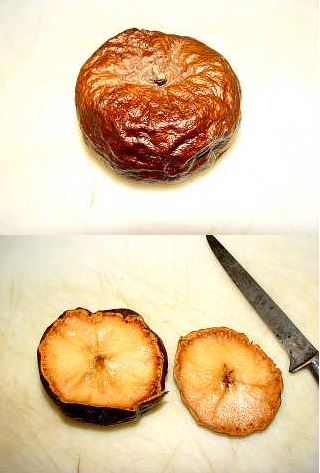
A Norfolk Biffin after cooking

A Norfolk Biffin after cooking

Biffin/Beefing apples have very tough skins, which allows them to be baked whole, and then preserved cold. Apparently when cooked this way they are “creamy with hints of cinnamon and nutmeg”.  They were mentioned in Dickens’ story “Holly Tree” and also in “A Christmas Carol” :

“Norfolk Biffins, squab and swarthy, setting off the yellow of oranges and lemons, and in the great compactness of their juicy persons, urgently entreating and beseeching to be carried home in paper bags and eaten after dinner.”

Nearby, lies the site of a former Windmill. This can be seen if you look carefully at one of the earliest paintings of the workhouse, by Kerrison. Built in 1781, the Mill provided the workhouse with meal and flour for about 50 years. The Workhouse Master would buy a year’s supply of wheat from the local markets and this was then ground at he Mill.

In 1783, records show that William Pulling (of nearby Shipdham) was the Miller and was paid 6d a week (in old pence, or 2.5 new pence!).

By 1829 just a baker was employed, suggesting that the windmill was no longer in use. In 1837 the remains of the mill were removed. This was just one of the special buildings or rooms set aside for meeting the food and drink requirements of the workhouse, it having had a brewery as well as a bakehouse and kitchens!

Early painting of Gressenhall Workhouse (Kerrison) with windmill ringed in red

Early painting of Gressenhall Workhouse (Kerrison) with windmill ringed in red

Next to this site sits the modern compost making area, well organised and used by the volunteer gardeners to improve the soil and mulch the gardens at the Museum. Originally designed for maintenance by farm machinery, it became under used and recently has been reorganised so that the gardeners can maintain it. A system of different bays provide for the different stages of turning vegetable matter into compost (including stems and branches which are periodically chipped into smaller pieces and incorporated into the mix). There are also areas for creating leaf mould, for depositing paper waste generated by the Museum (which is incorporated into the compost) and also a turf mound which will eventually decompose into a fine loam for use in the gardens. The resulting compost is of a coarse texture, but rich in organic matter which is so good for improving soil structure, moisture retention and adding nutrients to the soil.

apple dayThe Museum  hosts an annual ‘Apple Day’ in October which is a great family day out with a range of stalls, activities and attractions including the fresh pressing of apple juice and an opportunity to bring along any ‘mystery apples’  to get them identified by a number of local experts. This lively event contrasts with the peace of the orchard, which is a fitting commemoration of those buried here long ago.

Other posts in  this series:

Down on the Farm – Gardens to ‘dye’ for at Norfolk Museum…

From Grand entrance to Grand Central at Norfolk Museum

Gypsies, tramps and thieves: garden where poor once trod at Norfolk Museum

Cottage Garden recreates 1930’s at Norfolk Museum

Old Workhouse Garden a wildlife oasis at Norfolk Museum

Unique Heritage Gardens at Norfolk Museum
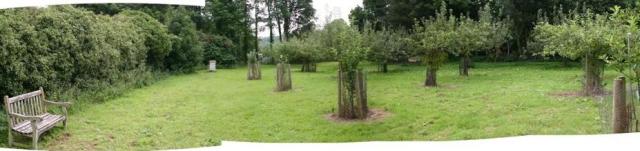
Gressenhall's orchard - a peaceful place to remember the unamed poor once buried here

Gressenhall’s orchard – a peaceful place to remember the unamed poor once buried here

Old School Gardener

If you’ve enjoyed reading this post and others on this blog, why not comment and join others by signing up for automatic updates via email (see side bar, above right ) or through an RSS feed (see top of page)?

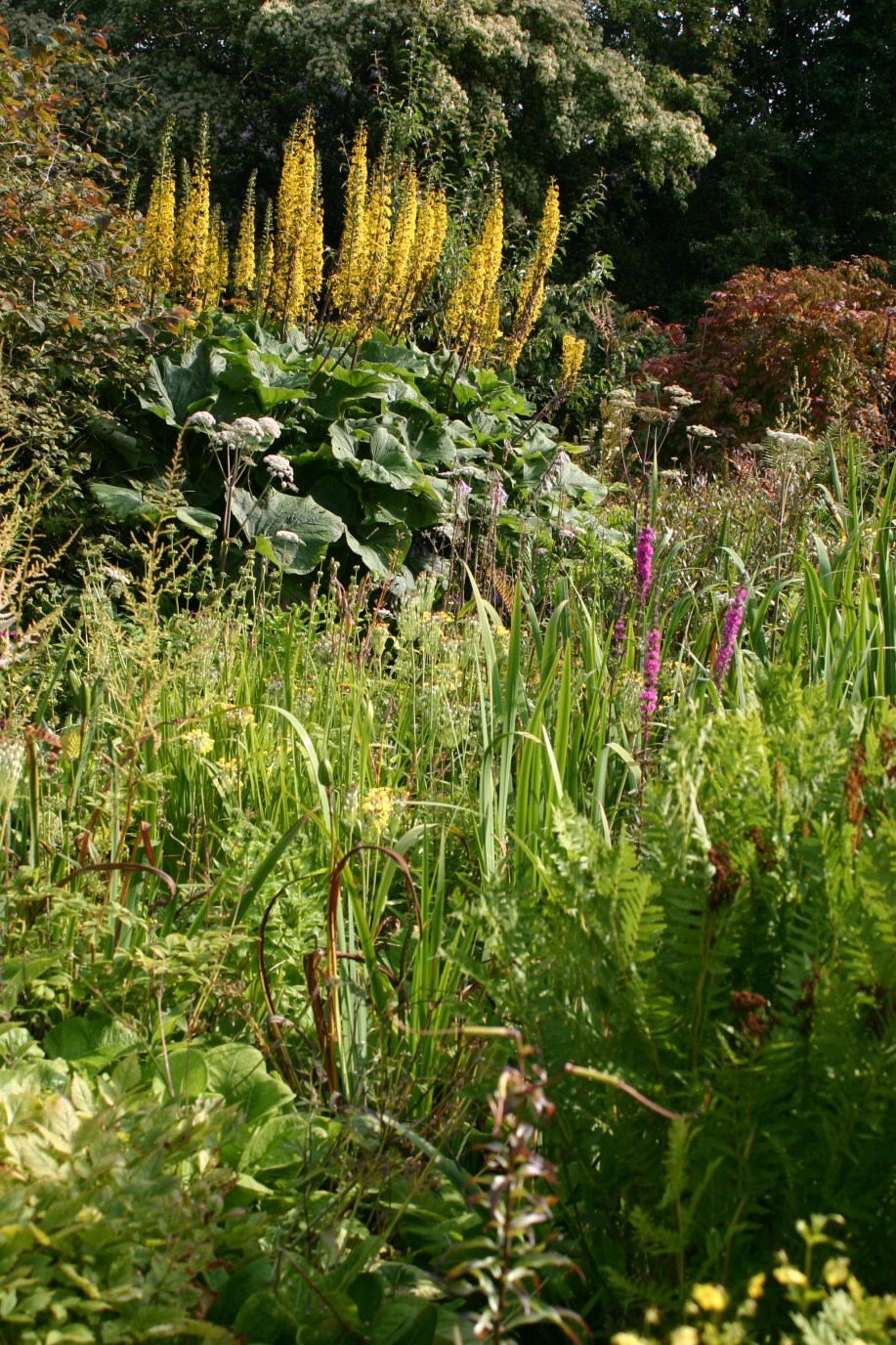
PicPost: Great Garden @ Park Guell, Barcelona

Park Guell is one of the most impressive public parks in the world. The park is located in Barcelona and was designed by famous architect Antonio Gaudi.

Gaudi planned and directed the construction of the park from 1900 to 1914 for Eusebi Guell for a residential park intended for sixty single- family residences. The project, however, was unsuccessful and the park became city property in 1923. Though never fully completed, it still remains one of Gaudi’s most colorful and playful works.

Park Guell, intended to serve Guell’s private city, became all of Barcelona’s, then the world’s favourite. Gaudi let loose his imagination.

While for houses he drew on natural forms, here he shaped nature into colonnades, archways and covered galleries with well-camouflaged artificial structures.

It’s a playground for the mind: visual jokes, like columns that simulate palm-tree trunks, rubble-surfaced arches that grow out of the ground, quilts of ceramic tiles. A graceful gazebo is made of twisted angle iron – cheap to make, looks good, does not lie about its material yet its shape is as softly curved as climbing vines.’ (Park Guell website)

Old School Gardener

PicPost: Roots

Picture taken at Stourhead, Wiltshire

Old School Gardener

PicPost: Great Garden @ Mile End Park, London

Mile End Park

Mile End Park is unusual. It was created as a result of a plan for London in the 1940s which envisaged that there would be several green areas connecting different areas of London to the River Thames.

As a result the park has been created from land brought into park uses over 50 years – much of it formerly housing and industrial buildings. Some of this land is separated by roads, railways and waterways.’ (Tower Hamlets Council website)

Old School Gardener

Picpost: Ensete ventricosum 'Maurelii'

Photo – Will Giles- The Exotic Garden

Finding Nature

Nature Connectedness Research Blog by Prof. Miles Richardson

Norfolk Green Care Network

Connecting People with Nature

Discover WordPress

A daily selection of the best content published on WordPress, collected for you by humans who love to read.

Susan Rushton

Celebrating gardens, photography and a creative life

Unlocking Landscapes

Writing, photography and more by Daniel Greenwood

Alphabet Ravine

Lydia Rae Bush Poetry

TIME GENTS

Australian Pub Project, Established 2013

Vanha Talo Suomi

The Journey from Finnish Rintamamiestalo to Arboretum & Gardens

Marigolds and Gin

Because even in chaos, there’s always gin and a good story …

Bits & Tidbits

RANDOM BITS & MORE TIDBITS

Rambling in the Garden

.....and nurturing my soul

The Interpretation Game

Cultural Heritage and the Digital Economy

pbmGarden

Sense of place, purpose, rejuvenation and joy

SISSINGHURST GARDEN

Notes from the Gardeners...

Deep Green Permaculture

Connecting People to Nature, Empowering People to Live Sustainably

BloominBootiful

A girl and her garden :)