Category: Great Gardens


IMG_6053” ‘T was a hot afternoon, the last day of June and the sun was a demon….”

Remember the tune? I’ll give you the title and artist at the end of this article….

Well Sunday afternoon was certainly hot (the hottest day of the year so far) and whilst some may have headed for the beach, hundreds found their way to Gressenhall Farm & Workhouse Museum, Norfolk.

One of the Museum’s ‘Days with a difference’, the event saw a range of stalls selling, advising and demonstrating garden – related topics. I was there for the afternoon as a Master Gardener, offering advice on growing your own food, composting and just enjoying a chat or two with some seasoned garden folk. I particularly liked the ornamental ironwork display with some large pieces that would look good as eye catchers in the garden. And there was a very interesting vegetable stall selling plug plants of some unusual varieties – if I had more space in my kitchen garden I’d have bought some! Here’s a gallery of some of the stalls and their offerings.

And the gardens at the museum (you may recall that I’m a volunteer gardener here), also drew many positive comments and questions about the plans looking good at present – especially the ranks of Salvia sylvestris ‘Mainacht’ fronted by a low hedge of Lavandula angustifolia ‘Little Lady’ just coming into flower. The other gardens also looked good – the ‘Rambling Rector’ rose a colleague and I carefully pruned and tied in earlier in the year is particularly floriferous , tumbling over the metal arbour in the Wildlife Garden as well as draping one of the museum’s walls. Anmd the veg in cherry tree Cottage is starting to fill up the beds well. The Cafe Garden, looked after by volunteer Sue, is superb this year with a varied display of shrubs and perennials witha good mixtures of height, form and colour. Here are some pictures of some of the gardens and the newly reopenend ‘Seed Merchant’s Shop’ on the day.

…and the song?  ‘Summer (the first time)’ by Bobby Goldsboro (1973) – a classic summer song!

Relive it here:

Old School Gardener

If you’ve enjoyed reading this post and others on this blog, why not comment and join others by signing up for automatic updates via email (see side bar, above right ) or through an RSS feed (see top of page)?

Well, we had a great day out on Sunday visiting this garden near Fakenham, Norfolk. A Tudor Hall with some fantastic chimneys and gables plus a superbly crafted and well-kept garden. Not normally open to the public, on Sunday the St. John’s Ambulance Brigade were the beneficiaries of the garden day.

Thorpland Hall is a sixteenth century hall set in 6 acres of quintessentially English country gardens.  It is a gem of a place with some very nice touches:

  • grass cut to varying heights to create informal paths and visual interest
  • subtle shrub and plant combinations
  • well stocked, traditional kitchen garden with Broad Beans as well as peas held up by brushwood and interesting intermingling of herbaceous and other perennials
  • A stone flag path with side planting pockets from which various ‘low growers’ soften the edges
  • Use of ‘saved’ architectural features from local churches as well as its own ‘ruined chapel’
  • a vast variety of trees and shrubs all looking mature and well cared for
  • a lily covered lake excavated by the owners, Nigel and Annabel Savory, with a ‘nod to Monet’ in its wooden bridge
  • a delightful ‘shepherds hut’ summer house and ‘his and hers’ rustic chairs.

Well worth a visit, if and when you get the chance!

So, what is a putto?

Tamara Jare's avatarMy Botanical Garden

ImageImageImageImageImageImageImageImageImage It was in the middle of winter when Nigel (Old school garden ) was asking me about historical gardens in my country. Dear Nigel, I have not forgotten I only haven’t found the right one My Botanical Garden could present-till now! But this one is just perfect, listen to  the story:

A.D. 1763

Count Lanthieri enters his room, with handful of first cherries from the valley. Crop is good this year, God knows how will the  wine be. Anno Domini 1762 was a good year. Extensive family vineyards, dominating the valley, gave exquisite wine, it was sold to Venice, Rome, Vienna, Luwigana. And the palace was renovated, garden was redesigned, all in baroque manner. Count opens the window overlooking  the garden, his glance slowly glides along the long garden axis. He is expecting guests from Luwigana today. Before they come, he will have a walk down in the garden…

View original post 241 more words

Picpost: Hotel Heligan

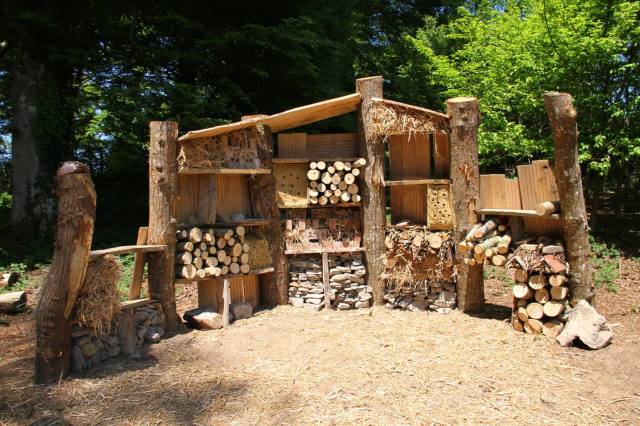
‘Work is nearing completion on our new insect hotel which is located on our Georgian Ride! This fantastic structure has been built using a variety of natural materials and will attract various Heligan insects such as solitary bees, earwigs, spiders, lady bird, maybe the odd toad and much much more!’  The Lost Gardens of Heligan

My mother – in – law is currently on a two week visit to us. A keen gardener (she was until a year ago Chair of the Tavistock Ladies Gardening club), she is not as mobile as she once was (she celebrated her 83rd birthday last week). However, she still enjoys looking at gardens so this is a great excuse (as if I needed one) to get out and about to see some interesting local gardens. The weather has also been kind so we’ve been to a few places that I haven’t been before, or haven’t seen for a good number of  years. Two of them are in Norwich, our local cathedral city, and they are fine examples of gardens developed for very different reasons; the one out of  the passion of a Victorian entrepreneur, the other based on a medieval religious garden.

The Plantation Garden

The Garden in 1897

In 1856, a prosperous upholsterer and cabinet maker living in Norwich, took a long lease on an industrial site just outside the old City walls. His name was Henry Trevor, and for the next forty years, he spent considerable sums of money and much effort transforming a chalk quarry into a magical garden.

Henry Trevor

In many ways, Henry Trevor’s garden was typical of Victorian taste and technology. He built a fountain, terraces with balustrades, rockworks, a Palm House, and a rustic bridge. He planted elaborate carpet beds, woodlands and shrubberies. He designed serpentine paths to conduct the visitor along circular routes, and he built and heated several greenhouses with boilers and hot water pipes.

Henry Trevor, however, was also a man of strong personal tastes. His “Gothic” fountain is unique, and he displayed great enterprise in using the fancy bricks from a local manufacturer to create medieval style walls, ruins and follies. Within less than 3 acres, he established a gentleman’s residence and garden that reflected in miniature the grand country houses of the Victorian period. Visitors were frequently welcomed in the garden by Henry Trevor, for he was always ready to allow his garden to be used for charitable causes.

The Garden in Victorian times- the Palm House no longer exists.

After the 1939-45 war, the garden was virtually abandoned. Fortunately, much of the structure has survived, and is gradually being restored by the The Plantation Garden Preservation Trust. The first task of its members was to clear a forest of sycamores and a blanket of ivy to reveal what had become hidden during the past 40 years. Since then, they have restored the flowerbeds, fountain, balustrading, Italian terrace, rustic bridge and in 2007, the Gothic alcove.

Trevor’s original passion has been matched by this band of volunteers and our visit, on a beautifully sunny afternoon, showed considerable progress in the restoration programme since my last visit some years ago. I was particularly impressed with the enormous amount of work done to stabilise, weed – proof and replant the steeply sloping sides of the garden, which remain topped off with a range of majestic Beech and other trees.

The Bishop’s Garden

Our second visit, on one of it’s open days in aid of local charities, was to the Bishop’s Garden, a four acre green oasis in the centre of Norwich, sitting in the shadow of the Gothic cathedral.

There has been a garden of sorts since around 1100 AD when Bishop de Losinga began to build the cathedral and palace. From the existing garden one can still marvel at the original detailing of Norman stonework on the North Transept of the cathedral which is only visible from the Bishop’s Garden.

In the early 14th century, Bishop John Salmon greatly increased the size of the garden by compulsory purchase of additional land. The general form of the garden was laid down at least 300 years ago. The lower end was cultivated and separated by a wall running straight across the garden. The colossal Old Bishops Palace which still stands was completed in around 1860. In 1959 a major change took place when a new Bishops House built and the Old Palace came to be used by Norwich School. The garden was reduced from 6 and half acres down to the present 4 acres. Records show that in the 1940s up to 15 gardeners were employed reducing to 9 in the 1950’s and today the garden is looked after by 1 fulltime and 1 part time gardener, plus a team of volunteers.

The garden has a range of features typical of many grand gardens developed over the last hundred plus years – large herbaceous borders (which have a persistent ground elder problem and are to be successively dug up and weeds systematically removed in the coming couple of years), a small woodland walk and box – edged rose beds. There is a long shade border with Hostas, Meconopsis and tree ferns, all but the latter looking splendid on our visit. There is also a large wild grass labyrinth, very popular with children (I walked it and contemplated my life as I went…). This is of a size where it can be easily mown using a ride on mower, the gardener told me that he cuts it all down in the autumn and then the path edges are left for the various wild flowers and other species to grow up over the growing season.

There are also extensive shrubberies containing many rare and unusual plants, among these being a Hebe planted from a sprig taken from Queen Victoria’s wedding bouquet in 1840. There is an organic kitchen garden and  ‘bambooserie’. The garden continues to evolve with new plants and features being introduced year by year. The Bishop’s Garden has developed links with Easton College, helping horticulture students gain valuable experience.

Though busy on our visit, including delightful music from a local Youth Orchestra and Choir, one can imagine the garden creating a peaceful mood – one where a succession of Norwich Bishops, stretching back 1000 years, paused to reflect, pray and secure spiritual renewal.

Sources and Links:

The Plantation Garden

The Bishop’s Garden

Old School Gardener

If you’ve enjoyed reading this post and others on this blog, why not comment and join others by signing up for automatic updates via email (see side bar, above right ) or through an RSS feed (see top of page)?

Bom Jesus de Mont

Bom Jesus de Mont

I was fortunate to visit the northern Portuguese town of Braga about 10 years ago, though it was a rather cold and wet November, so it wasn’t an ideal time for garden viewing! And as I was on a study visit focused on social enterprise, gardens and gardening were not really on my mind.

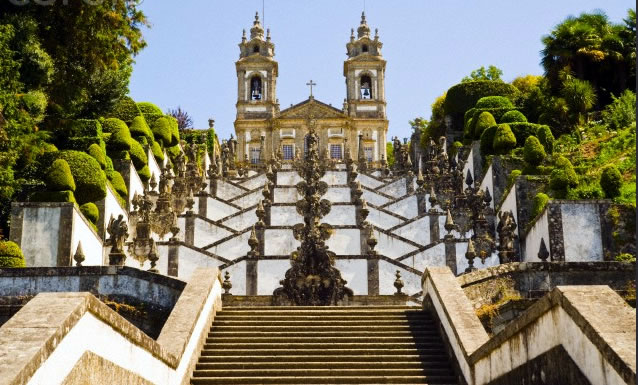
Having said that one of my hosts, a lovely lady called Isabelle, did take me to the very impressive religious centre of Bom Jesus do Mont (Good Jesus of the Mount). Braga is a noteable religious centre and this Sanctuary is a famous pilgrimage site with a monumental Baroque stairway that climbs 116 metres and is flanked by several fountains. Pilgrims were traditionally  encouraged to climb the stairs on their knees as they took a journey that contrasted the senses of the material world with the virtues of the spirit. At the same time they experienced tableux scenes of the Passion of Christ (or Stations of the Cross), and the fountains suggested purification.The culmination of their efforts was found in the Temple of God – the church on the top of the hill. This sanctuary was begun in the 18th century and work proceeded over many decades, with the stairway and area around the church being turned into a park in the 19th century.

The other major space I visited was the Garden of Saint Barbara (Jardim de Santa Bárbara). In the early winter weather this was lacking in colour or any significance, but its layout looked interesting and there was some winter structure afforded by the evergreen topiary. Some of the pictures I’ve seen since show what a wonderful colourful oasis this is in summer. The garden was laid out in 1955 and the space was formerly part of the medieval Arch Bishop’s Palace, the remains of which adjoin the garden. The layout consists of geometric designs carved from beds of boxwood, decorated with cedar topiaries and filled with summer flowering plants.

There’s another important garden in Braga – the garden of the Biscainhos Palace (Casa dos Biscainhos – today a museum). I haven’t had the pleasure of visiting this, but it appears a to be a lovely example of a mid 18th century Rococo style garden, created at a time when the area was home to some of Portugal’s finest granite sculptors. The resulting garden is both ‘lighthearted and flamboyant’ (so writes Helena Attlee). Built on three levels it includes a flower garden and some typical Portuguese elements – wall planting troughs, azulejos (colourful tiles), complex box parterres and granite statues. The garden’s most notable feature, though, is its ‘Cool Houses’ (Casa do fresco) sculpted from living Camellias to form summer retreats. I do hope that I can see it, one day.

Other articles in this series:

Portuguese Gardens: Tropical Botanical Gardens, Belem

Portuguese Gardens: Estrela Gardens, Lisbon

Oranges and Azulejos: Portuguese Heritage Gardens

Old School Gardener

If you’ve enjoyed reading this post and others on this blog, why not comment and also join some other people and sign up for automatic updates via email (see side bar, above right ) or through an RSS feed (see top of page)?

PicPost: Great Garden @ Awaji Yumebutai, Japan

‘Awaji Yumebutai is the site where earth was removed to build artificial islands in Osaka Bay such as the Kansai International Airport. The natural environment which was once destroyed by man has been returned to its original state and a place where various animals and plants exist has been created.

Before the building was built, saplings that match the flora of Awaji Island were first planted. Designed by famous architect Tadao Ando, Awaji Yumebutai is a one-of-a-kind “environment creation” project equipped with facilities that blend in with the magnificent landscape that takes advantage of a dynamic slope.

As a core part of the “Awaji Island International Park City” being promoted by Hyogo Prefecture, Awaji Yumebutai was constructed along with the adjacent Akashi Kaikyo National Government Park and opened on March 9, 2000. The facilities also hosted the Awaji Flower Exposition “Japan Flower 2000” that ran from March 18 to September 17 that same year…’

About  Awaji Yumebutai

Finding Nature

Nature Connectedness Research Blog by Prof. Miles Richardson

Norfolk Green Care Network

Connecting People with Nature

Discover WordPress

A daily selection of the best content published on WordPress, collected for you by humans who love to read.

Susan Rushton

Celebrating gardens, photography and a creative life

Unlocking Landscapes

Writing, photography and more by Daniel Greenwood

Alphabet Ravine

Lydia Rae Bush Poetry

TIME GENTS

Australian Pub Project, Established 2013

Vanha Talo Suomi

The Journey from Finnish Rintamamiestalo to Arboretum & Gardens

Marigolds and Gin

Because even in chaos, there’s always gin and a good story …

Bits & Tidbits

RANDOM BITS & MORE TIDBITS

Rambling in the Garden

.....and nurturing my soul

The Interpretation Game

Cultural Heritage and the Digital Economy

pbmGarden

Sense of place, purpose, rejuvenation and joy

SISSINGHURST GARDEN

Notes from the Gardeners...

Deep Green Permaculture

Connecting People to Nature, Empowering People to Live Sustainably

BloominBootiful

A girl and her garden :)