Category: Great Gardens


The Oregon Garden, Silverton via Gardening Fans

The Oregon Garden, Silverton via Gardening Fans


IMG_7272I was privileged to be invited to the opening of a ‘new’ glasshouse at Peckover House, Wisbech last week.

You may recall that I spent some time here as a Heritage Gardening Trainee last year, and really learnt a lot from the Gardener in  Charge, Allison and her cheerful accomplices, Jenny and Janet. I wrote a lengthier piece about the garden earlier in the year (see link below), and at that time it wasn’t yet certain that the fast – decaying Orangery in this superb Victorian Garden was going to be saved. But thanks to some local fundraising and additional funds and wisdom of the owners, the National Trust, I’m very pleased to say that this focal point in the garden has been saved. Or rather, recreated, as the original was in such a poor condition, that further repairs weren’t possible. The replacement is a faithful rendition of the old structure, with a few minor amendments to make life easier for the gardeners. The former tiled floor, surrounding walls and walled containers with three ancient Orange trees have been retained, now with a new covering made, as was the original, in timber and glass. It includes sash window ventilation and roller blinds to help with temperature and light control.

During the rebuild the 300 year old orange trees were exposed to the elements and what a stroke of luck that we had one of the best summers in recent years, for they have obviously benefitted from that exposure to fresh air and sunshine!

The overall feeling is of a light, colourful and inviting atmosphere. The old Orangery had a typically Victorian air of ‘gothic gloom’ about it, especially as some of the older specimens accompanying the oranges were mature and shaded the interior. I guess the replacement plantings alongside the outer wall will eventually make their mark, but for now I do like the open, bright interior. The inner, sun – facing side of the Orangery is once more populated with a colourful array of terracotta pots containing a wide variety of tender specimens, all laid out on benches ans shelves in the spirit of the Victorian passion for collecting the unusual and exotic. Here are some pictures of the opening event and the new Orangery.

The overall project cost over £200,000. I’m sure it will be worth it as the garden- already a jewel in the National Trust’s crown – would have seemed empty without it. If you’re ever near to Wisbech in Cambridgeshire the place is well worth a visit – as you can see from this selection of pictures taken last week.

Congratulations National Trust, the Peckover House Gardening team and all those others who contributed to the project!

Related article- ‘Banker’s bonus:  Secret Garden Gem’

Old School Gardener

PicPost: Designer Stubble

Chateau de Hautefort, Dordogne, France – via Richard Wright

IMG_6568

On my recent West Country holiday I had the pleasure or revisiting the Minack Open Air Theatre, perched on a clifftop on the Cornish coast. It must be thirty years since I was last here and it’s certainly been developed, with new visitor facilities and altogether a more organised feel to things.

The play, which told the tale of 19th century Australian convicts acting out a play, was entertaining, but of greater impact were the sub tropical gardens that weave themselves in and out of the amphitheatre planned, financed and created between 1931 and 1983 by one determined woman – Rowena Cade. And of course, the setting. This overlooks the English Channel, and as we were there for an evening performance, one of the fullest moons ever came to dominate the scene as darkness fell.

Oh, and towards the end a large, speeding helicopter suddenly emerged from behind the bluff on which the theatre sits – congratulations to the actors who seemed unmoved by this sudden intrusion!

Here are a few shots of the evening to give you a sense of the gardens, setting and the occasion.

Further information:

Minack theatre website

Old School Gardener

If you’ve enjoyed reading this post and others on this blog, why not comment and join others by signing up for automatic updates via email (see side bar, above right ) or through an RSS feed (see top of page)?

IMG_6457

The ‘Cornwall Gardens Guide’ mentions 9 gardens beginning with ‘Tre’ (Cornish for ‘homestead’ or ‘town’). Having just returned from two weeks there and in Devon, I visited three of these (Trengwainton and Trelissick as well as Trerice) as well as Godolphin, Glendurgan and St. Michael’s Mount. They all share Cornwall’s mild climate and several have river valley settings and their associated semi – tropical microclimates. Despite these similarities, I found these wonderful gardens to have a range of distinctive styles or features, largely reflecting the historic interests of their owners and gardeners.

Over the coming weeks I’ll do a photo feature on each of these as well as Killerton Gardens (near Exeter, Devon) and will throw in a couple of very special places – the Barbara Hepworth Sculpture Garden in St. Ives and Chysauster Ancient Village, both in Cornwall. I begin where we began our tour, at Trerice near Newquay, a place we visited en route to our destination of St. Ives. This Elisabethan house and gardens is described by the National Trust as:

‘An intimate Elizabethan manor and a Cornish gem, Trerice remains little changed by the advances in building fashions over the centuries, thanks to long periods under absentee owners.’

The house is certainly delightful to look at, with its rust coloured granite stone, ‘dutch’ gables and ancient leaded windows – many of which are cracked from the test flights of ‘Concorde’ 50 years ago! These ‘sonic booms’ must have been especially noticeable in  what is otherwise a very quiet, peaceful place, far away from busy roads or settlements (we managed to get very lost in some frighteningly narrow country lanes trying to find our way to our next destination).

A formal approach to the house sets it off beautifully and the other garden areas include a grass labyrinth, ancient bowling alley, a woven – fenced kitchen garden and some more recent sloping borders containing a mix of food and ornamental plants – I imagine this might be something of a challenge at harvest time! Of particular interest is an Elisabethan garden in the making, based on a ceiling design in the house as a nod to the sort of layout the original might have been based on, records of what actually existed not being available. This was in the course of setting out when we visited, but a very good artist’s impression shows how this will look – a formal pattern of Box hedging enclosing lavender and roses, which will be a great addition to these lovely gardens.

And the house is of great interest too, with some very friendly and helpful guides to show you around and help you (and any younger members of your party) try on suits of chain mail and pose with a longbow!

Further information:

National Trust web site

Old School Gardener

If you’ve enjoyed reading this post and others on this blog, why not comment and join others by signing up for automatic updates via email (see side bar, above right ) or through an RSS feed (see top of page)?

IMG_6314Whilst visiting friends recently, we were fortunate to be given a guided tour of an historic garden and house in the course of renovation.

Copped Hall, close to Epping in Essex, is a substantial Georgian mansion which I remember visiting about 30 years ago.

At that time I can remember the house being a gutted shell, having no roof and pigs being kept in what remained of the ground floor!

There has been a grand house here since Norman times, with the current building dating from the middle of the 18th century. It has a fascinating history, culminating in the near destruction of the latest house by fire in 1917. Since then, various attempts have been made to redevelop the site, but local opposition has fought these off. The outcome was the formation of a charitable trust which raised funds to purchase the site with the aims of:

  • preventing development of the buildings or in their vicinity
  • raising further funds to carry out sympathetic restoration of the buildings and grounds
  • educating the public on the site and it’s social and natural history.

An active ‘Friends’ group supports the trust, including a small band of gardening volunteers, 2 of whom (Marion & John), kindly showed us around. The house itself has been made wind and weatherproof and some progress has been made in reinstating the interior structure. As anything portable and of value was stripped out of the buildings and grounds in the 1950’s, much of what remains are functional, structural features such as the brick piers supporting former stone steps and stairs. These tumbled down ruins are interesting in themselves, and with the still significant columns of clipped Yew give a gothic, romantic ruin feel to what was once a grand, formal, elevated approach to the house along with parterres and clipped hedges and bushes.

This space gives way to a wooded walk to the walled garden. There are some open archaelogical excavations in these grounds, adding further interest, and some more recent large scale landscaping projects in areas on the site of what was once the Tudor Manor house. Originally built in 1740, the 4 acre walled garden (one of the largest in Britain), is clothed on the approach to its outer wall with a glorious herbaceous border. Several metres deep, with excellent variation in height, this border also features large groupings of plants providing a strong structure and rhythm through their repetition, along the full 100 metres or so of its length.

Inside, a series of original Boulton and Paul glasshouses- most in urgent need of renovation, contain a fascinating collection of fruit and flowers, including vines and peaches now open to the elements as the former covering of glass has fallen away.

The scale of the renovation task, especially here, is enormous, but the small band of volunteers is making steady progress, though could perhaps do with an overall ‘Conservation Plan’ to help to channel their efforts and encourage others along. We wish them well, and but for the distance from home, would offer to help them!

Copped Hall is open to the public one day a month and guided tours are available – see the weblink below for more information.

Further information:

Copped Hall Trust

Old School Gardener

If you’ve enjoyed reading this post and others on this blog, why not comment and join others by signing up for automatic updates via email (see side bar, above right ) or through an RSS feed (see top of page)?

Ox Eye Daisies and Cornflowers make a wonderful display at Myddelton House

Ox Eye Daisies and Cornflowers make a wonderful display at Myddelton House

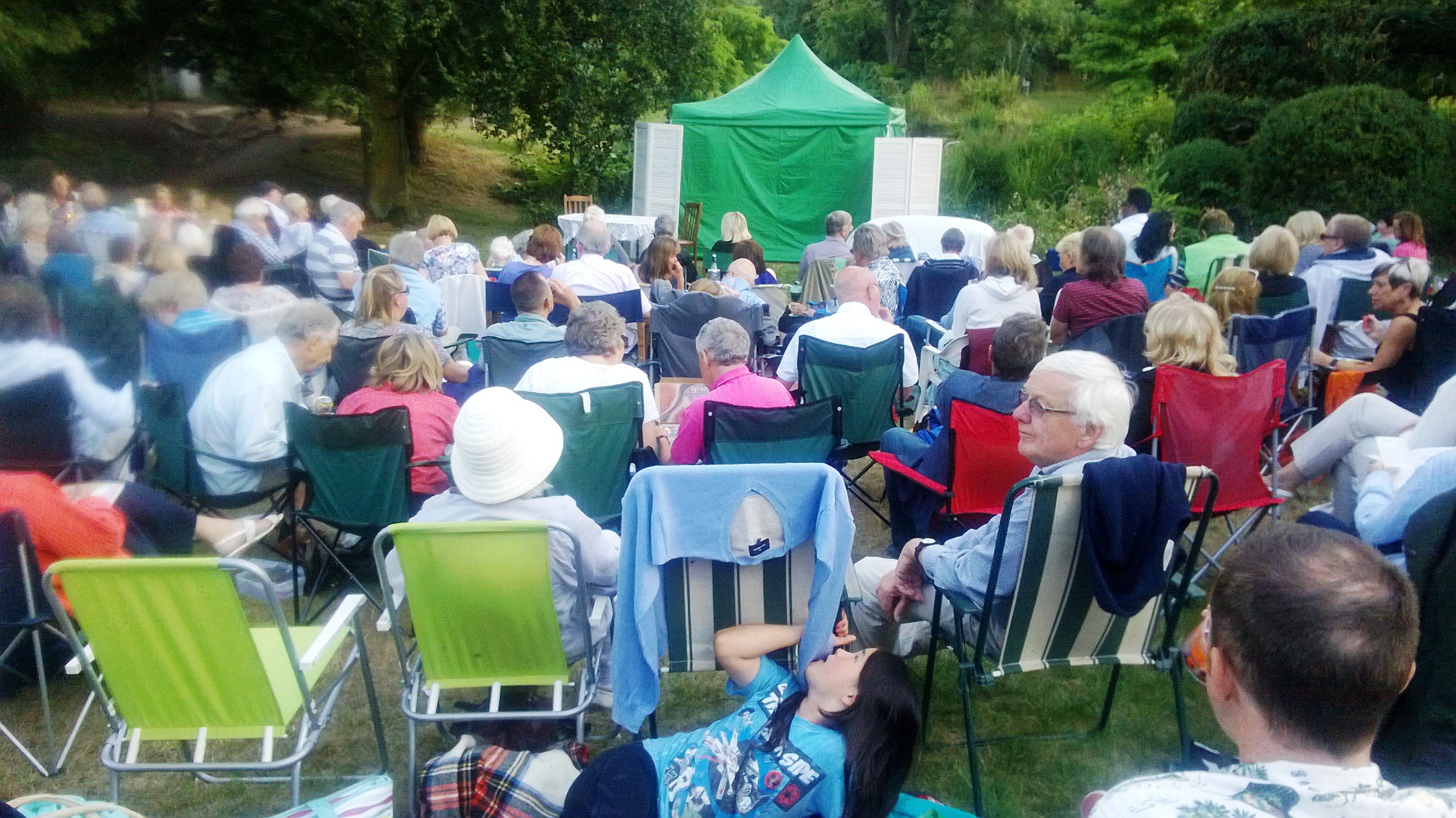
A visit to the open air theatre is always a treat, and last weekend proved no exception. We joined our good friends Dave and Jenny for a performance of ‘Lady Windermere’s Fan’, Oscar Wilde’s comic drama ‘with a message’. The symmetry of the plot coupled with showy 19th century language and costume were well echoed in the gardens of the venue, Myddelton House, in Enfield, Middlesex. Before the performance started I had a chance to look around this recently restored Victorian plot whose most famous former resident was the renowned self – taught gardener, artist and expert botanist, E.A. Bowles. In the late evening summer sun it was a joy. More of its key features later, but first, here’s a little background on the place.

Covering eight acres Myddelton House Gardens were occupied by Edward Augustus Bowles from 1865 to 1954. He dedicated himself to transforming the gardens with unusual and exotic plants. Originally built circa 1812, and completed in 1818, the House was built by Henry Carrington Bowles, one of five generations of London print and map makers. Bowles built the new house in the then fashionable white brick from Suffolk and named it Myddelton House in honour of Sir Hugh Myddelton, an engineering ‘genius’ who created the New River, a section of which had bisected the garden from 1613 until 1968.

The youngest son of five children to Henry Carrington Bowles and his wife Cornelia was Edward Augustus “Gussie” Bowles, who became one of the great gardeners of the 20th century. He originally trained for the church, but family tragedies caused him to change course and he remained at Myddelton House and developed the remarkable garden as a self-taught horticulturist. For many years people came from all over the country to visit. He became an expert on many plants, particularly the Crocus and was dubbed “The Crocus King”.

Crocus 'E.A. Bowles'

Crocus ‘E.A. Bowles’

Today’s gardens have an impressive range of flora with something to stimulate the senses each season, from colourful spring crocuses to dazzling summer irises. In spring 2011 a newly restored Myddelton House Gardens were unveiled, following a two year Heritage Lottery Fund enabled project.

The gardens are home to a beautiful carp lake, a Victorian conservatory and a number of historical artefacts collected and treasured by E A Bowles, including pieces from the original St Paul’s Cathedral and the Enfield Market Cross. There’s a 111 year old Wisteria which turns a brilliant blue when it flowers during May. A beautiful newly created Victorian Glasshouse Range retains unique details, such as four climatic zones, a vine house and a sunken glasshouse that would have been used to grow fruit such as melons and cucumbers.

The gardens have been well restored and further work is obviously in hand. It is a typical Victorian pot pourri of different gardens and areas of historical or other interest. I was particularly impressed with the glasshouse area with its clean – cut display of irises in a gravel – covered bed, cutting flower beds in lovely colour combinations and areas of wildflower planting which look like a soft, frothy sea which I was tempted to dive into! The House is the headquarters of the Lea valley Regional Park Authority and apart from the gardens there is a museum about E.A.Bowles. All are open to the public and there’s free entry.

The whole evening, including good company, fun drama and good food and drink was delightful. So, thanks once more, Dave and Jenny!

The audience awaits...

The audience awaits…

Further information:

E.A.Bowles – wikipedia

Myddelton House web site

Old School Gardener

If you’ve enjoyed reading this post and others on this blog, why not comment and join others by signing up for automatic updates via email (see side bar, above right ) or through an RSS feed (see top of page)?

Picpost: Gingerbread house

PicPost: Nature's embrace

Where’s that lawnmower…

picture from ilandscape

deltagardener's avatarThat Bloomin' Garden

Yesterday I had the privilege of walking through Minter Gardens in Rosedale, BC. What a wonderful garden to visit with 32 acres of garden exquisitely designed. Minter Gardens has been open since 1980 and is obviously the passion of Brian Minter. The colours and design elements are outstanding. It was sad news when we heard recently that this garden would close in October of 2013. The garden is made up of twelve theme gardens with vistas I can only dream about.

minter gardens

The first one we saw was the lake garden with its beautiful waterfall. As we walked through the gardens it was a warm 31C and just seeing the water made it seem cooler outside.

DSC03561

What I loved about this garden is, it was like walking through a  series of garden rooms. You have to love this arbor and how it leads the eye way down to the arbor far…

View original post 461 more words

Finding Nature

Nature Connectedness Research Blog by Prof. Miles Richardson

Norfolk Green Care Network

Connecting People with Nature

Discover WordPress

A daily selection of the best content published on WordPress, collected for you by humans who love to read.

Susan Rushton

Celebrating gardens, photography and a creative life

Unlocking Landscapes

Writing, photography and more by Daniel Greenwood

Alphabet Ravine

Lydia Rae Bush Poetry

TIME GENTS

Australian Pub Project, Established 2013

Vanha Talo Suomi

The Journey from Finnish Rintamamiestalo to Arboretum & Gardens

Marigolds and Gin

Because even in chaos, there’s always gin and a good story …

Bits & Tidbits

RANDOM BITS & MORE TIDBITS

Rambling in the Garden

.....and nurturing my soul

The Interpretation Game

Cultural Heritage and the Digital Economy

pbmGarden

Sense of place, purpose, rejuvenation and joy

SISSINGHURST GARDEN

Notes from the Gardeners...

Deep Green Permaculture

Connecting People to Nature, Empowering People to Live Sustainably

BloominBootiful

A girl and her garden :)