Category: GQT: your gardening queries answered


plum

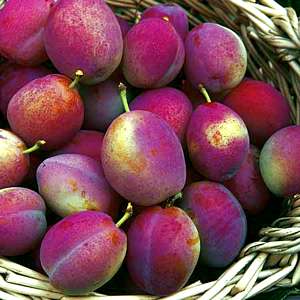
‘We have two plum trees that both blossom, but a lot of the fruit drop before they are fully formed – why is this?’

So ask a Mr. and Mrs. Howard Hughes from Surbiton, Surrey.

Well, the likely reason is a lack of calcium, as this is vital when the stones are being formed. Many sandy soils are low in Calcium, so if you have this sort of soil, this might explain the problem. If there is insufficient Calcium to go round, some fruit will drop off before they have fully formed. To remedy this try a dressing of Lime over the whole area during the winter and then in the spring a mulch around the trees with well-rotted manure or compost should also help.

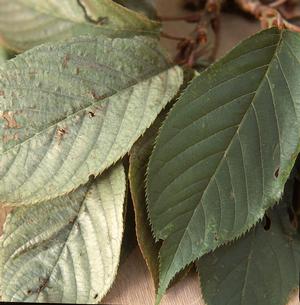
Whilst we’re dealing with plums another problem you might come across is the leaves developing a silvery sheen and the tree looking sick. This is most probably a sign of ‘silver leaf’ – a disease which requires all of the infected and dead wood to be burned before the middle of July. If you accidentally cut into healthy wood, cover the cut with a wound sealant.  To improve the general health of the tree apply a general fertiliser such as Fish, Blood and Bone in February /March.

Silver Leaf- infected leaves (left) compared to healthy

Silver Leaf- infected leaves (left) compared to healthy

Old School Gardener

If you’ve enjoyed reading this post and others on this blog, why not comment and also join some other people and sign up for automatic updates via email (see side bar, above right ) or through an RSS feed (see top of page)?

Public domain image, royalty free stock photo from www.public-domain-image.comFollowing my first ‘Gardeners’ Question Time’ post last week, I’m pleased to say that I’ve had a question from a Mrs.Trellis of North Wales, who asks,

‘Is it possible to grow peppers and aubergines outdoors in the UK?’

Well, Mrs. Trellis, even though global warming is raising the overall average temperature in the UK, this is very gradual and is unlikely to make it possible for you to grow these exotics outside where you live – unless of course you have a very sheltered, sunny and warm spot (in a courtyard perhaps). However, even there in North Wales its unlikely to  be warm enough, long enough during the summer. Having said that, you could of course have a scorching summer and I’ll be proved wrong!

If you do want to have a go and have a greenhouse and/or cold frame you could try to start the plants off inside with seed sowing in late February or early March with some added heat from a propagator (minimum 21 degrees C). Then pot them up into small pots and gradually harden them off, first in an unheated greenhouse, then perhaps a cold frame. Then, ‘if the weather is with you’ plant them out/pot them on into larger pots once all risk of frost has passed – I guess that might be well into June for you? If you are planting into open ground then it’s advisable to give some temporary protection in the form of a cloche or fleece covering for a couple of weeks into June.

Once they are growing well, pinch out the growing tips of both peppers and aubergines when they reach about 37 cms high, to make them grow bushy. And you might also need to stake and support them if they get top-heavy with foliage and fruit.

Aubergines have great health benefits

Aubergines have great health benefits

To give you some ability to respond to the weather, if you grow the plants in containers you can bring them into the greenhouse/inside if the temperatures don’t reach the sorts of levels they need (they will grow only slowly at about 12 degrees C for peppers and 16-18 degrees C for Aubergines – but ideally they both need it hotter). However, if there is a lack of sunshine you can’t do much about that – unless you invest in some expensive lighting perhaps! Also, Aubergines don’t do well in humid conditions – they need heat and well-drained soil to thrive. So, that moist North Wales climate might also be a problem!

For those living further south/east in the UK, where the climate is perhaps more likely to be both warmer and drier, outdoor peppers and aubergines are a real possibility, especially in a greenhouse – but again they need consistent heat, sun and shelter to do really well outside.

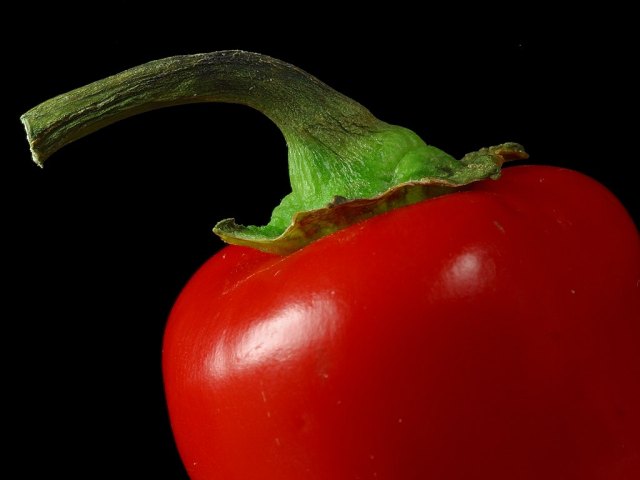
Chilli peppers have their own hotness rating scale

Chilli peppers have their own hotness rating scale

Oh, and by the way, yes, both peppers and aubergines are fruit (botanically speaking) though we tend to refer to them as vegetables in the kitchen! If you have any experiences or tips on growing peppers or aubergines outside I’d love to hear from you!

Further information:

Growing aubergines

Aubergine recipes and the health benefits

Growing sweet peppers

Growing Chilli peppers

Pepper recipes

Old School Gardener

If you’ve enjoyed reading this post and others on this blog, why not comment and also join some other people and sign up for automatic updates via email (see side bar, above right ) or through an RSS feed (see top of page)?

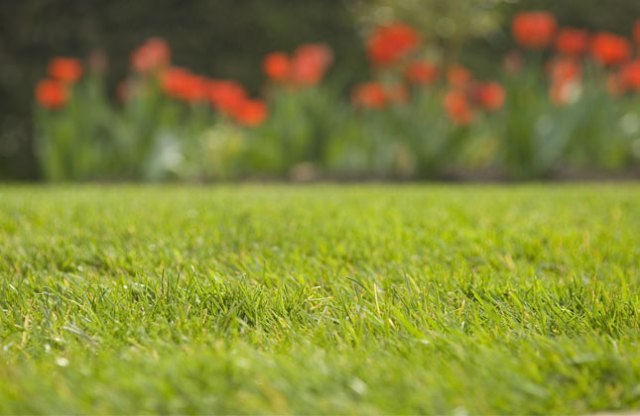
lawn - credit RHS

I thought I’d offer to (try to) answer any gardening queries you have as a regular blog feature on Old School Garden. In the comments on my recent review of the blog, several people mentioned the value of the gardening tips I include in some of my posts, so I thought I’d try out something a bit more focused and regular – a sort of ‘Gardeners’ Question Time’ (or GQT for the initiated!).

I was prompted to do this by a book I came across the other day, whilst rummaging in my local charity shop (a great place to pick up gardening books, I find). Though about 20 years old it still seems to ‘pack a punch’ so I’m going to use it to kick off the GQT series! It’s called ‘1000 Handy Gardening Hints’ and covers a wide range of topics, so hopefully it should be useful to someone out there in blogland!

topdressThe first question, as you can see, concerns lawns and ‘top dressing’. Here’s my take on what the ‘Handy Hints’ book says, plus a few thoughts of my own:

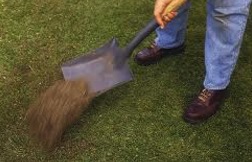
Top dressing usually means applying a fertiliser, particularly a nitrogenous one, to the surface of soil bearing a crop, usually in concentrations of about 18 grams per square metre. In lawn management top-dressing means the application of suitable ‘bulky material’ to the surface of the lawn at the rate of 1 – 3.5 kg per square metre. The material should  ideally be a made up or ready-made compost (of 6 parts medium grade, lime free sand to 1 part granulated peat or other organic material and 3 parts topsoil). This should be well worked into the lawn by means of a drag brush or ‘lute’ to make the surface smooth.

I remember my Dad (who was the Green Warden at our local Lawn Bowls Club around 50 years ago)  spiking the grass surface before hand to provide some holes into which the top-dressing could be brushed (I also remember helping him to do this as an enthusiastic youngster!). Whilst this fed the grass it also helped to improve aeration and drainage. Top dressing can also help to even out dips in the surface. If you want to get the ‘Bowling Green ‘ effect, now is the ideal time to be applying top-dressing to your lawn!

Here’s a video that you might find helpful.

And you can find out how to make your lawn care more sustainable at Wild About Gardens

So that’s the first session of ‘GQT’ – what did you think?

I’ll try out a regular weekly session, so if you have any questions you’d liked answered then email me and I’ll do my best to feature your question and hopefully provide an answer!

My email address: nbold@btinternet.com, and put ‘GQT question’ in the subject line, please.

Old School Gardener

If you’ve enjoyed reading this post and others on this blog, why not comment and also join some other people and sign up for automatic updates via email (see side bar, above right ) or through an RSS feed (see top of page)?
Finding Nature

Nature Connectedness Research Blog by Prof. Miles Richardson

Norfolk Green Care Network

Connecting People with Nature

Discover WordPress

A daily selection of the best content published on WordPress, collected for you by humans who love to read.

Susan Rushton

Celebrating gardens, photography and a creative life

Unlocking Landscapes

Writing, photography and more by Daniel Greenwood

Alphabet Ravine

Lydia Rae Bush Poetry

TIME GENTS

Australian Pub Project, Established 2013

Vanha Talo Suomi

The Journey from Finnish Rintamamiestalo to Arboretum & Gardens

Marigolds and Gin

Because even in chaos, there’s always gin and a good story …

Bits & Tidbits

RANDOM BITS & MORE TIDBITS

Rambling in the Garden

.....and nurturing my soul

The Interpretation Game

Cultural Heritage and the Digital Economy

pbmGarden

Sense of place, purpose, rejuvenation and joy

SISSINGHURST GARDEN

Notes from the Gardeners...

Deep Green Permaculture

Connecting People to Nature, Empowering People to Live Sustainably

BloominBootiful

A girl and her garden :)