Category: Gardening techniques


nWh
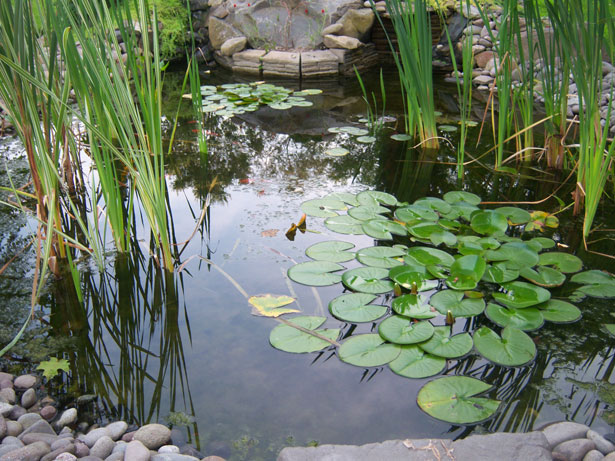
A pond is a fantastic resource for wildlife

A pond is a fantastic resource for wildlife

Most gardens play an important part in promoting biodiversity and maintaining ecosystems – vital if we are to have a sustainable planet. You might want to further enhance your garden’s ecological value, or perhaps promote wildlife to help pollinate plants (important if you want to gather your own seed and/or are growing your own food) and to help control unwanted pests.

Promoting wildlife is also a way or enriching the garden experience – just think about birdsong, the buzzing and gentle flitting of bees from flower to flower, the colourful displays of butterflies and the fascinating movements of the myriad insects and other ‘critters’ out there! So how can you ‘design’ wildlife into your garden and gardening activities?

Plant nectar- rich flowers to attract pollinators

Plant nectar- rich flowers to attract pollinators

First it’s important to recognise that you and your friends and family are also going to use the garden, so there’s no need to ‘go completely wild’ and make it unpleasant or difficult for humans to use the garden. In fact the best designed and managed gardens (and often the most beautiful) can also be the best for wildlife. These are the places where nature has not been allowed to take over.

You can ‘tip the balance in favour of wildlife’ in a number of ways. If you have a large garden you can adopt a ‘conservation’ approach and set out separate areas to attract and support different types of wildlife. If your garden is smaller, you can provide a range of features for the wildlife species you want to encourage. This approach is especially important if you want to actively harness nature to control pests.

Bird feeders need to be out of the reach of cats!

Bird feeders need to be out of the reach of cats!

So what can you do?

  • Create habitats that mimic those in nature and complement the local range outside the garden

  • Provide natural shelter, nesting, food and drink –  important as ‘stopping off’ points for temporary visitors to your garden as well as for longer term residents

  • Aim to increase diversity- and recognise that this is going to be a gradual process

  • Build in some key features, such as…..
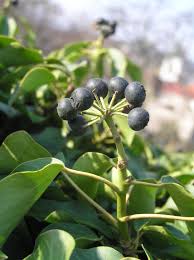
Climbign planst like Ivy provide a valuable food source for wildlife

Climbing plants like Ivy provide a valuable food source for wildlife

  1. Native plants- these act as a host to many more species than non native plants

  2. Wildflowers, grasses, weeds- these attract butterflies and many other insects. Nettles are important hosts for species that aid a healthy garden; butterflies and ladybirds. Maybe you can grow these in a container if you don’t have the space to leave patch in the garden?

  3. Nectar and pollen rich flowering plants- these  feed butterflies, bees, hoverflies etc.- which in turn attract birds

  4. Trees, flowering and fruiting shrubs- these provide food and shelter for birds

  5. Climbing plants- they provide food and cover for birds and food for insects and butterflies. Examples include Ivy, honeysuckle, quince, wisteria, clematis..

  6. Hedges- these give food and shelter for wildlife (e.g hedgehogs, voles and shrews), food and nesting for birds- where it’s practical choose to install a hedge rather than a fence

  7. Water- a pond brings masses of creatures to drink as well as attracting resident pond life

  8. Wood piles – insects colonise the decaying wood, attracting spiders and birds; beetles lay grubs; toads and hedgehogs hibernate underneath; slow worms use it as home (and these prey on slugs)

  9. Compost heap – provides both food for the soil and home for minute insects and other ‘mini beasts’ which feed birds, hedgehogs, toads. It also acts as a possible nesting place for hedgehogs, toads and slow worms.

  10. Bird and Bat boxes, tables, feeders and baths- put these up in secluded and sheltered spots out of full sun – and out of the reach of cats! Birds need extra food in winter. provide a range of foods according to the species you want to attract. Birds need to drink and bathe to keep their plumage in good order- even in winter, so keep birdbaths unfrozen

  11. Stones and walls- toads, newts and female frogs usually spend winter on land, under rockery stones (or in a log pile). Beetles, spiders, insects live in nooks and crannies

  12. Bug hotels’ can provide a ‘man made’ substitute for the above, and are good fun to make with children.
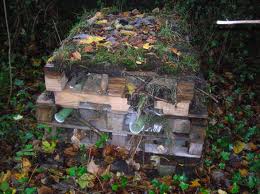
'Bug Hotels' can provide a 'Des Res' for many insects and other critters

‘Bug Hotels’ can provide a ‘Des Res’ for many insects and other critters

Further information: A range of useful wildlife gardening guides

Old School Gardener

I recently attended a lecture by Sir Gordon Conway, the gist of which I hope to reflect on and share soon- its all about ‘sustainable intensification’ of food growing as the way forward to tackle global hunger…fascinating projects and innovations from around the world point the way. Here’s an article that captures the approach.

canwefeedtheworld's avatarOne Billion Hungry: Can We Feed the World?

ID-10088298Professor Sir Gordon Conway and Katy Wilson highlight the need for innovative solutions to food insecurity

Article originally appeared on The Economist Insights

With global population expected to reach 9.6 billion by 2050 the world faces unprecedented demands on its resources – not least water, biodiversity and land. Add to this the likely impact of climate change, and the challenge of feeding a world where some 870 million people are already chronically hungry appears a difficult one.

Governments, NGOs, academia and the private sector are searching for long-term sustainable solutions to global food insecurity and future resource scarcity.  One solution, first proposed by Jules Pretty in the 1990s, and backed by the Montpellier Panel, a high-level group of European and African experts in the fields of agriculture, trade, policy, and global development, is sustainable intensification. At its heart sustainable intensification is about producing more food, more efficiently.

Achieving global…

View original post 640 more words

cornus alba sibirica and green yellow stems of C. flavirameaCornus is a genus of about 30- 60 species of woody trees and shrubs, commonly known as dogwoods. Most are deciduous, but a few are more like herbaceous perennials (subshrubs) and some are evergreen. Cornus is the latin word for ‘horn’ referring to the hardness of the wood.

The name “dog-tree” was recorded in 1548, and this had changed to “dogwood” by 1614. After this the plants soon became known as the Hound’s Tree, while the fruits came to be known as dogberries or houndberries (the latter is also the name given to the fruits of the black nightshade- alluding to Hecate’s hounds).

The plants may have become known as ‘dogwoods’ from the Old English word dagwood, which refers to the ways it’s slender stems of very hard wood were used to make “dags” (daggers, skewers, and arrows).

Another, earlier name of the dogwood in English is the whipple-tree. Chaucer refers to the “whippletree” in The Canterbury Tales (‘The Knight’s Tale- verse 2065). A whippletree is also a part of a horse – drawn cart; the link between the drawpole of the cart and the harnesses of the horses lined up behind one another, and commonly carved from the Whippletree or Dogwood.

Some of the Cornus species names are:

C. alba = white

C. canadensis = of Canada

C. candidissima = very white- the flowers

C. capitata = headed- the grouping of flowers

C. florida = flowering richly

C. fragifera = strawberry-like – the fruits

C. glabrata = glabrous

C. kousa = a japanese name

C. mas = male (mascula of Linnaeus)

C. nuttallii = after Nuttall

C. sanguinea = blood-red- the twigs

Cornus are either grown for their flowers, interesting leaves (some both of interest during summer and autumn) or for their colourful winter stems. These are just coming into their own in winter gardens around Britain – including Old School Garden. I have several groups of C. alba ‘Sibirica’, C. sanguinea ‘Midwinter Fire’ and C. sericea ‘Flaviramea’ (some grown easily from hardwood cuttings). I ‘stool’ these (i.e. cut the stems to the base) each spring to encourage new growth, which once the leaves have fallen (these are also very colourful in the autumn), reveals bright red, orange and yellow- green stems, which really glow in the winter sunshine..

Sources and further information:

Wikipedia

Seven Plants for Winter Wonder -article on Old School Garden

Cornus- RHS advice

Cornus- an essential winter shrub- Daily Telegraph

Old School Gardener

Cherry on the treeHere’s the final article by one of the participants in a ‘Grow Your Own Food’ course I ran recently in Foulsham, Norfolk. I’m planning to run another course starting in February (Tuesday mornings for 6 weeks) as well as another one focused on helping participants use design to reshape their own gardens (Monday evenings at Reepham, Norfolk). More details can be found at www.reephamlearningcommunity.co.uk

Cherry Trees

Guest article by Ann Blezard

Choose a sunny spot for your tree (approx. 6 hours direct sunlight a day). Acid cherries will tolerate some shade. Cherries grow particularly well in southern and central England.

Cherries will grow well in almost any kind of soil, but avoid soil that stays soggy for extended periods. Spreading a layer of mulch over the soil around your tree will help it grow better.

Some cherry trees cannot pollinate themselves and will need pollination partners. Others are self- fertile.

It is preferable to grow cherries from a rootstock as it can take 10 years or more to obtain the first fruits from a cherry grown from seed.

Cherries are now available as a dwarf rootstock, growing to approx. 10ft, instead of the usual 40ft, allowing you to cover the tree with bird netting to protect your crop.

Cherry trees should be planted between November and March.  Mulch in late February with well-rotted organic matter.  Keep trees well watered during the early stages of fruit development. Apply potash if fruiting is poor.

Cherry trees flower early in the year, the flowers will need protecting from frost. Cover with horticultural fleece if frost is predicted,  however  remove during the day to allow access to pollinating insects.

Sweet cherries will fruit on one-year old and older wood. Formative pruning takes place in spring as the buds begin to open. Established trees are pruned from late July to the end of August.

Cherries are not totally disease free. Sweet cherries are susceptible to a disease called brown rot.  This can be prevented by pruning in between branches to allow good air flow, be scrupulous about cleaning up blossoms, fruit and leaves that might have been affected. Sulfur is an organic method for brown rot. Spray when the flower buds are pink, when the flowers are open, when the petals fall and once again about 14 days later.

Cherries can also be affected by Silver Leaf, a fungal disease of the wood and leaves, causing a silvering of the leaves and death of the branch. The fungus produces most of its infectious spores in autumn and winter. Prune susceptible plants in summer when not only are there fewer spores, but pruning wounds, the main point of entry for the spores, heal more quickly.

Cherry blackfly is an aphid that sucks sap from the foliage of fruiting cherries during spring and early summer. Attract  natural predators like blue tits or use soap based sprays before the leaves curl.  Cherry blackfly will not affect fruiting, but looks unsightly

Cherries will shed fruit that they do not have the resources to bear, known as cherry fruit drop or cherry run off. Pruning trees to give an open canopy, maximising light to the leaves and increasing the photosynthetic rate is likely to minimise the fruit drop. Thinning the cherries is also an option, creating a balance between the supporting leaf and the fruit, thus increasing fruit retention.

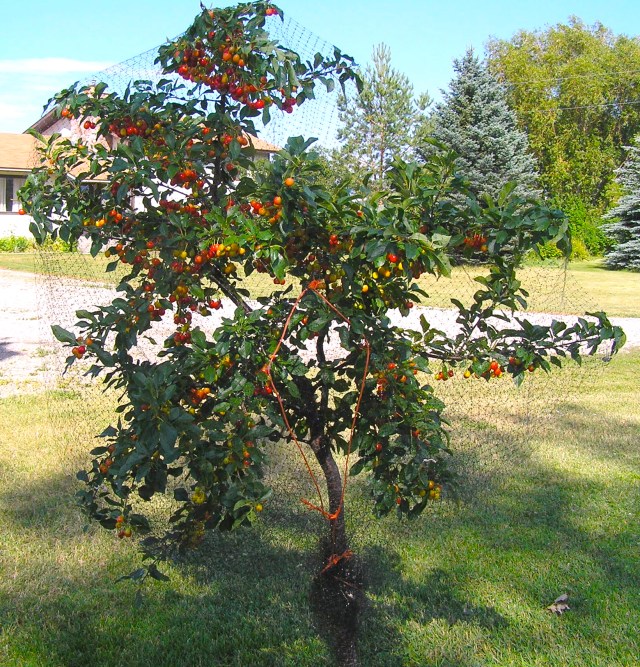
The Evans Cherry variety showing ripening fruit

Examples of cherry varieties are:-

Sweet Cherry- ‘Stella’ : Black, large , rich, high quality fruits, regular heavy crops; self-fertile. Late season; harvest  in July.

 Acid Cherry- ‘Morello’: Self-fertile , dark red fruits, excellent for preserves and tarts. Attractive blossom, heavy crops, late season; harvest  July and early August.

SWEET CHERRY COBBLER

(Serves 8)

Ingredients

350g Caster Sugar

45g Butter, melted

125g Plain Flour

¼ tsp Salt

1 tsp Baking Powder

120ml Milk

1 tbsp Cornflour

225ml Boiling Water

500g Fresh Cherries, stones removed (frozen cherries may be used)

 Method

Preheat oven 180 deg C/Gas 4

1) Mix 150g sugar, butter, flour, salt, baking powder and milk together. Place cherries in bottom of 23cm square tin. Spread topping over cherries.

2) In small bowl combine 200g sugar and cornflour, stir in boiling water, pour mixture over topping.

3) Bake for 45 minutes, serve warm with vanilla ice cream.

Bing cherries- the most widely grown variety of sweet cherry in the U.S.A.

Bing cherries- the most widely grown variety of sweet cherry in the U.S.A.

Depending on the shade amd soil conditions many plants can be grown under trees

This week’s question is one that affects many gardens- the impact of trees on other planting. Jenny Bough from Gateshead asks;

‘Part of my garden is in shade for most of the day because of trees in a neighbour’s garden. Since I cannot remove the trees, what can I do to improve the conditions for my plants? And what plants will grow well?’

If the trees grow close to your garden the shade will probably be dense, and the soil may well be permanently moist from overhead drip. If so, you can improve the drainage by adding coarse grit to the soil under the tree and plant moisture- and shade- loving plants such as hardy Ferns, Primula species, Violets and Periwinkles. If you have lighter or more dappled shade then there are plants which like these conditions: Lilies, hostas, Azaleas, Rhododendrons and Blue Poppy (Mecanopsis) for example.

Epimedium- a good choice for dry shade

If the tree is close to your boundary, or indeed within your garden, and its roots make the immediate area very dry and shady, then plants such as dwarf Cyclamen (C. hederifolium), small-leaved Ivies and Epimedium should do well. You could also try to dig out a few pockets where bulbs can be planted. If you can mix plenty of compost or other organic matter  into the soil then many more options are open to you as the soil will be relatively nutritious and will retain moisture better. The London Orchard Project have added a helpful piece of advice:

‘Wait until the tree has established before any underplanting is carried out. Then be sure to plant perennials,  as (these), including trees, prefer a fungally dominated soil, whereas annuals prefer bacterial domination. Also, disturbing the shallow feeder roots of the tree can be minimised by not having to replant/remove annuals.’

Some trees produce roots close to or above the soil surface, which then send up new shoots or ‘suckers’; e.g Poplars. If you want to grow grass over these root runs, once again the best approach is to ensure a good depth of topsoil above the roots and so give the grass a good layer of soil to grow on and reduce the chances of suckers appearing. Another approach- and one I’ve used in Old School Garden under a large Black Poplar tree- is to cover the immediate surrounds of the tree with landscaping fabric and then use a decorative aggregate or other material as a covering (I’ve used purple slate). This has reduced, but not entirely removed the problem of suckers appearing. Alternatively, there’s nothing else for it but to keep pruning/mowing off the shoots as they come up. This is best done in early summer after the tree has put on its initial growth spurt- doing it in the dormant season will only encourage more suckers to appear in the new season.

Some trees (in this case a Maple) will send out shallow or surface level roots from which new shoots or 'suckers' will grow
Some trees (in this case a Maple) will send out shallow or surface level roots from which new shoots or ‘suckers’ will grow

Further information: a useful guide to tree care

Old School Gardener

raspberriesAnother guest article by one of the participants in the ‘Grow Your Own Food’ course I ran recently in Foulsham, Norfolk.
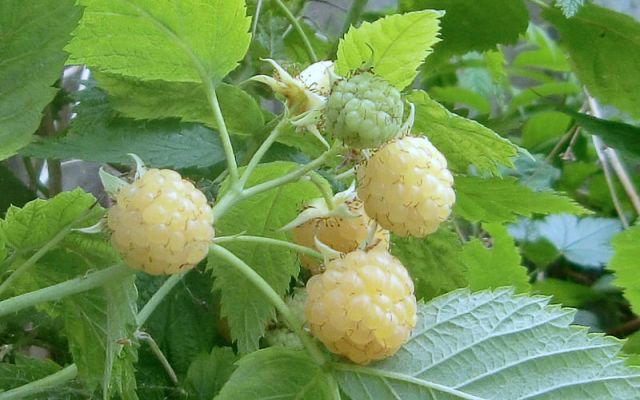
Raspberries – A superfood that tastes better than spinach-what’s not to like?!

by Chris Richmond

Health

Antioxidant and anti-inflammatory phytonutrients in Raspberries may have anti-cancer benefits and assist in the management of obesity, though possibly not if eaten with oodles of cream.

However, raspberries are among a small number of foods that contain measurable amounts of oxalates. When oxalates become too concentrated in body fluids, they can crystallize and cause health problems. For this reason, individuals with already existing and untreated kidney or gallbladder problems may want to avoid eating raspberries.

So…everything in moderation, even raspberries- unfortunately.

Varieties

There are two types of raspberry available to the kitchen gardener. Summer-fruiting varieties will crop at any time from the beginning of July to early August on stems of last season’s growth; autumn-fruiters bear their berries over a longer period – from mid-August to the first frosts – on the current season’s growth. Both are similarly easy to care for but require slightly different pruning techniques. As long as you know how to wield your secateurs around them there is little mystery to growing these accommodating fruits and their length of service – up to 12 years – means they give a lot back in return.

‘Glen Ample’ AGM – Delicious, large fruit produced in mid-summer on this extremely heavy-yielding summer cultivar with vigorous, upright, spine-free canes. The berries are produced on long, upright stems, making picking easy.

‘Glen Moy’ AGM – This early summer raspberry bears heavy crops of medium to large berries, which have a good flavour. It may also produce a small crop on the new canes, in autumn. The spine-free canes are compact.

‘Leo’ AGM – This cultivar is one of the latest summer raspberries to ripen, producing large, firm fruits with an excellent flavour. The stems are very long, so harvesting is easy. Site in a sheltered position.

‘Malling Admiral’ – A summer raspberry bearing good yields in mid- to late summer on strong-growing, tall canes, which are best sited in a sheltered spot. The flavour is excellent, and the large berries ripen to deep red.

‘Autumn Bliss’ AGM – The short, sturdy canes of this popular autumn cultivar produce high yields from late summer to mid-autumn. The fruit is large and deep red with a firm texture and excellent flavour.

‘Polka’ – This new autumn cultivar ripens two weeks earlier than ‘Autumn Bliss’, bridging the gap between summer and autumn. It produces very high yields of large, well-flavoured fruit.

A Golden Raspberry Variety

Preparation

Like most edible crops, raspberries produce a better yield when grown in full sun. However, thanks to their woodland origins, they can be grown in a degree of shade too, as long as they receive at least a few hours of direct sunshine each day. They prefer slightly acidic soils, which is great news for gardeners who struggle to grow plants in these conditions. They like it to be moist as well, so be prepared to water the plants as they establish – but beware of waterlogged winter ground.

Be prepared to put in a bit of effort to get soil conditions just right before planting: thoroughly dig down to a spade’s depth along a row 90cm wide. Turn it over and remove any weeds, especially perennial types (such as bindweed and horsetail) and their roots.

Raspberries are shallow rooted, which means there won’t be much of an opportunity to weed as meticulously once the plants are in place, for fear of damaging their root system. They are also heavy feeders, so for every plant you intend to grow incorporate a bucketful of well-rotted manure or compost while digging, turning it all into the soil. Ideally soil preparation should be complete a month before planting; at the very least you should allow two weeks to give the earth time to settle.

They might play second fiddle to their Wimbledon-associated cousins on shop shelves but on the plot there should be no such bias – raspberry plants crop reliably year-after-year and ask for little in return. They even thrive in partially-shaded areas where few fruit or vegetables would grow. And such is their hardiness that they will produce a bumper crop of their sweet, mildly acidic fruits even in disappointing summers – a valuable trait given the last few we’ve experienced. They’re a great choice for those gardening in cooler, northern climates – as they flower late in the spring there is little danger of them being damaged by unexpected late frosts.

Planting

With a well-prepared growing area in place, planting shouldn’t present any difficulties. Buy in certified disease-free, one-year-old plants (usually called canes) from a reputable nursery or mail-order catalogue. They are usually acquired bare rooted, packaged up into bundles ready for planting. The best to time to plant them is in the autumn, from October through to early December, as the soil still retains a degree of warmth which will help the roots to grow and quickly settle the new introductions into place. If this isn’t possible they can, however, be planted any time up to March.

Position each cane into a shallow hole about 22cm wide and 7cm deep, spreading the roots evenly across the bottom. Backfill and firm in around them as you go, making sure that the soil mark on the canes is at least level with the surface and up to an inch beneath it – this will encourage extra root growth and quickly anchor the plants into place. Space them 45cm apart within the row, leaving 1.8m between further rows to allow room for the roots to spread sufficiently and enough space for picking.

The tall, gangly canes will need to be supported, so set up a suitable support system at planting time. The best system is a simple post-and-wire set-up – hammer in two sturdy, 2.4m-high posts at either end of the row, 60cm into the ground and 3m apart. Stretch three galvanised wires horizontally in-between them at heights of 75cm, 1m and 1.5m.

The top wire can be omitted if you’re growing an autumn-fruiting variety as they are much sturdier and require less support.

Grow your own tip- If you only intend to grow a few plants you can do away with a complete post and wire system and simply position up to two plants at the base of a single post for support. As the stems grow upwards, tie them loosely to the post using garden string.

Growing

Immediately after planting your canes, cut each one just above a bud so that they’re 30cm in height. By spring, new shoots will appear from the base of the old cane and these will need to be tied into the wires as they reach them. The original cane can be cut right down to about 3cm above ground level at this point, again just above a bud. Remove any weak shoots in this first summer and any appearing more than 20cm from the row. Be disciplined and remove any flowers that develop in the initial season too – the object of the first year is to establish a good base and allowing plants to channel energy into setting fruit will compromise this effort. In the following years pruning is simple, although it’s important to use the correct method depending on whether you’ve opted for summer- or autumn-fruiting varieties. The former should be cut right back to ground level as soon as they have finished cropping.

At this stage there will already be plenty of new growth at the base of the plant and these will be the fruiting stems for next year. Tie them into your support system using garden string, so that each stem is spaced around 10cm from the last. Cut down any spindly stems or those growing away from the row. Towards the end of the growing season, loop over and tie in place any really tall stems to prevent them falling over in the wind over winter. In early spring, before growth commences, cut them back to a bud about 15cm above the top wire so that they are uncluttered and in a good position when they start fruiting.

Pruning autumn-fruiters is much more straightforward – just cut back all of last year’s canes to ground level before growth starts in February. New shoots will appear from the base by spring and these should all produce fruit on the upper stem sections.

Crop care

Feeding and watering are pivotal to the success of a raspberry crop. Keep your canes moist and well-fed and, coupled with the correct pruning regime, you should be carrying away punnets full of berries. Watering is particularly important at flowering time, as the fruits swell, and during any dry spells.

Applying a thick layer of organic matter as a mulch in early spring will help to lock-in moisture (make sure the soil is moist beforehand) as well as feed the canes. Be generous – make it at least 5cm deep and more if you can spare it. Any well-rotted organic matter such as compost or manure will do but avoid mushroom compost – it is alkaline and therefore unsuited to the acid-loving plants. Mulches will also help to naturally nourish the soil and stifle weed growth. As raspberry roots are very shallow and can easily be damaged by hoeing, any weeds that make it through the mulch will need to be removed by hand.

New shoots that appear away from the main row or post are called suckers. It will be difficult to tie them in to the support system – instead, you should remove them by lifting them out of the soil, then use secateurs to sever them from the parent plant below ground level.

Raspberry curd quark dessert- one of many delicious sweets using raspberries

Raspberry curd quark dessert- one of many delicious sweets using raspberries

Stolen without permission from various websites including:

www.rhs.org.uk

www.growfruitandveg.co.uk

You might recall that a month or two back one of my blog followers, Elena, asked what to do with a couple of Amaryllis bulbs she’d bought. I gave her (or rather a useful video did) the tried and tested advice of potting them up and putting them somewhere warm and dark until there were signs of growth aboove ground. I’m pleased to say that her two bulbs are coming on well- here’s the latest evidence, courtesy of Elena, who’s living in Bergamo, Italy.

Old School Gardener

800px-Fuchsia_2008

With winter around the corner, this week’s question comes from Penny Rose in Hampshire:

‘I’ve moved house earlier this year and planted some fuchsias in the garden. I bought these from a local nursery and they are described as ‘hardy’. Can I leave them in the ground over winter and if so do I need to protect them in some way?’

Well, Penny, In the coldest parts of the UK you’ll have no option but to dig up your plants and put them in a conservatory or greenhouse. It’s also a good insurance policy to take cuttings (preferably in early autumn) to bring on new plants in case of a particularly severe frost or disease problems. In warmer areas you can leave plants in the ground but take steps to protect them by not cutting down the stems in Autumn, and by making some holes in the ground around each plant with a a border fork, to help water drain away- particularly important if you have heavy soil that retains water. Once this is done you should put a mulch of leaf mould, wood ashes or soil around the base of  the plant to protect it further. Some Fuchsia varieties are hardier than  others; the toughest are F. magellanica, F.’Riccartonii’ and F. ‘Mrs. Popple’ which can withstand temperatures down to between -5C and -15C.

So in somewhere like Hampshire, you’ll probably be OK  to leave your Fuchsias outside (but take the action suggested above). For me here in Norfolk, it’s a little more difficult to be sure, so I’ll leave some outside (in a pot in a warmish courtyard) and either bring others in or mulch my sandy loam soil (forming drainage holes isn’t as important).

Old School Gardener

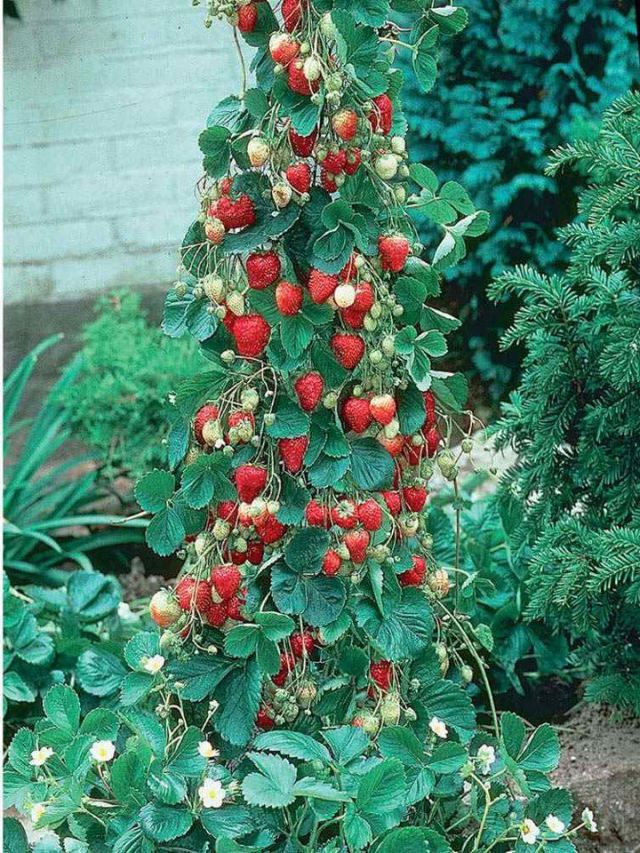
PicPost: Strawberry Fall

Old School Gardener

Seed Bombs – all you wanted to know…

A neat description of the various kinds of seed bomb in use by ‘Guerilla Gardeners’- why not get some or make your own to lay siege to that unattractive piece of wasteland at the end of the road?

Old School Gardener

Finding Nature

Nature Connectedness Research Blog by Prof. Miles Richardson

Norfolk Green Care Network

Connecting People with Nature

Discover WordPress

A daily selection of the best content published on WordPress, collected for you by humans who love to read.

Susan Rushton

Celebrating gardens, photography and a creative life

Unlocking Landscapes

Writing, photography and more by Daniel Greenwood

Alphabet Ravine

Lydia Rae Bush Poetry

TIME GENTS

Australian Pub Project, Established 2013

Vanha Talo Suomi

The Journey from Finnish Rintamamiestalo to Arboretum & Gardens

Marigolds and Gin

Because even in chaos, there’s always gin and a good story …

Bits & Tidbits

RANDOM BITS & MORE TIDBITS

Rambling in the Garden

.....and nurturing my soul

The Interpretation Game

Cultural Heritage and the Digital Economy

pbmGarden

Sense of place, purpose, rejuvenation and joy

SISSINGHURST GARDEN

Notes from the Gardeners...

Deep Green Permaculture

Connecting People to Nature, Empowering People to Live Sustainably

BloominBootiful

A girl and her garden :)