
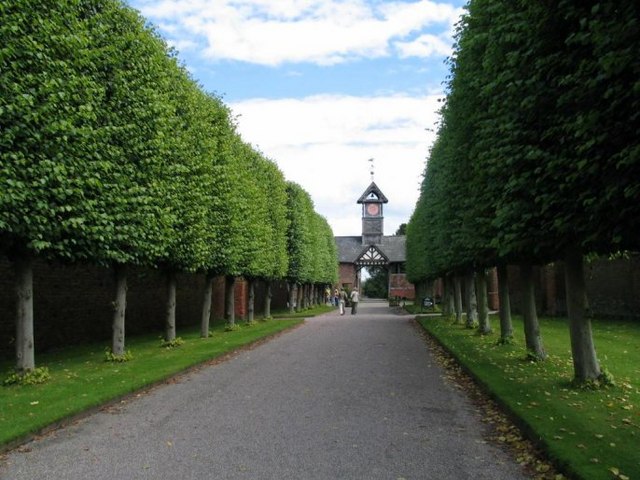
- The Lime Walk at Arley Hall, Cheshire, an example of pleaching
It’s that time of year when the summer growth of hedges – at least those that need to be kept in trim- is being cut back. Joe Sloley from Hintlesham has an interesting opportunity with one of his hedges:
‘I have a row of overgrown lime trees which originally formed a screen and which I want to cut back and pleach. Are limes suitable for this kind of training and what are the details of the method?’
Pleaching or plashing (an early synonym) was common in gardens from late medieval times to the early eighteenth century. It means the interweaving of growing branches of trees and shrubs to form a hedge, living fence or arbour which provides a strong barrier, shaded paths or garden features. The word ‘plexus’ derives from the same Latin root word ‘plecto’, meaning to weave or twist together. This craft had originally been developed by European farmers who used it to make their hedgerows more secure.
"Walking in a thick pleached alley in mine orchard" - William Shakespeare, 'Much Ado About Nothing'
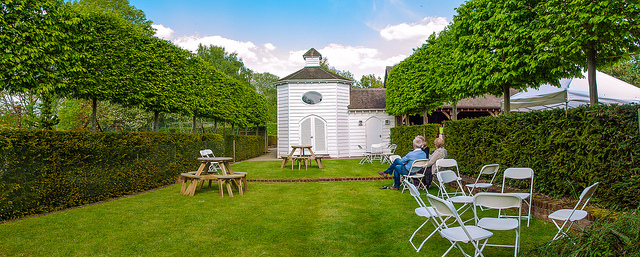
Pleached Trees and an underlying Yew hedge ay Dipley Mill, Hampshire, via
Angus Kirk
Today the term tends to be used to refer to what might be called the process of creating a ‘hedge on stilts’ where (usually smooth-barked) trees have their lower side growth removed and the higher growth is pruned and trained to form a continuous, elevated hedge.
Limes can certainly be pleached: they have pliable growth, and the shoots rapidly grow long enough to be woven in and out. Once the trees have been cut back to the height you require, the lower part of the trunks should be cleared of side growths. Then attach horizontal canes or wires to the trunks and across the gaps between the trees. Allow new shoots to grow out sideways; any which grow forwards or backwards should be pruned out completely. The side shoots are tied to the canes/ wires and when plentiful enough are interwoven with one another. As the shoots mature into branches, the canes or wires can be dispensed with and new growth trained amongst the old.

Pleaching in process
Tilia (lime) is the most commonly used tree for pleached walks; usually the red-twigged lime (Tilia platyphyllos ‘Rubra’). Ash, beech, chestnut, hornbeam and plane can also be pleached, as can apples and pears. These can often be obtained ready trained.
Laburnum and Wisteria are favoured for pleached arbours and covered walks, especially tunnels, which show off the attractive flowers perfectly. Use Wisteria grown from cuttings or raised by grafting, as it will flower more reliably and uniformly than seed-raised plants, and Laburnum x watereri ‘Vossii’ is a better choice than seed-raised L. anagyroides.

Pleached hornbeams forming a tunnel, via Catherine Wachs

A pleached enclosure
If you want to start a pleached hedge, select young, whippy plants that are more easily trained. Plant these out in winter and during the early years also prune in the winter when the plants are leafless and dormant. Train and tie new shoots in over the summer. Once pleached trees have reached their full extent, prune in the summer, pruning to shape the new growth and reduce the tree’s vigour.
Here’s a fascinating example of how pleaching could be used to ‘grow homes’!


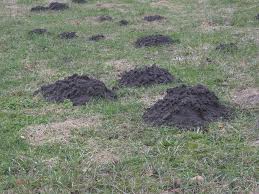 ‘The worst ENEMYES to gardens are Moles, Catts, Earewiggs, Snailes and Mice, and they must be carefully destroyed, or all your labor all the year long is lost.’


![WP_20140622_001[1]](https://audaxdesign.org/wp-content/uploads/2014/06/wp_20140622_0011.jpg?w=677&h=1205) Stepped planters seen outside a hotel in Maida Vale, London, last week.
Stepped planters seen outside a hotel in Maida Vale, London, last week.


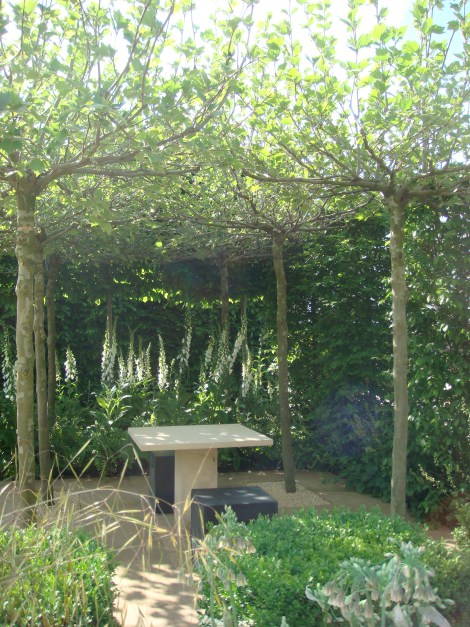





 Old School Garden