Category: Feature plants


An early Christmas present!

Brigid Jackson's avatararistonorganic


I have been waiting eagerly for this Orchid Cactus to open. This is my reward this morning.

Epiphyllum

RELATED ARTICLES:

The Lady in Red 

View original post

Rosa rubiginosa- a wild or species rose that needs minimal pruning

This week’s gardener’s question comes from a Miss Flora Dunmore of Argyll, and focuses on roses:

‘I’ve just inherited a big garden with lots of different roses, icncuding bush, climbers and ramblers. Can you tell me why, when and how to prune these, please?’

Flora, what a lovely inheritance! First why do you prune:

  • to remove weak, spindly and diseased shoots

  • to encourage strong new shoots to grow from the base of the plant each year (these bear the best flowers)

  • to open out the centre of the bush to increase air circulation (this helps to check disease)

  • to create a pleasing (usually symmetrical) outline to the plant.

When to prune depends on the types of roses you have:

  • For large-flowered bush roses the traditional months are March in the south and April in the north of England (and possibly even later in Scotland), when growth is just beginning- but pruning can be done safely any time from November  onwards in the south, provided you are prepared, if necessary to remove some frost damaged growth in spring. Most importantly never prune during a frosty spell.

  • For ramblers the best time to prune is after flowering, probably late August (you can dead head throughout the flowering season to achieve much the same result)

  • For climbers, the best time is October, when the recurrently flowering types have finished their show, but it can be done later if the weather is mild.

The techniques for pruning vary according to the type of rose:

For large flowered, bush roses cut away completely any diseased,weak and spindly shoots as well as removing all dead stumps from earlier pruning (use a fine toothed saw if they are particularly woody and thick). If there are many canes criss-crossing in the centre then remove a few to open out the bush. If two shoots are growing so that they rub each other, remove one. Finally, cut the remaining shoots back to about 200-250mm long. Harder pruning than this will produce larger, but probably fewer flowers – but it won’t harm the rose.

For smaller, cluster-flowered roses do the same as for larger flowered varieties but leave  the main shoots 300-350mm long. If the main shoots have side shoots, the latter don’t need to be removed, provided they are fairly thick (say about a pencil thickness), but they should be cut back by about two-thirds of their length.

Climbers should be pruned to establish a permanent framework of significant branches from which flowering stems are produced. To achieve this cut back side shoots to one or two buds from the point where they branch out from the main shoots. If the plant has become bare at the base, cut one of it’s main shoots hard back to encourage new growth from ground level.

Ramblers need to be pruned to encourage flowering on young shoots that grow from the base of the plant each year. To achieve this cut out completely the side shoots that have finished flowering and tie in the new shoots in their place. If in some years there are only a few of these, some of the old shoots (which can still produce flowers) may be left in place, but their side shoots should be shortened by about two-thirds.

Rambling roses need a framework of stems establishing with selctive removal of the oldest to encourage new growth form the base and flowering shoots pruned after flowering

Rambling roses need a framework of stems establishing, with selective removal of the oldest to encourage new growth from the base and flowering shoots pruned after flowering

Miniature Roses which produce a thick tangle of tiny, wiry shoots, require these to be thinned out. Remove dead or diseased shoots and trim back the rest by about two-thirds. It may be difficult to find a bud to cut back to, so just clip them over so that they look neat.

Shrub roses vary enormously in size and type, so it’s difficult to give a general guide to pruning. Wild (species) roses should not be pruned at all, other than for removal of dead or diseased branches. Most of the old garden roses such as Gallicas, Damasks, Albas, Centifolias and Bourbons will give more flowers if they have their side shoots shortened by about two-thirds in winter. Modern shrub roses that are in fact like giant versions of the smaller cluster types should be pruned in a similar way to those – but reduce their height by only about two-thirds. The Rugosa family needs little if any pruning, although for the less dense kinds,  a few older canes cut back every two-three years will encourage bushiness.

If you have newly planted roses then you should prune them even harder than established plants so that a strong framework of new shoots will be built up for the beginning. Leave their shoots only about 50-75mm long. Prune autumn planted roses when you do your established ones and spring planted ones at planting time. But, don’t prune climbers at all in their first year, as they take longer to establish.

Pruning cuts are easiest with secateurs. Ensure that a clean cut is made with clean blades (these should be sterilised with surgical spirit/alcohol to avoid passing on diseases from plant to plant). Cuts should be made about 6mm above a bud on a shoot; the cut should slope down towards the side away from the bud. Cutting to an outward- facing bud encourages the bush to spread outwards, but don’t worry if you can’t find one exactly where you want to cut- often a bud lower down will grow away more vigourously in the direction you want, and you can always trim it back later.

Clean secateurs with surgical spirit or alcohol before pruning each rose plant

Old School Gardener

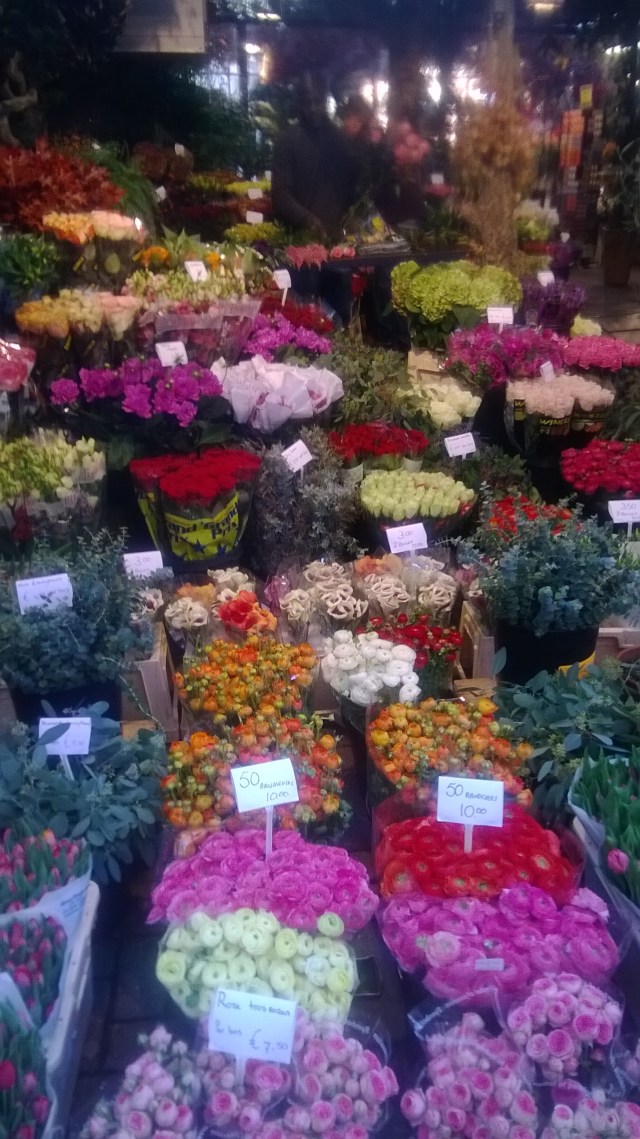
WP_20131109_022I couldn’t resist a trip to Amsterdam’s Flower Market (Bloemenmarkt) at the weekend. My wife- whose birthday was the real reason for being in the city- was very tolerant (as she usually is when I lag behind at garden visits, soaking up the atmosphere, photographing or studying the plants).

We gazed at the wonderful displays (me rather more spellbound than her, I think), and of course couldn’t resist a purchase of some unusual blue tulip bulbs (I will be amazed if they don’t turn out to be more of a purple). Well, I say some tulips, when in reality I fell for the offer of 4 packs of 10 for 10 euros. I found some lovely violet-coloured and white varieties which will work well together and provide a good spread of flowers over April – June.

I must have looked like I knew what I was doing, because a lady from Shropshire got talking and asked my advice about what to buy. I explained my thinking: blue is an unusual colour, you don’t see very often in the UK (or at least that’s my experience). I was also looking for different shaped flower heads, colour combinations and flowering periods. She seemed impressed. In fact she ended up coming away with more or less the same choice as me. That got me thinking that maybe I could offer a consultancy service to the bulb seller? But no, I was here for other things, after all.

All I’ve got to do now is decide where to plant the 70 bulbs I brought home (I forgot to tell you that my wife was also given a present of 30 mixed tulips as one of her birthday presents).

Old School Gardener

deltagardener's avatarThat Bloomin' Garden

Its been a few years since I planted spring bulbs. One year I was able to get a very good buy on almost 1500 bulbs so needless to say the garden looked fabulous the following spring. I must admit that it seemed like a lot of bulbs but they don’t go as far as you think. With half an acre to cover we soon had them all planted.

Its time to talk  Tulips

Tulips grow very well here in the lower mainland of British Columbia. Even with our spring rains they will often stand up to the weather. Above is a photo of Tulips in one area of my garden. I love a mix of colours and have lots of pinks, reds, oranges and yellows.

Its Time to talk Tulips

This grouping of Tulips amazed me last spring. In the winter this area sat underwater for a few days. They still grew. It seems that even though it was very…

View original post 518 more words

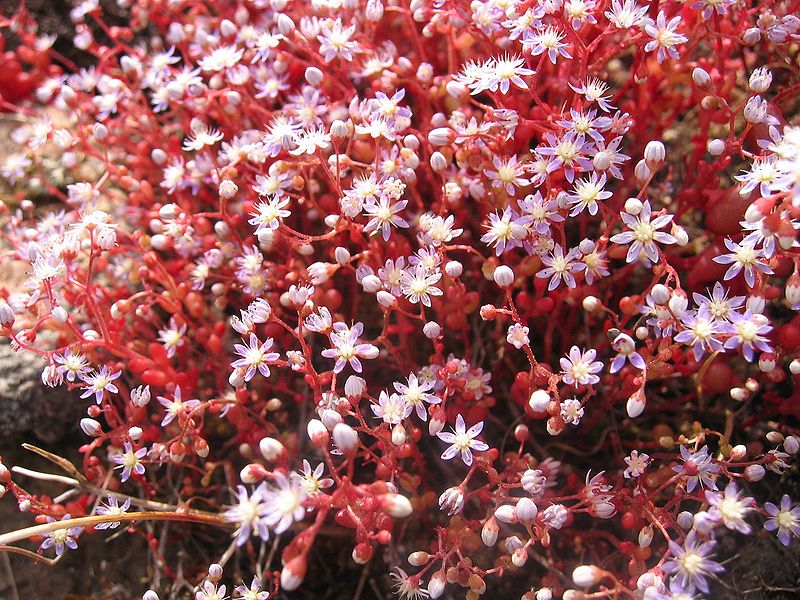
Sedum caeruleum
Sedum caeruleum

So, I’m getting close to the end of the alphabet and thinking about if and how I should follow up my current ‘A-Z’ series with another- what do you think? Any ideas? Maybe trees or shrubs? Or perhaps bulbs? Let me have your ideas!

S caused me a moment of uncertainty. I thought, it has to be Salvia, then I thought, Sedum is obvious as many are at (or close to) their best at this time of year, and I do love the larger forms which add so much to the garden with their chunky, glaucous foliage and shields of flowers, especially in autumn and on into winter as the flowers fade and their strong shapes give structure to the ‘close season’ border.

Sedum (common name ‘Stonecrop’) is a wide genus of some 400 species, encompassing annuals, biennials, deciduous, semi evergreen and evergreen perennials, subshrubs and shrubs- from both hemispheres! What you might call a botanical success story!

Their habitats in the wild vary from mountainous areas (where most come from), to arid regions of South America. As a result, they vary widely from dwarf, rock garden plants (the predominant type) to fairly  tall plants, very suitable for beds and borders. Some of the smaller species can be quite invasive. Sedums prefer sun, but some will tolerate light shade. They are drought tolerant, and prefer light, well-drained soils. The border types  will grow in almost all soil types, but do become rather lush and need to be staked if grown in over fertile conditions.

The foliage of ‘stonecrops’ is usually thick, fleshy and succulent, although the arrangement of the leaves varies. Individual flowers appear in summer and autumn, are mostly 5 – petalled and star shaped, and are borne in a range of different forms: corymbs, panicles or cymes.

Butterflies love the flowers- especially Sedum spectabile. The green buds on this species look good from midsummer, then colour pink into autumn. Stems are succulent and frosted, hence the common name “ice plant”. Unfortunately slugs and snails are fond of the leaves . All parts of the plant are poisonous, and contact with the sap may cause skin irritation.

Smaller, rock garden types are used extensively in ‘green roofs’. The ever popular Sedum spectabile ‘Herbstfreude’ (also know as ‘Autumn Joy’) goes well with many other autumn flowering herbaceous plants such as Michaelmas Daisies (Asters) and some of the shorter grasses such as Stipa tennuissima (‘Pony Tail’ grass). Carefully chosen cultivars of Japanese anemones, penstemons and phlox will also look good with them. They can also be used to good effect massed below a sun baked wall or hedge where other things might struggle, perhaps intermingled with spring bulbs and backed by early – mid summer ‘floppers’ like Perovskia (‘Russian Sage’). Leave the faded flower heads on over winter for some interesting garden shapes, especially after a ‘hoar’ frost.

Further information:

Sedum spectabile

Sedum spectabile ‘Brilliant’- BBC

Sedum ‘Purple Emperor’

Herbaceous Sedums- trials and awards by RHS (pdf)

Living sedum roofs

Sedum photos

Sedum Society

Old Schoool Gardener

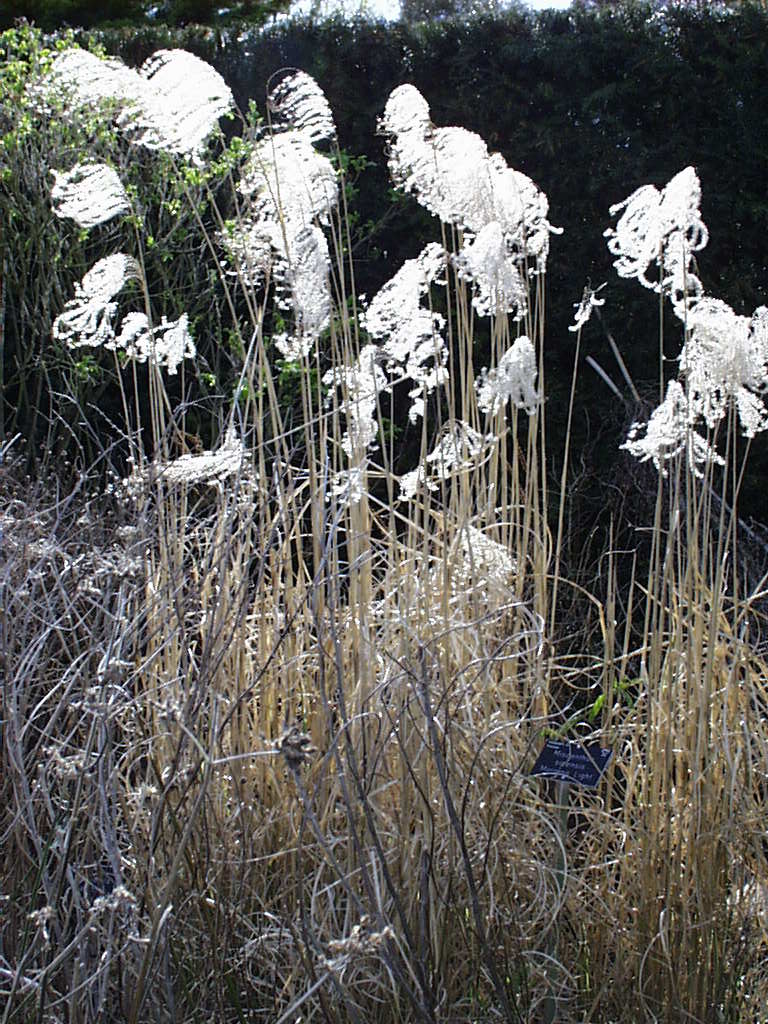
Dried flowers and stems of Miscanthus sinensis 'Morning Light' providing interest at RHS Garden Hyde Hall in March

Dried flowers and stems of Miscanthus sinensis ‘Morning Light’ providing March  interest at RHS Garden Hyde Hall

My previous post set out the background to the growth in popularity of grasses as border plants. I’ve come to appreciate their simple beauty and the way they can add a different dimension to the traditional herbaceous and mixed border and at the moment some of them are looking great in Old school Garden, especially as the low autumn sun catches their golden stems and heads.

So what are the ways you can use grasses to best effect in your garden?

They contribute in a number of ways – texture, light, colour and as structural elements in your overall garden framework (and some sound lovely as the breeze finds its way through them or their seed heads are rattled like mini maracas). Here are some thoughts gleaned (no pun intended) from the very useful book, ‘Grasses’ by Roger Grounds.

Texture

Most grass stems and leaves provide strong vertical or curved lines and are best used in contrast:

  • With other perennial broad – leaved plants (often most effective if seen from a distance),

  • With strong vertical lines like clipped Yew or the corners of buildings (where the grass has a curved or arching stem),

  • More subtle, unusual combinations (e.g. with Ferns),

  • Contrasting the ‘fuzzy’ flower heads of many grasses with those plants that have a more linear or defined form e.g. Digitalis, Lythrum, Achillea, Phlomis russelliana, Echinops and Allium giganteum

  • With other grasses that have different leaf form; e.g. the narrow leaves of Miscanthus sinensis ‘Gracillimus’ with the broad bold leaves of Arundo donax, or the wide, short leaves of Panicum alopecuroides.

  • At the front of borders to act as ‘veils’ through which other plants or a more distant landscape can be revealed.

Annual  grasses- complete their growth cycle in one growing season. Hardy varieties can withstand frost and most can be sown in autumn to over winter in the ground and germinate in spring. Tender grasses need to be sown once all risk of frost has passed. Many of these are perennial in frost-free climates.

Light

  • Position grasses to catch the sun, preferably against a dark backdrop to ‘light up’ the wider garden.

  • Use grasses to take advantage of the different tonal values of light as it changes from season to season and at different times of the day – especially the more mellow light of autumn and also early and late in the day as these are the times when the richest colours are revealed. I’ve positioned some Stipa gigantea (‘Golden Oat Grass’) to catch the low sun of late summer and autumn, and close to the house where we can see the full

  • Associate grasses with seasonal changes in perennials and foliage; e.g. in spring the foliage of grasses is more prominent so think about using bold coloured grass leaves as foils for spring flower colour- the yellow of Bowle’s Golden Grass with the blues of Bluebells for instance.

Cool season grasses- these start into growth in autumn, grow through the winter and flower in spring or early summer. Best planted among winter or spring- flowering perennials. Plants grown for their foliage, or among spring and early summer bulbs. Most then become dormant/semi dormant and so can be planted where summer flowers or other grasses can grow up to conceal their faded foliage. They can be divided or transplanted in spring or autumn.

Colour

  • Use the ‘washed out’ or subtle colours of grasses as a counterpoint to the richer colours in surrounding plants.

  • Grasses with coloured leaves can be used to reinforce a particular colour theme- reds with reds, blues with blues etc. As they last longer than many of the flowers around them, grasses help to maintain continuity in colour themed borders. Blues from grasses such as the varieties of Panicum virgatum, reds from Imperata cylindrica ‘Rubra’ (Japanese Blood Grass) and the yellow of Hakone grass (Hakonechloa macra ‘Aureola’). Yellow is the dominant colour of many grasses’ flower panicles, especially as they fade and the seed heads ripen to shades of amber, straw and gold.

Massing, grouping and markers

  • Grasses look best when grown in groups of three or more- though few gardens have the scope for mass planting. They can also be effective as specimens. Grasses planted as masses or groups should be spaced closer together than in smaller groups.

  • Many low growing grasses make excellent ground cover, and this can be an effective way of massing them in smaller gardens.

  • Taller grasses, or those with strong colouring can act as successful specimens or ‘markers’ in a garden, either planted by themselves or as accents in a border. Clumps of grasses can have a similar impact if planted to contrast with other surrounding grasses or plants.

  • More subtle ways of creating a focus include using grasses with distinctive flower or foliage forms; e.g. Calamagrostis brachytrica with its elongated ovoid flower panicles.

  • A repetition of specimen grasses in a strict rhythm along a border – especially if placed towards the middle of front of it – will impel the eye along its full length. A similar effect, but with less impact, can be achieved with taller grasses placed at the back of the border; e.g. Stipa gigantea.

Warm season grasses- these do not start into growth until late spring or early summer, so they are best planted among other perennials or shrubs that flower from midsummer to autumn. They can be left standing through winter to provide interest- especially when they are covered with raindrops, dew or frost. They should be transplanted or divided in early spring, once they have started into growth.

Seasons and sitings

  • Think about the ‘plant partners’ to go with your grasses, and use the key features of both to complement each other at different times of the year. For example combine a range of strong flower forms which use the structure of grasses to greatest effect; Umbellifers like Anthriscus; Spires like Veronicastrum virginicum; Ball-like or pincushion flowers like Echinops  and Knautia macedonica; loosely structured heads like Astilbe; daisy-like flowers such as Rudbeckia. If possible go for those with the longest flowering period.

  • Use grasses in special sites; e.g. as part of a meadow; as a larger scale ‘prairie’ planting or border; in woodland or shade; at the water’s edge.

Sedges, Rushes and Cat tails – though they generally look like grasses, these plants have taken a different evolutionary path and so vary in leaf and flower details, and also their growing needs. Sedges are large family of diverse plants, mostly from the cool temperate regions, enjoying cooler and damper conditions than most of the true grasses. Rushes are a smaller family with few garden-worthy plants though the woodrushes are often decorative as well as useful, for example as ground cover. Cat tails (or reedmaces or bullrushes)are a single genus family with aquatic or marginal plants that have conspicuous flower heads.

Source: ‘Grasses’ by Roger Grounds (RHS and Quadrille Publishing)

Linked article: Design my Garden: Grasses- first the background…

Further information: Garden design with grasses

Old School Gardener

If you’ve enjoyed reading this post and others on this blog, why not comment and join others by signing up for automatic updates via email (see side bar, above right ) or through an RSS feed (see top of page)?

Amaryllis (Hippeastrum) 'Candy Floss'

Amaryllis (Hippeastrum) ‘Candy Floss’

This week’s question comes from a recent blog follower, Elena who lives in Bergamo, Italy:

“Yesterday I bought three big Amaryllis bulbs, any tips?! There was a Dutch flower stand in my city and I couldn’t resist!”

Elena, I can do no better than show this useful video of the way to pot these wonderful bulbs. After you’ve completed the potting up, place the pot in a warm, dark place and watch for signs of new leaves. Once these are showing, then place the pot in a bright, sunny, frost-free place indoors – a windowsill would do fine. Planted about now you should have some glorious colour at Christmas!

amaryllis christmasWhilst on the subject of keeping things frost-free over winter, there is one golden rule when trying to protect tender plants over the coldest months: don’t over water.

When temperatures are low, the great enemy of plants is dampness, as rot may set in. During very cold spells it is usually best to withhold water entirely. Plants that are dormant or resting should in any case be watered very rarely, perhaps just enough to prevent complete drying out. Plants with fleshy roots, and bulbs, corms, tubers, rhizomes and other storage organs must be kept quite dry and frost-free or they will rot. They should be stored in containers of clean, dry sand or gritty compost. If stored in a greenhouse, the atmosphere must also be kept on the dry side, and should be ventilated when the general temperature allows. If you have an extra cold spell and you can’t keep the air temperature up, you can protect your plants to some extent against frost damage by covering them with horticultural fleece, dry newspaper or ‘bubble wrap’ plastic anchored with stones.

dahlia tubers

Dahlia tubers are best lifted, cleaned off, dried and then stored in sand or gritty compost before significant frost

Old School Gardener

If you’ve enjoyed reading this post and others on this blog, why not comment and join others by signing up for automatic updates via email (see side bar, above right ) or through an RSS feed (see top of page)?

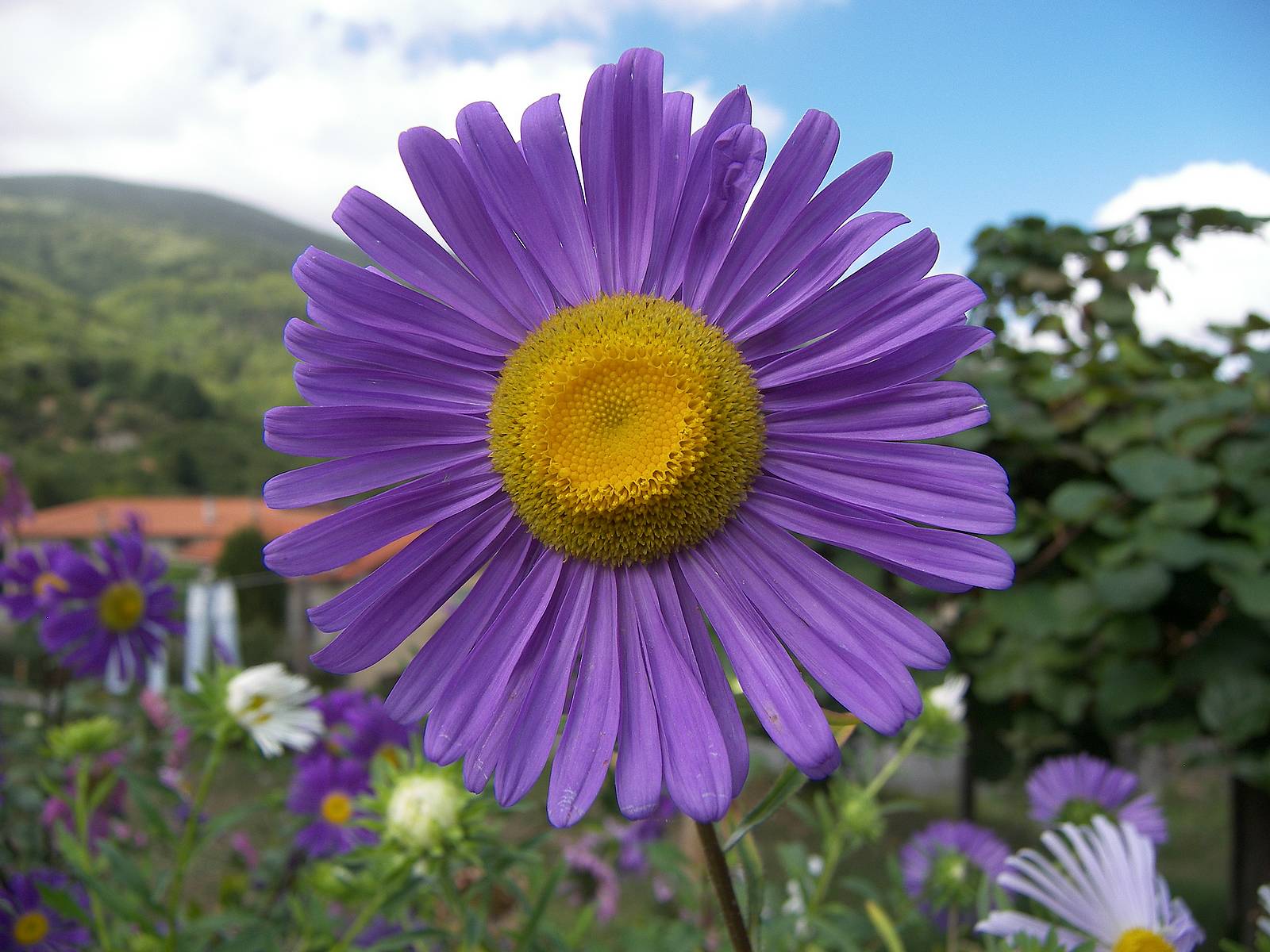
Aster alpinus

Aster alpinus

Michaelmas Daisies or Asters are simply named – from the greek ‘Aster’ meaning ‘a star’- referring to the shape of the flowers (though in truth some are more star – shaped than others).

The genus Aster once contained nearly 600 species in Eurasia and North America, but after research on the genus during the 1990s, it was decided that the North American species are better treated in a series of other related genera. After this split there are now roughly 180 species within the genus, all but one being confined to Eurasia. Many species and a variety of hybrids and varieties are popular as garden plants because of their attractive and colourful flowers, which are abundant in the Autumn- hence the association with Michaelmas – the feast of Saint Michael the Archangel (also the Feast of Saints Michael, Gabriel, Uriel and Raphael, the Feast of the Archangels, or the Feast of Saint Michael and All Angels) – 29th September. Because it falls near the equinox, this date is associated in the northern hemisphere with the beginning of Autumn and the shortening of daylight.

The genus Aster is now generally restricted to the Old World species, with Aster amellus being the type species of the genus, as well as of the family Asteraceae. Species names include:

A. acris = acrid, pungent

A. alpinus = alpine

A. amellus = name given by Virgil to a blue aster-like plant by the River Melia

A. cordifolia = heart-shaped leaves

A. delayvi = of Abbe Delayvi, a missionary

A. diffusus = spread out

A. dumosus = bushy

A. ericoides = like Erica (heather)

A. farreri = of Farrer

A. x frikartii = Frickart’s Aster, a hybrid of A. amellus and A. thomsonii

A. laevis = small, polished

A. linosyris = flax (Linum)- like

A. puniceus = purple

A. subcoeruleus = somewhat or slightly blue

A. vimineus = with long, pliant growths , like an osier

A. yunnanensis = of Yunnan, China

The Hungarian revolution of 31 October 1918, became known as the ‘Aster Revolution’ due to protesters in Budapest wearing this flower.

flower-petals-aster-nature-free-hd

Sources and further information:

Wikipedia

Ontario wildfowers- Asters information

Aster images

Old School Gardener

If you’ve enjoyed reading this post and others on this blog, why not comment and join others by signing up for automatic updates via email (see side bar, above right ) or through an RSS feed (see top of page)?

rudbeckia via thegardendeliRudbeckia is a plant genus of 23 species, commonly called ‘Coneflowers’ and ‘Black-eyed-susans’. They are native to North America (‘prairie plants’) and are cultivated for their showy flower heads of yellow and orange, with a dark centre seed head, but there are also russet, bronze and mahogany tones. Mainly herbaceous perennials, some are annual or biennial.

They grow to between 0.5m and 3m tall, with simple or branched stems. The leaves are spirally arranged, and are between 5cm and 25 cm long. The flowers are daisy-like, with yellow or orange florets arranged in a prominent, cone-shaped head; “cone-shaped” because the ray florets tend to point out and down as the flower head opens.

A large number of species have been proposed within Rudbeckia, but most are now regarded as synonyms of a more restricted list. Several of these currently accepted species have a number of accepted varieties. Some of them (for example the Black-eyed Susan, R. hirta), are popular garden flowers, and prized for their long flowering times. There are many  cultivars of these species.

The name Rudbeckia was given by Linnaeus in honour of his botany teacher at Uppsala University – Professor Olof Rudbeck (1660-1740), and his father (also Professor Olaf – 1630-1702). Rudbeckia shares the common name ‘coneflower’ with other plants in the Asteraceae family – Echinacea, Dracopis and Ratibida.


Rudbeckias are not particular about soil, but do best in soil that is not too rich, with well-draining conditions. Rudbeckias love sunshine but R. laciniata and R. hirta (syn. gloriosa) will grow happily in dappled shade provided they have adequate moisture. Their blooms brighten up shadowy places wonderfully.  The flowers are daisy-like and can be single, semi double and fully double. Rudbeckias flower for a long period from late July well into autumn. Some of the varieties available include:

  • R. fulgida var. sullivantii ‘Goldsturm’ – The standard for Rudbeckia. Long blooming and virtually pest free (60cm)

  • R. hirta ‘Cherokee Sunset’ – Double and semi-double flowers in shades of yellow, orange, red, bronze and mahogany. Short lived, but re-seeds itself (60cm)

  • R. hirta ‘Indian Summer’ – Traditional daisy-like, large yellow flowers. Short lived, but re-seeds itself or grow as an annual. (1m-1.2m)

  • Rudbeckia ‘Toto Rustic’ – A dwarf Rudbeckia in autumn colors. There are also golden ‘Toto’ & pale ‘Toto Lemon’.

  • R. maxima Giant Coneflower – 12cm flowers and large leaves on an imposing plant (1.3m – 2.5m)

R. maxima (the ‘Great Coneflower’ or ‘Cabbage-leaved Coneflower’) is a favourite variety – It is an elegant plant with flowers with tall, black central cones which launch themselves upwards as its long petals droop downwards. Its foliage – unique among coneflowers – is a rosette of long paddle-shaped glaucous leaves, each with an elongated stem. Because it is late into flower it sometimes gets put at the back of a border, but it is a star performer that should be used nearer the front where its beautiful blue-grey foliage can be appreciated. Another advantage is that its flower stems are almost bare, so are easy to see through.

Rudbeckia maxima

Rudbeckia maxima

Rudbeckia work equally well as a complement to blue and purple flowers, like Russian sage and Veronica and mixed in with other jewel tones, like Sedum ‘Herbstfreude’, Purple Echinacea and Asters. Rudbeckia also make great cut flowers and even the seed heads will hold up in arrangements. Some plant combinations to try:

R. fulgida var. deamii with aster ‘Little Carlow’.

R. ‘Goldquelle’, lightened up with the airy wands of Gaura lindheimeri among it and foamy Calamintha nepetoides at its feet.

R. maxima with big-leaved plants such as bananas, hedychiums and ricinus for a late-summer ‘jungle’ effect.


Keep plants well watered the first season, to get them established. Once established, they will be quite drought resistant. A mulch of compost should be all the feeding they need. Regular deadheading of the faded flowers will keep the plants in bloom longer. You can let the last flowers of the season remain on the plants to go to seed and feed the birds, but you will also get a good deal of self-seeding. All perennial Rudbeckia can be increased by dividing clumps in spring or taking basal cuttings.


Sources and further information:

Wikipedia

Growing R. laciniata ‘Herbstonne’ – RHS

Growing R. fulgida– Daily Telegraph

Choosing and growing Rudbeckia- About.com

Rudbeckias- special perennials.com

Old School Gardener

If you’ve enjoyed reading this post and others on this blog, why not comment and join others by signing up for automatic updates via email (see side bar, above right ) or through an RSS feed (see top of page)?

Finding Nature

Nature Connectedness Research Blog by Prof. Miles Richardson

Norfolk Green Care Network

Connecting People with Nature

Discover WordPress

A daily selection of the best content published on WordPress, collected for you by humans who love to read.

Susan Rushton

Celebrating gardens, photography and a creative life

Unlocking Landscapes

Writing, photography and more by Daniel Greenwood

Alphabet Ravine

Lydia Rae Bush Poetry

TIME GENTS

Australian Pub Project, Established 2013

Vanha Talo Suomi

The Journey from Finnish Rintamamiestalo to Arboretum & Gardens

Marigolds and Gin

Because even in chaos, there’s always gin and a good story …

Bits & Tidbits

RANDOM BITS & MORE TIDBITS

Rambling in the Garden

.....and nurturing my soul

The Interpretation Game

Cultural Heritage and the Digital Economy

pbmGarden

Sense of place, purpose, rejuvenation and joy

SISSINGHURST GARDEN

Notes from the Gardeners...

Deep Green Permaculture

Connecting People to Nature, Empowering People to Live Sustainably

BloominBootiful

A girl and her garden :)