Category: Feature plants


Brigid Jackson's avatararistonorganic

????????

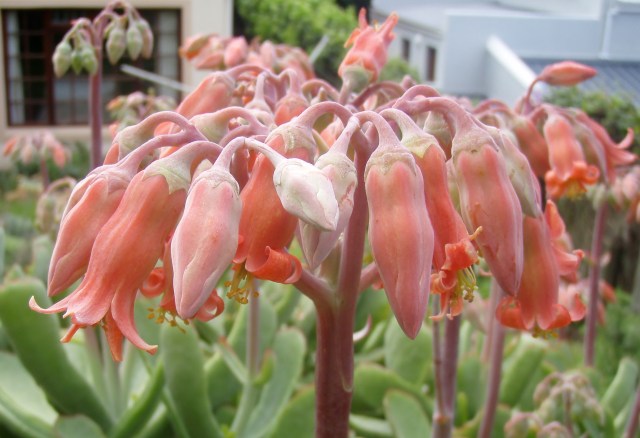
Pigs’ Ears, “plakkies” (Afrikaans) Cotyledon orbiculata, fast-growing succulent is well known to gardeners, forms a low shrub and adds colour to the winter garden. Forms with handsome grey leaves provide year-round interest in the garden.

??????????????

These are photographs of ones I planted in a garden 2 years ago. What a beautiful display they make. The brightly coloured flowers attract bees and birds, which feed on the nectar of the plant. The silver-grey leaves of some forms owe much of their attractive colouring to a powdery white coating which may assist in reflecting much of the sun’s heat to prevent excessive water loss from the thick succulent leaves.

????????Uses and cultural aspects
This is a well-known medicinal plant. The fleshy part of the leaf is applied by many South Africans to soften and remove hard corns and warts. The Southern Sotho use a dried leaf as a protective charm for an orphan…

View original post 151 more words
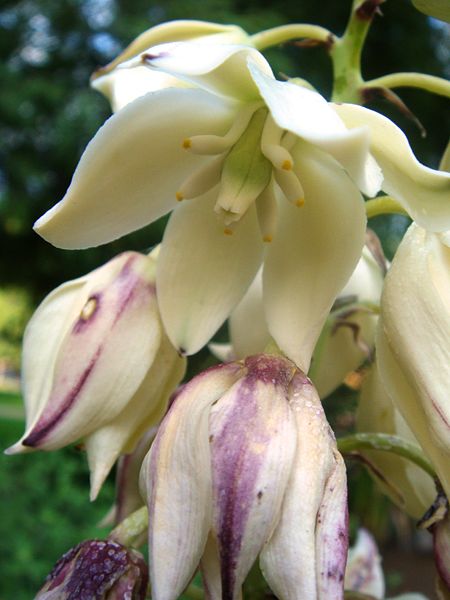
Yucca aloifolia flowers

Yucca aloifolia flowers

A genus of about 40 species of perennial evergreen shrubs or trees, Yucca is rosette-forming or woody- based and comes from hot, dry places such as deserts. sand dunes and plains in north and central America and the West Indies. It is also colloquially known in the Midwest United States as “ghosts in the graveyard”, as it is commonly found growing in rural graveyards and when in bloom the cluster of (usually pale) flowers on a thin stalk appear as floating apparitions. So striking are these flowers that early settlers of the south-western United States called them “Lamparas de Dios” or “Lanterns of God”. 

A member of the Agavae family, the yucca is closely related to the lily and has its origins in Mexico and Central America where it was prized by indigenous peoples for the medicinal and nutritional properties of the yucca flower.

North American natives, too, found the plant useful, using it to make clothing and soap (yucca roots are rich in saponins).

Cultivated for their bold, linear to lance shaped leaves and their erect (sometimes pendent) panicles of, usually white bell-shaped flowers. Many species also bear edible parts, including fruits, seeds,flowers, flowering stems and more rarely roots. References to yucca root as food often stem from confusion with the similarly pronounced, but botanically unrelated, yuca, also called cassava (Manihot esculenta).

They tolerate a range of conditions, but are best grown in full sun in subtropical or mild temperate areas. In gardening centres and horticultural catalogues they are usually grouped with other architectural plants such as Cordylines and Phormiums.

Joshua trees

(Yucca brevifolia) are protected by law in some American states. A permit is needed for wild collection. As a landscape plant, they can be killed by excessive water during their summer dormant phase, so are avoided by landscape contractors.

Several species of yucca can be grown outdoors in mild temperate climates where they are protected from frost. These include:-

Y. filamentosa

Y. flaccida

Y. gloriosa

y. recurvifolia

Yuccas are widely grown as architectural plants providing a dramatic accent to landscape design. They can be used as specimen plants in courtyards or borders and in frost prone areas can be grown in a cool or temperate greenhouse or conservatory. Pollination and proper yucca care are necessary for the formation of these flowers on indoor plants.

Be careful to site them away from paths or other places people could be scratched by their sharp leaves. Free-draining soil and sun is all yuccas require.They are fully frost hardy to frost tender and can be propagated by seed sown in spring. Rooted suckers can also be removed in spring and root cuttings can be taken in the autumn. They can be susceptible to leaf spot and aphid attack.

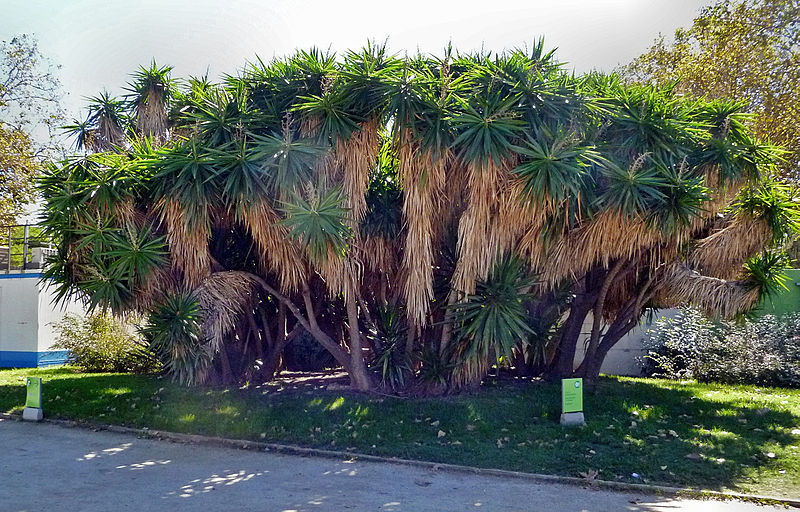
Yucca guatemalensis (syn Yucca elephantipes)

Yucca guatemalensis (syn Yucca elephantipes)

Further Information:

Wikipedia

Yucca filamentosa- RHS guide

How to Grow Yucca

Yucca Care

Yucca- Plant Encyclopedia

Old School Gardener

Rosa rugosa 'Frau Dagmar Hastrup'- shrub rose growing at Old School Garden

Rosa rugosa ‘Frau Dagmar Hastrup’- a shrub rose growing at Old School Garden

What an appropriate question for St. Valentine’s Day, from Minah Petaly of Lincoln:

‘I’ve heard that old roses and shrub roses only flower once a year and that shrub roses would be too big for a small garden like mine. And what would you suggest I grow to get large, decorative hips (no sniggering please)?’

Ha, ha, Minah! It’s true that all the old garden roses will flower once a year but there are some notable exceptions: most Bourbons, the hybrid perpetuals and China roses. This is also true of the wild (species) roses, however, a high proportion of modern shrub roses raised during the last 100 years are recurrent flowerers.

As to size, it’s by no means true that all shrub roses are too large for small gardens. Some of the modern ones developed in the past century will reach only 1.2m (4′) high or less. And the varieties ‘Yesterday’, ‘Frank Naylor’, and ‘Saga’ could also be added to these.

R.'Yesterday'

R.’Yesterday’

Of the older roses, most of the Gallicas and China roses grow within this limit too, as do a few examples from other groups. Particularly suitable for smaller gardens are the alba roses like ‘Felicite Parmentier’ and ‘Konigin von Danemarck’ while the species or wild rose ‘Canary Bird’ (pause for a chant of ‘Come on you Yellows’- the canaries is the nickname of Norwich City F.C.), can be kept to a moderate height if grown as a standard.

Looking at hips (!), for their sheer size and redness, pick members of the rugosa family that have single flowers, such as ‘Frau Dagmar Hartopp’, R. rugosa alba, and ‘Scabrosa’. Another good one, growing here in Old School Garden is ‘Frau Dagmar Hastrup’. As they are recurrent flowerers, the hips from the first flush of flowers appear with later blooms.

A hip on Rosa rugosa

A hip on Rosa rugosa

Many of the wild (species) roses have hips in varying colours from red through to orange and yellow, and some even black. R. roxburghii has prickly hips resembling the fruit of the Horse Chestnut (conkers), while those of R.pomifera resemble large red gooseberries. Perhaps the most spectacular hips are those of R. moyesii and its various hybrids; they are bottle-shaped, bright red and each may be up to 50mm long. To continue with the footballing (soccer) theme, this is perhaps one for Manchester United supporters – both on grounds of colour and name!

Old School Gardener

Sophie Hudson's avatarThe Forget-me-Not Cultivation Blog

I know, February – it’s so cold and grey.

There appears to be mud and bare branches every where.  But don’t despair.  Below are 20 plants you can sow from seed in February that will make you feel like Spring is here now.

February is actually a really good month to begin setting your garden, patio, and balcony up ready for the new growing season.  So ignore the wind, the rain and snow (what snow!), and instead gather your tools.

February is a month when all seeds bought/saved need to be sown indoors only.

It’s not warm enough outside to leave the little seeds fighting for warmth when there isn’t a lot going around.  Instead you can start your garden off indoors and once the plants have germinated and grown they can be moved and planted outside.

By sowing a month early (assuming you take March to be the month…

View original post 443 more words

single_red_rose‘It will never rain roses; when we want to have more roses we must plant more trees’

(George Eliot)

So, male readers (73% of those buying flowers for Valentine’s Day are men), with about a week to go to that feast of romance, you may have started to think about a suitable card and flowers for your loved one. Unless, of course, you forget and pay through the nose on the day itself for a sad-looking bouquet as you fill the car’s tank at your local garage (not guilty m’lord!).

The ‘modern’ celebration of St. Valentine’s day seems to have begun in France and England – the first box of chocolates was proffered in the 1800’s but the first card was sent way back in 1415 by the Duke of Orleans to his wife! The first recorded association of Valentine’s Day with romantic love is in  Parlement of Foules (1382) by English poet Geoffrey Chaucer:

For this was on seynt Volantynys day
Whan euery bryd comyth there to chese his make.

[“For this was on Saint Valentine’s Day, when every bird cometh there to choose his mate.”]. And he may have been referring not to February 14th but May 3rd!

Traditionally the Rose and the Cacao are the ‘patron saint plants’ of Valentine’s Day, but have you thought about  how your roses have been grown and where they’ve come from? On the one hand the UK cut flower market is worth around £2 billion per annum, and Valentine’s Day is an important element in that business. Roses account for more than half of the flowers bought for the day.

Why think of an alternative to cut roses?

Antique Valentine - 1909
Antique Valentine – 1909

Dick Skeffington of the Open University says that over 90% of the roses bought for Valentine’s Day are imported – most from Colombia (for the US market) and Kenya (for the UK). The debate about Kenyan roses goes beyond the ‘flower miles’ generated by their import from Africa to Europe. For instance, there’s the carbon released from fossil fuels involved in fertilisation and cultivation. The flowers also need refrigerating  and methane is released from flowers that are rejected and binned.  Some of the other issues to consider are:

  • Lake Naivasha, the complex eco system around which most of the Kenyan rose production is focused, has suffered from pollution and has seen water levels drop due to rose production

  • During 2007-8, following a disputed election in Kenya, it was said that the Army and police turned their attention to protecting the rose industry at the expense of local people – some 100 deaths and the displacement of 300,000 people resulted

  • Rose production may have resulted in significant increases in miscarriages, birth defects and other health problems associated with the toxic chemicals used in rose production

Some Kenyan rose growers have sought to improve things by adopting Fairtrade status which is a mark of a more sustainable production cycle, and one which brings money back into the local workforce as well as subsidising local welfare and community improvements.

So what to do this coming Valentine’s Day?

Dick says:

‘The best advice this St Valentine’s Day is to purchase flowers with a certified Fairtrade logo clearly marked. That way you can be sure that the flower growers receive a premium to invest in their communities, or you could circumvent the ethical minefield and purchase seasonal British flowers. But do beware of mixed bouquets as the flowers in them can come from a range of sources, some of dubious ethical credentials.’

Alternatively, why not think about a lasting plant gift, something that will continue to grow with the love you have for your partner, rather than get wasted after a few days?! So, a new rose bush for the garden, perhaps (and an extra large box of chocs to make up for the lack of immediate flowers) – or maybe some packets of vegetable seeds?

A rose bush for Valentine's Day? She'll be 'Tickled Pink'!
A rose bush for Valentine’s Day? She’ll be ‘Tickled Pink’!

Further information:

Wikipedia

Fun facts about St. Valentine’s Day

Brief history and facts about St. Valentine’s Day

Old School Gardener

If you’ve enjoyed reading this post and others on this blog, why not comment and also join some other people and sign up for automatic updates via email (see side bar, above right ) or through an RSS feed (see top of page)?

close up of Xerochrysum bracteatumAs you might guess there aren’t that many plants beginning with ‘X’, but Xerochrysum is an interesting genus of around 6 or 7 species of short- lived perennials and annuals which are native to open grassland and scrub in Australia.

The stemless lance – like leaves are hairy. The flowers are dasiy like with papery white, yellow or pink bracts and a central disc of, often, yellow florets. The perennials can be used to fill in gaps in herbaceous borders and low – growing cultivars are suitable as edging or for containers.

The name Xerochrysum comes from Greek xeros meaning “dry” and chrysos meaning “gold” (this refers to the common yellow papery bracts that occur within the genus).

X. bracteatum is often grown for its cut and dried flowers and it self seeds freely. Also known as the “Golden Everlasting”, this is one of the best known of the “paper daisies” as it is a very widespread species occurring in both annual and perennial forms. It varies in habit from prostrate to a shrubby plant of about 1m in height. The leaves are usually large (up to 100mm long) and green to grey-green in colour. The individual flowers are very small but are formed into a large cluster surrounded by large papery bracts. The overall appearance is that of a large, single “flower” with the bracts as the “petals”. However, well over a hundred true flowers occur inside the ring of bracts.

The ‘golden everlasting’ has been cultivated for many years and a number of forms have been selected for cultivation. These include several which have resulted from both chance and deliberate hybridisation. Some examples are:

  • “Diamond Head” – perennial; green foliage, 0.2m x 0.5m. Yellow flowers

  • “Dargan Hill Monarch” – perennial; grey leaves, 0.8m x 1m. Yellow flowers

  • “Cockatoo” – perennial; similar to “Dargan Hill Monarch”, pale yellow bracts around a head of small orange flowers

  • “Princess of Wales” – perennial; similar to “Dargan Hill Monarch” but more compact (0.6m x 0.6m). Yellow flowers

  • “Kimberley Sunset” – perennial; grey leaves, 0.8m x 1m. Pink flowers

In addition, breeding work in Europe and Australia has produced annual forms with an outstanding range of colours – yellow, red, purple, orange. These are excellent for a massed, colourful display. Most forms are suited to cultivation in many areas. The annual forms can be purchased in packets from a number of commercial suppliers and established as instructed on the packs.

Perennial forms are usually quick growing in a sunny, well drained position. They benefit from a regular light pruning annually to encourage branching and a greater number of flowers. Severe pruning to overcome “legginess” may be successful but only as a last resort.

Golden everlasting responds well to annual fertilising, usually with a slow-release type and appreciates an assured water supply. The plants vary in their ability to withstand frost but most are at least moderately frost resistant.

Propagation of X.bracteatum from seed is easy; no pretreatment is required. Propagation from cuttings is also fairly easy and is the only way that named cultivars should be propagated.

Xerochrysum is half hardy to frost hardy and should be grown in moderately fertile, moist but well-drained soil in full sun. Those cultivars which reach 90 cms or more need staking. They can be propagated from seed in the spring. they might susceptible to downy mildew.

These very popular plants bring long-lasting colour and warmth into the garden. There are many cultivars available in nurseries with flowers varying from white through cream, lemon, canary yellow, gold and bronze. Many of the pink varieties are the result of plant breeding, most probably using South African species as this colour is very uncommon in Australian plants.

They will keep producing flowers particularly if spent flowers are continually removed. Butterflies and other insects love them and will flock to your garden adding another layer of interest. They are also excellent as dried flowers keeping their shape and colour well for years – just hang a bunch up-side-down in a dark airy place and let them dry for a few weeks.

Sources and further information:

Australian Native Plants Society

Wikipedia

Growing Xerochrysum bracteatum-RHS

Old School Gardener

Osteospermum

Brigid Jackson's avatararistonorganic

osteospernum_by_selinarainbowmoon-d5enkmc

“The Kingdom of Flowering Plants holds a special compassion for human travail. Because of this, the essences of flowers support us with a special compassion through our earthbound transformation. Flower essences contain the vibratory qualities of the flowers, and are made by infusing the flower into spring water under sun or moon light.”
– Flowers of the Soul.

http://selinarainbowmoon.deviantart.com/art/Osteospernum-326945316

View original post

Eremurus 'Shelford Hybrids'
Eremurus ‘Shelford Hybrids’

With Spring round the corner and thoughts of summer-flowering bulbs, this week’s timely question comes from George White of Walthamstow, London:

‘A friend has some magnificent border plants which he knows only by the name Foxtail Lilies. What are they, and are they easy to grow?’

George, these plants are a glorious addition to summer borders and belong to the genus Eremurus. They are also known as ‘Desert Candles’ and are hardy herbaceous perennials in which tall spikes of star-shaped flowers arise from a ring of narrow, pointed foliage. The best and tallest are the series known as  ‘Shelford Hybrids’, whose flowers vary in colour but are often a pleasing soft, pinky beige. They can reach 2.75 metres tall and bear hundreds of primrose-sized flowers.

Eremurus stenophyllus bungei  is the yellow-flowered parent of these hybrids and reaches 1 metre in height. The other parent E. olgae, is late flowering, bears pink blooms, and reaches a height of 1.5 metres.

Other fine examples are the very tall E. elwesii with soft pink flowers (and it’s white-flowered variety ‘Albus’), and the even taller (up to 3 metres) E. robustus with pinky yellow flowers on spikes up to 1.2 metres long. Eremurus are quite easy to grow as long as they have a free draining soil around their roots and have lots of warm sunshine. Here’s a video on how to plant Eremurus bulbs. It will probably be at least one season before you see any flowers.

If you can’t wait until next year then now’s the time to  think about some other unusual summer flowering bulbs for your borders.

Camassia (Quamash) are easy to grow and are attractive late spring performers that look good with late tulips (I have some whose lavender-purple flower spikes contrast well with the orange tulip ‘Ballerina’). C. cusickii is 200mm tall with lots of pale blue flowers, while C. quamash (syn. esculenta) has spikes of white to deep-blue flowers and grows to 250mm tall. C. leichtlinii, 900mm tall, has white or blue star-like flowers and C. semiplena has semi double creamy flowers on sturdy stems.

Other summer bulbs of interest are Fritillaria persica ‘Adiyaman’ which stands between 800mm – 1.2 metres tall and in May produces unusual, deep -hanging bells of rich plum-purple. Leucojum aestivum ‘Gravetye Giant’ is probably the best of the summer flowering ‘snowflakes’ standing 300-500mm tall and has wide- hanging white bells in April and May.

If you are in a frost free area or able to lift your bulbs to protect them from winter frost, then Watsonia is a colourful spike- flowered border plant. And why not go for a touch of the exotic with a Canna or two? (better make that 3 at least). Summer flowering bulbs are already available to buy online through various well-known nursery companies and should soon start appearing in your local Garden Centre or nursery. Plant them in the spring as the soil begins to warm up.

Further information:

BBC gardening guide – summer flowering bulbs

Foxtail Lilies

How to grow Eremurus robustus

How to grow Eremurus stenophyllus AGM

Old School Gardener

Verbascum 'Kynaston'

Verbascum ‘Kynaston’

A genus of over 350 species, Verbascums are native to Europe, North Africa and Asia. Most of the species are biennial, though there are some annuals, perennials and sub shrubs and a few evergreens.

The perennials are often short-lived, dying after flowering, though they (like all species) are prolific self seeders. Verbascums mostly grow on open scrubland or dry hillsides, though some are found in open woodland. They like a sunny position with sharply drained soil.

Verbascums generally form a basal clump or rosette of leaves, these usually being large, soft and simple in shape, some with lobed or toothed edges. They produce one or a few spikes of flowers- these are densely packed and with saucer-shaped flowers. The flowers are individually short-lived, but are borne successively over along growing season. Flowers on hybrid cultivars are larger and showier.

Many Verbascums (or ‘mulleins’) grow quite tall (up to 3 metres) and need to be staked. Seedlings of named varieties will not grow true to their host, so these should be deadheaded before shedding their seed if you want to avoid a mixture of flower colours. The cultivars  ‘Gainsborough’, ‘Letitia and ‘Pink Domino’ have gained the Royal Horticultural Society’s ‘Award of Garden Merit’. Since the year 2000, a number of new hybrid cultivars have come out that have increased flower size, shorter heights, and a tendency to be longer-lived plants and a number have colour ranges not typical of the species.

Larger species can be left to naturalise in gravel or wild gardens, where they make impressive architectural plants, and will benefit from the support of adjacent plants. Smaller types are good in rock gardens, screes, or even walls. All Mulleins can be prone to mildew.

Vita Sackville-West wrote in 1936 that her Verbascums looked as though “a colony of tiny buff butterflies had settled all over them”. She described the colourings as “dusty, fusty, musty”. Verbascums have not changed much since then. The Cotswold Group about which she was writing are still grown, and there are others – for example ‘Megan’s Mauve’, and the new variety, ‘June Johnson’ – in which purple and apricot have become interwoven.

Verbascums make good partners for old roses (which they succeed in flower); in groups of plants with rounded or vase-shaped form to provide a contrast; or (where they are white-flowered) placed in front of softly coloured Hydrangeas.

Apart from propagation by seed, replacement plants can easily be grown from root cuttings. In March, scrape soil away from the roots area, take a knife and sever two or three fat, strong roots. Cut these into 4cm lengths and set them upright, individually, in small pots of potting soil with plenty of perlite mixed in. After three months in a frame and kept watered, each will have grown into a new plant.

Sources and further information:

Wikipedia

Verbascum.org

Growing Verbascums- Daily Telegraph

Plant guide- Fine Gardens

Rosy Hardy’s blogspot

Verbascum dumulosum- Kew Gardens

Old School Gardener

cornus alba sibirica and green yellow stems of C. flavirameaCornus is a genus of about 30- 60 species of woody trees and shrubs, commonly known as dogwoods. Most are deciduous, but a few are more like herbaceous perennials (subshrubs) and some are evergreen. Cornus is the latin word for ‘horn’ referring to the hardness of the wood.

The name “dog-tree” was recorded in 1548, and this had changed to “dogwood” by 1614. After this the plants soon became known as the Hound’s Tree, while the fruits came to be known as dogberries or houndberries (the latter is also the name given to the fruits of the black nightshade- alluding to Hecate’s hounds).

The plants may have become known as ‘dogwoods’ from the Old English word dagwood, which refers to the ways it’s slender stems of very hard wood were used to make “dags” (daggers, skewers, and arrows).

Another, earlier name of the dogwood in English is the whipple-tree. Chaucer refers to the “whippletree” in The Canterbury Tales (‘The Knight’s Tale- verse 2065). A whippletree is also a part of a horse – drawn cart; the link between the drawpole of the cart and the harnesses of the horses lined up behind one another, and commonly carved from the Whippletree or Dogwood.

Some of the Cornus species names are:

C. alba = white

C. canadensis = of Canada

C. candidissima = very white- the flowers

C. capitata = headed- the grouping of flowers

C. florida = flowering richly

C. fragifera = strawberry-like – the fruits

C. glabrata = glabrous

C. kousa = a japanese name

C. mas = male (mascula of Linnaeus)

C. nuttallii = after Nuttall

C. sanguinea = blood-red- the twigs

Cornus are either grown for their flowers, interesting leaves (some both of interest during summer and autumn) or for their colourful winter stems. These are just coming into their own in winter gardens around Britain – including Old School Garden. I have several groups of C. alba ‘Sibirica’, C. sanguinea ‘Midwinter Fire’ and C. sericea ‘Flaviramea’ (some grown easily from hardwood cuttings). I ‘stool’ these (i.e. cut the stems to the base) each spring to encourage new growth, which once the leaves have fallen (these are also very colourful in the autumn), reveals bright red, orange and yellow- green stems, which really glow in the winter sunshine..

Sources and further information:

Wikipedia

Seven Plants for Winter Wonder -article on Old School Garden

Cornus- RHS advice

Cornus- an essential winter shrub- Daily Telegraph

Old School Gardener

Finding Nature

Nature Connectedness Research Blog by Prof. Miles Richardson

Norfolk Green Care Network

Connecting People with Nature

Discover WordPress

A daily selection of the best content published on WordPress, collected for you by humans who love to read.

Susan Rushton

Celebrating gardens, photography and a creative life

Unlocking Landscapes

Writing, photography and more by Daniel Greenwood

Alphabet Ravine

Lydia Rae Bush Poetry

TIME GENTS

Australian Pub Project, Established 2013

Vanha Talo Suomi

The Journey from Finnish Rintamamiestalo to Arboretum & Gardens

Marigolds and Gin

Because even in chaos, there’s always gin and a good story …

Bits & Tidbits

RANDOM BITS & MORE TIDBITS

Rambling in the Garden

.....and nurturing my soul

The Interpretation Game

Cultural Heritage and the Digital Economy

pbmGarden

Sense of place, purpose, rejuvenation and joy

SISSINGHURST GARDEN

Notes from the Gardeners...

Deep Green Permaculture

Connecting People to Nature, Empowering People to Live Sustainably

BloominBootiful

A girl and her garden :)