Category: Feature plants


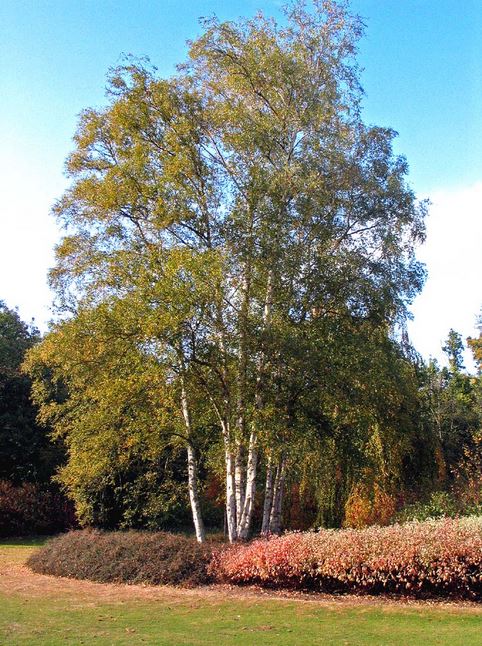
mature betula pendula bartram treesThis is the second in my new series on garden trees. I’ll shortly be doing one or two articles about trees and garden design, in my series ‘Design my garden’, so keep an eye out.

Common name: Silver Birch

Native areas: Europe, though in southern Europe it is only found at higher altitudes

Historical notes: Also known as the ‘Lady of the woods’ because of its slender and graceful appearance. Especially popular in the UK. Grown as an ornamental plant and also for its timber. It is used for a range of purposes, from broom-making and steeple-chase fencing to medicines.

Features: A medium tree (15- 20 metres tall), with a conical, semi weeping habit, with white bark and horizontal lines and large diamond -shaped cracks which form as the tree matures. Leaves ovate, yellow in autumn. Flowers in catkins. Can be grown either as a single or multi-stemmed tree.

This slideshow requires JavaScript.

Uses: Very good as a multi-stemmed tree for exposed or elevated positions as they have a low centre of gravity. These look good in small groups in informal settings. I have a few that contribute to a mixed ‘woodland edge’  here at Old School Garden, providing a natural boundary to the garden. It can also be used as a specimen, though some of the cultivars available perhaps provide more interesting features than the species plant:

‘Dalecarlica’ (Swedish Birch, syn. ‘Laciniata’ or ‘Crispa’)- deeply cut leaves which weep gracefully, white peeling bark

‘Fastigiata’- stiffly ascending branches give it a columnar shape, resembling Lombardy Poplar

‘Purpurea’ slow growing and rare, with new, dark purple leaves,softening t o dark green/purple by summer.

‘Tristis’- tall (15-20 metres), weeping birch, with beautiful winter structure.

‘Youngii’- similar habit to ‘Tristis’ but shorter (5-10 metres) and so more suitable for smaller gardens, especially good as a specimen  in lawns.

‘Zwisters Glory’- from Switzerland, this new variety has gleaming white bark, so makes a good avenue tree and a good choice for urban areas and is quick growing.

Two other species of birch are also worth mentioning:

Betula pubescens- ‘Common White Birch’, prefers damper conditions than B. pendula, also it’s more hardy. It’s ascending branches give it a more solid appearance than B. pendula.

Betula utilis ‘Jacquemontii’/ ‘Doorenbos’-a medium tree with ascending branches, most admired for its almost pure white bark, looking very effective against a dark background.

Growing conditions: grows well in most soils and is good for parks and woodland, but is not suitable for areas which have soil that becomes compacted. Difficult to transfer as a bare rooted specimen, but containerised plants are more successful.

Further information:

Wikipedia

RHS

Barcham trees directory
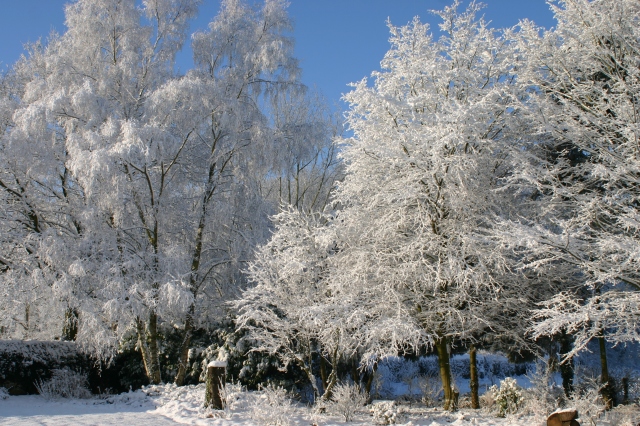
Silver Birch among others in the snow at Old School Garden, January 2013

Old School Gardener

IMG_8433My earlier article described how I put together a new wooden planter for my courtyard garden, made by Woodblocx. I’ve now finished it.

First, I gave the rough planed outside a sand down with a medium grade sanding disc, wiped it over and then applied two coats of Dulux Woodsheen (colour Ebony) to make the finished article match in with the other black planters in the garden. This gives it a nice semi gloss finish. I then fixed some hammer- in studs to the bottom to raise it slightly off the ground (to prevent it being in contact with standing water), and lined it with landscape fabric, stapled to the sides to give a neat finish. This will hold the soil in and also protect the inside surfaces of the planter.

The planter painted and lined, ready to fill.

I then made up a mix to fill it- roughly 3 parts soil, 2 parts compost and 2 parts horticultural grit, to ensure that the soil is free draining. Having really packed this in and slightly overfilled it to allow for settlement, I arranged a selection of alpine plants I’d bought from my local nursery (£12.50 for ten plants – I ended up buying 20 – and then a few more larger plants to give the planting a bit of structure).

The planter isn’t really large enough for me to create a more ‘mountain-like’ scene with rocks and crevices to create shady conditions, but hopefully the plants that need a shadier spot will be helped by the shade cast by the larger plants. To finish off or ‘dress’ the surface I used a bag of ‘Eco Aggregate’ – this is a range of recycled stones. I chose crushed terracotta (old tiles) which picks up the colours of some of the other terracotta pots, brickwork and floor pavers.

I’m pleased with the result – it will add an interesting feature to the courtyard and is low enough to be viewed from the seating next to it. What do you think? If you’re interested in finding out more about ‘Woodblocx’ click the link on the right hand side.

IMG_8434

Old School Gardener

acer campestre by wendy cutler

Acer campestre Autumn colour by Wendy Cutler

Welcome to my new ‘A-Z’ series on Garden Trees. My recently concluded series on perennials proved to be very popular so I hope that this will be equally appealing to my blog readers and followers. I plan to give a few brief facts on 26 trees that are suitable for gardens, together with a picture or two and how they might be used in the garden. My companion collection of articles called ‘Design my Garden’ will feature a few articles about the different design uses of trees in parallel with this new series.

I will be using various sources for the articles, but much will come from the very useful catalogues of Barcham Trees,a specialist tree nursery in Cambridgeshire I had the pleasure of visiting a couple of years go. So, here we go…..

Common name: Field Maple

Native areas: England

Historical notes: used for making musical instruments in the Middle Ages.

Features: small to medium height tree (10-15 metres) with rounded for. Leaves with 5 blunt lobes, turning varied tints of yellow, golden brown and red in the autumn.  Flowers small, green, forming typical winged maple fruitsCan be grown as a single or multi-stem tree.

Uses: a tree for woodland settings or used in small groups in large open gardens and landscapes especially valuable for its autumn colour; also useful in hedgerows (it is very wildlife friendly and will tolerate rough pruning in winter to keep its shape). Various clones of Acer campestre are well suited to streetscapes and urban settings as they have a more regular shaped crown than the parent.

Growing conditions: grows best in rich, well-drained soils, but will do well in most soil types and is tolerant of drought, soil compaction and air pollution.

Further information:

Wikipedia

RHS

Barcham trees directory

Old School Gardener

PicPost: Red Beard

Calochilus paludosus- the Red Beard Orchid

Old School Gardener

Epithets

gillians's avatarPlant Heritage

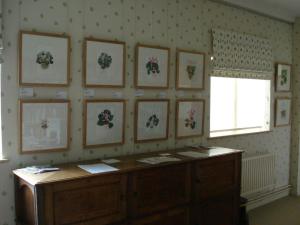
The Garden Library at RHS Garden Wisley is hosting a rare opportunity to see original botanical artworks on loan from the Cyclamen Society. The twenty five portraits on display feature in the recently published Genus Cyclamen: Science, Cultivation, Art and Culture  edited by Brian Mathew which also has on its cover this digital image of a 17th C  engraving from Naawkeurige beschryving der aardgewassen by Abraham Munting (1696)

Cyclamen print © Martin Denney

As part of my work as a volunteer in the library I was given this wonderful tome of c. 600 pages and asked to provide a couple of descriptive lines on each of the paintings which would be used as a crib sheet for visitors to the exhibition.

DSC02024DSC02022

In so few words there was little point in describing the plants so beautifully depicted in the paintings, but an explanation of the species epithet for each of the plants seemed a…

View original post 362 more words

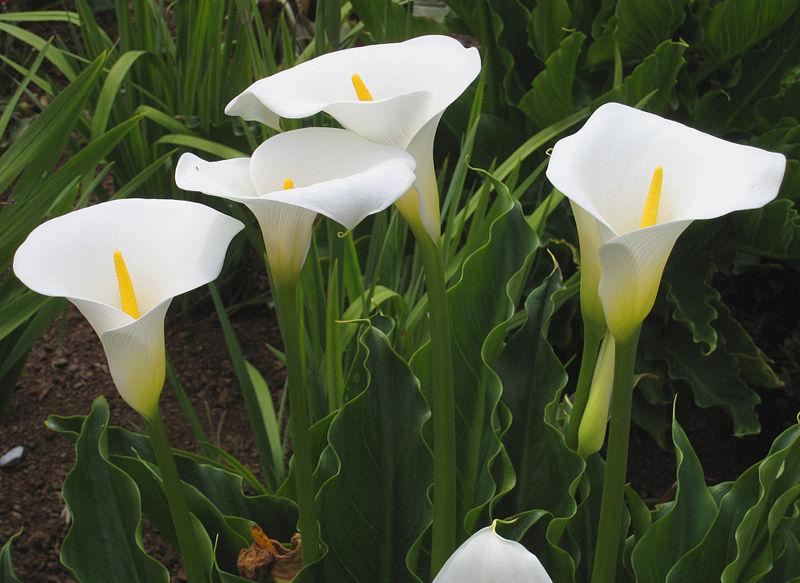
Zantedeschia aethiopica

Zantedeschia is a genus of about 8 tuberous or rhizomatous perennials, found in swamps or moist soils at the margins of lakes in southern and eastern Africa. The name of the genus was given as a tribute to Italian botanist Giovanni Zantedeschi (1773–1846) by the German botanist Kurt Sprengel (1766–1833).

Zantedeschia fall into two main types:

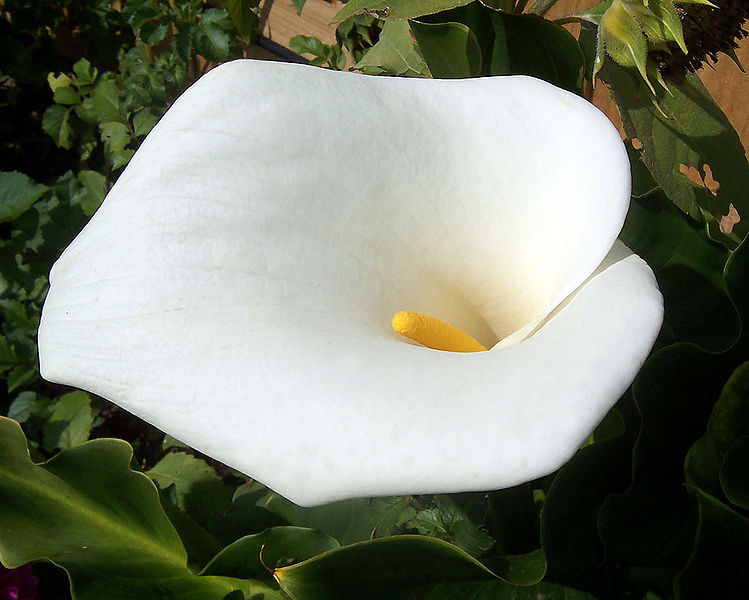
  • hardier outdoor forms (Z. aethiopica and Z. pentlandii ), often called arum lilies, with striking white flowers (these are in fact ‘spathes’ – a coloured bract or leaf- wrapped round a thin, creamy yellow column, or spadice); and

  • the more tender hybrid forms, typically with white-spotted leaves and pretty yellow, orange, pink or dark purple spathes (Z. elliottiana and Z. rehmannii  hybrids), which are borne in spring  or summer.  Z. elliottiana have broadly, heart shaped leaves, most with a covering of translucent white dots and usually yellow spathes, whereas Z. rehmannii have mid to dark green, lance – shaped leaves, rarely spotted, with white to pink or dark purple spathes. These are often called calla lilies.

However, Zantedeschia is neither a true lily (Liliaceae) nor an Arum or a Calla!

It has often been used in paintings, and is visible in many of Diego Rivera’s works of art (see The Flower Vendor, amongst others). It was a favourite subject of the painter Georgia O’Keefe.

Zantedeschia aethiopica

Z. aethiopica is  the most common form in British gardens, grown as a marginal aquatic plant. This is a wonderful architectural plant for pond margins in areas that do not suffer from very hard frosts. The leaves alone are an attraction. They are large, 40cm (16in) long, and arrow-shaped, and a bright, glossy green with distinct veins. However, arum lilies are mainly popular for their serene, white flowers.They make superb, classy cut flowers.

Grow the arum lily as a water plant, planting it into a special aquatic basket, in water up to 30cm (12in) deep. Or you can plant it into moist soil around the pond, protecting it with a deep mulch over winter. The Royal Horticultural Society have given it their prestigious Award of Garden Merit.

In frost – prone areas they should be covered with a deep winter mulch. Where temperatures fall below 10 celsius more tender arums can be grown in a warm greenhouse  or as houseplants, or can be planted out in summer in a sunny site. Zantedeschia can be propagated by seed or division (divide in spring).

For early flowering plants at Easter, plant the rhizomes in December. Keep in a light, cool place at a temperature of 16°C (61°F) by night and 18°C (65°F) during the day. Feed fortnightly with a high-nitrogen fertiliser when in active growth but withhold feed during flowering. A high potassium feed such as a tomato fertiliser can be given once a week after flowering.

Both types of Zantedeschia can be grown in containers. When planting, use a loam-based compost such as John Innes No. 2 and plant the rhizomes (underground stems) just showing at the surface of a container with the eyes of the rhizome uppermost.

Water freely through the summer and feed with a balanced liquid fertiliser every two weeks until the flowers have faded. Zantedeschia are generally pest and disease free, but can suffer from winter cold unless protected.

Zantedeschia species are poisonous due to the presence of calcium oxalate. All parts of the plant are poisonous, typically producing local irritation or a burning sensation in the mouth and occasionally vomiting and diarrhoea. However leaves are sometimes cooked and eaten.

Sources and further information:

Wikipedia

RHS guide to growing Zantedeschia

Lakeside guide to growing Callas

Gardeners’ World guide to Z. aethiopica

Kew Gardens- Z. aethiopica

This concludes my series ‘A-Z of Perennials’, started last year. I hope you’ve enjoyed it and will also like my new series- ‘A-Z of Garden Trees’, coming soon!

Old School Gardener

This slideshow requires JavaScript.

Old School Gardener

PicPost: Unfurling

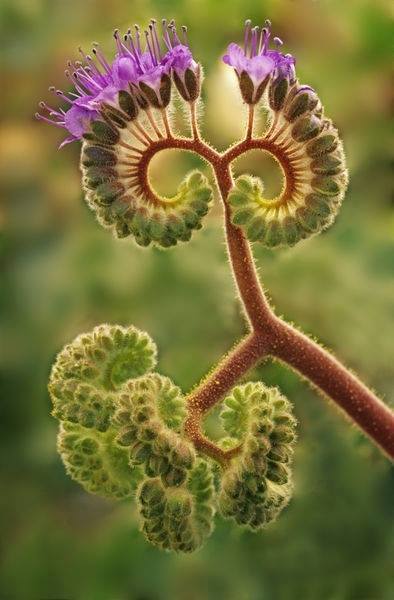
Phacelia via Gardening Naturally

Convolvulus tricolor

A genus of about 200-250  shrubby annual, perennial herbaceous and rock plants, the name Convolvulus comes from  the latin convolvo, referring to the twining habit of some species. It is widely distributed around the world and is commonly known as Bindweed and Morning Glory, both names shared with other closely related genera.

Growing to 0.3–3 m tall, their leaves are spirally arranged, and the flowers trumpet-shaped, mostly white or pink, but blue, violet, purple or yellow in some species.

Many of the species are problematic weeds, which can swamp other more valuable plants by climbing over them, but some are also cultivated for their attractive flowers. Some species are globally threatened. Convolvulus species are used as food plants by the larvae of some Lepidoptera.

Other species names include:

C. althaeoides – like an Althaea (hollyhock)- referring to the flowers

C. cantabrica Cantabria, Spain

C. cneorum – meaning is obscure, from the greek Kneoron, a plant

C. lineatus – with lines

C. mauritanicus – of Mauretania (Morocco)

C. nitidus – somewhat glossy

C. soldanella – leaves like a Soldanella

C. tenuissimus – most slender

C. tricolor – three- coloured

C. althaeoides- from Flora Graeca

Sources and further information:

Wikipedia

RHS- growing C. sabatius

RHS- growing C. cneorum

Old School Gardener

Tamara Jare's avatarMy Botanical Garden

Viburnum tinus is among  stars of the Mediterranean spring. Its dark green leaves contrast fragrant pentamerous flowers in white or pale pink, evolving into dark blue fruit resembling small pearls. Yet this obvious picture from maquis has its invisible side .It is called domatium, after Latin word domus, for home. Domatia are microscopically small chambers at the under sides of the evergreen leaves. Plant grows domatia to host mites. In this way Viburnum tinus can be seen as a botanical skyscraper with many  tiny apartments for arthropod neighbors. Imagine a little mite calling her friends to come over for a party at her condo! I am kidding, it only fascinates me to recognize there is another life underlying the botanical beauty of the plant we can see with our eyes. It is like a parallel world. Only the question remains, are the mites, or are we , at the right…

View original post 1 more word

Finding Nature

Nature Connectedness Research Blog by Prof. Miles Richardson

Norfolk Green Care Network

Connecting People with Nature

Discover WordPress

A daily selection of the best content published on WordPress, collected for you by humans who love to read.

Susan Rushton

Celebrating gardens, photography and a creative life

Unlocking Landscapes

Writing, photography and more by Daniel Greenwood

Alphabet Ravine

Lydia Rae Bush Poetry

TIME GENTS

Australian Pub Project, Established 2013

Vanha Talo Suomi

The Journey from Finnish Rintamamiestalo to Arboretum & Gardens

Marigolds and Gin

Because even in chaos, there’s always gin and a good story …

Bits & Tidbits

RANDOM BITS & MORE TIDBITS

Rambling in the Garden

.....and nurturing my soul

The Interpretation Game

Cultural Heritage and the Digital Economy

pbmGarden

Sense of place, purpose, rejuvenation and joy

SISSINGHURST GARDEN

Notes from the Gardeners...

Deep Green Permaculture

Connecting People to Nature, Empowering People to Live Sustainably

BloominBootiful

A girl and her garden :)