
Category: Feature plants
 Ilex, or the holly genus, is a genus of 400 to 600 species of flowering plants in the family Aquifoliaceae, and the only living genus in that family. The species are evergreen and deciduous trees, shrubs, and climbers from tropics to temperate zones worldwide. In Europe the genus is represented by a single species, the classically named holly, Ilex aquifolium.
 Common name: ‘Holly’ or ‘Common Holly’- the name “holly” in common speech refers to Ilex aquifolium, specifically stems with berries used in Christmas decoration. By extension, “holly” is also applied to the whole genus. The origin of the word “holly” is considered a reduced form of Old English hole(ġ)n, Middle English Holin, later Hollen.
Native areas: Ilex aquifolium is native to western and southern Europe, northwest Africa, and southwest Asia.
Historical notes: Ilex in Latin means the holm-oak or evergreen oak (Quercus ilex). Despite the Linnaean classification of Ilex as holly, as late as the 19th century in Britain, the term Ilex was still being applied to the oak as well as the holly – possibly due to the superficial similarity of the leaves.

Ilex aquifolium
Features: Holly is an evergreen, conical tree growing to 5-10 metres tall. The leaves are 5–12 cm long and 2–6 cm broad; they are evergreen, lasting about five years, and are dark green on the upper surface and lighter on the underside, oval, leathery, shiny, and about 5 to 9 cm long. In the young and in the lower limbs of mature trees, the leaves have three to five sharp spines on each side, pointing alternately upward and downward, while leaves of the upper branches in mature trees lack spines.
The flowers are white, four-lobed, and pollinated by bees. Holly is dioecious, meaning that there are male plants and female plants. The sex cannot be determined until the plants begin flowering, usually between 4 and 12 years of age. In male specimens, the flowers are yellowish and appear in axillary groups. In the female, flowers are isolated or in groups of three and are small and white or slightly pink, and consist of four petals and four sepals partially fused at the base. The ‘berry’ fruit is a red drupe, about 6–10 mm in diameter, a bright red or bright yellow, which matures around October or November.
Several varieties and clones are available with different features such as variegated foliage with creamy or pink tinged edges and different leaf shapes. Some of these are:
Ilex aquifolium ‘Alaska’– dark green foliage and bright red berries, can be grown as a standard/ specimen or screening.
Ilex aquifolium ‘Argentea Marginata’– with an Award of Garden Merit, this variety has spiny leaves edged with white and plenty of berries, young leaves tinged with pink.
Ilex aquifolium ‘J.C. Van Tol’– a self pollinating holly and possibly the best green-leaved holly available. Dark green almost sineless leaves witha good show of autumn berries. Also awarded an AGM, it is tolerant of shade.
Ilex aquifolium ‘Pyramidalis’– fast growing, self pollinating. Another AGM winner, it retains its pyramidal shape if pruned to retain it’s leader.
Ilex aquifolium ‘Silver Queen’– this is a dense small evergreen tree or shrub with purple young shoots and pink-tinged young leaves. Mature leaves spiny, dark green with a broad cream margin. Flowers small, white – this variety is, despite it’s name, a male!
Other Ilex varieties that are not part of the aquifolium species include:
Ilex castaneifolia– the ‘sweet chestnut leaved’ holly this is a fast grower, AGM awarded and produces a large tree of conical habit and has red berries in abundance.
Ilex x ‘Dragon Lady’– one of the Meserve Hybrid hollies this one has vivid green leaves and attractive spines that contrast well with the large red berries in the autumn.
Ilex x ‘Nellie Stevens’– this hybrid (of Ilex aquifolium and Ilex cornata) has smooth glossy leaves which contrast well with the orange-red berries.
Ilex x altaclarensis ‘Golden King’ – one of the best variegated hollies, this AGM winner is tolerant of coastal conditions, and is slow-growing. The opposite to the variety ‘Silver Queen’, this time, despite its name it is a female!

Ilex a. ‘JC Van Tol’

Ilex a. ‘Pyramidilis’ new growth

ilex a. ‘Alaska’ flowers

Ilex a. ‘ Silver Queen’

Ilex x altaclarensis ‘Golden King’

Ilex x ‘Dragon lady’ multi stem
Uses: One of the most evocative and best-loved of all trees; the Common holly is beautiful in its simplicity and brings cheer at the darkest time of the year. It provides year-round interest, but is particularly attractive in autumn and winter. great for gardens, it only retains its spiky leaves within the first ten – fifteen feet of height in the tree, as after this it suffers no predation so has no need of a thorny defence system! use as an under storey or edge fo woodland tree (as here at Old School Garden), as a specimen (especially those with interesting foliage), for hedging/ screening or as a structural element in mixed borders to provide all-year round interest. Can also be topiarised to provide simple but effective shapes in formal settings.
Growing conditions: Holly is very tolerant of shade and prefers well-drained soils.

Clipped hollies at Hatfield House, Hertfordshire
Further information:
Wikipedia- Ilex
Wikipedia- Ilex aquifolium
RHS- Ilex aquifolium
RHS- Ilex aquifolium ‘Silver Queen’
Barcham trees directory- Ilex genus
7 plants for Winter Wonder
Old School Gardener
 I mentioned the sunflowers in my last update from Old School Garden. I sowed a few different varieties and the big ones are now coming into their own, though the remnants of Hurricane Bertha have done their best to topple them in the last couple of days. In case of disaster I thought I’d better capture them right now, especially so that I can enter the title race(s) for the tallest, largest flower head and thickest stem….
OK, I got it wrong yesterday when I boasted on Twitter that I had a sunflower 20 feet tall! Still the actual measurement is still pretty impressive, if a bit short of that figure; 14 feet to be precise. That and a couple, of others have stems 2″ in diameter, and the largest flower heads are 10 “- 12” diameter.
Here are the pictures as promised….how big are yours?
Old School Gardener
Old School Gardener
Old School Gardener

Old School Gardener
 OK, a bit of a stretch with this entrant, as Hamamelis is more often a shrub rather than a tree, but there don’t seem to be any garden trees with a botanical name beginning with ‘H’ (go on, prove me wrong)!
Common name: ‘Witch – Hazel’ and occasionally for the North American species, ‘Winterbloom’
Native areas: A native of North America (3 species- ovalis, virginiana and vernalis) Japan (japonica) and China (mollis).
Historical notes: The name ‘Witch’ in witch-hazel has its origins in the middle english word ‘wiche’, from the Old English ‘wice’, meaning “pliant” or “bendable”. “Witch hazel” was used in England as a synonym for Wych Elm (Ulmus glabra) American colonists seem to have simply extended the familiar name to the new shrub they found in their new home. The use of the twigs as divining rods, just as hazel twigs were used in England, may also have influenced the “witch” part of the name. The plant-hunter Charles Maries collected Hamamelis mollis for Veitch Nurseries from China in 1879. It languished in nursery rows for years until it was noticed, propagated and put on the market in 1902.

- Hamamelis in Colonial Park Arboretum and Gardens
Features: The witch-hazels are deciduous shrubs or (rarely) small trees growing to 3–8 metres tall, rarely to 12 metres tall. The leaves are alternately arranged, oval, with a smooth or wavy margin. The genus name, Hamamelis, means “together with fruit”, referring to the simultaneous occurrence of flowers with the maturing fruit from the previous year. H. virginiana blooms in September-November while the other species bloom from January-March. Each flower has four slender strap-shaped petals 1–2 centimetres long, pale to dark yellow, orange, or red. The fruit is a two-part capsule 1 centimetre long.

Hamamelis- Autumn leaves by Jean Pol Grandmont

Autumn Hamamelis
Uses: Witch Hazels are popular ornamental shrubs, grown for their clusters of rich yellow to orange-red flowers which begin to expand in the autumn as or slightly before the leaves fall, and continue throughout the winter. Hamamelis virginiana is rarely seen in the nursery trade except for woodland/wildlife restoration projects and native plant enthusiasts. Much more common is H. mollis, which has bright red flowers that bloom in late winter instead of the yellow blossoms of H. virginiana which tend to be lost among the plant’s autumnal foliage. Numerous cultivars have been selected for use as garden shrubs, many of them derived from the hybrid H. x intermedia ‘Rehder’ (H. japonica × H. mollis). Jelena and Robert de Belder of Arboretum Kalmthout, selecting for red cultivars, found three: the first, with bronze flowers, was named ‘Jelena’; the next, with red flowers, was named ‘Diane’ (the name of their daughter); the last, with deep red flowers, was called ‘Livia’ (the name of their granddaughter). The cultivar ‘Arnold Promise’ (mature height 3- 5 metres) is recognised as one of the best yellow-flowering Witch – Hazels, with magnificent yellow flowers that contrast with the red inners, which sometimes last as long as two months without fading.
Growing conditions: An open, sunny position is best, as plants become straggly in shade, although they do tolerate partial shade. Avoid exposed and windy positions. Young witch hazels can be damaged by hard frosts, so avoid frost pockets, or be prepared to protect plants with a couple of layers of horticultural fleece in their first few years if there is a hard winter or late spring frost. Witch hazels need free-draining soil conditions with an adequate supply of moisture. A light soil with plenty of added organic matter, such as well-rotted manure or compost, is best. They will tolerate heavy or clay soils if they are improved by digging in organic matter and by ensuring good drainage. Acid to neutral soil pH is preferred (pH 4.5-6.5). Witch hazels may tolerate deep soils over chalk, with plenty of added organic matter. If they become chlorotic (yellow) because of the high pH, then treatment with a chelated (sequestrated) iron fertiliser, ideally one that also contains manganese, can help. They are unlikely to tolerate shallow chalky soils.

- Hamamelis virginiana
Further information:
Wikipedia- Witch – Hazel
RHS- Hamamelis
Barcham trees directory- Hamamelis x intermedia ‘Arnold Promise’
7 plants for Winter Wonder
Old School Gardener
‘Men seldom plant trees till they begin to grow Wise, that is, till they grow Old and find by Experience the Prudence and Necessity of it.’
John Evelyn
‘Trees are the best monuments that a man can erect to his own memory. They speak his praises without flattery, and they are blessings to children yet unborn.’
Lord Orrery to Thomas Carew 15th May 1749
‘Of all the wonders of nature, a tree in summer is perhaps the most remarkable; with the possible exception of a moose singing ‘Embraceable You’ in spats.’
Woody Allen

Old School Gardener
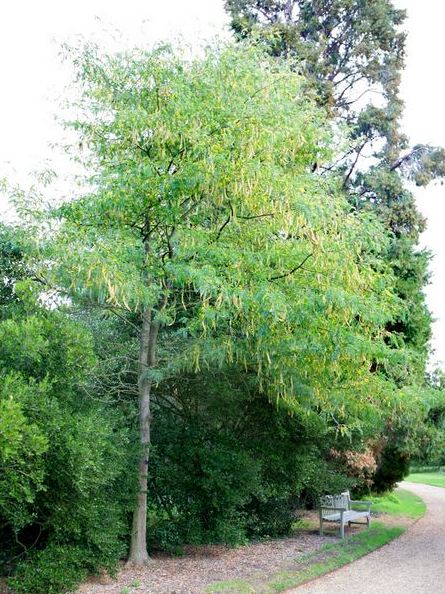 I bought a Gleditsia triacanthos ‘Sunburst’ some years ago as a young plant through the post. It’s now about 2 metres tall and beginning to find its feet in Old School Garden. I love its bright yellow foliage which is a great contrast to the maroon foliage of plants like Lysimachia ciliata ‘Firecracker’.
Common name: ‘Honey Locust’ or ‘Thorny Locust’
Native areas: A deciduous tree native to central North America, it is mostly found in the moist soil of river valleys ranging from southeastern South Dakota to New Orleans and central Texas, and as far east as eastern Massachusetts. It was introduced into Britain in 1700, with the cultivar ‘Sunburst’ introduced in the 1950’s.
Historical notes: The Honey Locust, despite its name, is not a significant honey plant. The name derives from the sweet taste of the legume pulp, which was used for food by Native American people, and can also be fermented to make beer. The long pods, which eventually dry and ripen to brown or maroon, are surrounded in a tough, leathery skin that adheres very strongly to the pulp within. The pulp—bright green in unripe pods—is strongly sweet, crisp and succulent in unripe pods. Dark brown tannin-rich beans are found in slots within the pulp. Honey locusts produce a high quality, durable wood that polishes well, but the tree does not grow in sufficient numbers to support a bulk industry; however, a niche market exists for honey locust furniture. It is also used for posts and rails since it takes a long time to rot. In the past, the hard thorns of the younger trees have been used as nails! The tree has been used in traditional Native American medicine.

- Gleditsia triacanthos ‘Sunburst’ in Old School Garden– with Lysimachia ciliata ‘Firecracker’ in front and Monarda ‘Cambridge Scarlet’ and Crocosmia ‘Lucifer’
Features: A large, oval and elegant tree growing to 20 metres plus and quick growing. It’s leaves resemble fronds and when mature, it looks most striking with its shiny, long seed pods. Leaves are bright green turning to golden yellow in autumn. The variety ‘Sunburst’ has bright yellow foliage in early summer and this turns greener as the season progresses.

Gleditsia triacanthos new foliage

Gleditsia triacanthos- mature thorns

Gleditisia triacanthos- thorns on branches

Gleditsia triacanthos ‘Sunburst’ foliage

Gleditsia triacanthos- unripe seed pod
Uses: A wonderful choice for heavily polluted environments prone to vandalism and a good choice for parks and industrial areas, it is also a great garden tree, doing well on most types of soil. It’s fast growth rate and ease of transplanting make it a good choice for new gardens where shade or a feature is wanted relatively quickly. The tree needs careful handling though, because of its thorns (however, most cultivars are thornless). The cultivar ‘Sunburst” has gained the RHS Award of Garden Merit (AGM). This cultivar grows to 15-20 metres and has a rounded, rather spreading form, a good substitute for the rather more damage-prone Robinia pseudoacacia ‘Frisia’.

- Gleditsia triacanthos – autumn colour
Growing conditions: The cultivars (e.g. ‘Sunburst’, ‘Skyline’, ‘Inermis’) are popular ornamental plants. It tolerates urban conditions, compacted soil, road salt, alkaline soil, heat and drought. The popularity is in part due to the fact that it transplants so easily, its fast growth rate and tolerance of poor site conditions. It is also great where shade is wanted quickly, such as new parks or housing developments, and in disturbed and reclaimed environments, such as mine tailings. It is resistant to gypsy moths but is defoliated by another pest, the Mimosa Webworm. Spider mites, cankers and galls are also a problem with some trees.

- Gleditsia triacanthos ‘Sunburst’
Further information:
Wikipedia- Gleditsia triacanthos
RHS- Gleditsia triacanthos ‘Sunburst’
Barcham trees directory
Old School Gardener

A Fig fruit
I have a fig in the courtyard here at Old School Garden, growing in a pot and ‘liberated’ as a young transplant when pruning a rather older and very vigourous example at our local primary school a few years ago. I remember gathering it when I helped to plant up the ‘Nectar Bar’ and ‘Eco Park’ there in 2007. Today our tree, along with a Grapevine, Olive and Peach, contributes a mediterranean touch to the space, and with last winter and spring’s mild and wet conditions it has put on some wonderful growth, including a crop of handsome and promising looking fruit. I can’t recall ever really tasting a ripe fig, but my recent experience of fig-flavoured yoghurt is tempting me to try to harvest some this year!

The Fig growing at Old School Garden

Close up of leaves and fruit
Common name: ‘Common Fig’
Native areas: A native of the Middle East and Western Asia.
Historical notes: The edible fig is one of the first plants that was cultivated by humans, predating the domestication of Wheat, Barley and Legumes, and may thus be the first known instance of agriculture. Figs were also a common food source for the Romans. The fruits were used, among other things, to fatten geese for the production of a precursor of foie gras. In the 16th century, Cardinal Reginald Pole introduced fig trees to Lambeth Palace in London.

An old Fig Tree
Features: A round-headed tree, if properly located and pruned, otherwise it can develop a mass of straggly growth (e.g if grown up against a wall and left untrained and its roots unrestricted). Mature height of 3 – 5 metres, it is grown for both its attractive, deeply lobed foliage, and fruits. Two crops of figs are potentially produced each year; the first or breba crop, develops in the spring on last year’s shoot growth. In contrast, the main fig crop develops on the current year’s shoot growth and ripens in the late summer or autumn. The main crop is generally superior in both quantity and quality to the breba crop.
Uses: It makes a small and elegant tree that is perfect for gardens where space is limited. Grow in a container or open ground. The cultivar ‘Brown Turkey’ has gained the RHS Award of Garden Merit (AGM).
 Growing conditions: The fig likes dry, sunny, warm, sheltered sites, where the soil is dry or very well-drained. It thrives in both sandy and rocky soil. As the sun is really important it is better to avoid shade. Excessive growth has to be limited to promote the fruiting. This can be achieved by pruning to achieve the desired shape and encouraging fruiting branches and also by restricting root development; by growing in a container or in an enclosed bay in open ground where brick walls or other barriers keep the roots in check. It is also often grown up against a south-facing wall to maximise fruiting potential. I’ve had experience of pruning back hard a few old unkempt examples successfully in spring; alternatively, phase your pruning over a number of years to lessen the visual impact and reduce stress on the plant. Some varieties are more adapted to harsh and wet climates. It is remarkably pest and disease resistant.

New leaves and fruit

Close up of leaf

Leaves and young fruit

A Fan- trained fig at RHS, Wisley. Picture RHS.




 Old School Garden