


Waldbodenstück mit Schneeglöckchen, Lauer Josef,1881
Waldbodenstück mit Schneeglöckchen, Lauer Josef,1881

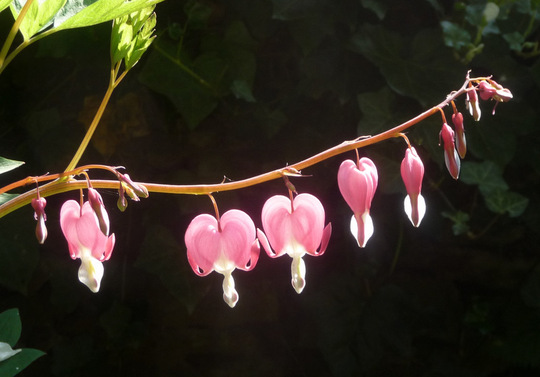 Dicentra is a genus of about 20 annuals and perennials (of which about 8 are perennial) and many cultivars. They are native to both Asia and North America (though possibly an ‘honorary native’ in the latter, dating from colonial times), mainly in woodland habitats.
Their roots vary between rhizomes,tubers or fleshy tap roots. All varieties are reliably hardy. Most are deciduous but some are evergreen and have fern-like, divided foliage, some of a silver – grey colour.
Flowers – which come in shades of red,pink and white – hang as pendents on racemes or panicles and are very distinctive – two outer petals are pouched, giving a heart-shaped outline with the two inner petals forming a hood over the anthers. Not surprisingly this arrangement has led to many descriptive common names such as:
- Bleeding heart (most usually used for D. spectabilis)
- Showy bleeding heart
- Dutchman’s breeches
- Chinaman’s breeches
- Locks and keys
- Lyre flower
- Seal flower
- Old-fashioned bleeding heart
Flowering time is late spring into early summer. The flowers and foliage are useful in flower arrangements, the flowers lasting well in water.

Dicentra canadensis (Squirrel Corn)

Dicentra cucullaria (Dutchman’s breeches)

Dicentra formosa oregona ‘Pearl Drops’

Dicentra formosa
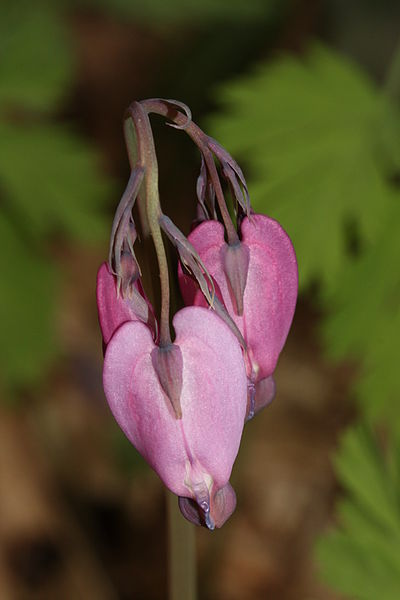
Dicentra formosa – close up of flowers
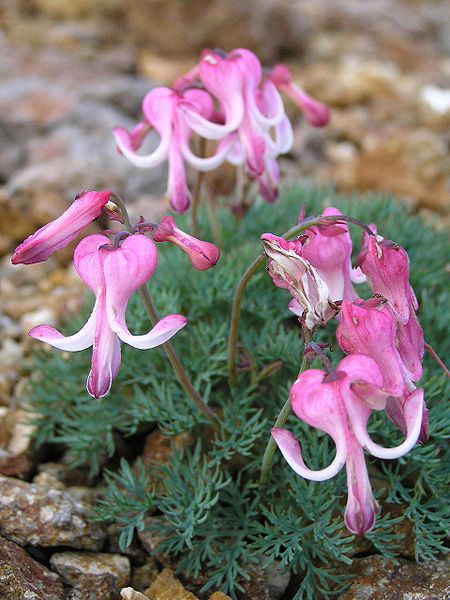
Dicentra peregrina ‘Komakusa’
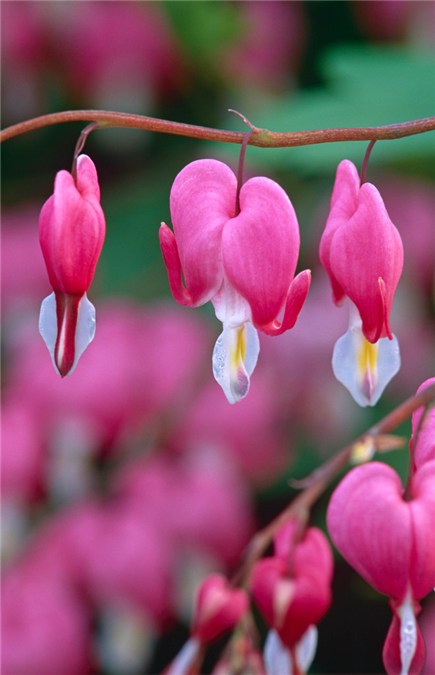
Dicentra spectablis
Most of the perennial Dicentra make good border plants, though a couple are rather invasive (spectabilis and formosa) and are best used in a woodland garden, where seedlings or spreading rhizomes can be allowed to expand or be easily removed. D. spectabilis is not long-lived. All Dicentra are low in allergens, but all parts of the plant are poisonous and a skin irritant.
Further information:
Varieties and growing Dicentra
Dicentra ‘Stuart Boothman’ AGM
If you’ve enjoyed reading this post and others on this blog, why not comment and join others by signing up for automatic updates via email (see side bar, above right ) or through an RSS feed (see top of page)?


Botany gets a bit more complicated when we meet bryophytes and cryptogams Something to start with could be: bryophytes are all cryptogams, but not vice-versa, some cryptogams are not bryophytes. Yet beware not to mess them all with cryptograms, although it seems that science may find some cryptograms (secret code) in genetic material of mosses, giving promise to new drugs development. Anyway,I was astonished seeing all those water pearls on our concrete wall moss looking as simple plain green carpet from far, but turning into a fine needlepoint when one comes close enough.It attracted me enough to spend some time observing tiny green hair.I can totally understand those guys from british bryological society !

“Muscinae” from Ernst Haeckel‘s Kunstformen der Natur, 1904
The spore-bearing sporophytes(i.e. the diploid multicellular generation) are short-lived and dependent on the gametophyte for water supply and nutrition. ,mosses and other bryophytes have only a single set of…
View original post 44 more words

“To be a star, you must shine your own light, follow your own path, and don’t worry about the darkness, for that is when the stars shine brightest”
Buy this print
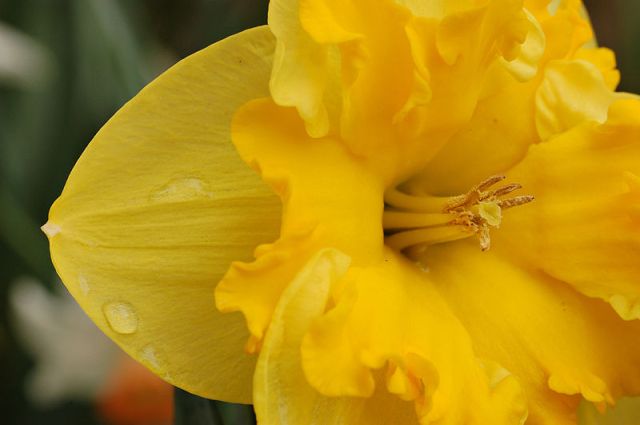
There is disagreement about the number of distinct species (these range from 26 to more than 60 depending on who you ask) – as some are very similar and others have hybridised. All Narcissus cultivars are split into 13 divisions (using a combination of flower form and genetic background). New cultivars are registered by name and color with the Royal Horticultural Society, which is the international registration authority for the genus.
More than 27,000 names were registered as of 2008!

Narcissus flowers
The name “daffodil” is derived from an earlier word “affodell”, a variant of Asphodel (another group of Mediterranean plants). The reason for the addition of the initial “d” is not known, although it could be a ‘slip of the dutch tongue’ – the merging of the main word with the Dutch article “de”, as in “De affodil”. Playful synonyms “Daffadown Dilly”, “daffadown dilly”, and “daffydowndilly” appeared as early as the 16th century. Everyday use of the term Daffodil tends to refer to the wild daffodil (N. pseudonarcissus).
The name Narcissus comes from the same latin word, which in turn is based on an ancient greek word – but its meaning is unknown. It could be a word loaned from another language. The most common explanation is based on the Greek myth of Narcissus, a Thespian hunter renowned for his beauty. He became so obsessed with his own reflection in a pool of water that as he knelt and gazed into it, he fell into the water and drowned. Some variations of the myth say that he died of starvation and thirst. In both versions the Narcissus plant sprang from his remains. However, this is by no means a certain derivation and it could be the that the hunter’s name was derived from the flower rather than the other way round!
Another explanation for the name comes from Pliny who stated that the plant was named because of its narcotic properties (the greek word means ‘to grow numb’). There’s no evidence to support this idea and it seems to have fallen out of favour. However, all Narcissus species do contain the poison lycorine (mostly in the bulb but also in the leaves). The bulbs can often be confused with onions, thereby leading to incidents of accidental poisoning.
On 1 May 2009 a number of schoolchildren fell ill at Gorseland Primary School in Martlesham Heath, Suffolk, England, after a daffodil bulb was added to soup during a cookery class.
Another problem is what florists call, “daffodil itch” – a skin problem often found on the hands after contact with the plant’s sap. Some cultivars seem more likely to cause this kind of dermatitis; eg ‘Actaea’, ‘Camparelle’, ‘Gloriosa’, ‘Grande Monarque’, ‘Ornatus’, ‘Princeps’ and ‘Scilly White’.

Narcissus geranium
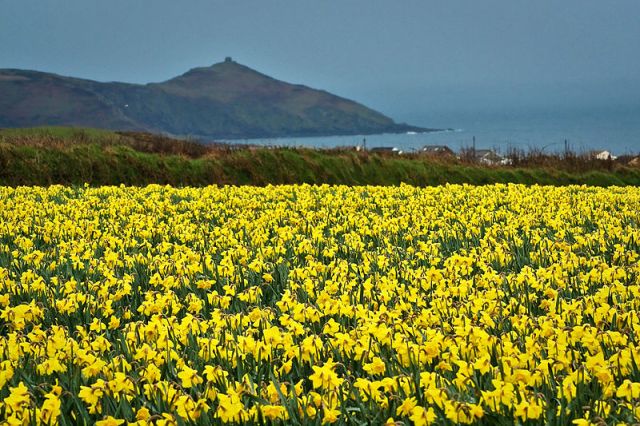
Cornwall Daffodils- traditionally the place (along with the Scilly Isles and Channel Islands) where early supplies of cut flowers are sent out to the rest of Britain.
N. bulbocodium = probably greek for ‘bulb’ (bolbos) and ‘a little fleece’ (kodion) – referring to the covering of the bulb – the ‘Hoop Petticoat Daffodil’
N. cyclamineus = like a Cyclamen flower
N. incomparabilis = incomparable
N. jonquilla = probably from ‘juncus’ (a rush) – the leaves being rush-like. The ‘Jonquil’
N. juncifolia = like Jonquil, rush – leaved!
N. major = larger
N. maximus = largest
N. minor = smaller
N. odorus = sweet-scented
N. poeticus = poet’s – the ‘Poets’ Narcissus’
N. pseudonarcissus = the false Narcissus. The ‘English Daffodil’
N. tazetta = an old name for the ‘Polyanthus Narcissus’
N. triandrus = having three stamens
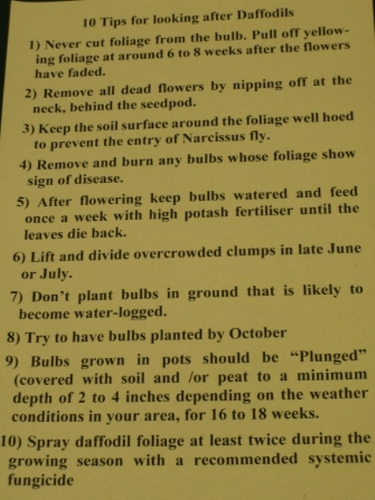
Daffodil growing tips
Both species and hybrids are used extensively in gardens and grounds, looking good planted in borders or in naturalized drifts at the base of deciduous trees. Propagation is mainly from bulbs which are very easy to grow. They require little maintenance, but with some minimum care they can be more vigorous and floriferous, and they’ll multiply much more quickly, improving the show they provide each year. (see ‘Ten tips for looking after Daffodils’ above). Narcissus grows almost anywhere, although it does prefer well-drained soils with a sunny or light shade environment. The Narcissus species types are more specific in their requirements.

Naturalised Daffodils
Source and further information:
Kew Gardens- Narcissus pseudonarcissus
If you’ve enjoyed reading this post and others on this blog, why not comment and join others by signing up for automatic updates via email (see side bar, above right ) or through an RSS feed (see top of page)?
Nigel Boldero aka 'Old School Gardener'
 | Nigel Boldero on Fighting to Reduce Climate Cha… |
 | Anonymous on Fighting to Reduce Climate Cha… |
| Anonymous on PicPost: Carrot, my foot! |
| 18 Surprising Hydran… on Plantax 16: Hydrangea the wate… | |
| Nigel Boldero on Poppyland: A Victorian romance… |
| Anonymous on Poppyland: A Victorian romance… |
| Anonymous on Plants to die for… |
 | Isabella Childress on PicPost: Forest, but not as we… |
 | Happiness Factor on Is child-friendly planning a l… |
 | zidane on Top Tip: On a Pedestal- make m… |


Nature Connectedness Research Blog by Prof. Miles Richardson
Connecting People with Nature
A daily selection of the best content published on WordPress, collected for you by humans who love to read.
Celebrating gardens, photography and a creative life
Writing, photography and more by Daniel Greenwood
Lydia Rae Bush Poetry
Australian Pub Project, Established 2013
The Journey from Finnish Rintamamiestalo to Arboretum & Gardens
Because even in chaos, there’s always gin and a good story …
RANDOM BITS & MORE TIDBITS
.....and nurturing my soul
Cultural Heritage and the Digital Economy
Sense of place, purpose, rejuvenation and joy
Notes from the Gardeners...
Connecting People to Nature, Empowering People to Live Sustainably
A girl and her garden :)


 Old School Garden
