A bit like Marmite, gardeners seem to either love or hate Euphorbia (Spurge) – I love them!
This is a large genus of over 2,000 species, including annuals,perennials as well as shrubs and succulents. They originate from many different parts of the world and as a result their growing requirements differ widely. They include the red-leaved species commonly seen at Christmas, Euphorbia pulcherrima (Poinsettia)
Euphorbia pulcherrima (Poinsettia)
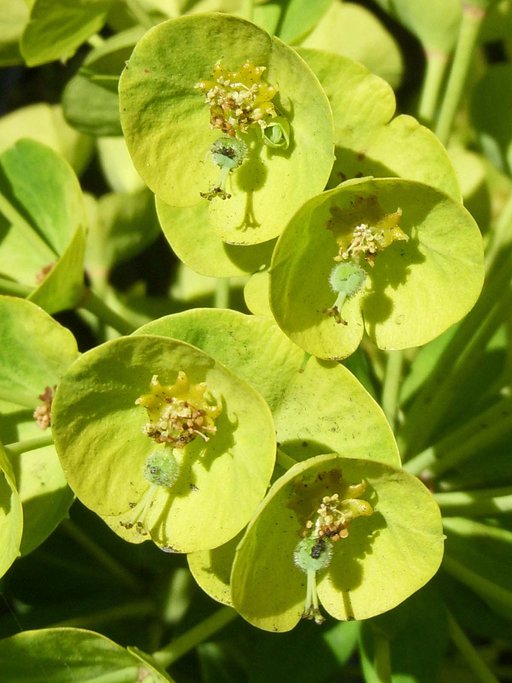
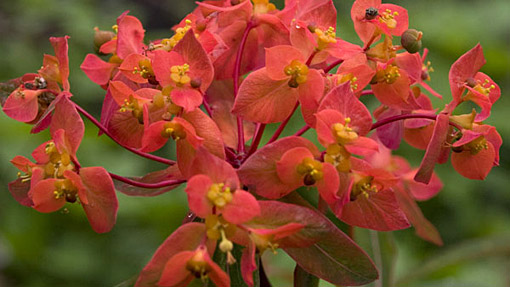
Some are evergreen and hardy, others are semi evergreen or deciduous.Nearly all species have distinctive ‘cyathia‘- small cups of long – lasting bracts that can be green, yellow, red, brown or purple. These are ‘cupping nectaries’ containing insignificant flowers with much reduced parts. In the perennials and shrubs these cyathia are carried in dense clusters. The leaves are very varied and often are shed quite quickly.
Some species are very invasive and are not really suitable for the garden(e.g. E. cyparissias and E. pseudovirgata) others will self seed prolifically so need to be used with care (e.g. E. lathyris, E. hybernia,E.coralloides and E.wallichii). Some species can be invasive in some climates (e.g. E. myrsinites in parts of the USA) but are less problematic in milder, wetter places.
Euphorbia cyparissias (Cypress Spurge)
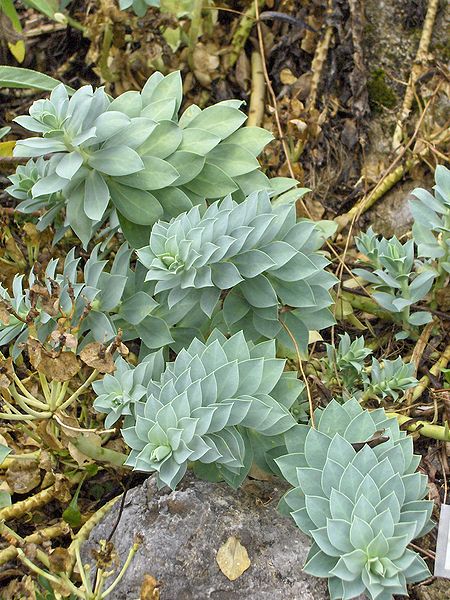
Euphorbia myrsinites
All Euphorbias resent disturbance, so siting them carefully from the start is important for long lasting plants. Euphorbia suit every situation from desert to bog, formal courtyard to wild woodland. With a couple of exceptions Euphorbia are easy to grow. They are also look great in the garden, the colourful bracts lasting many weeks.
Euphorbia look best if allowed to sprawl at will, but if space is limited, you may need to support the floppier ones.
The evergreens require no routine pruning – simply tidy them up when they start to look untidy. Deciduous ones should be cut down to ground level in autumn. New shoots will emerge from the crown in spring. The biennial forms such as E. characias produce new shoots from the base each year. Cut out dead stems in winter. They are not fussy as to soil, but most prefer good drainage.
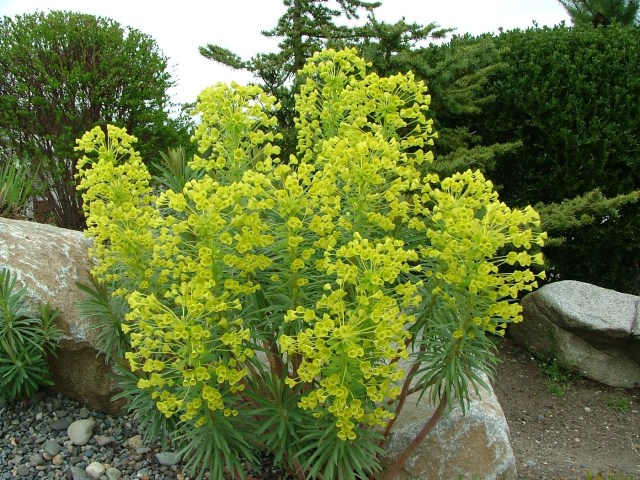
The bigger, more sculptural forms look good with architecture – against steps or walls, or in corners of courtyards. E. mellifera is a superb statement plant. E. myrsinites can be used in raised planters to sprawl over the sides. E. griffithii ‘Fireglow’ looks great beside water, with bronzy Rodgersias and red-flushed Astilbes, but will also look good in a hot border, while E. ‘Whistleberry Garnet’ associates well with ferns, Hostas and the dark-patterned leaves of Geranium phaeum.
All parts of Euphorbia are useful in flower arranging either in the fresh or dried state.
However all Euphorbia are poisonous and bleed a skin irritant milky sap, whereas the flowers are highly allergenic, so be careful when cutting or handling these wonderful plants.
If you’ve enjoyed reading this post and others on this blog, why not comment and join others by signing up for automatic updates via email (see side bar, above right ) or through an RSS feed (see top of page)?
‘The Jaboticaba tree – a mature tree will give you 6 to 8 crops a year. Apparently it’s one of the most nutritious & delicious fruits you will ever taste. ‘ Grow Veg
I am so glad its Friday. It’s already been a busy morning receiving lumber for a work party at the community garden.Tomorrow we hope it won’t rain so we can get our building party underway. Now that I am home I took a walk through the garden and guess what, it’s not raining. It is very mucky out there. The pineapple express has brought us lots and lots of rain. That has meant that it been almost impossible to get out in the garden. Good thing I have a greenhouse to tinker in.
Today I am linking up with Glenda over at Tootsie Time. Glenda has a gorgeous post on orchids that she saw at the Northwest Flower and Garden Show. You have to check out her post.
I love my Hellebores but dislike the fact that they hang their faces down. Lots of flowers but I can’t bend over…
Lovely to think of roses blooming at this time of year (ie early Spring in the UK), though of course it’s really towards the end of the season in Aus! They are doing well though!
Not through any work on my part – the roses in our front garden have bravely bloomed through the hottest week ever recorded in March. There were even some small beads on the petals from light rain overnight.
Tropaeolum is a genus of about 80 species of annuals and perennials native to South/Central America. The common Nasturtium (Tropaeolum majus) is the most frequently found member of the family.
Nasturtiumis from the latin words meaning literally “nose-twister” or “nose-tweaker” (referring to the pungent smell of some species!). The Tropaeolum Nasturtiums received their common name because they produce an oil that is similar to that produced by watercress (Nasturtium officinale).
Tropaeolum peregrinum
Tropaeolum includes several very popular garden plants, the most commonly grown being T. majus T. peregrinum and T. speciosum. The hardiest species is T. polyphyllum from Chile, the perennial roots of which can survive underground when air temperatures drop as low as −15 °C (5 °F).
Plants in this genus have showy, often intensely bright flowers (in reds, oranges and yellows), and rounded, shield- shaped leaves which vary in colour and include some attractive blue – green tones. Flowers have five petals (sometimes more) and a funnel-shaped nectar tube at the back. The name Tropaeolum is from the Latin tropaeum , meaning ‘trophy’ and was originally chosen by the swedish botanist Carl Linnaeus in the 18th century.
After victory in battle, the Romans used to set up a trophy pole called a tropaeum (from the Greek tropaion, source of the English word ‘trophy’). On this the armour and weapons of the vanquished foe were hung. Linnaeus was reminded of this by the plant as the round leaves resemble shields and the flowers, blood-stained helmets.
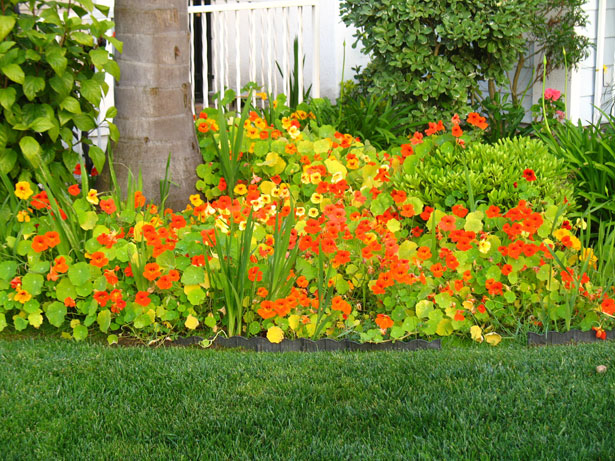
Tropaeolums in a border
Species names of Tropaeolum include:
T. aduncum = hooked (the flowers)
T. canariense = canary – referring to the colour and shape of the flowers (the ‘Canary Creeper’)
T. lobbianum = after Lobb the plant collector
T. majus = great (the Climbing Nasturtium)
T. minus = small (the Dwarf Nasturtium)
T. pentaphyllum = five leaved or divided into five
T. pergrinum = foreign or wandering, probably referring to its straggly growth
T. speciosum = showy
T. tuberosum = tuberous
‘Canary Creeper’ (T. canariense)
Nasturtiums were also known as “Indian cress”. This derived from their use as a salad ingredient and because at that time South/Central America was referred to as ‘the Indies’. The 16th-century herbalist John Gerard called the plant “Lark’s Heel”, referring to the flower’s spur (and similar to Larkspur).
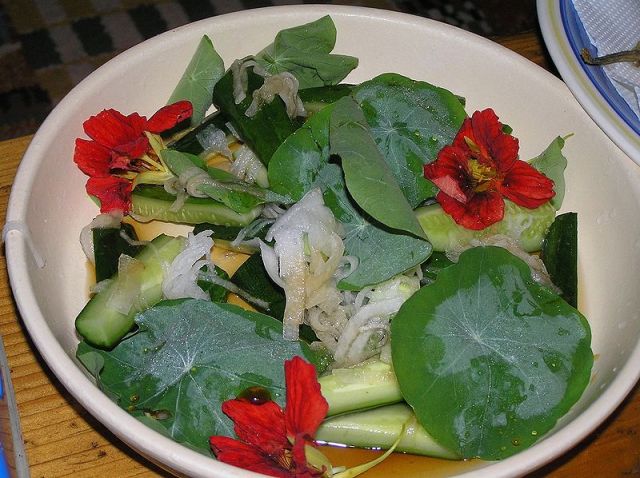
All parts of T. majus are edible. The flower is most often eaten as an ornamental salad ingredient or in a stir fry; it has a slightly peppery taste reminiscent of watercress. The flowers contain about 130 milligrams of Vitamin C per 100 grams or about the same amount as in Parsley. The unripe seed pods can be harvested and dropped into spiced vinegar to produce a condiment and garnish, sometimes used in place of capers.
Tropaeolum leaves and flowers as salad ingredients
Nasturtiums have been used in herbal medicines for their antiseptic and expectorant qualities. They are said to be good for a chest cold and to promote well being by the formation of new blood cells. The common Nasturtium has been used in herbal medicine for respiratory and urinary tract infections.
The bright, quaintly – shaped flowers are usually freely produced on long stalks, and the fast growth of many of the climbers makes the Tropaeolum a very useful, decorative plant. They will spill beautifully over walls and onto paths, when used as edging plants. They also hold up very well in containers. Climbing varieties, such as ‘Canary Creeper’ will amble up and through shrubs. Bushy, ground hugging plants will fill in gaps among complementary – coloured day lilies and roses.
You can use clusters of plants to brighten up the vegetable garden – and to act as ‘sacrificial’ ‘plants to attract caterpillars away from your brassicas!
Quizzicals: two cryptic clues to flower, plant, veg or fruit names –
Bird swearing
Vasectomy for Dad
(thanks to Les Palmer, answers in the next Plantax!)
Old School Gardener
If you’ve enjoyed reading this post and others on this blog, why not comment and join others by signing up for automatic updates via email (see side bar, above right ) or through an RSS feed (see top of page)?













 Old School Garden