


Flowers always make people better, happier, and more helpful; they are sunshine, food and medicine for the soul.
Luther Burbank
Thunbergia alata
- Photo
- Art Print
- Art Gifts
Flowers always make people better, happier, and more helpful; they are sunshine, food and medicine for the soul.
Luther Burbank


When May comes after a long winter, it looks like green hues are painting the landscape all over the place.Since always you remember the spring smell of new leaves opening all over the forests, gardens, parks.And, indeed, when then first fresh green tiny leaves are unpacked from buds ,it again feels in spring of this year everything could be possible, even the almost forgotten smell of lilacs seems to become more as mere memory quite soon.And when then comes the first tiny spring rain,washing down leafy smell from the air,you feel spring is already evidently here ,but then you open the window and sweet smell of lilacs embraces you.There it is, lilacs in fool bloom , and now you know for sure, this spring is real……
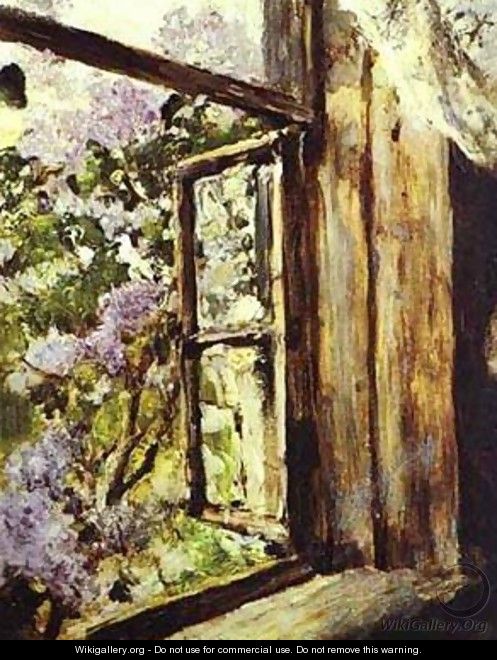
“Open Window Lilacs Study 1886” oil on Canvas,Valentin Aleksandrovich Serov, from:http://www.wikigallery.org/wiki/painting_297499/Valentin-Aleksandrovich-Serov/page-1
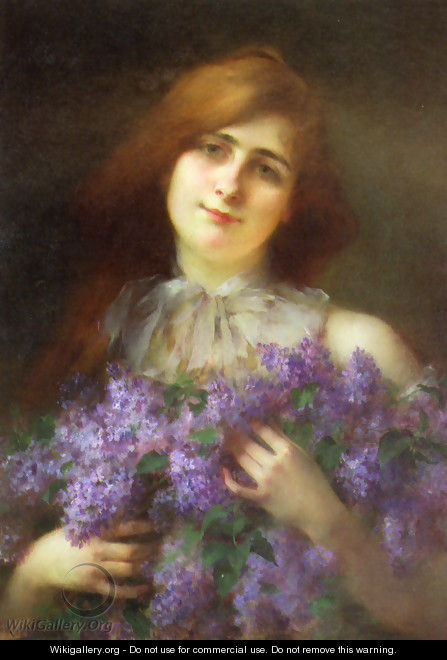
“The Lilac Bouquet” oil on Canvas, location: Private collection.Serkis Diranian
View original post 36 more words
Some plants become taken for granted and fail to be fully appreciated. I recently posted about celandines and got lots of favourable comments, so today I shall feature the wonderful pulmonarias with their subtle flowers and unusual foliage.
Here is the classic pulmonaria seen in so many British gardens with flowers in both pink and blue on the same plant and bristled leaves splodged with silver. We grow them in almost every border in our patch but they really prefer a little shade.

The best way to sing the praises of pulmonarias and hopefully encourage a few more gardeners to go out and get some for their own gardens is to put together a little gallery of photos of our plants to show their subtle beauty.
Just click on a photo and follow the journey to see if you are convinced.
Last week I had a lovely visit to Roozengaarde Tulip fields and display garden. This family has been raising Tulips since the mid 1700’s. Roozengaarde was established in 1985 by the Roozen family and the Washington Bulb Company and they are the largest bulb growers in the world specializing in Daffodils, Tulips and Irises.

In the fields we saw every colour of Tulip possible. It was amazing to view them against the rural background.

Fields and fields filled with colour. Roozengaarde has almost 1000 acres dedicated to growing bulbs! Now if that doesn’t tire you out just thinking about it. Imagine digging all those up and replanting in the fall. What a huge job that must be!

The fields are a great place to bring your children. Not only do the Tulips attract them but so does the mud. This little guy had cameras clicking as he dove over…
View original post 281 more words
Many gardeners are beginners. I see this from the number of gardening bloggers who say so, and from my experience living in and about a large city where people work constantly and are afraid to plunge into having much of a garden, because they don’t know how to put one together or how to look after a garden once they have it.
People constantly say that they don’t want to be tied to the maintenance of a garden–they work, they are away in the summer–and that is why they give up the joy of having their own personal piece of paradise.
One easy way to have a garden look after itself is to know what the conditions of the various areas of your property are and to plant only plants that love to be in those conditions. An experienced garden designer would never do otherwise!
Another is to choose mainly…
View original post 1,210 more words
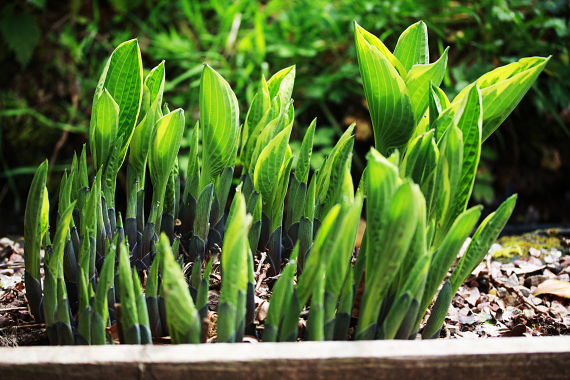
Hosta shoots -courtesy Marcus Bawdon http://www.countrywoodsmoke.com
Otherwise known as the ‘Plantain lily’, Hostas come originally from eastern Russia, China, Japan and Korea. They are very hardy. Most of the 40 – 70 or so species (there is disagreement over the exact number) and over 7000 cultivars are grown for their foliage, though for many the flowers are also noteable. True perennials, their foliage dies back and they descend underground over winter, to send up new growth spears in spring and achieve their full glory in summer with some varieties flowering into early autumn. Some species also give a second, albeit brief, display in autumn.
 Hosta ‘Ginko Craig’ flower
  Hosta fortunei ‘Picta’ flower
The leaves vary between round, ovate, lance or heart – shaped and are between 12cm and 50cm in length. They come in all shades of green, some solid in colour others with margins or centres variegated in shades from white to golden yellow. Flowers range from bell to trumpet shaped, and are held in one-sided racemes or ‘scapes’.
 ‘Bette Davis’ eyes’
  ‘Fried Green Tomatoes’
  ‘Sweet Sunshine’
  Hosta ‘Bressingham Blue’
Hostas will grow in full sun to full shade – they flower better if in the sun and the yellow-leaved varieties also do better in full sun. Overall, however, they tend to do best in dappled shade and where they are away from the hot noon-day sun (the blue – green leaved varieties have more intense colouring in the shade). They need moisture at their roots and this is even more the case in full sun – so they need watering in dry spells and generally do best in moist ground which is rich in organic matter and neutral to slightly alkaline . Foliage will start to wilt if they are too dry. They can be easily propagated by division at almost any time of year – a sharp spade or knife thrust down to split the roots is all that’s required.
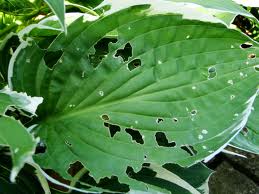
Slug and snail damage
Pest problems focus on slugs and snails which can nibble the emerging shoots – such damage can scar the leaves for the rest of the season, so preventative and quick action to remove slugs and nails is crucial, especially in early spring. Sometimes, especially in water – logged ground, the plants can be susceptible to ‘crown rot’ and if this is the case they should be moved to a more suitable site. Hostas have low levels of allergens. Some Hostas are edible, their young shoots being forced and harvested in the far east, eaten sauted or rolled in proscuitto!
 Hosta border edge
  Hosta grouping
  Hostas and Lillies
  Mixed Hosta planting
  Hosta ‘Royal Standard’ flowering
Hostas look good in groups around ponds and damp areas, and are particularly useful in areas of medium to light shade. Their foliage makes for a bold texture so they are good as focal points, contrasting well with grassy – like leaves and stems. They are also good in containers where the leaves and flowers can be seen close up. I grow most of mine this way, in black planters in our Courtyard Garden – the black provides wonderful contrast to the rich greens and yellows of the foliage. But it’s important to keep them well watered once growth starts. Other ideas for using Hostas include:
‘Plant different varieties in large masses or drifts for reliable color and texture in the garden.
Brighten shady garden areas with gold or variegated hostas.
Use hostas to bridge gaps in seasonal perennial bloom.
Variegated hostas with white or cream margins paired with other white flowering plants glow in “moonlight gardens” when homeowners arrive in the evening from work.
Hosta leaves emerge just as spring bulb foliage starts to fade, hiding it from view.
A single hosta in a container is dramatic and sculptural. Hostas look great in containers paired with other foliage plants or annuals. Remember to provide adequate water.
Plant fragrant hostas close to paths and walkways for best appreciation.
Use small hostas for edging along walkways and flower borders.
Hosta leaves and flowers are attractive in floral arrangements.’
Source: University of Minnesota Extension
Images from: Newtonairds Lodge Hostas and Garden (the national collection), Wikipedia and other sites as shown on picture titles.
Further information:
British Hosta and Hemerocallis Society
How to lift and divide Hostas (video)
Hosta varieties and where to buy etc.
Winsford Walled Garden, Devon- success with Hostas
Hosta shoots wrapped in prosciutto


If you’ve enjoyed reading this post and others on this blog, why not comment and join others by signing up for automatic updates via email (see side bar, above right ) or through an RSS feed (see top of page)?

Geranium ‘Johnson’s Blue’
They don’t like waterlogged soil and so in the wild you find them all habitats except boggy ones. They are a diverse group, varying in both hardiness and their growing needs. G. malviflorum is unusual in that it makes top -growth through the winter, flowers in spring and disappears until winter!
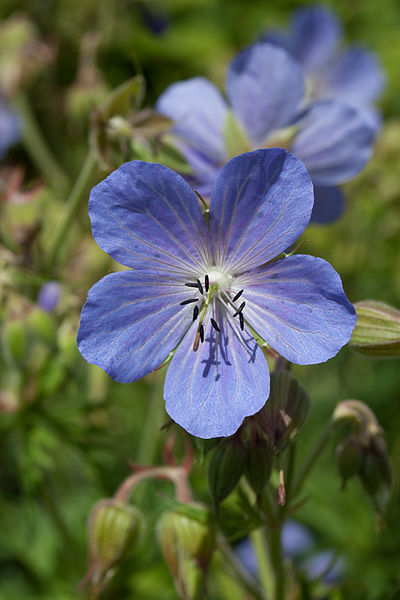
Geranium pratense (Meadow Cranesbill)

Geranium platypetalum

Geranium dissectum
Most Geranium flowers are saucer-shaped, but can be flat or star like. They can come in umbels, panicles or cymes. They range in colour from white to dark plum through an array of pinks, blues and purples. Leaves are grouped around the base and the stem and are often deeply divided and toothed, and some are evergreen.
Many species are floppy or scramble and most need some sort of support to make them look reasonable. They all need shearing over the autumn/winter to encourage new basal growth, and some species, if sheared immediately after flowering will put on a second flush of leaves and flowers. Propagate by taking semi-ripe cuttings in summer, by seed, or by division in autumn or spring.
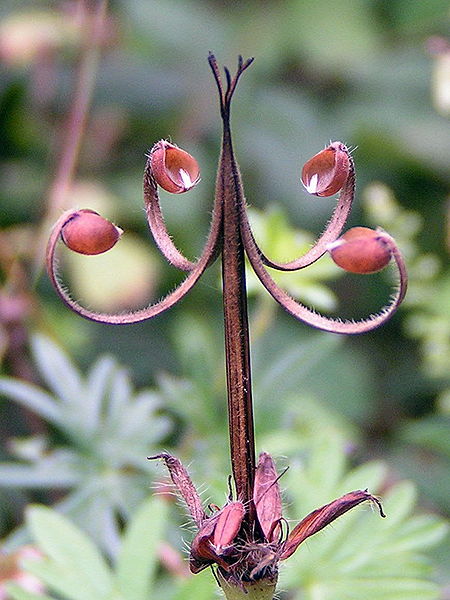
Geranium sanguineum showing ‘bill’ which aids seed dispersal
Most are drought tolerant and all are low in allergens. Some, such as G. nodosum and G. procurrens root when their stems touch the soil and G. thunbergii self seeds to a considerable extent, so should be deadheaded before the seeds form, if you want to restrict its spread.
Pelargoniums are often given the common name ‘Geranium’- both genuses are members of the Geraniaceae family. both were originally part of one family as defined by the botanist Linnaeus.

Geranium maculatum

Geranium maderense
Further information:
10 AGM Hardy Geraniums for the garden- RHS
‘Geraniums- my hardy heroes’ – article by Bunny Guinness
National Collection of Geraniums- Cambridge Botanic Garden
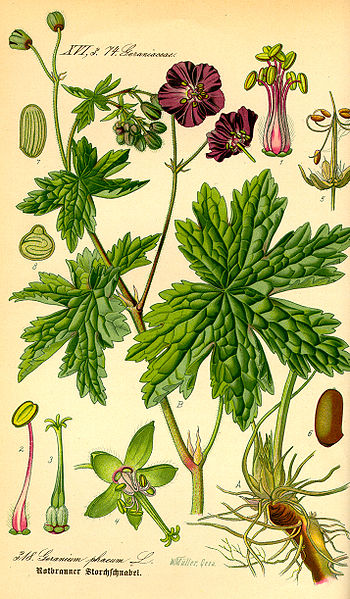
Geranium phaeum – from Thomé ‘Flora von Deutschland, Österreich und der Schweiz’ 1885
If you’ve enjoyed reading this post and others on this blog, why not comment and join others by signing up for automatic updates via email (see side bar, above right ) or through an RSS feed (see top of page)?
The Gisborne Garden full of gold and silver glimpses.
Have been out painting the outside of (another) house all weekend – absolutely knackered – so this is in honour of enjoying those arcadian afternoons when you can wander around someone else’s garden.
Nigel Boldero aka 'Old School Gardener'
 | Nigel Boldero on Fighting to Reduce Climate Cha… |
 | Anonymous on Fighting to Reduce Climate Cha… |
| Anonymous on PicPost: Carrot, my foot! |
| 18 Surprising Hydran… on Plantax 16: Hydrangea the wate… | |
| Nigel Boldero on Poppyland: A Victorian romance… |
| Anonymous on Poppyland: A Victorian romance… |
| Anonymous on Plants to die for… |
 | Isabella Childress on PicPost: Forest, but not as we… |
 | Happiness Factor on Is child-friendly planning a l… |
 | zidane on Top Tip: On a Pedestal- make m… |


Nature Connectedness Research Blog by Prof. Miles Richardson
Connecting People with Nature
A daily selection of the best content published on WordPress, collected for you by humans who love to read.
Celebrating gardens, photography and a creative life
Writing, photography and more by Daniel Greenwood
Lydia Rae Bush Poetry
Australian Pub Project, Established 2013
The Journey from Finnish Rintamamiestalo to Arboretum & Gardens
Because even in chaos, there’s always gin and a good story …
RANDOM BITS & MORE TIDBITS
.....and nurturing my soul
Cultural Heritage and the Digital Economy
Sense of place, purpose, rejuvenation and joy
Notes from the Gardeners...
Connecting People to Nature, Empowering People to Live Sustainably
A girl and her garden :)


 Old School Garden