Category: Feature plants


PicPost: Tulip Mania

ilandscape.com

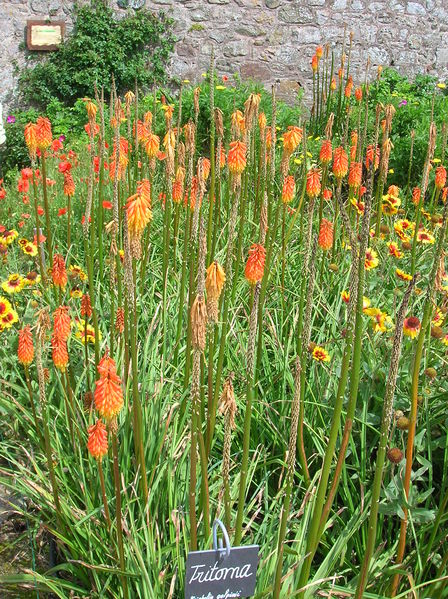
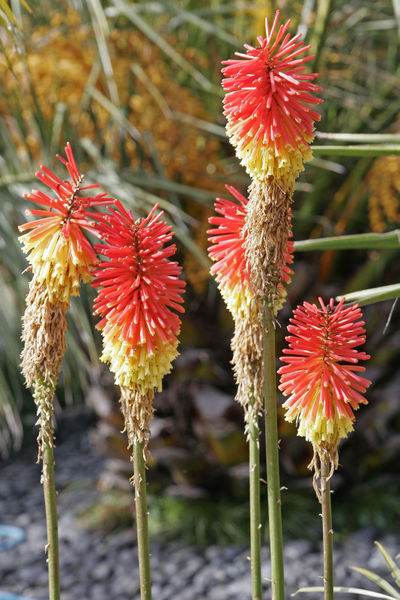
KniphofiaA genus of 70 or so rhizomatous perennials from central and southern Africa, Kniphofia – or ‘red hot pokers’ – can often be found in moist places; alongside river banks, in grasslands or mountainsides. They are also called tritoma, torch lily, knofflers or poker plant. The Kniphofia genus is named after Johann Kniphof, an 18th-century German physician and botanist.

Kniphofia form clumps, with arching, strap-like leaves. They can be evergreen or deciduous, the leaves of the deciduous varieties tending to be narrower and shorter than the evergreens. They thrive in any soil as long as it is moisture retentive, prefer sun but will tolerate light shade and can vary from tender to fully hardy. Many tolerate coastal conditions. Coming from South Africa, they are not completely hardy, particularly in the far north. For safety grow the more hardy evergreen varieties, where you should tie up the leaves over the winter, so protecting each other from frost.  They are also susceptible to ‘wet feet’ – this is particularly bad in clay soils when they are also cold.

The flowers are cylindrical or tubular and usually hang down (‘pendent’), though in some varieties are upright. Flowers are borne well above the leaves in dense spike – like racemes. The flowers come in various colours, including green and toffee, but most of the commonly seen types open red and turn to yellow, giving  the characteristic, bicoloured flower spikes.

Red Hot Pokers make good cut flowers. The flowers produce copious nectar while blooming and are attractive to bees and butterflies. In the New World they may attract sap-suckers such as hummingbirds and New World orioles. They are low in allergens.

Tritoma group

A group of Kniphofia or ‘Tritoma’

Red hot pokers seem to have suffered a bad press over the years, stemming from Victorian times when one influential garden writer (Shirley Hibberd) thought they were vulgar and that their use required “a little extra care to avoid a violation of good taste”.

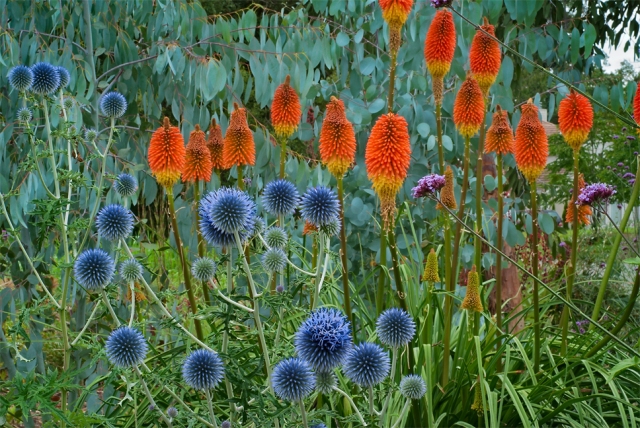
Cultivars range from 50cm to 2 metres in height, and the taller ones may need staking. Late-summer flowers such as Crocosmias look good with them, as do different sorts of marigolds; e.g. ‘Touch of Red’ and ‘Art Shades’ which are ideal for a showy look. Salvia uliginosa combined with yellow or coral-coloured pokers gives a more subtle effect. They mix well in the border with other tall plants such as Alliums and Echinops.  Sometimes a mixture of gaudy colours – Delphiniums, Alliums, Lilies and Knifophia – is quite attractive.

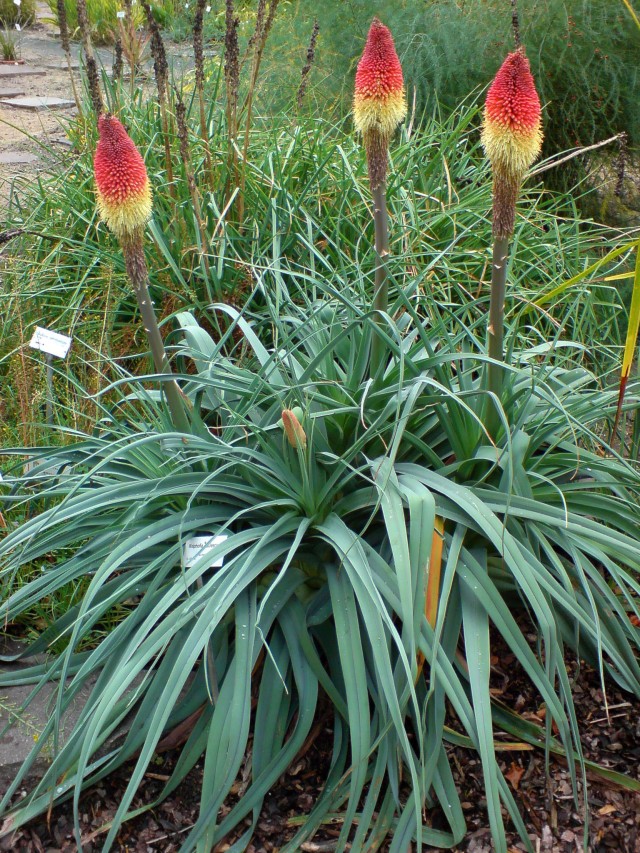
Kniphofia caulescens

Kniphofia caulescens

You can grow them from seed quite easily using ordinary seed compost – just push the seeds partially into the compost in April, water and they will be transplantable by summertime. Once mature, after a year of growth, the plant is dividable to increase stock. Do this in late September, into pots of 50% compost 50% grit. Dividing is easy enough, they pull apart quite easily and you can simply pot them up. Leave the divided plants in pots in a cool but frost-free greenhouse, and replant in May the next year. When transplanting your Kniphofia, dig a hole that is about 20cm deep by 10cm wide, and half fill with 50% compost, 50% grit mixture and then top up with compost and plant in this. Each spring give them a mulch with good rich compost. You can also give them a liquid feed in June when they start to show signs of flowering. I have some in my long borders at Old School Garden and they are just coming into flower.

Kniphofia and Echinops. Photo- Jenny Cochran's garden

Kniphofia and Echinops. Photo- Jenny Cochran’s garden

Further information:

How to grow Kniphofias- Telegraph article

How to grow Kniphofias-Mirror article

RHS- Kniphofia ‘Bees Sunset’ and other links

RHS 2007/9 Kniphofia trials

Old School Gardener

If you’ve enjoyed reading this post and others on this blog, why not comment and join others by signing up for automatic updates via email (see side bar, above right ) or through an RSS feed (see top of page)?

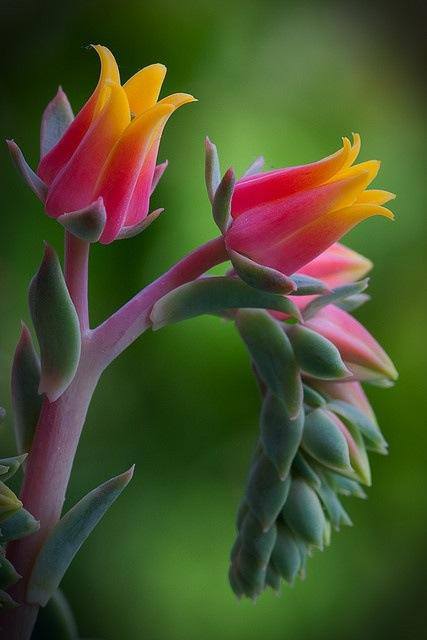
PicPost: Echeveria

iLandscape.com

PicPost: Thanks Vermillion

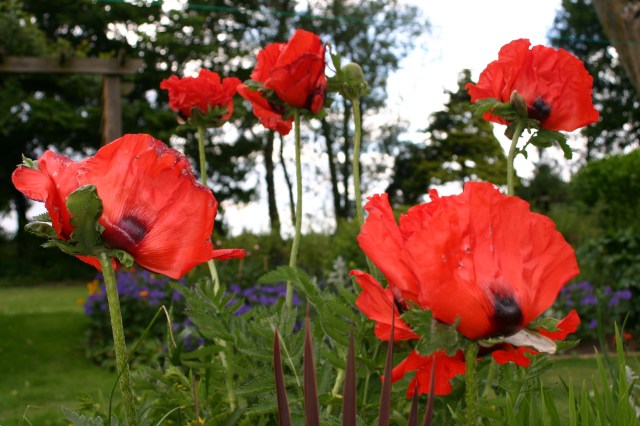
Oriental poppies in Old School Garden today

gressenhallfw's avatarGressenhall Farm and Workhouse

There are lots of poppies at Gressenhall, Scott Tampin, Heritage Gardening Trainee has been researching them.

The Poppy is a flowering plant of the family Papaverceae and many varieties can be found flowering all over the farm and workhouse site at this time of year. Ornamental Poppies are grown for their colourful flowers and some varieties are used in many cuisines around the world including European, Indian and Jewish. Some varieties produce a powerful medicinal alkaloid opium which has been used since ancient times to create analgesic and narcotic medicinal.

Poppies have long been a symbol of sleep, peace and death. Sleep because of the opium extracted from them, death because of the common blood red colour of the red ones in particular. In Greek and Roman myths time poppies were used as offerings to the dead and decorated tombstones. The bright scarlet colour also signifies resurrection from death in…

View original post 141 more words

PicPost: Smell the air

iLandscape.com.au

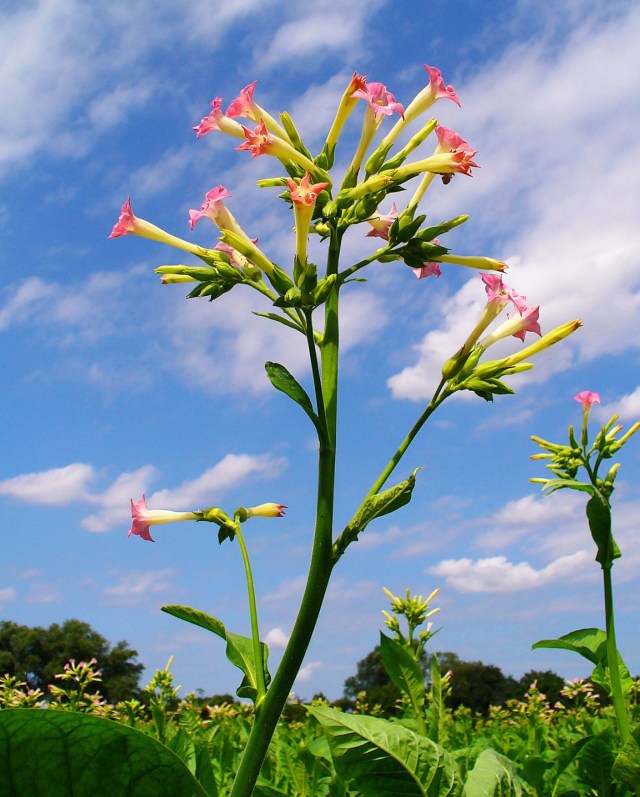
The tobacco plant - Nicotiana tabacum

The tobacco plant – Nicotiana tabacum

Nicotiana is a wonderful garden plant, its highly scented flowers providing a heady scent on warm summer evenings. I grew a large group of N. sylvestris one year which provided both an eye – catching feature and intoxicating fragrance for my younger daughter’s wedding celebration – truly memorable.

I guess ‘intoxicating’ is the right term as the tobacco plant is one of the most important plant discoveries in history, albeit one whose chief product we have come to understand and increasingly reject as a major cause of disease.

Fortunately though, the ‘baby hasn’t been thrown out with the bath water’ and we can still appreciate it as a garden plant, and its one which I grow each year and place in groups around Old School Garden as well as along the main entrance path at Gressenhall Museum where I volunteer.

Indigenous to the Americas, Australia, south west Africa and the South Pacific, there are various Nicotiana species, all commonly referred to as ‘tobacco plants’, though it is N. tabacum that is still grown worldwide for production of tobacco leaf for cigarettes etc. Nicotiana can be annuals, biennials, perennials or shrubs – some 70 species are grown as ornamentals.

Nicotiana sylvestris

Nicotiana sylvestris

N. sylvestris is a stately plant which looks well at the back of a lightly shaded or sunny border, or grown in bold groups. It’s flower heads seem to explode like a graceful firework. The Royal Horticultural Society has given it its prestigious Award of Garden Merit (AGM). There are many variations in size, colour and fragrance between the species and hybrids. Older heirloom species are often identified by their genus and species name.

Nicotiana alata - photo Carl E. Lewis

Nicotiana alata – photo Carl E. Lewis

Its genus name, designated by Linnaeus in 1753, recognizes Frenchman Jean Nicot, ambassador to Portugal from 1559-1561 who brought powdered tobacco to France to cure the Queen’s son of migraine headaches. Leonhart Fuchs (1501-1566) coined the name ‘Nicotiana’. However, Nicot’s credit as the first to bring the plant to Europe is wrong as it was known in the Low Countries after being brought there by Spanish merchants in the 1540s.  Knowledge of the plant by Europeans dates from 1492 when Columbus’s sailors saw it being smoked in Cuba and Haiti.


Many of the species names refer to a characteristic of the plant. Nicotiana alata gets its species name from the Latin word meaning winged, referring to its winged petioles (the stalks attaching the leaf blades to the stem). N. sylvestris, from the Latin sylva, meaning of the forest or woodland, possibly refers to its native habitat. N. langsdorffii was named after G. I. Langsdorf, the Russian Consul in Rio de Janeiro who organized an expedition to explore the inner regions of Brazil in the 1820’s.

Other varieties include:

N. affinis = related to, probably N. alata (= ‘winged’), some use it as a synonym. The ‘Night Scented Tobacco Plant’

N. x sanderae = ‘Sander’s Tobacco’, a group to which most of the newer hybrids belong

N. suaveolens = sweet smelling

Nicotiana can be used as specimen or bedding plants, in borders, woodland gardens or containers. Heights range from less than 1 foot to over 10 feet. They are long-blooming, attractive plants with trumpet-shaped flowers in shades of green, white, red, and pastels. Some species have attractive foliage. They are fairly easy to grow from seed. Contact with the hairy foliage may irritate the skin.

This year I’m growing  N. sylvestris in a border along with Verbena bonariensis and Ammi majus – a new combination for me and I’ll show you the results later in the summer!

Nicotiana x sanderae hybrids

Nicotiana x sanderae hybrids

Sources and further information:

Wikipedia

Growing Nicotiana (USA)

RHS Plant finder

The Poison Garden

Fine Gardening- plant guide

Nicotiana alata ‘Grandiflora’ is the most highly scented tobacco plant you can grow. It has delicate creamy-white flowers which are delicate in bright sunlight, so best planted with a little shade.Nicotiana are a great family of very long-flowering half hardy annuals, many of them with lovely evening and night scent. Nicotiana are moth pollinated, so pour out the fragrance when the moths are around.- See more at: http://www.sarahraven.com/shop/nicotiana-alata-grandiflora.html#sthash.FvJ4Z0Kg.dpuf

Quizzicals: answers to the two clues given in Plantax 11…

  • Where policemen spend their holidays- Copper Beech
  • Feline relative – Catkin

..and 2 more cryptic clues to the names of plants, fruit or veg…

  • Place in Oxfordshire painted a gaudy colour
  • Tie up skinny coward

Special thanks to Les Palmer, whose new book ‘How to Win your Pub Quiz’ was published recently. A great celebration of the British Pub Quiz!

Old School Gardener

If you’ve enjoyed reading this post and others on this blog, why not comment and join others by signing up for automatic updates via email (see side bar, above right ) or through an RSS feed (see top of page)?

jasmine-bush OK, I know that Jasmine is technically a shrub or climber and not strictly a ‘perennial’ but it is a perennial plant like all shrubs, so perhaps you’ll allow me some license on a letter of the alphabet that is decidely low on choice of ‘proper perennials’!

Jasmine (Jasminum) is a genus in the olive family (Oleaceae). It contains around 200 species native to tropical and warm temperate regions. Jasmines are widely cultivated for the characteristic fragrance of their flowers. They can be either deciduous or evergreen, and can be erect, spreading, or climbing in habit. The flowers are typically around 2.5 cm (0.98 in) in diameter, are white or yellow in colour, although in rare instances they can be slightly reddish. The flowers are borne in clusters with a minimum of three flowers, though they can also be solitary on the ends of branchlets. Each flower has about four to nine petals. They are usually very fragrant. The berry fruits of jasmines turn black when ripe.  Of the 200 species, only one is native to Europe, but a number of jasmine species have become naturalized in the Mediterranean area. For example, the so-called Spanish jasmine or Catalonian jasmine (Jasminum grandiflorum) was originally from Iran and south western Asia, and is now naturalized in Spain and Portugal.

Widely cultivated for its flowers, jasmine is enjoyed in the garden, as a house plant, and as cut flowers. The flowers are worn by women in their hair in southern and southeast Asia. The delicate jasmine flower opens only at night and may be plucked in the morning when the tiny petals are tightly closed, then stored in a cool place until night. The petals begin to open between six and eight in the evening, as the temperature lowers.

Symbolically, Jasmine was used to mark the Tunisian revolution of 2011 and the pro democracy protests in China of the same year. Damascus in Syria is called the ‘City of Jasmine’ and in Thailand, jasmine flowers are used as a symbol of motherhood.  Several countries have Jasmine as their national flower. ‘Jasmine’ is also a girls name in some countries.

There are many cultivars of Jasmine – for summer and winter. Jasminum officinale (summer jasmine) is perfect for a sunny, sheltered spot in mild regions of the UK. Trachelospermum jasminoides, also known as ‘Confederate’ or ‘Star Jasmine’ is a sweet-smelling vine with small white flowers. It grows quickly up walls, trellises, fences, and even thrives as ground cover, but It is especially well-suited to be grown indoors.

Trachelospermum jasminoides

Trachelospermum jasminoides

The cheery yellow flowers of Jasminum nudiflorum (winter jasmine) will brighten up even partially shaded and cold sites at a time when little else is in flower. A popular and reliable shrub, introduced from China in 1844, and widely grown as a wall shrub, it can be allowed to scramble freely over a low wall or up a bank, or trained up a vertical framework. Unlike many other jasmines, winter jasmine does not twine, so will need tying-in if grown vertically. The stems are bright green and give an evergreen impression, even in winter when the tiny bright yellow blooms appear, weatherproof in all but the coldest snaps. Regular pruning keeps bushes under control and prevents bare patches from appearing. The Royal Horticultural Society has given it the Award of Garden Merit (AGM).


All jasmines need a fertile, well-drained soil in full or partial sun. Summer jasmine needs a sheltered spot, full sun and a south- or south west-facing aspect. Winter jasmine is more tolerant of partial shade and a south east or north west aspect. North and north east aspects are best avoided. Frost hardy species are fine in an unheated conservatory or a cold greenhouse kept frost-free with a small heater. Tender species may require a minimum night temperature of 13-15ºC (55-59ºF). Jasmines make lovely container specimens. Ensure you use a container with good drainage holes, cover the holes with crocks or grit, and fill with John Innes No 2 compost. Leave space at the top for watering, and place the pot in bright but filtered light.

Jasmine plant care is not difficult but does require vigilance.Well worth it to have that wonderful evening fragrance in the summer or some brightness in the dark winter months!


Sources and further information:

Wikipedia

Beginners guide to Jasmine

Royal Horticultural Society – growing Jasmine

How to grow Jasmine

Pruning Star Jasmine

Growing Jasmine indoors

Trachelospermum – RHS

Old School Gardener

If you’ve enjoyed reading this post and others on this blog, why not comment and join others by signing up for automatic updates via email (see side bar, above right ) or through an RSS feed (see top of page)?
Tamara Jare's avatarMy Botanical Garden

ImageImageImage

Bufo bufo is part of a species complex, a group of closely related species which cannot be clearly demarcated.[1] Several modern species are believed to form an ancient group of related taxa from preglacial times. These are the spiny toad (Bufo spinosus), the Caucasian toad (Bufo verrucosissimus) and the Japanese common toad (Bufo japonicus). The European common toad (Bufo bufo) seems to have arisen more recently.[6] It is believed that the range of the ancestral form extended into Asia but that isolation between an eastern and western type occurred as a result of greater aridity and desertification in the Middle East during the Middle Miocene.[12]The exact taxonomic relationships between these species remains unclear.

Mr. Toad Esq. is one of the main characters in the children’s novel The Wind in the Willows, byKenneth Grahame

from:http://en.wikipedia.org/wiki/Common_toad


View original post

Finding Nature

Nature Connectedness Research Blog by Prof. Miles Richardson

Norfolk Green Care Network

Connecting People with Nature

Discover WordPress

A daily selection of the best content published on WordPress, collected for you by humans who love to read.

Susan Rushton

Celebrating gardens, photography and a creative life

Unlocking Landscapes

Writing, photography and more by Daniel Greenwood

Alphabet Ravine

Lydia Rae Bush Poetry

TIME GENTS

Australian Pub Project, Established 2013

Vanha Talo Suomi

The Journey from Finnish Rintamamiestalo to Arboretum & Gardens

Marigolds and Gin

Because even in chaos, there’s always gin and a good story …

Bits & Tidbits

RANDOM BITS & MORE TIDBITS

Rambling in the Garden

.....and nurturing my soul

The Interpretation Game

Cultural Heritage and the Digital Economy

pbmGarden

Sense of place, purpose, rejuvenation and joy

SISSINGHURST GARDEN

Notes from the Gardeners...

Deep Green Permaculture

Connecting People to Nature, Empowering People to Live Sustainably

BloominBootiful

A girl and her garden :)