
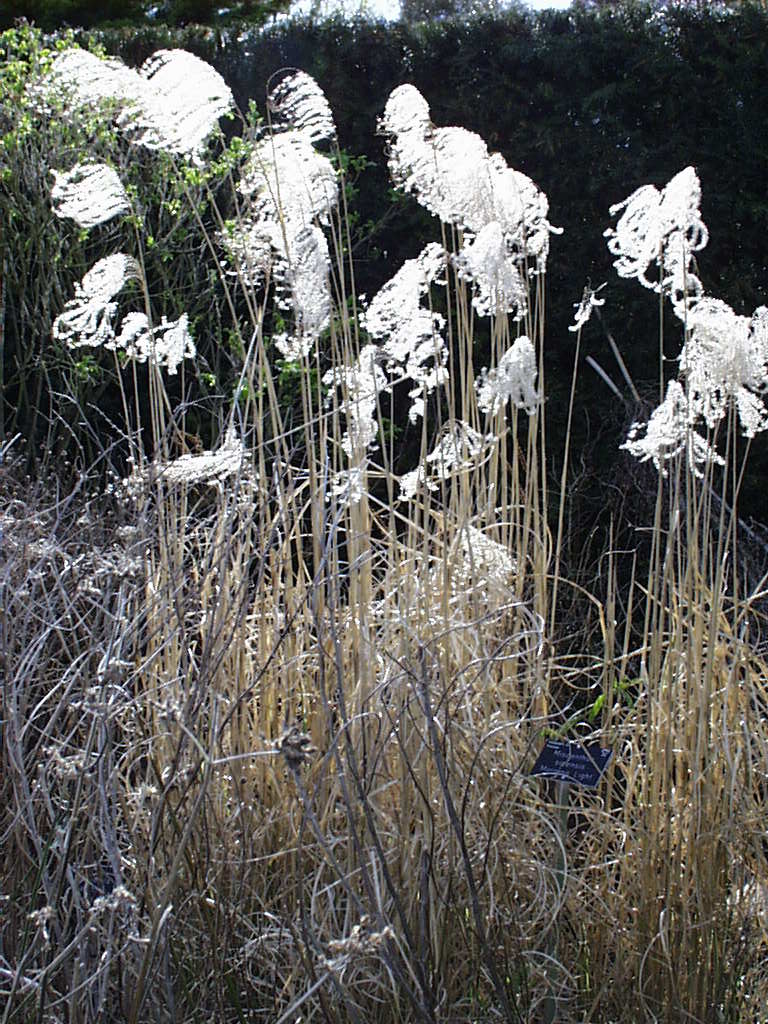
Dried flowers and stems of Miscanthus sinensis ‘Morning Light’ providing March interest at RHS Garden Hyde Hall
My previous post set out the background to the growth in popularity of grasses as border plants. I’ve come to appreciate their simple beauty and the way they can add a different dimension to the traditional herbaceous and mixed border and at the moment some of them are looking great in Old school Garden, especially as the low autumn sun catches their golden stems and heads.
So what are the ways you can use grasses to best effect in your garden?
They contribute in a number of ways – texture, light, colour and as structural elements in your overall garden framework (and some sound lovely as the breeze finds its way through them or their seed heads are rattled like mini maracas). Here are some thoughts gleaned (no pun intended) from the very useful book, ‘Grasses’ by Roger Grounds.
Texture
Most grass stems and leaves provide strong vertical or curved lines and are best used in contrast:
-
With other perennial broad – leaved plants (often most effective if seen from a distance),
-
With strong vertical lines like clipped Yew or the corners of buildings (where the grass has a curved or arching stem),
-
More subtle, unusual combinations (e.g. with Ferns),
-
Contrasting the ‘fuzzy’ flower heads of many grasses with those plants that have a more linear or defined form e.g. Digitalis, Lythrum, Achillea, Phlomis russelliana, Echinops and Allium giganteum
-
With other grasses that have different leaf form; e.g. the narrow leaves of Miscanthus sinensis ‘Gracillimus’ with the broad bold leaves of Arundo donax, or the wide, short leaves of Panicum alopecuroides.
-
At the front of borders to act as ‘veils’ through which other plants or a more distant landscape can be revealed.
Annual grasses- complete their growth cycle in one growing season. Hardy varieties can withstand frost and most can be sown in autumn to over winter in the ground and germinate in spring. Tender grasses need to be sown once all risk of frost has passed. Many of these are perennial in frost-free climates.

Briza maxima

Hordeum jubatum

Zea mays (Sweet corn!)

pennisetum seataceum ‘Rubrum’
Light
-
Position grasses to catch the sun, preferably against a dark backdrop to ‘light up’ the wider garden.
-
Use grasses to take advantage of the different tonal values of light as it changes from season to season and at different times of the day – especially the more mellow light of autumn and also early and late in the day as these are the times when the richest colours are revealed. I’ve positioned some Stipa gigantea (‘Golden Oat Grass’) to catch the low sun of late summer and autumn, and close to the house where we can see the full
-
Associate grasses with seasonal changes in perennials and foliage; e.g. in spring the foliage of grasses is more prominent so think about using bold coloured grass leaves as foils for spring flower colour- the yellow of Bowle’s Golden Grass with the blues of Bluebells for instance.
Cool season grasses- these start into growth in autumn, grow through the winter and flower in spring or early summer. Best planted among winter or spring- flowering perennials. Plants grown for their foliage, or among spring and early summer bulbs. Most then become dormant/semi dormant and so can be planted where summer flowers or other grasses can grow up to conceal their faded foliage. They can be divided or transplanted in spring or autumn.

Sesleria caerulea

Briza media ‘Limouzi’

Phalaris arundinacea var. ‘Picta’

Festuca glauca

Deschampsia cespitosa
Colour
-
Use the ‘washed out’ or subtle colours of grasses as a counterpoint to the richer colours in surrounding plants.
-
Grasses with coloured leaves can be used to reinforce a particular colour theme- reds with reds, blues with blues etc. As they last longer than many of the flowers around them, grasses help to maintain continuity in colour themed borders. Blues from grasses such as the varieties of Panicum virgatum, reds from Imperata cylindrica ‘Rubra’ (Japanese Blood Grass) and the yellow of Hakone grass (Hakonechloa macra ‘Aureola’). Yellow is the dominant colour of many grasses’ flower panicles, especially as they fade and the seed heads ripen to shades of amber, straw and gold.
Massing, grouping and markers
-
Grasses look best when grown in groups of three or more- though few gardens have the scope for mass planting. They can also be effective as specimens. Grasses planted as masses or groups should be spaced closer together than in smaller groups.
-
Many low growing grasses make excellent ground cover, and this can be an effective way of massing them in smaller gardens.
-
Taller grasses, or those with strong colouring can act as successful specimens or ‘markers’ in a garden, either planted by themselves or as accents in a border. Clumps of grasses can have a similar impact if planted to contrast with other surrounding grasses or plants.
-
More subtle ways of creating a focus include using grasses with distinctive flower or foliage forms; e.g. Calamagrostis brachytrica with its elongated ovoid flower panicles.
-
A repetition of specimen grasses in a strict rhythm along a border – especially if placed towards the middle of front of it – will impel the eye along its full length. A similar effect, but with less impact, can be achieved with taller grasses placed at the back of the border; e.g. Stipa gigantea.
Warm season grasses- these do not start into growth until late spring or early summer, so they are best planted among other perennials or shrubs that flower from midsummer to autumn. They can be left standing through winter to provide interest- especially when they are covered with raindrops, dew or frost. They should be transplanted or divided in early spring, once they have started into growth.

Miscanthis sinensis

Molinia caerulea

Molinia caerulea ‘Transparent’

Panicum virgatum ‘Dallas Blues”

Pennisetum macrourum

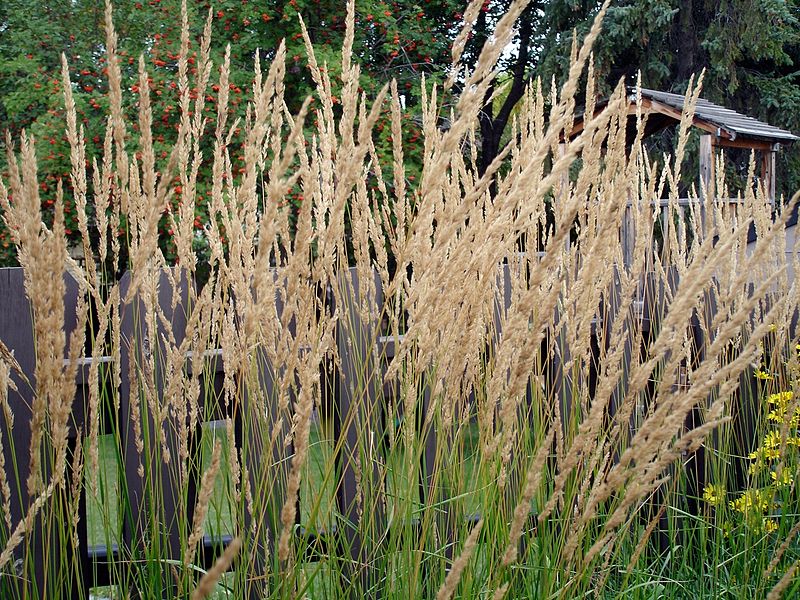
Calamagrostis brachytrycha

Anemanthele lessoniana (formerly Stipa arundinacea)
Seasons and sitings
-
Think about the ‘plant partners’ to go with your grasses, and use the key features of both to complement each other at different times of the year. For example combine a range of strong flower forms which use the structure of grasses to greatest effect; Umbellifers like Anthriscus; Spires like Veronicastrum virginicum; Ball-like or pincushion flowers like Echinops and Knautia macedonica; loosely structured heads like Astilbe; daisy-like flowers such as Rudbeckia. If possible go for those with the longest flowering period.
-
Use grasses in special sites; e.g. as part of a meadow; as a larger scale ‘prairie’ planting or border; in woodland or shade; at the water’s edge.
Sedges, Rushes and Cat tails – though they generally look like grasses, these plants have taken a different evolutionary path and so vary in leaf and flower details, and also their growing needs. Sedges are large family of diverse plants, mostly from the cool temperate regions, enjoying cooler and damper conditions than most of the true grasses. Rushes are a smaller family with few garden-worthy plants though the woodrushes are often decorative as well as useful, for example as ground cover. Cat tails (or reedmaces or bullrushes)are a single genus family with aquatic or marginal plants that have conspicuous flower heads.

Luzula nivea- Common woodrush

Juncus effusus f. spiralis

Cyperus alternifolius

Carex elata ‘Aurea’
Source: ‘Grasses’ by Roger Grounds (RHS and Quadrille Publishing)
Old School Gardener
If you’ve enjoyed reading this post and others on this blog, why not comment and join others by signing up for automatic updates via email (see side bar, above right ) or through an RSS feed (see top of page)?












 Old School Garden