
Category: Design
Biomimetic Products- Exhibition


Location of Emona within present day central Ljubljana, from: http://en.wikipedia.org/wiki/Emona
Ljubljana is celebrating 2000 years since Emona, a Roman settlement, was founded. Emona belonged to the province of Italy and had around 5000 inhabitants. Modern Ljubljana overlaps with site of old Emona. Roman remnants are to be seen in archaeological parks, galleries, architecture and museums across Ljubljana. I’ve found a ’73 year booklet about Emona frescoes yesterday. It is fascinating to discover Emona homes were as neatly decorated as they are today. I am particularly fond of floral motifs used on Emona frescoes , they tell us the story of nearby flora of the time , of the artists of the time, of the pigments used and of the social importance of the beauty that is telling its story even after 2000 years! Here are some illustrations from the booklet:
Ljudmila Plesničar Gec, Emonske freske, Ljubljana 1973


Imagine a Hampstead Garden Suburb built for working people. Better still, if you’re in London take the Tube and get off at Acton East and visit the Old Oak Estate where you’ll find just such an estate.
We’ve looked at the work of the LCC’s Architects’ Department Housing of the Working Classes branch before – at the Millbank Estate, at Totterdown Fields, and at the White Hart Lane Estate. These are all fine arts and crafts-inspired estates but to Susan Beattie, Old Oak stands as ‘the culminating achievement of the Council’s venture into garden suburb planning before the first world war’ – a work of ‘splendid maturity’. (1)
Rising costs of land and labour were forcing the LCC to look to what were then the London fringes. In 1905, the Council purchased 54 acres in Hammersmith from the Ecclesiastical Commissioners at a cost of £29,858. Eight acres…
View original post 1,394 more words

- Using focal points- including the more unusual- is an effective way of drawing the eye away from the edges of a space

Sometimes, especially with awkwardly shaped or smaller gardens, it makes sense to try and draw the eye from the outer boundaries and create a more pleasing and, apparently larger space. Here are seven ‘top tips’ for achieving this:
1. Put square and rectangular patios and lawns at 45/30/60 degrees to the side boundaries or use shapes for these and other flat areas which contrast with the outer shape of the garden.
2. Set paths to run at an angle to the garden boundaries in zig zags or dog leg style.
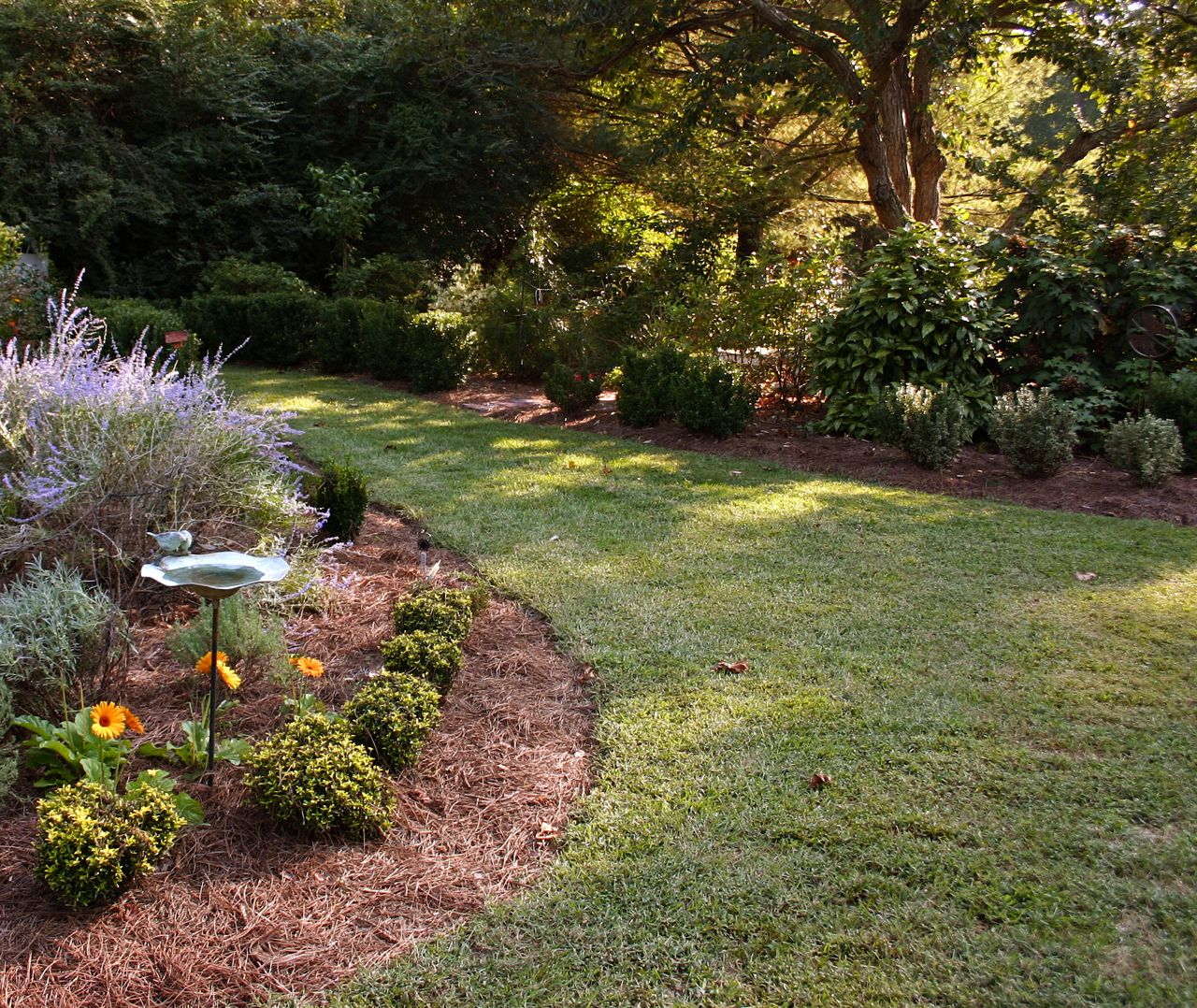
3. Make paths curved, meandering from side to side.
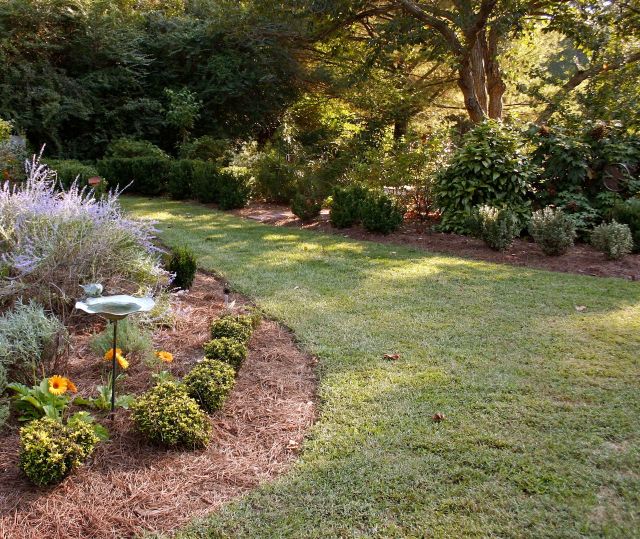
- Paths- including grass- and the border edges they create can be meandering to take the eye on a journey..
 Hedges can be used to divide up a space and perhaps be a point of interest themselves..
  Likewise, trellises, arches and other structures ..
Hedges can be used to divide up a space and perhaps be a point of interest themselves..
Likewise, trellises, arches and other structures ..
4. Fix structures such as trellis, pergolas and arches or plant hedges across the garden to interrupt the view and to create separate compartments.
5. Place groups of tall shrubs or trees at intervals in the line of sight to block views across or down the garden.
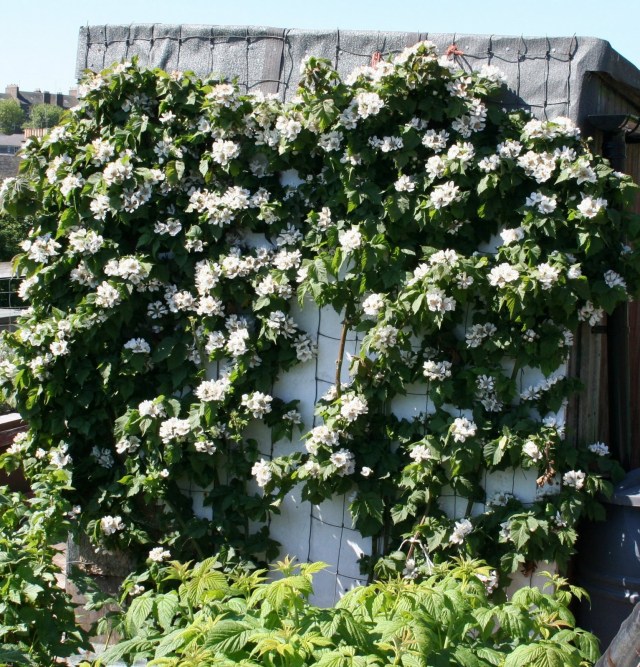
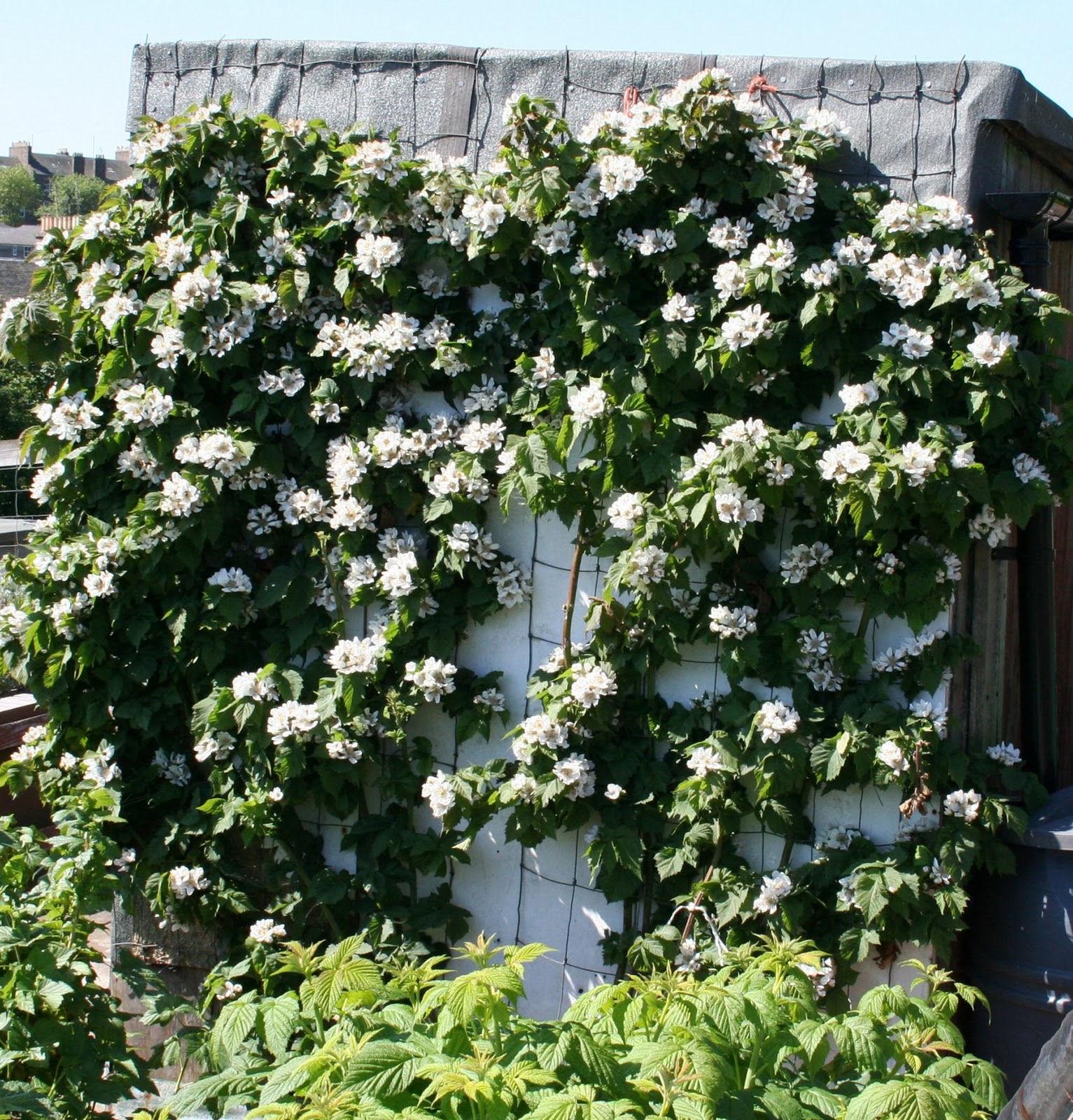
6. Use climbers and large shrubs, especially evergreens, to disguise solid formal boundary fences and to break up the straight lines, particularly the horizontal ones of fence/ wall tops.
7. Carefully place focal points to draw the eye in various chosen directions, positioning them so that they can be seen from different places in the garden.
-
Use climbing plants to cover up and soften hard boundaries
Related article: Arbours and Pergolas in the Garden- 7 Top Tips
Old School Gardener
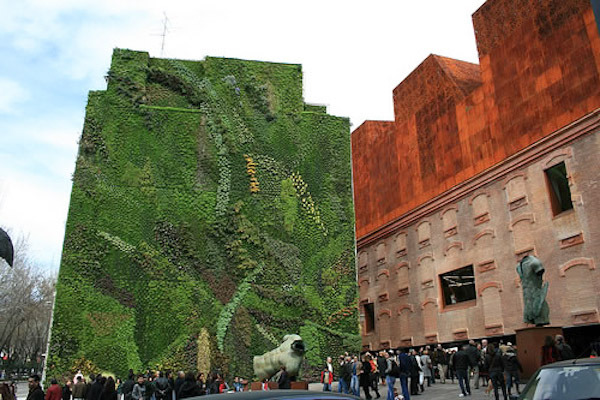
Here’s my latest trawl of interesting projects to enhance your garden. Most are from 1001 Pallets and a few from The Container Gardening Alliance.
Furniture…

A log lounger..

Baby chair from pallets…

Swinging bench from pallets..
Planting spaces…

A greenhouse from old windows…

A planter ladder….

An ‘A’ frame planter with old plastixc bottles, and cartons as containers..

‘Rustic raised beds’ !!

An experimental pallet garden..

Give plants a hand..

Drawers for plants…

Raised planter for my aching back…
and a few more unusual items….

A mobile bar – stools stowed underneath..

Old shutters used for decorative screening/fencing

Canadian rustic retreat..

Pallet Meeting Point..

Tool rack from pallets by Kylee Baumie at mylittleacre.com

Pallet bug hotel..
Old School Gardener
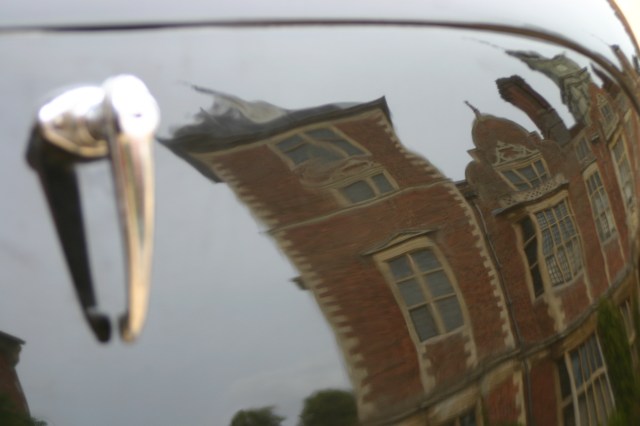 I frequently visit this wonderful Jacobean Mansion and more particularly it’s gardens and parkland. After all it is just 7 miles from home. A walk around the park after a Christmas Day ‘brunch’ has become something of a family institution, often complete with festive headwear!

I try to visit the gardens at different times of the year as they offer something for every season, and back in September I was keen to experience the late summer colour festival of its herbaceous and other plantings. At this time of year it’s mix of formal and informal styles is most evident.


Coincidentally, there was a splendid event going on to celebrate the role of the Hall in the Second World War, including people dressed in military uniforms and plenty of vehicles and ‘kit’ from the time. This is my photo record of my most recent visit along with a very good summary of the gardens’ history and features from Wikipedia:
‘A house and garden existed at Blickling before the estate was purchased by the Boleyn family in the 1450s, but no records survive to give an indication of their appearance. After Sir Henry Hobart acquired the estate in 1616, he remodelled the gardens to include ponds, wilderness and a parterre. A garden mount– an artificial hill in Blickling’s flat landscape, was made to provide views of the new garden. With the accession of Sir John Hobart (later the 1st Earl of Buckingham) in 1698 the garden was expanded to add a new wilderness and the temple was constructed.
In the latter half of the 18th century John Hobart, 2nd Earl of Buckingham, embarked on works that would radically change the appearance of the gardens. All traces of formality were removed, and naturally arranged clumps of trees were planted to create a landscape garden. By the 1780s an orangery had been built to overwinter tender citrus trees. Following the 2nd Earl’s death in 1793, his youngest daughter Caroline, Lady Suffield, employed landscape gardener Humphry Repton and his son John Adey Repton to advise on garden matters. John Adey Repton would go on to provide designs for many garden features. 


The estate was inherited by nine-year-old William Schomberg Robert Kerr, 8th Marquess of Lothian in 1840. He later re-introduced the formality and colour schemes of the parterre. After his death at the age of 38, responsibility for the gardens rested with Lady Lothian and her head gardener Mr Lyon. Philip Henry Kerr, 11th Marquis of Lothian, inherited the estate in 1930. After disparaging comments in a publication of Country Life, Lothian engaged socialite gardener Norah Lindsay to remodel the gardens. In the parterre she replaced the jumble of minuscule flower beds with four large square beds planted with a mixture of herbaceous plants in graduated and harmonious colours. Other improvements included removal of a line of conifers in the Temple walk, which were replaced with plantings of azaleas.
The garden today
The garden at Blickling covers 55 acres (22 ha) and contains formal and informal gardens, Grade II listed buildings and structures, woodland, specimen trees, Victorian garden ornaments, topiary, the kitchen garden .. and 18th century yew hedges.
The lawns which frame the main approach to the hall are bounded by yew hedges which were first recorded by William Freeman of Hamels in 1745. Surrounding the hall on three sides is the dry Moat. The plantings in the moist, sheltered conditions of the moat were considerably revised by Lindsay who introduced hosta, species of hydrangea, buddleja and rosemary. 


To the rear of the hall is the noted Parterre garden which is located on the east lawn. Originally created as a Victorian sunken garden it was remodelled by Lindsay in the early 1930s. Set around an 18th-century listed stone fountain, she divided the garden into four large, colourful herbaceous beds surrounded by L shaped borders stocked with roses and catmint with an acorn shaped yew marking each corner. 


In the terraces above the parterre there are plantings of peony, seasonal beds and the Double Borders created in 2006, contain a wide variety of perennials, shrubs and grasses with colours ranging from hot to cool. Close by, are the White and Black Borders which were established in 2009, together with a collection of eleagnus. 


The western side of the garden features the lawned Acre which is fringed by a spreading oriental plane tree. Outdoor sports such as croquet are played here in the summer months. Further highlights are a collection of magnolia underplanted with autumn cyclamen, the shell fountain and the kitchen garden. To the north of the parterre is the Wilderness garden which is bisected by radial grassed avenues flanked with turkey oak, lime and beech trees and naturalised bulbs. The wilderness hides a Secret Garden with a summerhouse, scented plants and a central sundial. 


Nearby is the listed 18th century orangery which houses a collection of citrus trees. Adjacent, to the building is the steep sided Dell which is home to many woodland plants including a selection of hellebore and foxglove. In 2009, an area of woodland was cleared close to the orangery to create a new garden. Stocked with a wide range of woodland plants including camellia and varieties of mahonia. Opened in 2010, it will be known as the Orangery Garden.
The Grade II listed Temple is approached by the Temple walk which is lined with azalea planted by Lindsay in her original 1930s design. Scattered throughout the garden are many garden ornaments including thirty pieces supplied to Lady Lothian in 1877 by Austin & Seeley of Euston Road, London.
Future projects include the creation of a philadelphus and rose garden. Both of which will be located in the Wilderness and open to the public in the near future .’ (Note – these have now been established and are open to the public- see pics below). 


Further information:
National Trust Website
Wikipedia
Old School Gardener
- The Garden- man made artifice?
‘Let us, then, begin by defining what a garden is, and what it ought to be. It is a piece of ground fenced off from cattle, and appropriated to the use and pleasure of man: it is or ought to be, cultivated and enriched by art, with such products as are not natural to this country, and consequently, it must be artificial in its treatment, and may, without impropriety, be so in its appearance; yet, there is so much of littleness in art, when compared with nature, that they cannot be well blended; it were, therefore, to be wished, that the exterior of a garden should be made to assimilate with park scenery, of the landscape of nature; the interior may then be laid out with all the variety, contrast, and even whim, that can produce pleasing objects to the eye.’

Humphry Repton- ‘Observations on the Theory and Practice of Landscape Gardening’, 1803
Hmmm. what do you think? Repton’s advice about blending the edges of a garden with it’s surrounding landscape has become a tenet of garden design, but what about his words on making the garden itself a clearly ‘man made’ feature? Is the phrase ‘natural garden’ a contradiction in terms?
Old School Gardener


What great ideas for recycling tea cups and crockery!
Old School Gardener




 Old School Garden