Category: Design


Municipal Dreams's avatarMunicipal Dreams

There were those who looked askance at the London County Council’s new Dover House Estate in 1919.  Well-heeled local people in the big houses nearby expressed concern that transport links were poor for the area’s new residents.  And then there was another ‘element for consideration’ – ‘that its conversion into a working-class district must enormously depreciate the rateable value of property in the vicinity’. (1)

Dover House Road Dover House Road

In fact, worries that the Estate would blight the neighbourhood and would be filled by ‘very, very poor people from the bad areas of the East End’ were illusory.  The Dover House Estate, initially known as the Roehampton Estate, would become a ‘show place in its day…visited by many from all over the world.’ (2)  And it would house an overwhelmingly ‘respectable’ working class.  Many of these worked in the public services – in public transport, as police officers or postal workers – and they…

View original post 1,927 more words
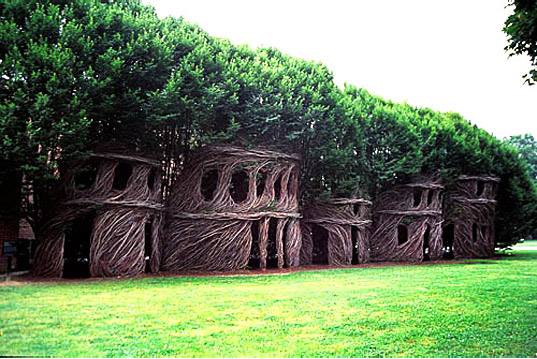
houses from woven  trees green renaissance

Houses woven from trees!

Old School Gardener

PicPost: Wind Charm

‘Singing Ringing Tree’- when the wind blows

Old School Gardener

IMG_8801You may have read previously that one of my latest projects involves designing, and then helping to install a new border alongside a 200-year-old ‘Crinkle Crankle’ Wall, near Fakenham town centre, Norfolk. I’m not sure about the history of the wall, but it seems to have enclosed a substantial garden for an important house next to the Church (possibly the old Vicarage or Rectory?). There’s certainly evidence of lean-to glasshouses on some (straight) parts of the wall, which are all ‘listed’ as being of historic or architectural interest.

Crinkle Crankle walls have an interesting history, as Wikipedia says:

‘A crinkle crankle wall, also known as a crinkum crankum, serpentine, ribbon or wavy wall, is an unusual type of garden wall.

The crinkle crankle wall economizes on bricks, despite its sinuous configuration, because it can be made just one brick thin. If a wall this thin were to be made in a straight line, without buttresses, it would easily topple over. The alternate convex and concave curves in the wall provide stability and help it to resist lateral forces.

Both crinkle and crankle are defined as something with bends and turns (Webster’s), but the term is also thought to come from Old English meaning zig-zag. The earliest reference to this meaning has been cited in 1598, but it was not until the 18th century that the term began to be applied to wavy walls. At that time these garden walls were usually aligned east-west, so that one side faced south (Dictionary of Architecture and Landscape Architecture by James Stevens Curl) to catch the warming sun and were historically used for growing fruit.

Many crinkle crankle walls are found in the East Anglia area of England where the marshes of the fen country were drained by Dutch engineers starting in the mid-1600s. The walls’ construction is attributed to these engineers who called them slange muur, meaning snaking wall……’

The Fakenham wall (which must be one of the oldest surviving examples in the U.K.), now encloses the Town’s Community Centre, Registry Office and other community buildings and the surrounding site is mainly laid to grass, with some areas of mature trees and more formal borders. Next to the wall is an old asphalt tennis court (no longer in use) and the border immediately in front was covered in weeds (mainly Alkanet- it has a pretty blue flower, but also has tough tap roots and is a real ‘spreader’), as well as a large area of Hemerocallis (Day Lily). Perhaps a legacy from the wall’s days as a backdrop for fruit growing, each ‘bay’ created by the wavy wall has a fruit tree- apple, cherry or fig. These old trees are all looking rather uncared for and one of my first jobs was to cut back the fig which was covering one of the old brick and slate seats that once must have been used to watch the tennis. Here’s what the area looked like at the start of the project….

The clients (the Community Centre and the Gardening in Fakenham Town – GiFT project) have ideas for improving this wider area and perhaps encouraging it as a space for wedding photos, outdoor events etc. The brief was to come up with a planting plan for the border in front of the south -facing wall to better show off its features, use plants that require limited maintenance and which can cope with the poor soil and aspect.

My design involved limited pruning of the other fruit trees, thinning out the large area of Day Lilies and using the thinnings to create a continuous ribbon of these around the base of the wall, and introducing a few shrubs and sub shrubs (Buddleja and Lavender) at key points. These, and a range of herbaceous perennials and grasses were positioned to provide contrasting textures and forms within a broadly colour-themed series of ‘waves’ to pick up the shape of the wall, and taking account of the other strong structural features of the seats and fruit trees.

These waves are alternating combinations of mainly blue and red; blue and yellow and with purple (including purple foliage) to tie these together as a more continuous ribbon through the whole scheme. In addition a selection of different grasses (including Stipa gigantea and Miscanthus sinensis) have been used around each seat to provide a taller, contrasting, soft veil effect with both flowers and foliage to catch the sunlight. I also suggested that old bricks, to harmonise with the wall, could be laid as flooring in front of each seat, softened with ad hoc planting of varieties of Thyme. The first of these seating areas has been used to pilot this and it is hoped that further work will be done to complete the other areas as voluntary help and materials become available.

Children from the local Junior School were involved alongside a handful of volunteers to help me clear the border, prepare the soil and then to plant it up. Here’s how it looked after clearing and planting up…

The final scheme involved planting over 200 plants supplied in the main by Howard Nursery of Wortham, Suffolk and Taverham Nursery Centre, Norfolk. The planting has deliberately been placed closer together than would ultimately be necessary, so as to speed up the ground coverage and so reduce the need for weeding. However, not surprisingly, some roots of the Alkanet remain and have started to sprout once more, so the border will need to be carefully managed to ensure the plants survive and the weeds are removed in its early days.

This week, the children from the Junior School returned to carry out the ‘first weed’ since planting and to draw the wall and look out for insects etc. This marked the formal completion of the project. Here are some pictures of that event…

This slideshow requires JavaScript.

And here’s one of me together with representatives of the main partners: from left to right Rhoda Hincks (Junior School), Janet Holdom (Community Centre) and Pauline Chamberlain (GiFT).

IMG_8926

This has been an interesting and enjoyable project and I look forward to seeing the border in a few months once it has become better established and to seeing progress on the improvements to the wider area. If you’d like to look at pictures and a brief account of the Junior School’s involvement take a look at their blog. 

Old School Gardener

IMG_8876We paid a visit to an ‘open garden’ under the National Gardens Scheme at the weekend, Oulton Hall, not far from Old School Garden. And we cycled! (about 10 miles in  total).

Home of the Agnew family, originally Oulton Hall was built in the 16th Century, but the present building is Georgian in style and incorporates a yellow brick stable. The house and stable block are surrounded by a garden (or rather gardens) designed by Chelsea medal winner, Clare Agnew.

With a strong overall structure, the gardens are a combination of spaces which together hang together as a delightful country landscape. However, there are several spaces which give a different feel to the place- Mediterranean and more contemporary designs (including ornamental grasses) are well integrated and used to good effect. The journey through the various small courtyards and niches as well as the grander open lawns, wider woodland and lakeside areas was a joy on a sunny Sunday afternoon.

I particularly liked the series of pergolas enclosing an old church font at the centre, overhung with white and lavender Wisteria, creating a quiet, monastic feel (see main picture, above). I also liked the vines trained into ‘parasols’ which, with surrounding features, create a mediterranean atmosphere. There is also a superb, densely planted walk with a seat by a bubbling water feature, illuminated by the sunshine. Certainly a garden where a lot of thought and skill has gone into creating a mix of experiences which aren’t overpowering, with the emphasis on the intimate and restful. Here’s a photo gallery of our visit.

This slideshow requires JavaScript.

And  here’s a selection of some of the flowers in bloom when we visited.

Old School Gardener

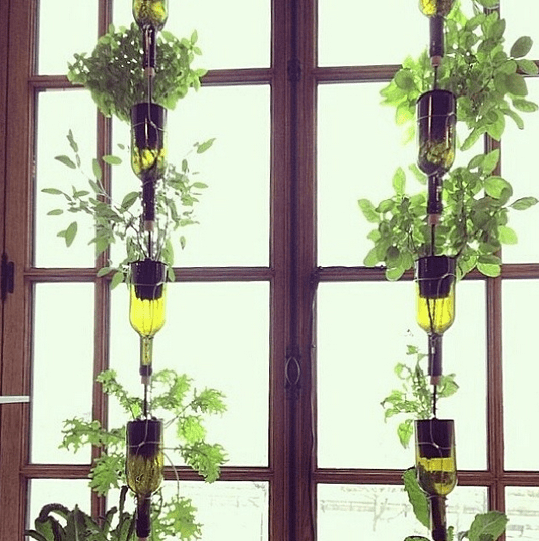
hanging bottle gadn via urban organic gardener

Cut glass bottle window garden via Urban Organic Gardener

Old School Gardener


lily of the valley by Jill RaggetLily of the Valley among the paving

Old School Gardener

Municipal Dreams's avatarMunicipal Dreams

Council housing transformed Bristol between the wars.  Some 15,000 council homes were built, principally in nine new suburban estates.  Forty per cent of new homes in the city in this period were council homes.  Designed according to the finest planning principles of the day, they represented not just new buildings but radically altered lives.

Woodcote Road, Hillfields Park, c1930 © Paul Townsend and made available under the Creative Commons licence Woodcote Road, Hillfields Park, c1930 © Paul Townsend and made available under a Creative Commons licence

Despite these later efforts, Bristol had come slowly to the necessity of council housing.  Before 1914, the Corporation had built just 72 tenement homes – and these mainly to replace homes demolished in road improvement schemes.  Constructed in Fox Road, Chapel Street, Braggs Lane, Millpond Avenue and Fishponds Road, the only survivors of this period are tenements in Mina Road, St Werburghs. (1)

Mina Road tenements Mina Road tenements, built 1906

But even before 1914, a wind of change was apparent.  Though a proposal to build a…

View original post 1,604 more words

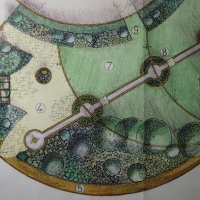
vertical gdn pattern via urban gdns


Wall carpet via Urban Gardens– or maybe a plan of the wider garden? 😉

Old School Gardener

Install Your Own Green Roof

harland garage roof

Maddy Harland describes how to convert a pitch and tar flat roof into a green roof: a beautiful and enduring paradise for birds and bees -click the title for the full article.

Old School Gardener

Finding Nature

Nature Connectedness Research Blog by Prof. Miles Richardson

Norfolk Green Care Network

Connecting People with Nature

Discover WordPress

A daily selection of the best content published on WordPress, collected for you by humans who love to read.

Susan Rushton

Celebrating gardens, photography and a creative life

Unlocking Landscapes

Writing, photography and more by Daniel Greenwood

Alphabet Ravine

Lydia Rae Bush Poetry

TIME GENTS

Australian Pub Project, Established 2013

Vanha Talo Suomi

The Journey from Finnish Rintamamiestalo to Arboretum & Gardens

Marigolds and Gin

Because even in chaos, there’s always gin and a good story …

Bits & Tidbits

RANDOM BITS & MORE TIDBITS

Rambling in the Garden

.....and nurturing my soul

The Interpretation Game

Cultural Heritage and the Digital Economy

pbmGarden

Sense of place, purpose, rejuvenation and joy

SISSINGHURST GARDEN

Notes from the Gardeners...

Deep Green Permaculture

Connecting People to Nature, Empowering People to Live Sustainably

BloominBootiful

A girl and her garden :)