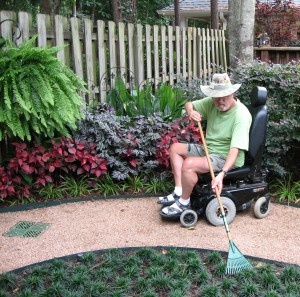
 This is the first in a new series of articles aimed at providing some tips on using design successfully in your (or someone else’s) garden.
Do you have a disability? Maybe someone in your family isn’t as mobile as they were? Perhaps normal ageing processes are reducing your ability to garden in the way you once did?
Disability can take many forms – it might affect someone from birth or early life or perhaps is the result of an accident or the processes of ageing. The UK Equality Act 2010 (which replaced the Disability Discrimination Act 1995) talks about a person having a disability ‘if you have a physical or mental impairment that has a ‘substantial’ and ‘long-term’ negative effect on your ability to do normal daily activities.’ The Act requires the providers of services to make ‘reasonable adjustments’ for a disabled person in any place which members of the public are permitted to enter, which includes public parks, gardens and other open spaces.
The Equality Act and associated design guidelines, which seek to remove obstacles to access, enjoyment and use of public spaces, is also a useful starting point when considering the design of a private garden or open space for someone with a disability. This covers people who are wheelchair users, have restricted mobility, sensory impairments or a learning disability, but also those who might be affected by the conditions that are associated with the normal process of ageing; e.g. loss of stamina, arthritis, declining vision and hearing and reduced balance.

Public parks are making it easier for disabled users
As with any garden design project asking the client what he/she wants to do in their garden is the starting point – and absolutely essential if the client has a disability of some kind. Detailed assessment of their abilities, interests and disabilites can be obtained through more specific follow up questions:
-
how far can you walk?
-
how far can you bend?
-
has everything to be done from a wheelchair?
-
what do you see?
-
what can you hear?
As well as these questions it is important to observe the client in the garden, around the house etc. to see how they walk, bend, the shape of their body, how they make a cup of tea (lifting, holding, carrying skills). Often people with arthritis have coped for so long they can no longer describe how they move, so it’s important to watch them. So, taking careful and detailed note of the individual’s abilities and desires is the critical starting point for any assessment and design of a garden for someone with a disability.
At this point its worth asking – is the disability of an order or kind that means their current garden can be suitably adapted, or do they need to think about moving or perhaps becoming involved in more communal gardening activity which is more in line with their ability and physical strength?
If the answer is that they can ‘stay put’, then options open include not only physical changes in the garden , but getting outside help for tasks like lawn care, hedge cutting, or one off construction projects. This might be paid contractors but could also be helpful friends, relatives or neighbours. When looking at the garden, it might also be possible to change a person’s gardening routines and practices, such as installing raised beds if they can’t bend over or are wheelchair bound; installing automatic irrigation systems; making paths easier to use by putting lights along them, clearing vegetation away from them and perhaps putting in more defined edges as well as levelling uneven surfaces to make routes more obvious and less of a ‘trip and slip’ hazard.
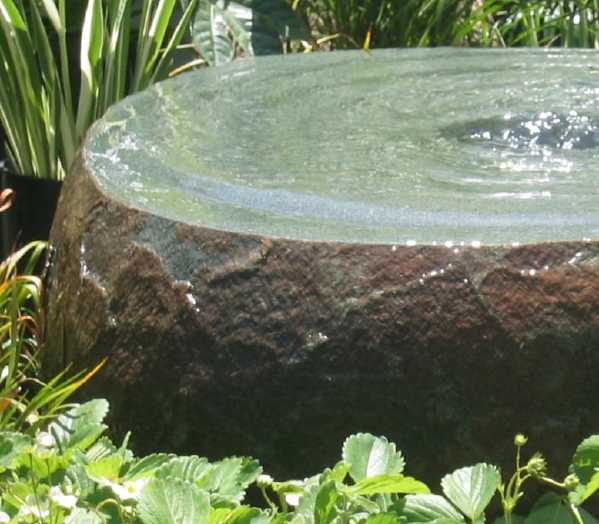
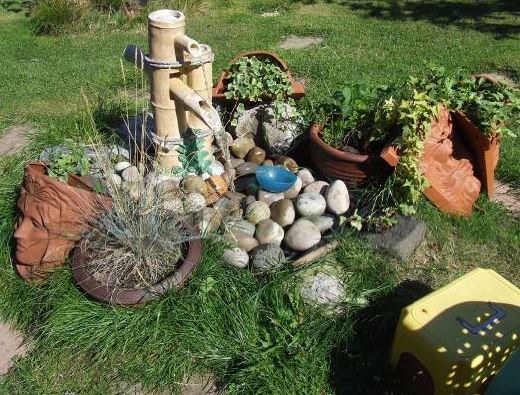
Water features can be important in gardens designed to stimulate the senses
Paths and seats
But it’s also important to look carefully at things like the gradients of paths. Following recommended standards can result in ramps or other structures which do not meet the wider or particular needs of the individual. For instance whilst a ramp might be perfectly in line with the standards, the user might be wary of using it because they are afraid the ramp will make them lose control of their wheelchair and they will go crashing into a low wall at a T junction at the end of the ramp’s run. A more suitable alternative might be to install a longer ramp (with a gentler gradient) going in a different direction and/or removing the low wall.
Path widths are another area that will repay close attention. A 1.2 metre wide path may not be wide enough for someone in a wheelchair who is being pushed – try to imagine pushing the person and trying to constantly get past the chair to talk to the person face to face, rather than constantly taking to the back of their head! With restricted or no sight, or a hearing impairment, a muffled or hidden face heightens the level of disability. And think about a space where the wheelchair (or perhaps someone with a guide dog) can stop and there is comfortable space for the carer/assistant/friend to sit alongside the wheelchair user for a chat. So think a parking space for the wheelchair alongside a conventional seat might be a good idea.
Paths also need spaces where turning is possible for both pushed and self propelled wheelchairs. If the client has restricted mobility but does not use a wheelchair, think about seat heights and surrounding space to allow for comfortable descent and ascent from the seat. The number of seats in a garden for someone with arthritis may need to be increased to make it easy for them to take frequent rests while walking about or gardening.
Path and other hard surfaces shouldn’t be totally smooth and slippery (especially when wet), but also not so ‘riven’ that they give a bumpy wheelchair ride. Resin – bonded gravel works well and looks good, though it is relatively expensive. Ensure that the client can get in and out of their house comfortably- how do they lift their legs over a door threshold? What surface do their feet connect with? Risers may need to be lower than the standard 150mm, and people with inflexible ankles may need steps rather than ramps.

‘Disability’ extends way beyond wheelchair users
Beds and borders
Design beds and borders with the abilities as well as the interests and desires of the client in mind. Checking the ability to bend over comfortably (including from a wheelchair or mobility scooter) is critical in deciding the height and size of any raised beds, For some garden tasks – clipping low hedges for instance – the wheelchair/scooter user may already be at the perfect height!
When it comes to planting, the usual considerations apply:
-
what’s the climate (and any microclimates) like?
-
what space is there?
-
what is the aspect?
-
what sort of soil is there?
-
what are the irrigation options?
But it’s also especially important to think about the senses of the disabled client and respond to their abilities as well as disabilities. So, can heightened attention be given to specific sensual experiences in the garden’s planting? For example planting herbs for smell, planting things to touch – e.g. furry leaves such as Stachys byzantina (‘Lamb’s Ears’),things to taste straight from the plant (vegetables, fruit, flowers, leaves etc.) and planting grasses and other plants that create interesting sounds (and maybe also things that help to reduce noise pollution from outside the garden). It’s also worth thinking about how your planting will support wildlife. Getting any ‘free’ helpers in the garden by planting nectar rich plants or those that provide a habitat will all help to reduce the gardening burden for the disabled person. Planting should also be chosen which gives a range of visual interests – textures of foliage, bark etc; seasonal changes in leaf, bark and form; different heights and shapes by the way plants are grouped and massed.

One sort of raised bed- with removable containers

A more permanent, fixed raised bed
Down sizing
But what if the client’s garden is just too big and can’t be easily managed? The option of garden ‘down sizing’ (perhaps coinciding with a reduced size house too) is a choice that suits many people, especially as age related disability starts to affect them. One option might be to offer part of the garden to a friend or neighbour to manage as a sort of allotment, What remains or perhaps a new, smaller garden area, can still provide varied and interesting gardening. Patios, courtyards, terraces and balconies all offer possibilities through container gardening (the larger the better to reduce the need for watering).
These containers should be frost proof and of a weight when full of soil and plants that means they can be moved (if this is required) – or perhaps they can be mounted on wheeled platforms available from garden centres. Window boxes are another useful option for balcony railings or window sills. These ‘shrunken gardens’ can be planted to give all year round interest (perhaps including some evergreen shrubs for instance) as well as low maintenance plants (e.g. bulbs and shrubs), height variation (perhaps by adding a trellis to the back of a container to allow a climber to be grown), using hanging baskets with pulley systems to make it easier to lower and raise them for watering (and/or using a ‘watering wand’).
Communal gardening
Finally, it may be that the client is no longer able to manage the full range of garden tasks and a more communal approach is appropriate. Sheltered, supported housing and residential homes often provide a communal gardening space which the residents maintain, perhaps with some outside help. Just as with the individual disabled person, where communal gardens are being set up or developed it is important to involve the residents in the design process. Spending time talking to and understanding them and teasing out what sorts of garden they would like is vital, as is the involvement of care staff who will have another perspective on the way the garden can be used. For example, a garden with lots of hard landscaping might make sense for clients with a restricted mobility or who are wheelchair users. Similarly the planning of routes around the garden and the views out of individual bedrooms/ apartments are important design considerations
For the individual a more communal style of gardening offers scope for learning new knowledge and skills as well as sharing their own. This ‘garden therapy’ can extend into bringing in specialist assistance and advice, creation of libraries of gardening books/ other resources and provision of meeting places and outings to maintain and foster residents’ interest in the garden and gardening.

An accessible water feature
Different disabilities lead to different design responses and focuses, and whilst it’s tempting to focus on the needs of those who are wheelchair users, there are other conditions that are just as important. For example:
-
Arthritis reduces bodily strength, endurance and flexibility so start by looking at adapting tools, get special devices and modify gardening routines to cope – e.g cushioned hand grips, adjustable handles, different sizing options on tools. in time more fundamental changes to the layout of the garden may be needed.
-
Hypertension can be helped through gardening activity and so reduce the risk of heart disease – 30 minutes of moderate exercise a day is recommended!
-
Visual impairment may lead to a loss of focus or sense of depth, so ‘fine tune’ the garden: perhaps add ramps; improve storage of hoses; and refine gardening tasks. Taping different tools in different colours can aid recognition – and retrieval from borders!
-
Reduced balance suggests a need for smooth walking surfaces, with good grip/traction, hand rails. Levelling uneven grass and paved surfaces, adding raised beds and seating at key points in the garden may all help.
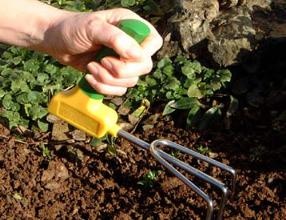
Special tools can be useful for the disabled gardener
To sum up – talking to the disabled person and achieving a detailed understanding of their desires, interests and abilities as well as their disabilities is critical when considering the design of a new garden or adaptation of an existing one. There are many ways of making the garden easier to access and easier to use and garden in. The client must know that you have listened and the design must show this and be owned by the client – even if that’s a close relative or yourself!
Sources:
‘The Age Proof Garden’ – Patty Cassidy (Arness Publishing 2012)
‘Go Easy’ – Bella D’Arcy (Garden Design Journal November 2008)- see an extended article here
Further information:
Old School Gardener
If you’ve enjoyed reading this post and others on this blog, why not comment and join others by signing up for automatic updates via email (see side bar, above right ) or through an RSS feed (see top of page)?








 Old School Garden