Latest Entries »

I recently had a ‘tweet’ from fellow Norfolk resident, Claire in Thetford. She was wondering what the growths on these leaves were.

I must admit to being a bit puzzled at first, but some further research suggested that they are some sort of Gall, which Wikipedia describes as:

‘…abnormal outgrowths of plant tissues and can be caused by various parasites, from fungi and bacteria, to insects and mites. Plant galls are often highly organized structures and because of this the cause of the gall can often be determined without the actual agent being identified. This applies particularly to some insect and mite plant galls.’

My guess from the pictures was that these were galls possibly created by some sort of parasitic wasp (in this case on the leaves of a Lime Tree). Claire’s own research came up with a more precise description: a ‘Nail Gall’ formed by a small mite Eriophyes tiliae. These microscopic mites overwinter in the bark of lime trees and crawl on to the underside of the foliage in spring to feed. The mites secrete chemicals into the leaves causing them to produce the unusual projections into which the mites move to continue feeding during the summer. Infestations of mites and the nail galls they induce don’t appear to affect the health of the trees and there’s no way of controlling or preventing them. The galls caused by this mite are said to be yellow-green or red in colour (see picture below). It may be that the whitish nails in Claire’s picture have been be caused by another mite (Aceria lateannulatus), which affects both the small-leaved lime (Tilia cordata) and the Common Lime (Tilia x europaeus), but not the large-leaved lime (Tilia platyphyllos).
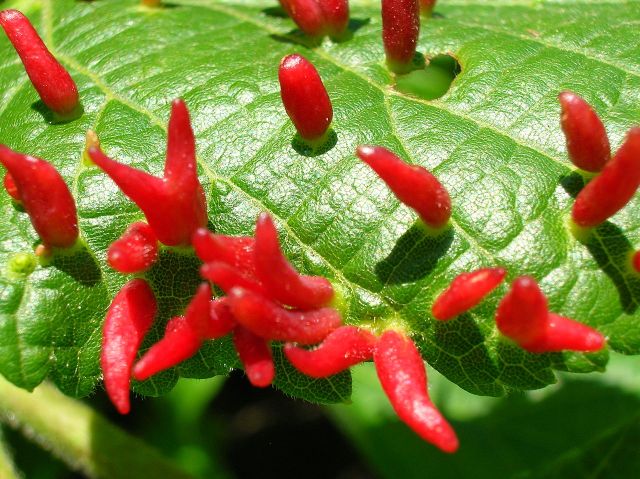
Nail Galls cauised by Eriophyes tiliae

Nail Galls cauised by Eriophyes tiliae

Galls are fascinating phenomena. As Wikipedia continues, those created by insects are:

‘…highly distinctive plant structures formed by some herbivorous insects as their own microhabitats. They are plant tissue which is controlled by the insect. Galls act as both the habitat and food source for the maker of the gall. The interior of a gall can contain edible nutritious starch and other tissues. Some galls act as “physiologic sinks”, concentrating resources in the gall from the surrounding plant parts. Galls may also provide the insect with physical protection from predators.

Insect galls are usually induced by chemicals injected by the larvae or the adults of the insects into the plants, and possibly mechanical damage. After the galls are formed, the larvae develop inside until fully grown, when they leave. In order to form galls, the insects must seize the time when plant cell division occurs quickly: the growing season, usually spring in temperate climates, but which is extended in the tropics.

The meristems, where plant cell division occurs, are the usual sites of galls, though insect galls can be found on other parts of the plant, such as the leaves, stalks,branches, buds, roots and even flowers and fruits. Gall-inducing insects are usually species-specific and sometimes tissue-specific on the plants they gall.’

Galls are also caused by fungi, bacteria, viruses and nematodes. It seems that in many instances these growths do not cause any significant harm to the plants they infest, though in some cases long term harm can be caused to some species, for example by affecting their overall shape and vigour.
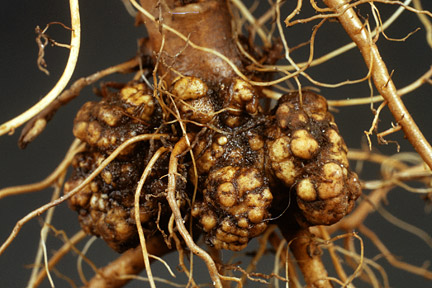
Crown Gall on apple- RHS

Crown Gall on apple- RHS

Crown gall affects a wide array of plants and roses are definitely one of them. It is a plant disorder caused by the bacterium Agrobacterium tumefaciens, that interferes with the plants ability to take up water and nutrients. This results in poor growth and weak plants that are easily stressed and injured- the only remedy in this case is to dig up the plant and dispose of it.

The study of plant galls is called cecidology. While these weird structures have intrigued humans for many years, there is still much that we don’t know about them.
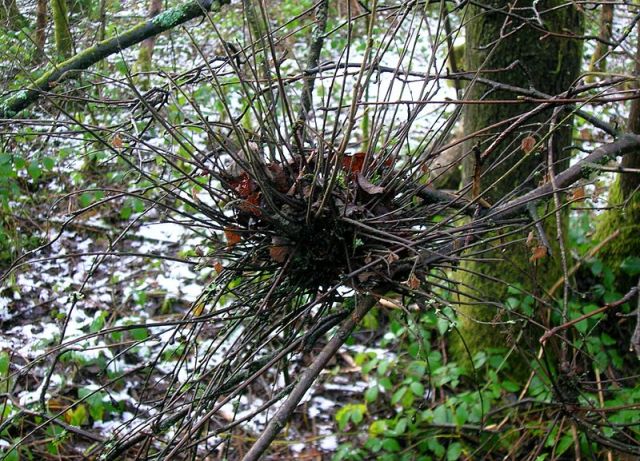
Wiches Broom Gall - picture Rosser1954

Wiches Broom Gall – picture Rosser1954

While some galls are well hidden and hard to spot, others are much more conspicuous. Have you ever looked up into a birch tree (Betula spp.) and noticed what looked like large, dense birds’ nests? In some cases these may well be nests, but very often they are actually galls called ‘witches’ brooms’. These are caused by a fungus (Taphrina betulina), which stimulates the tree to produce numerous extra shoots, resulting in a dense nest-like cluster. The fungus can then feed on the shoots. It was once believed that they were caused by witches flying over the tree!

If you spot an odd-looking growth on a dog rose (Rosa canina) it could well be a Robin’s pincushion gall, caused by a wasp (Diplolepis rosae). There was once a belief in England that these were caused by the woodland sprite, Robin Goodfellow or Puck. It is hardly surprising that people ascribed supernatural causes to some galls – they look pretty strange, and their causes aren’t exactly obvious.
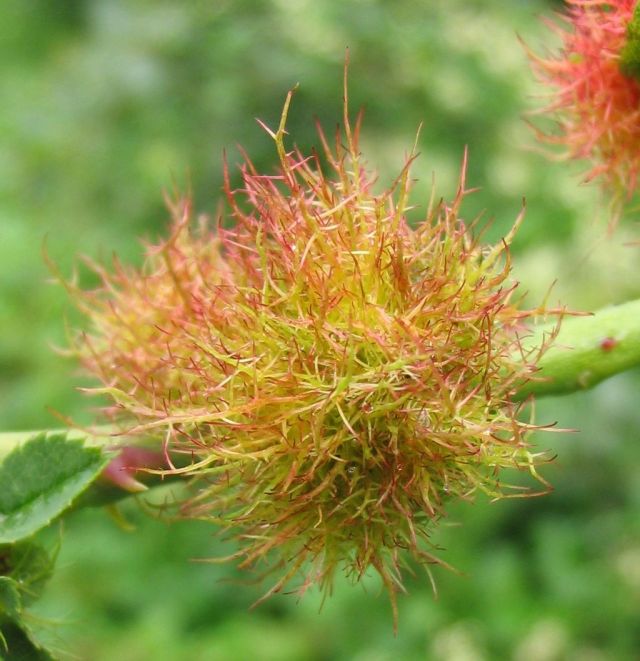
'Robins Pincushion' gall on a Wild rose

‘Robins Pincushion’ gall on a Wild rose

The real gall specialists include gall midges, gall flies and gall wasps. Perhaps one of the most familiar galls is the oak apple, caused by a tiny wasp (Biorhiza pallida).
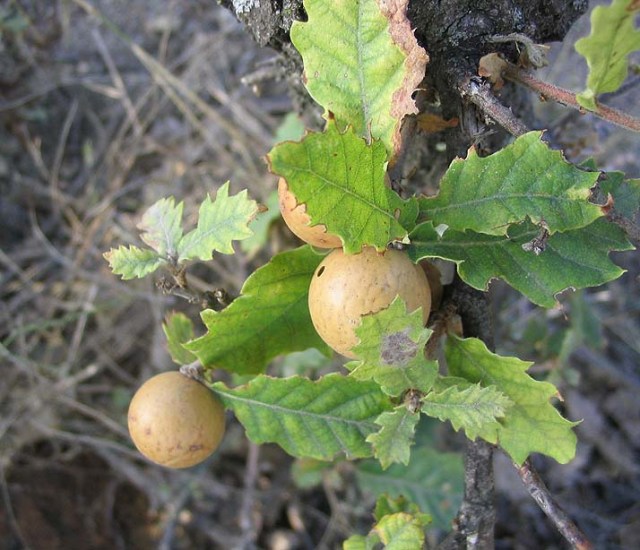
Oak apples

Oak apples

There are actually hundreds of species of oak gall wasps and they cause a fantastic variety of galls on oaks (Quercus spp.). A single oak tree may support many thousands of galls. Each gall wasp species creates its own unique and outlandish structure: some resemble cotton wool or marbles, pineapples or tiny UFOs!

Here’s a gallery of some of the other amazing galls to be found.

This slideshow requires JavaScript.

Sources and further information:

Galls- Wikipedia

Eriphyes tiliae- Wikipedia

British Plant Gall Society

Trees for Life- Galls

RHS- Crown Gall

Old School Gardener

If you’ve enjoyed reading this post and others on this blog, why not comment and join others by signing up for automatic updates via email (see side bar, above right ) or through an RSS feed (see top of page)?

Jardin's avatarJardin

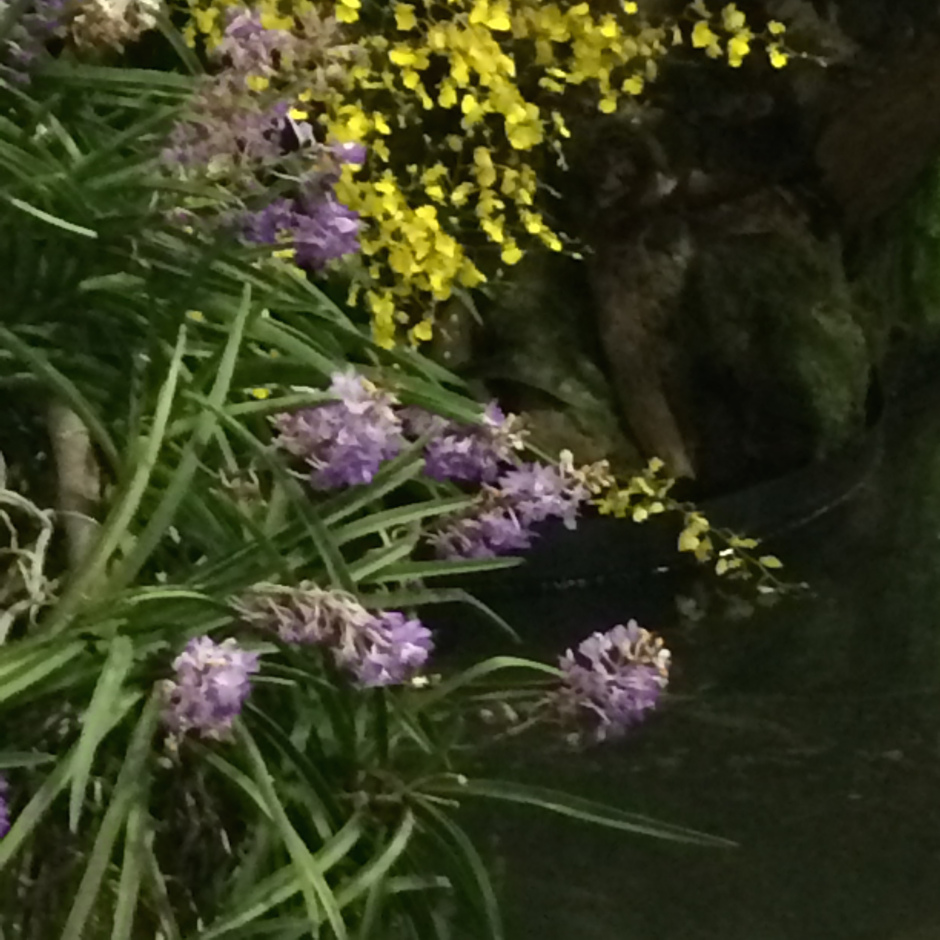
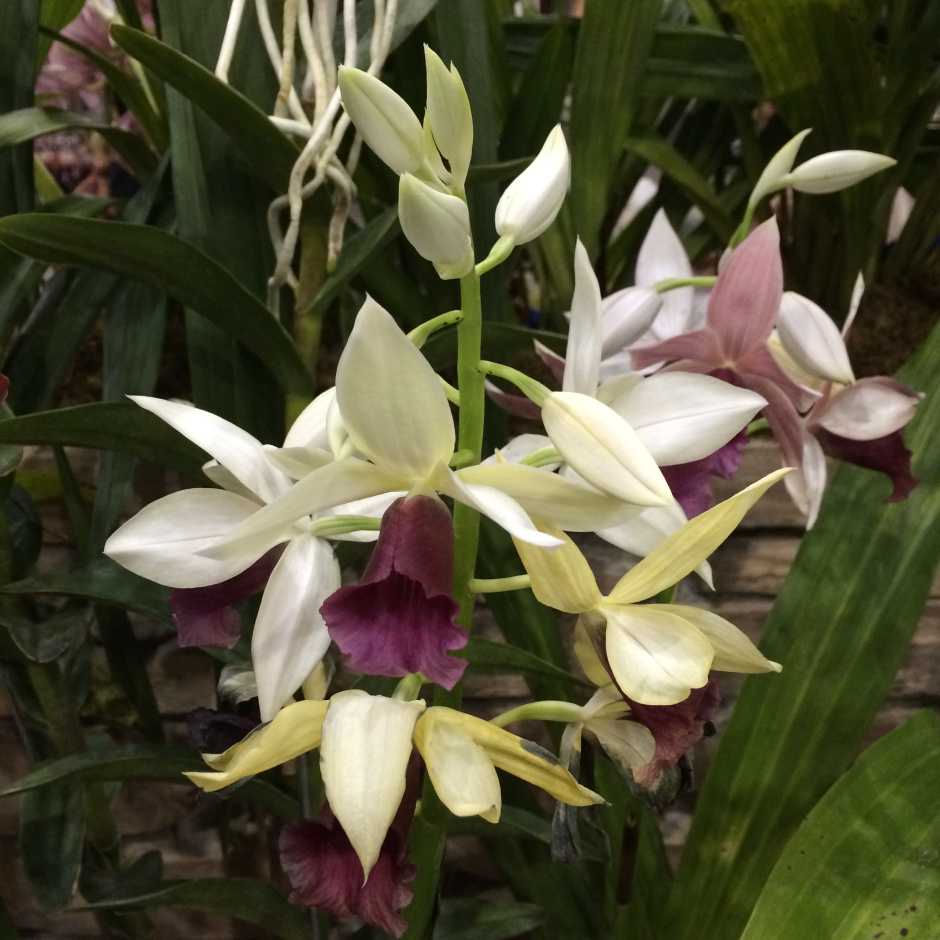
My recent stay in Johannesburg fortunately coincided with the World Orchid Conference and Show, sometimes called the Olympics of Orchids, at the Sandton Convention Centre.

World Orchid show

The Theme was “Gold in the Green Age”, reflecting the natural riches of southern Africa and the need to balance the exploitation of these riches with the preservation of the natural environment.

South Africa has almost 500 wild orchids, many only growing in SA. In Gauteng,the home province, there are 54 recorded wild orchid species, mostly terrestrial grassland orchids much threatened now by urban development.

World Orchid Show

I loved the Cape Orchid Society’s Stand which recreated a botanist’s study, complete with microscope and small reference library.

Botanist's study, World Orchid Show, Johannesburg Botanist’s study, World Orchid Show, Johannesburg

There were representatives from the orchid societies across South Africa, including the local Witwatersrand Orchid Society, whose emblem is the spring-flowering Leopard orchid (Ansellia africana).

Leopard orchid Leopard orchid

There were participants from Denmark, Ecuador…

View original post 164 more words

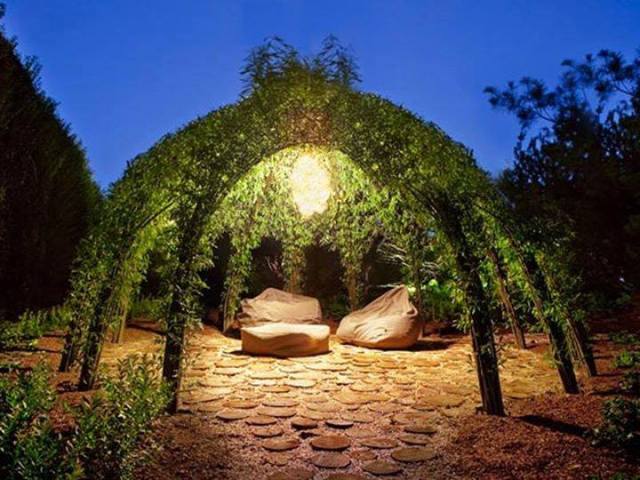
Living Willow Structure by Bonnie Gale

Living willow structure by Bonnie Gale

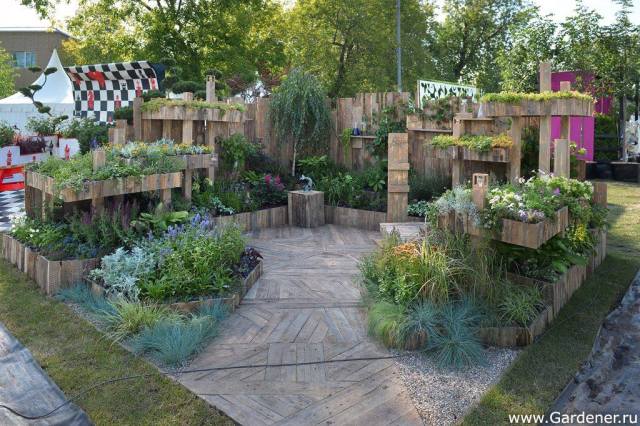
multi level gdn

I love the use of space in this garden. It also looks like something you can create from pallets and other recycled materials and offers a very effective and, I think, beautiful answer to maximising growing space in small gardens.

Old School Gardener

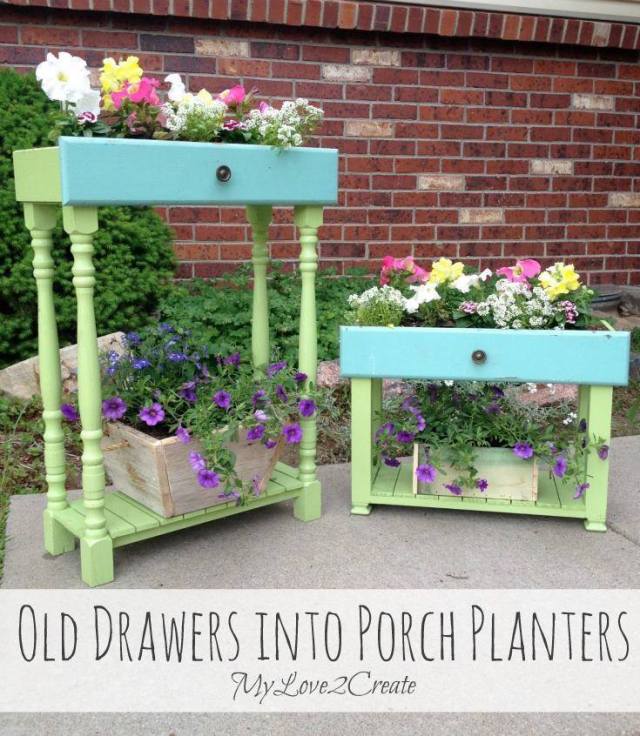
recycled drawers

canwefeedtheworld's avatarOne Billion Hungry: Can We Feed the World?

ID-100207881On the 29th September 2014 two events laid out global and African strategies for agriculture and food security. At its 24th session, the Committee on Agriculture (COAG), one of FAO’s Governing Bodies providing overall guidance on policies relating to agriculture, livestock, food safety, nutrition, rural development and natural resource management, met to discuss a wide range of issues, including family farming and sustainable agriculture.

Opening the event, FAO Director-General José Graziano da Silva, emphasised the broad range of options needed to transform global food systems and that a paradigm shift is needed to make agriculture sustainable. In particular a departure from “an input intensive model”. We need to reduce the use of agricultural inputs such as water and fertilizer and look to new solutions. Such approaches as agroecology, climate-smart agriculture and biotechnology were used as examples of alternatives to the current system but that their use…

View original post 620 more words

IMG_0972Old School Garden – 3rd October 2014

To Walter Degrasse

Dear Walter,

I’m feeling very guilty. A month has gone by and three weeks out of four we have been away from Old School Garden. So, as you can guess, I’ve not much to report as far as our garden is concerned, well at least in terms of effort, that is. I’m pleased to say, though, that due to the diligent watering of our son and neighbours, we were pleasantly surprised at the state of the garden on our return from foreign climes. Well, mostly.

I thought I’d give you a snapshot of some of the wonderful places we visited whilst away in Spain and Portugal, but first, one of the good things to report is the continued harvest. Here are a few pictures of this month’s offerings. As you’ll see, I’ve cheated a bit and included a bag of almonds donated to us by our hosts in Spain, Michael and Lisa. We sampled some of these, and especially loved the salted ones- I threw a few into a Spaghetti Bolognese we had for supper one day- they added a new dimension!

More generally, the Old School Garden has definitely put on some of its autumn clothes. However, the driest (and possibly the warmest) September on record in the UK has meant that some things you’d associate with high summer have continued to put on a show, or in some cases, a second flowering. I even spotted some new strawberries in our patch! I’m hoping that the weather will be kind enough to encourage the Melianthus major to flower this year; you remember I grew this from a cutting I took whilst working at Peckover House a couple of years ago? It’s the plant with leaves that smell of peanut butter when you rub them and has claret-coloured spikey flowers.

Here’s a selection of pictures of some of the ornamental interest in the garden right now…

This slideshow requires JavaScript.

I said that the previous month had involved little gardening effort on my part. I’d forgotten a few things that I managed to squeeze in between the holidays:

  • I sowed some green manure (Phacelia) which is now beginning to look good

  • I tackled (with our soon to move neighbour) an overgrown, mixed hedge boundary and removed a lot of growth to open up the kitchen garden to more morning sun

  • I did the usual late summer round of hedge clipping (and managed to cut through the hedge clipper’s electric cable too)

  • I took some yew cuttings from the old bushes/trees at Gressenhall, and last, but not least…..

  • I continue to ‘deal with’ the rash of mole hills and runs that have spread right across all the areas of our grass (I don’t any longer call them lawns).

Turning to our trips abroad, these weren’t all about visiting gardens, parks and other lovely places – near the end we did a bit of ‘hands on’ gardening! Our daughter and son-in-law live in Almada, just over the river from Lisbon, Portugal. Their apartment has a rear patio (which I’ve written about before) and also a rather blank piece of ground at the front. This is covered with different layers of concrete and apart from providing a parking place for our son-in-law’s motorbike, does little more than collect wind-swept rubbish and provide a challenging growing space for some tough old weeds which seem to have gradually worked their way into cracks and, once there, swelled these as their roots get a grip.

I don’t know if it was us tiring of being on holiday or the annoyance of looking at this plot every day, but Deborah proposed to do some weeding one morning and so three of us set out ‘armed’ with only our hands and a draw hoe (not usually put into service for this sort of job). You can see the result below. Having begun with limited ambitions, not surprisingly we managed to remove some large chunks of concrete (!) and tilled the rather poor soil in readiness for some planting next year (I suggested some annual poppies and marigolds as good ‘pioneer’ species). Diego, our son-in-law, was obviously inspired by this effort and is now proposing to remove a larger strip of concrete to create some more significant planting areas…watch this space.

I promised you a snapshot of some of the wonderful places we visited whilst in Spain and Portugal, so here’s a selection to whet your appetite for more extensive articles (and pictures) in the next few weeks…

This slideshow requires JavaScript.

I almost forgot to mention my holiday reading. Whilst our travels meant we weren’t able to read that much, I did make a start on ‘Noah’s Children’ by Sara Stein. You may recall that I was pointed in her direction by a fellow blogger? After reading her previous book ‘Noah’s Garden’ (in which she discusses her approach to ecological gardening), the sequel gets into the whole issue of how we do or don’t enable children to build a relationship with their environment. I’ve been saving some thought-provoking extracts from this and will somehow share them with you in the coming weeks. Here’s a starter from the Introduction, where Stein sets out her stall for the rest of the book:

‘Land is nourished or not by humans; humans are nourished or not by land. Place and occupant only seem separable because we have created such a distance between liveliness and livelihood. In creating that distance, we have unwittingly detached the nature of childhood from the sense it ought to make. Childish curiosity is to make connections, to realize the larger picture, to become able in the physical environment our lives depend on. We’ve removed the red from the fruit, the fruit from the tree, the tree from the wood, the wood from all the things a child might make of it, and so left fragments much harder to connect than laces on a shoe.’

To conclude this month’s letter, Walter, I’ve a positive note, not unrelated to the theme of ‘Noah’s Children’. Whilst at Gressenhall Museum on Wednesday, the co-ordinator Lynne, mentioned a comment she’d had from a recent visitor. The visitor said her young children loved coming to the ‘Curiosity Corner’ I and colleagues had created for under 5’s in a small part of the gardens here; to the extent that she’d spent a considerable sum getting her own garden landscaped to make it more ‘child friendly’, to introduce some of the features that can engage the young mind in exploring and learning from their environment. That warmed my heart.

The Kitchen Garden in autumn - 'fulsome'

The Kitchen Garden in autumn – ‘fulsome’

All the best for now, old friend,

Old School Gardener


Municipal Dreams's avatarMunicipal Dreams

The London County Council built over 89,000 homes between the wars.   Over half – some 47,000 – were built in out-of-county ‘cottage suburbs’.   The Watling Estate, then in the urban district of Hendon, was the third largest of these (after Becontree and St Helier) with a population of 19,000 by 1939. But not everyone was sympathetic to the drive to rehouse Londoners from the crowded inner-cities, at least not in their backyard: (1)

Under construction, 1927: Burnt Oak Station to the right and Watling Avenue and Watling Avenue and Barnfield Road in centre © Britain from Above, EPW019190 Under construction, 1927: Burnt Oak Station to the right and Watling Avenue with Watling Avenue and Barnfield Road in centre © Britain from Above, EPW019190

Isn’t it time that Mill Hill woke up and tried to save itself from being trampled to death? Already the raw, red tentacles of that housing octopus, the London County Council Watling Estate, are pushing their way through the green meadows, devouring everything in their path…LCC wooden bungalows face houses that sold a…

View original post 1,284 more words

Tim Gill's avatarRethinking Childhood

I was in Bilbao a few weekends ago and spent several evenings in Plaza Nueva, a square in the old town and a popular weekend meeting place for local people. While grown-ups enjoyed drinks and tapas (or to use the Basque term, pintxos) in bars under the elegant colonnades, the central area was humming with children playing. Ball games, scooter races, chalk-picture-drawing, heely tricks (remember Heelys?) and chit-chat were just some of what was in the mix.

IMG_4002

View original post 736 more words

Finding Nature

Nature Connectedness Research Blog by Prof. Miles Richardson

Norfolk Green Care Network

Connecting People with Nature

Discover WordPress

A daily selection of the best content published on WordPress, collected for you by humans who love to read.

Susan Rushton

Celebrating gardens, photography and a creative life

Unlocking Landscapes

Writing, photography and more by Daniel Greenwood

Alphabet Ravine

Lydia Rae Bush Poetry

TIME GENTS

Australian Pub Project, Established 2013

Vanha Talo Suomi

The Journey from Finnish Rintamamiestalo to Arboretum & Gardens

Marigolds and Gin

Because even in chaos, there’s always gin and a good story …

Bits & Tidbits

RANDOM BITS & MORE TIDBITS

Rambling in the Garden

.....and nurturing my soul

The Interpretation Game

Cultural Heritage and the Digital Economy

pbmGarden

Sense of place, purpose, rejuvenation and joy

SISSINGHURST GARDEN

Notes from the Gardeners...

Deep Green Permaculture

Connecting People to Nature, Empowering People to Live Sustainably

BloominBootiful

A girl and her garden :)