
Latest Entries »
 My fifth offering from a book I bought in a charity shop recently…..
Glut
The trouble with overspill is that you find yourself being nice to neighbours you never liked.
Corollary: when the radish season is at it’s height, a neighbour in need is a friend indeed.
Plenty
The number of any given relatives, friends,business colleagues and acquantainces a gardener may have at any given time varies in direct proportion to the season; i.e. whether the raspberries and strawberries are ripe.
Corollaries:
1. The number increases or decreases with the type of gardener- the one who picks the fruit for you and the one who says, ‘Help yourself’.
2. Nothing from the country garden is given away, except for a very good reason.
From : ‘Mrs. Murphy’s Laws of Gardening’ – Faith Hines (Temple House books, 1992)
Old School Gardener
 ….or:
….or:
‘OK, so I’ve germinated… what’s next?’
Seedling seen on the beach at Arrabida, Portugal
Old School Gardener

Each summer we trek a couple of hundred kilometres to camp at Kejimkujik one of Canada’s east coast national parks. For the kids it’s an unparalleled play ecosystem – woods, water, wildlife, wonder. They always have something close at hand in the natural environment that is readily transformed into adventure.
This trip, we are tucked away in the far corner of a walk in area. The cozy comfort of familiarity is all around us. We’ve tented here several times over the years on solo family excursions and with friends. A small inlet is just down the path where rocks, a mighty old tree and gently rippling water beckon.
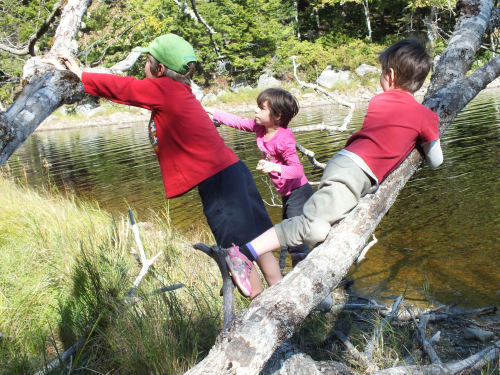 Gathering moss and lichen from old man tree
Since our last stay, old man tree is no longer reaching skyward. Cracked at the trunk and toppled, its growing days are over. But like the tree in Shel Silverstein’s story (original animation video)…
View original post 463 more words

It was late September and we had travelled to Spain for a week’s break in a farmhouse home in a remote mountainous region of innner Andalucia. Having settled in, done our first food shop and enjoyed our first evening meal by the pool we decided to make a short trip out on our first full day to the nearby village and lake of Iznajar.

- Felicity enjoying our lunchtime view
Andalucia.com describes the village and area:
‘This small town of some six thousand inhabitants was transformed some years ago by the creation of an ’embalse’, or reservoir, below the promontory on which Iznajar sits in the River Genil valley. Today, to all intents and purposes, Iznajar now has a waterfront, overlooking an inland sea some thirty kilometres long, and containing an estimated 900 million cubic metres of water destined for domestic consumption…
Iznajar itself escaped the submersion that often visits towns and villages in the region of Andalucía’s controversial programme to construct more and more dams and reservoirs to serve this increasingly thirsty region. If anything, the lake below has given further resonance to its unofficial title as the Mirador (viewpoint) del Genil. Surrounding countryside and communications have been radically altered, not least by a bridge built across the reservoir near Iznajar in order to continue to carry traffic on the Archidona/Priego de Córdoba road…
The village was originally a prehistoric Iberian settlement, but flourished in the eighth century when Arab settlers, in the wake of the 711AD invasion by Tariq ibn Zayid and his Moorish armies, built a castle on the promontory and called it ‘Hins Ashar’ (hence the modern Spanish name). It became the focus of battles between various north African factions, finally being taken by the army of Abderramán III. After the fall of the Caliphate of Córdoba, then the capital of Al-Andalus, it fell under the rule of the dependency of Granada. In 1431, in the reign of Catholic monarch Juan II, it was taken back by the Christian rulers, some sixty years before Granada was to fall in 1492. Iznajar gained brief notoriety in 1861 when the town supported an uprising against the monarchy, led by Rafael Perez del Alamo, with grimly predictable consequences…
The ruins of the 1,200-year-old castle are the obvious key attraction for the visitor… Parts of the fortified town walls can also be seen in the upper reaches of the town. Inside the town walls, a small square called the Patio de las Comedias suggests that, despite its defensive position, Iznajar once had a theatre culture that probably tracks back millennia… the Iglesia de Santiago church, (was) built over time during the fifteenth and sixteenth centuries, with a remarkable late addition in the form of a Baroque altar piece. The cemetery next to the church only dates back to 1806…
The most interesting barrio, district, of Iznajar is the Barrio del Coso, a labyrinth of typical whitewashed Andalucían houses dotted around a labyrinth of narrow lanes that criss-cross the promontory. As if often the case in these hill towns, the ‘lower’ part is also the newer part of town…..’
I loved the majestic setting of this lovely village and the obvious care the residents take in looking after their private and public spaces. Having ‘mooched’ around the village in the morning and had a light tapas lunch with a splendid balcony view across the village, we moved off to the nearby ‘beach’, where we had the place almost to ourselves (that’s wife Deborah and friends Nick and Felicity). The beautiful setting, warm sunshine and water (I actually swam!) made for a relaxing beginning to our week’s adventure…
Old School Gardener

I love Autumn; the crisp, frosty mornings when spiders webs appear to have been decorated with crystals, the misty mornings when the fields are cloaked in white and the rich, damp, earthy smells as you walk through the woods. At this time of year most of the plants in the garden have started to die back, the stars of Autumn to my mind are the trees, many of which are dazzling in their ‘coats’ of many colours and heavily laden with masses of fruits and seeds of varying colours, shapes and sizes just waiting for the perfect time and opportunity to break free and become the next generation of trees.
There are many varieties of trees where I live, I just cannot resist the temptation to collect their seeds, my favourites are conkers from the Horse Chestnut Tree and the Spinning Jennies from the Maples, Sycamores and Ashes it is lovely…
View original post 331 more words
 The Walnut tree genus (juglans) has 21 species, but there are two main species in common garden or landscape use; the Black Walnut (Juglans nigra) and English (or Common or Persian)Walnut (Juglans regia). I’ve recently written about the poison they both contain and what this means for growing other plants underneath or nearby.
Common name: ‘Walnut’ or Black/English/Common/Persian Walnut. The word walnut derives from the Germanic wal– and Old English wealhhnutu, literally “foreign nut”, wealh meaning “foreign”. The genus name “Juglans” comes from Latin jūglans, meaning ‘walnut, walnut tree’; jūglans in turn is a contraction of Jōvis glans, ‘nut of [the god] Jupiter’
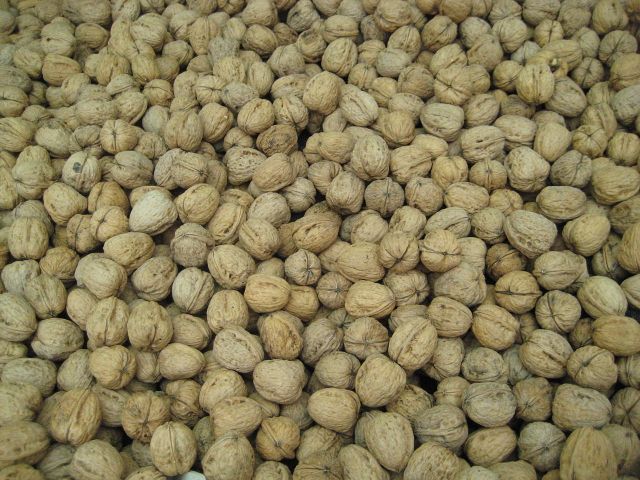 Native areas: The English Walnut (J. regia) originated in Persia, and the Black Walnut (J. nigra) is native to eastern North America.
Historical notes: The Black Walnut was introduced to Europe in 1629 from north America, whereas the English Walnut is thought to have been grown in Britian since Roman times. The worldwide production of walnuts has been increasing rapidly in recent years, with the largest increase coming from Asia. The husks of the black walnut Juglans nigra are used to make an ink for writing and drawing. Walnut ink has good archival properties, and was used by several great artists including Leonardo da Vinci and Rembrandt. Walnut husks are used as a brown dye for fabric. Walnut dyes were used in classical Rome and in medieval Europe for dyeing hair. The U.S. Army used ground walnut shells for the cleaning of aviation parts because it was inexpensive and non-abrasive. However, an investigation of a fatal helicopter crash in 1982 (in Mannheim, Germany) revealed that walnut grit clogged an oil port, leading to the accident and to the discontinuation of walnut shells as a cleaning agent.
Features: The Black Walnut is of high flavour, but due to its hard shell and poor hulling characteristics it is not grown commercially for nut production. The commercially produced walnut varieties are nearly all hybrids of the English Walnut. Walnuts are late to grow leaves, typically not until more than halfway through the spring. The blossoms also normally appear in spring. The male cylindrical catkins are developed from leafless shoots from the past year; they are about 10 cm (3.9 in) in length and have a large number of little flowers. Female flowers appear in a cluster at the peak of the current year’s leafy shoots. Both main species contain a chemical called “juglone” which can be poisonous (or allelopathic) to other plants. This can be a particular issue for growing other plants underneath a Black Walnut.
 Uses: As garden trees, Walnuts have some drawbacks, in particular the falling nuts and the release of Juglone.However, they are grown and both species make a stately subject for parkland and avenue plantings, or as specimen trees where space allows. The English Walnut develops a broad crown at maturity (and a height of 15- 20 metres). It also has delightfully aromatic young foliage, from which a wine can be made, followed by a crop of delicious nuts. It is smooth barked when young. Both species are also grown for their timber. The Black Walnut is fast growing and was awarded the RHS Award of Garden Merit in 2002. It can reach 20 metres or more in height and makes a large tree with a pyramidal crown. It produces an abundance of nuts over a long period, but they are rather difficult to extract from their very hard shells. It is rough barked from a young age.
Growing conditions: Walnuts are light-demanding species that benefit from protection from wind. Walnuts are also very hardy against drought. Walnuts grow on most soils but the English Walnut does not favour water logged conditions. The Black Walnut favours deep loam. Walnut trees are easily propagated from the nuts. Seedlings grow rapidly on good soils.

Walnut through the seasons….


Further information:
Wikipedia- Walnut
Wikipedia – Juglans
GQT: Underneath the Walnut Tree- what to plant.
Barcham trees directory- Juglans regia
Old School Gardener

By Sophie Towne
Over the last couple of months here at the Norfolk Museums Collection Centre we have largely been reorganising and giving a bit of TLC to our collection of fireplaces, fire screens, chimney cranes and roasting spits.
Each fireplace in our collection has its own character and personality; from grandiose and ostentatiously decorative to modestly useful.
Here are a couple of my favourite fire surrounds from our collection, polar opposites but both equally lovely:
 A typical fireplace from the 1850s with pillars decorated with acanthus leaves and Prince of Wales feathers in relief
 Cast iron fireplace with polychrome tiled floral surround dated 1910 from 72 St Mary’s Road in Lowestoft
This is just a taster of our amazing collection, check back soon for more updates on our fabulous array of all things fiery.
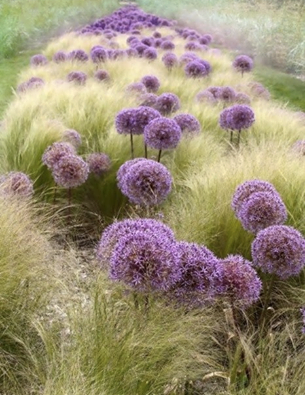
I love this planting scheme- simple combination of Alliums and Pony Tail grass (Stipa tenuissima)
Old School Gardener

We looked last week at the building of the Watling Estate and its early residents. Watling was seen – for good or ill – as a symbol of the ‘new England’. Middle-class observers – particularly the new breed of sociologists and planners – asked what type of community was it, was it a community at all? Perhaps what really concerned was that it should be the right sort of community.
 Storksmead Road
As we saw last week, it certainly wasn’t that for many of the well-heeled residents of near-by Mill Hill and Edgware, shocked by this supposed incursion of uncouth slum-dwellers. A 1927 letter to the Hendon and Finchley Times reported flowers stolen from gardens, fruit trees stripped and language that apparently even shocked a local workman. (1) Children attending the Watling Central School from outside Watling saw the Estate as ‘dirty’ and ‘rough’, according to Ruth Durant. (2)
 Watling Central School:…
View original post 2,068 more words




 Old School Garden