

Latest Entries »
 Koelreuteria is a genus of three species of flowering trees; K. paniculata, K. bipinnata and K. elegans
Common name: Common names include Golden Rain Tree, Pride of India, China tree, or varnish tree.
Native areas: The tree is Native to China and southern and eastern Asia.
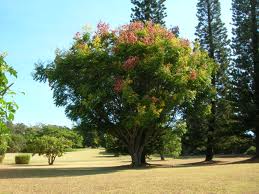
Koelreutia elegans subsp. formosa
Historical notes: It’s discovery is credited to Pierre d’Incarville, a Jesuit missionary; who sent first seed from China to Russia in 1747. It was classified by Russian botanist Erich Laxmann who named it after Joseph Gottlieb Kolreuter, from Karlsruhe, Germany, a contemporary and professor of natural history. It was later grown in Europe (by 1753) and reached America in 1811. The variety K. paniculata ‘Fastigiata’ was raised by Kew Gardens from seeds received in 1888 from Shanghai.
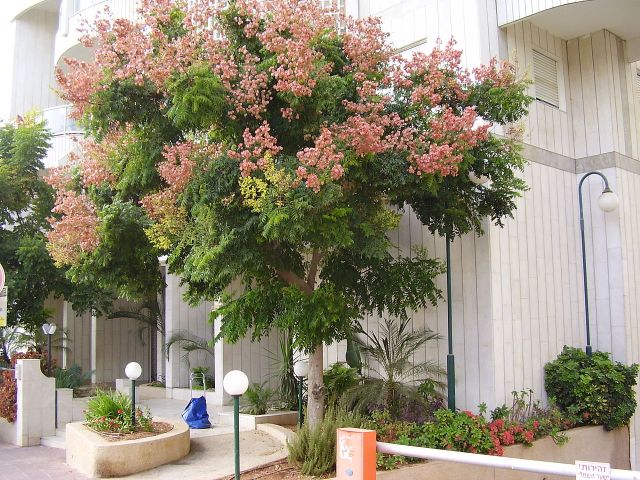
Koelreutia bipinnata
Features: Koelreuteria are medium-sized deciduous trees growing to 10–20 m (33–66 ft) tall, with spirally arranged pinnate or bipinnate leaves. Leaves are pinkish in spring, turning yellow in autumn. The flowers are small and yellow, produced in large branched panicles 20–50 cm (8–20 in) long. The fruit is a three-lobed inflated papery capsule or ‘bladder’ 3–6 cm long, containing several hard nut-like seeds 5–10 mm diameter. In some areas, notably parts of eastern North America, they have become invasive. the variety K. paniculata ‘Fastigiata’ tends to be shorter than the species (5-10 metres tall) and has a narrow columnar shape.
Uses: Koelreuteria are popularly grown as ornamental trees in temperate regions all across the world because of the aesthetic appeal of their flowers, leaves and seed pods. Koelreuteria are commonly used as focal points in landscape design. Several cultivars have been selected for garden planting, including ‘Fastigiata’ with a narrow crown, and ‘September Gold’, flowering in late summer. The seeds are edible when roasted, but are not commonly consumed. The variety K. paniculata ‘Fastigiata’ is a good choice for restricted spaces and excellent as a specimen tree in a park. The clusters of small yellow flowers which it produces in July and August are popular with bees and are followed by lantern-shaped fruits in the autumn.

Koelreutia paniculata ‘Fastigiata’ growing at Barcham Trees
Growing conditions: Koelreuteria grow in nutritionally poor soil including: clay, sand, well drained, alkaline, loam; they require full sun but not a lot of watering, with a moderate aerosol salt tolerance. They tolerate wind, air pollution, salt, heat, and drought and grow at a moderate rate, but are sometimes fast growers. Koelreuteria produce seeds that are blown away and get germinated and this might result in the growing of more trees next to the original one.’Fastigiata’ does best in dry, calcareous soils and in a reasonably sheltered position, such as an urban courtyard garden.

Fruit and flowers of K. paniculata
Further information:
Wikipedia- Koelreuteria
Wikipedia- Koelreuteria paniculata
Wikipedia- Kolreuteria bipinnata
RHS- Koelreuteria paniculata
Barcham Trees Directory- Koelreuteria paniculata
Barcham trees directory- Koelreuteria paniculata ‘Fastigiata’
Old School Gardener

As promised for the third in my week’s posts celebrating my 500th post we go down to Hertfordshire to explore Tom Stuart-Smith’s garden designs at his own home and the home of his sister. The family home at Serge Hill is surrounded by mature planting. The new gardens designed by T S-S are within its grounds. When these gardens open they are very popular with thousands of visitors making an appearance. It looks very busy and taking photos is difficult as the gardens are only open for one day each year as part of the National Garden Scheme, so people find it in the famous Yellow Book. The friendly herd of Guernsey calves greeted every visitor. We wandered through the gardens around the house which had been there a long time but the influence of T S-S can be seen.



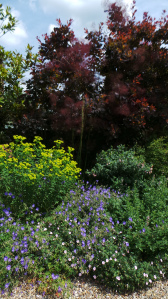


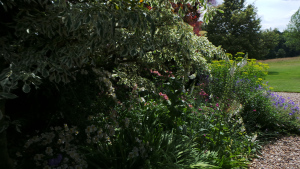
In the gardens at Tom’s and his…
View original post 203 more words
I’ve been writing about my recent trip to Andalucia, and in my last post covered the day we spent in Granada and especially the palaces of the Generalife and Alhambra. One of the powerful impressions of this visit was how water can be used to enhance a particular feeling or ambience of a space, so I took a couple of short videos to demonstrate this. The first is from the Generalife and is of a series of fountains in a fairly narrow court or garden. The feeling I get is of an active space, one which you’re encouraged to move through, onwards to the palace…. would you agree?
The second sound is of the Patio of the Myrtles in the Alhambra’s Nasrid Palace; a simpler, larger space where the barest burble of water adds to the restful atmosphere, and as I said in my previous post, the space is almost like an ‘outdoor cathedral’ in the way that sound is softened… enjoy…
Old School Gardener

 A series of international days as observed by the United Nations has and is taking place over several days this month.
Yesterday
Yesterday was International Day of Rural Women, the first of which occurred in 2008. The day is about recognising “the critical role and contribution of rural women, including indigenous women, in enhancing agricultural and rural development, improving food security and eradicating rural poverty.”
Rural women are crucial in attaining sustainable rural development but they often face inequalities in terms of access to productive resources, finance, health care and education. Women and girls are also more likely to be undernourished and to go without food despite the central roles they play in a household’s wealth and health. Gender equality and women’s empowerment are not only central to household welfare though but to rural communities, national economic growth and global food security. UN Women Executive Director Phumzile Mlambo-Ngcuka, in…
View original post 774 more words
 Victoria Park in Tower Hamlets, London, has beaten off stiff competition to be crowned the nation’s favourite park in this year’s prestigious People’s Choice Award, with a record breaking 32,694 votes being cast.
In second place was Mote Park, in Maidstone, Kent and in third place was Margam Park, in Neath, South Wales.
In the vote, organised by the Green Flag Award Scheme, which presents Green Flag status to the best open spaces in the country, Victoria Park came out on top against a staggering 1,482 parks and green spaces in the annual poll. The park has won the Green Flag Award on four occasions.
Victoria Park, now a two time winner of the People’s Choice Award, and also runner up in 2013, is London’s oldest and most important historic parks, visited by millions of Londoners for nearly 170 years.
The park is the largest in Tower Hamlets at 86.18 hectares in area and has one of the highest visitor numbers of all the London parks with around 12 million visits per year.
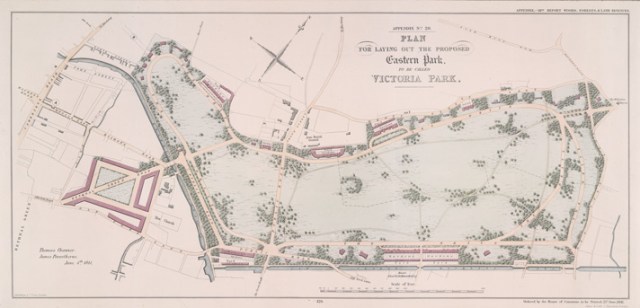
The Park proposed in 1841
Wikipedia offers some interesting facts on the Park’s history….
The original Park was laid out by notable London planner and architect Sir James Pennethorne between 1842 and 1846. The land had originally been parkland, associated with the Bishop’s Palace, but by the mid-1800s had been spoiled by the extraction of gravel, and clay for bricks. It was opened to the public in 1845.he Bridge Association can be seen inside these alcoves. A Lido opened in 1936 and reopened in 1952 following damage during the Second World War; it was closed in 1986 and demolished in 1990. The bathing pond, unused for bathing since the 1930s, is now popular with anglers.
In the latter half of the 19th Century, Victoria Park became an essential amenity for the working classes of the East End. For some East End children in the 1880s, this may have been the only large stretch of uninterrupted greenery they ever encountered. Victoria Park’s reputation as the ‘People’s Park’ grew as it became a centre for political meetings and rallies of all types. Although any one could set up their own soapbox, the biggest crowds were usually drawn to ‘star’ socialist speakers such as William Morris and Annie Besant.
This description by J. H. Rosney, correspondent for Harper’s Magazine (February 1888) evokes a scene:
‘On the big central lawn are scattered numerous groups, some of which are very closely packed. Almost all the religious sects of England and all the political and social parties are preaching their ideas and disputing […]
On this lawn the listener, as his fancy prompts him, may assist on Malthusianism, atheism, agnosticism, secularism, Calvinism, socialism, anarchism, Salvationism, Darwinism, and even, in exceptional cases, Swedenborgianism and Mormonism. I once heard there a prophet, a man who professed to be inspired by the Holy Ghost; but this prophet ended by being locked up in an asylum, where he will have to convert the doctor before he can recover his liberty.’
The tradition of public speaking in the park continued until well after the Second World War, and was still later reflected in politically oriented rock concerts. And it is still not uncommon for marches or demonstrations to begin or end in Victoria Park. On 26th June 2014, a campaign to revive the Speakers’ Corner at Victoria Park was launched and a campaign to recreate the well-known tradition of free speech and debate in Hyde Park in East London’s Victoria Park was launched earlier this year.
 Mayor of Tower Hamlets, Lutfur Rahman, said:
“I am delighted Victoria Park has reclaimed its title as the UK’s best loved open space. It is our flagship park and a fantastic asset which is enjoyed by thousands of visitors and residents alike.”
Councillor Shafiqul Haque, cabinet member for culture, added: “The council works hard to ensure all parks and open spaces are maintained to an excellent standard and the borough has six Green Flag Award winning parks to be proud of. I would like to congratulate the parks team for their dedication and commitment as our parks provide essential recreation, play and leisure facilities.”
The park draws in more than 275,000 visitors a year to enjoy festivals and events which attract international superstars and boasts of a year round community programme. Facilities at the park include children’s play areas, boat hire, both summer and winter football pitches, cricket practice nets, bowling greens and tennis courts, as well as several sports clubs.
Three and a half billion visits are made to parks every year across the UK and they are vital part of communities. The Green Flag Award is a way that the public can be assured they are visiting a clean and well managed green space.

The People’s Choice Top 10 and votes cast were:
1. Victoria Park (London Borough of Tower Hamlets,England) 13212
2. Mote Park (Maidstone Borough Council, England) 3689
3. Margam Park (Port Talbot County Borough Council, Wales) 3640
4. Cassiobury Park (Watford Borough Council, England) 1695
5. Kings Park (Bassetlaw District Council, England) 1627
6. Whiteknights (University of Reading, England) 1565
7. Bute Park (The City of Cardiff Council, Wales) 687
8. Clissold Park (London Borough of Hackney, England) 642
9. Valentines Park (Vision Redbridge Culture and Leisure Ltd, England) 618
10. Millennium Country Park (Marston Vale Trust, England) 464
Old School Gardener

Old School Gardener

Balfron Tower is now one of the stately homes of England – a National Trust attraction no less. Recently it’s hosted an arts season, a Shakespeare play, and it’s provided live-work accommodation for twenty-five artists since 2008. And all that, to be honest, makes me sad because once Balfron was simply housing for the local people who needed it – although its size and style and big name architect did always get it special attention.
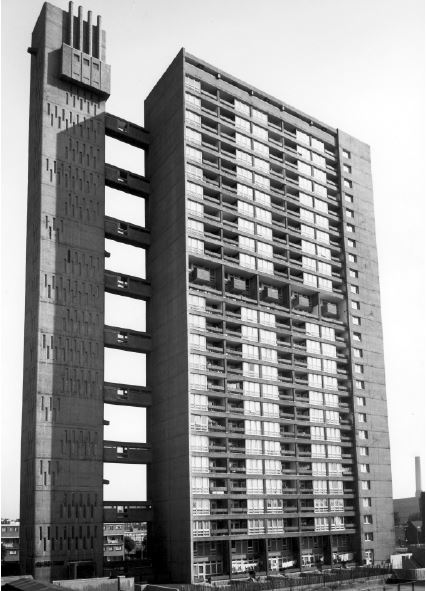 Photograph taken in 1969 showing original concrete chimneys to service tower boilers (from LBTH, Brownfield Estate, Poplar Conservation Management Plan)
The site for what is currently the Brownfield Estate, in which Balfron is located, had been identified as early as 1951. The now truncated St Leonard’s Road was one of Poplar’s principal streets; the area as a whole comprised a dense grid of old and substandard terraced housing. The land was acquired in 1959 just as…
View original post 1,118 more words

It was our second full day. We left home along mountain tracks and soon found our way onto one of the very good motorways here. I guess it took us a little over an hour to reach our destination for the day, Granada. Deborah and I had been here before, some 9 years ago, visiting our daughter who was studying at the University. I was excited about returning, especially to see the Alhambra, which was one of the experiences that turned me on to garden design.
We spent the morning and early afternoon walking the streets. Oh, and took a rather disappointing open-topped bus ride of the city, which we’d done before, but this time it seemed to be a stagger from one traffic light to the next, amidst heavy traffic and which, I guess, lacked the novelty of that first trip. Still, a nice coffee in the precincts of the cathedral and a wander around the moorish quarter, including a wonderful lunch in a restaurant overlooking the Alhambra, all made for a good start to the day.


The afternoon began with the ascent to the main entrance to the Alhambra, where pre booked tickets are essential as the place gets very busy and you need to have a time slot for the most famous bit, the Nasrid Palace. Ours was for late afternoon so we had a few hours to take in the Generalife (the adjacent palace) and the rest of the Alhambra before the real treat. I seem to remember we didn’t get much of a look around the Generalife 9 years before, so today we began there and it was well worth spending more time amongst its wonderful gardens. Here are a few pictures…
We wove our way through crowds towards the Alhambra and made it up to the castellated viewpoint of the Alcazaba, just in time to get to our allotted spot at the nearby Nasrid Palace. This consists of a series of interlocking rooms, chambers and courtyards or patios. It was worth the preamble.
As you enter the Palace you plunge into a room of near darkness, only to emerge into the dazzling light of the outside space. I’d forgotten how simple, peaceful and mystical the Patio of the Myrtles was, with its sheet of water and simple structural planting. I sat and took in the scene, which was rather like an outdoor cathedral- you know, even though there are people around and making noise, the space seems to dissipate and soften that so that it forms a sort of background murmur, almost of reverence?
The slow trickle of water from a fountain added to the ambience, quite a contrast to the rushing of the arched fountains in the Generalife (I’ll post a couple of videos comparing them in the next day or two). Here are some pictures of the outer Alhambra and the Nasrid Palace…
The moorish ornamentation of the rooms and external walls is breathtaking in its complexity, but there is an overall harmony. The light is used cleverly to provide alternating experiences of rich, internal splendour and simpler, but equally impressive outside spaces. The Patio of the Lions was altogether grander and more ornamental in style, the sort of space you can imagine political deals being concluded under the loggia, perhaps having spent time meditating on these in the previous patio? From there we gradually ‘came down’ through simple, lush outside spaces which are more expansive, but still attractive; blocks of colourful planting beginning to re-engage you with the outside world of colour and noise.


Well, I got my ‘fix’. Our drive home was a little more eventful than our outward one, as we had both darkness and rain to contend with. But we rolled safely into the Cortijo and managed a late night supper (I think it must have been 11pm before we ate) round the pool. A quieter day tomorrow, perhaps?
Further information: Granada- Wikipedia
Old School Gardener
Congratulations to Malc on his 500th post!
To celebrate reaching 500 posts in my Greenbenchramblings adventures I thought I would create a week of posts about my favourite garden designers, Piet Oudolf and Tom Stuart-Smith. I have featured examples of their gardens several times already but these are special gardens. The Piet Oudolf garden here is his latest creation in Somerset and the Tom Stuart-Smith gardens are his own garden and the one he designed for his sister who lives just yards away.
The garden, called the Oudolf Field sits within the grounds of the Hauser and Wirth Gallery in the Somerset village of Bruton. This 1.5 acre garden was only planted this year so we visited in its very early stages. The garden is better described as a perennial meadow than his usual tall prairie. The plants are generally shorter so that more of each border and the garden as a whole can be seen at…
View original post 243 more words





 Old School Garden