Archive for February, 2013


Roses are one of the splendours of the gardens

Roses are one of the splendours of the gardens

The Peckovers – a quaker banking family – left behind them a secret gem of a house and garden in Wisbech, Cambridgeshire. This is one ‘banker’s bonus’ that can be shared by everyone.

Peckover House is said to be one of the finest Georgian town houses in the country. It stands proudly fronting the River Nene in this Fenland market town of 20,000 people. Originally built in 1722, the house was initially rented by the Peckovers in 1794, and purchased soon after. Jonathan Peckover had a grocery business and then moved into banking, setting up the first bank in Wisbech in partnership with the Gurney family- who later founded Barclays Bank. Peckover established a good reputation – it was said that during times of financial crisis the Peckover Bank was safer than the Bank of England!

Peckover House was initially called Bank House, reflecting the role of the house and it’s newly built banking wing. The property remained in the family for over 150 years, eventually passing over to the National Trust from its last owner, Alexandrina Peckover, in 1948.

The gardens – of around 2 acres – extend to the rear of the house and grew over the years as the family purchased ground from adjacent landowners. They also included a much larger estate extending to 48 acres, much of which today is used as playing fields and has some character-ful old trees. The Peckovers were also  keen collectors, and introduced a number of foreign plants into the garden. The gardens today maintain the basic layout from Victorian times –  including the old walls that used to mark the boundaries of adjacent properties.

The rear of the hous with the Croquet lawn in front- surrounded by some glorious trees such as the Tulip Tree (Liriodendron tulipifera)

The rear of the house with the Croquet lawn in front- surrounded by some glorious trees such as the Tulip Tree (Liriodendron tulipifera)

Step out into the garden and you feel as though you are back in Victorian times, as you move from one delightful space to another.

Once needing a team of 17 gardeners, todays gardening team of three is headed up by Allison Napier. She finds it difficult to single out her favourite part of the garden –  ‘It depends on the time of year’, she says. ‘In late winter and early spring the Wilderness Walk is full of the colours and scents from bulbs, Hellebores, Winter Honeysuckle, Christmas Box and an impressive Cornus mas. There is also the  fantastic trunk of an old Ginkgo which stands out and this with surrounding evergreens, deciduous shrubs and trees creates a strong framework.’

‘In spring the Orangery is a riot of colour and fragrance from the various bulbs and other spring plants all arranged in terracotta pots on the staging and if the flowering of the Wisteria on the front of the house coincides with the wall flowers in the various formal beds at their peak, then that is a wonderful spot.’

Inside the orangery- a heady mix of seasonal colour and fragrance
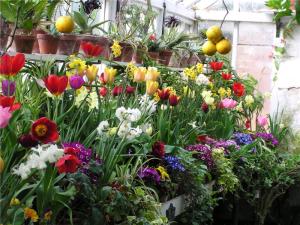
Inside the Orangery- a heady mix of seasonal colour and fragrance

And what about the summer The various rose gardens come into their own. There are over 60 species of rose here, many lovingly pruned and tied in every year over several metal pergolas and against walls. The area christened ‘Alexandrina’s Rose Garden‘ is a particular focal point.

But the show isn’t over yet. In late summer and autumn a ‘Red Border’ provides an array of warm colours and varied textures which are set off brilliantly against a golden privet hedge. This and an Autumn Border provide a glorious conclusion to the year. Jenny Windsor, one of the gardening team, loves these herbaceous borders and especially the contrast that they offer to other, more formal areas of the garden. ‘I love nothing more than to ‘have a play’ in the borders,’ she says –  ‘weeding, dead heading, tying in etc.’

Herbaceous borders

Herbaceous borders surrounding the Orchard Lawn with a fine old Quince tree

Many first-time visitors are surprised at the size and variety of plants in the garden. And, not surprisingly, they also commend the high standards of care maintained by the team.

Very few chemicals are used in the gardens and Allison finds that biological controls are effective in the glasshouses. As she says,

‘The healthy populations of beneficial insects, frogs and birds in the garden are testament to the ‘greener gardening’ policies we like to follow.’

The orangery (left) has rotten timbers and is due for a major renovation this year

The orangery (left) has rotten timbers and is due for a major renovation this year

The gardening team is well supported by local volunteers and a small number of trainees who come to gain practical horticultural experience (as I know, because I had the pleasure of being one last year!). Allison also thinks it important to encourage future generations of potential gardeners, so the team actively seeks school visits and has a Garden Club with students from the local grammar school.
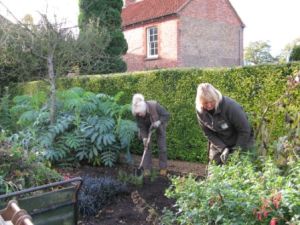
Gardeners Jenny and Janet digging over and mulching the 'Red Border'

Gardeners Jenny and Janet digging over and mulching the ‘Red Border’

What of the future? Well,the forthcoming restoration of the Orangery – with its 300 year old orange trees – is a major project due to get under way this year. Allison plans to complete work on the Conservation Plan for the garden this year, but it will be a major challenge working out the priorities and policies for the future, especially as the climate appears to be entering a very unpredictable phase affecting decisions about the range of plants to be used.

Still, the team seem to be a pretty content bunch, even though on occasions paperwork and ‘office stuff’ may get in the way of being outside and doing what they love. As Allison says, even the laborious turning of the compost heaps can sometimes be rewarding:

  ‘.. it gives you a good workout and you can find a surprising  number of lost hand tools!’

Gardener in charge Allison Napier- normally not sitting on the compost, but turnning it!

Gardener in charge Allison Napier- normally not sitting on the compost, but turning it!

Acknowledgement: thanks to Allison, Jenny and Janet, the Peckover Gardening Team for their contributions.

Quizzicals:

answers to the two on the post ‘Lock down- pros and cons of garden ties’

  • Hello Miss Black – Hyacinth
  • A punch up in the water – hydrophyte

Old School Gardener

If you’ve enjoyed reading this post and others on this blog, why not comment and also join some other people and sign up for automatic updates via email (see side bar, above right ) or through an RSS feed (see top of page)?


sethsnap's avatarsethsnap

There are so many beautiful things to see in nature.  When you step back and see the landscapes, they are amazing.  But, sometimes, the most beautiful things are those in which you find when you look real close.  Lake Isabella is beautiful as a whole with its large lake, river, trees and wildlife.  But close up, Lake Isabella is like being in another world.

Visit my store.

View original post

PicPost: give a hoot?

MartineauGardens_homepage

The Green Flag Award® scheme is the benchmark national standard for parks and green spaces in the UK. It was first launched in 1996 to recognise and reward the best green spaces in the country.

The first awards were given in 1997 and, many years later, it continues to provide the benchmark against which our parks and green spaces are measured. It is also seen as a way of encouraging others to achieve high environmental standards, setting a benchmark of excellence in recreational green areas.

Entries for the Green Flag Award® are open to parks/green spaces located in the UK. We are also currently piloting the scheme in The Netherlands and Germany.

To apply go to Green Flag Award website


Old School Gardener

PicPost: Great Garden @ Wrest Park

‘After decades behind virtually closed doors, its treasures overgrown and largely unknown, English Heritage is reviving one of Britain’s largest and most important ‘secret gardens’ – Wrest Park in Bedfordshire.

This is a wonderful 90-acre historic landscape and French-style mansion which will take its rightful place amongst the country’s great garden attractions – and give locals and visitors to Bedfordshire a superb new day out.

Stroll in the recently restored Italian and Rose Gardens. Enjoy miles of reinstated historic pathways as you discover the garden buildings, pavilion and statues. Find out more about the garden and the people that shaped it, in our new exhibitions in the house and garden buildings.’

Source: Wrest Park website

Old School Gardener

Twitter / ChannelCasting: NEW BBC2 GARDENING SERIES LOOKING … – Mozilla Firefox http://ow.ly/hv4hz

sowing seeds The case for gardening in schools has perhaps never been stronger – it encourages exercise and healthy eating and helps to ensure that children ‘reconnect with nature’ – as discussed in the initial post on school gardening.

Today, in the first of a series of posts on the practical steps to creating a successful School Garden, I’m looking at how to get your project up and running.

Where do you start? How do you build up the momentum that’ll be needed to turn your dreams into  reality? How can you get the resources you need to get it off the ground? Here are 7 steps to help get your school gardening project off the starting blocks.

1. Do your homework- check out the internet for advice and ideas about school garden learning and explore other school gardens in your area. This research will help you to firm up your ideas and think about how you might present them. Talk to those involved in the school gardens you visit – their advice and experience is priceless. And they might even offer to help you get started!

2. Make the Case – so how do you get the key people on your side? If you’re a volunteer, float your idea with one or more teachers who you think might be sympathetic and explore the idea a bit further (if you’re a teacher speak with your colleagues and sound out some parents). Once you’ve firmed up your initial thoughts, it’s time to get the Head teacher on board. You need to have a clear outline of what the project is going to achieve and how it could benefit the school’s approach to learning in general (including curriculum links if possible) and ‘learning outside the classroom’ in particular – so think ‘outdoor classroom’ and use this key phrase in your plans. Your outline should ideally include a suggested location for the garden, rough design,timescale and how the garden will be established and looked after. It might also be an idea to say how you think progress will be monitored and reported. If you are able to convice a number of teachers, governors, parents and friends of the School, so much the better.

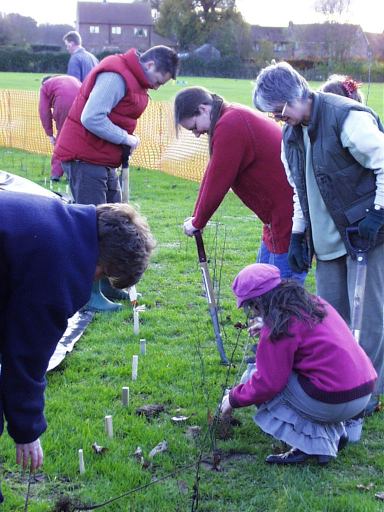
Hedge planting- put some natural boundaries around your garden with community effort!

Hedge planting- put some natural boundaries around your garden with community effort!

3. Build a team – you  will not create the garden alone, even less ensure its effective ongoing use. You need to build a team around the project which can do the many things needed. A committee/ steering group/ project team of some sort needs to be set up and at this stage. It will be important to get all the key interests in the project involved; later on your committee structure might be slimmed down as individual roles start to pan out and inevitably some people lose interest. So who should you target? Keep an eye out for parents who can bring particular skills, assets (mini diggers!) or contacts to the project  – these might be builders, gardeners, landscapers, forestry workers, publicists or funding bid writers and so on. Establishing a broad and varied support base at this stage will set the project on a positive course. Hold formal meetings to develop your project but also use the web to communicate. Don’t forget to ask the Head, teachers and governors to be on the committee – their involvement at this stage is important, but may reduce once the project is flying!

4. Think ahead – as the project develops it will become clear what the real goals will be and the main lines of action you’ll need to take to achieve these. Being clear, concise and friendly will help to communicate the project effectively. At the same time, be patient – it’s natural to want to launch right into construction works, but it will take time for your project to evolve and the learning opportunities to be firmed up, which will in turn have a bearing on your design, layout, routine etc. So it’s important to have detailed discussions with the teachers who will make use of their ‘outdoor classroom’. This discussion may take anything from a few months to a year.

picture- RHS

picture- RHS

5. ‘Quick wins’ to promote your cause – whilst it will take time to clarify your overall objectives and start to firm up your design, you can keep up the momentum and start to generate wider interest. Plan activities which will test out some ideas and generate interest ; e.g. can you start to grow things in containers around the school and get children involved in cultivating flowers or food in these? A little project starting with seed sowing in the classroom and eventually seeing mature plants placed outside will demonstrate what can be achieved and get the children on board.

6. Check possible barriers to progress and get permissions – check out whether your outline design has implications for the school’s utilities or the way it operates,  and if you need them get permissions in principle before going much further with your design work. For example, a reliable source of water nearby is an important if not vital consideration – will this be possible from existing outside taps/ rainwater harvesting or do you need to get another connection installed? Will this be acceptable to the school?

7. Secure the start-up resources – once you have a clear, albeit outline, view of your project and the design of the garden, it’s time to firm up what resources you’ll need to get the project established and get commitments for these. Some of these can be ‘promises’ of help from well skilled/equipped parents or friends of the school. But you’ll probably need some start up cash – to purchase materials, tools, seed etc.  Sources internal to the school can be approached – the school budget if possible, but more likely a Parents/ Friends Association. Then you can explore outside sources including local charities as well as national programmes like the Big Lottery.

Once you have a strong team around you, a clear plan with the start up resources you need and a growing awareness and support from the school and wider community, it’s time to get serious! In the next post on School Gardening I share some tips about planning and designing your new space for growing children!

Source: ‘How to grow a School Garden- a Complete Guide for Parents and Teachers’- Arden Bucklin-Sporer and Rachel Kathleen Pringle, Timber Press Books 2010

Useful websites:

Garden Organic support for Schools

RHS Campaign for School Gardening

RHS young gardener of the year 2013

Learning outside the classroom- manifesto

Learning through landscapes

Setting up and running a school garden- UN Food and Agriculture organisation

Morrisons ‘Let’s Grow’

Cawston Primary School Garden following work by a 'Garden Gang' event last Saturday

Cawston Primary School Garden following work by a ‘Garden Gang’ event last Saturday

Old School Gardener

If you’ve enjoyed reading this post and others on this blog, why not comment and also join some other people and sign up for automatic updates via email (see side bar, above right ) or through an RSS feed (see top of page)?

PicPost: Great Garden @ The Garden House

‘The Garden House is the elegant former home of the vicars of Buckland Monachorum..(near Tavistock, Devon)…

The present building dates from the early 19th century and now accommodates the tearooms and conference centre. The history of this 8-acre garden is closely entwined with that of Buckland Abbey and the local church. In 1305 the Bishop instructed the Abbot to build a house for the parish priest and this site was chosen. At the dissolution of the monasteries, the abbot became the vicar of Buckland Monachorum and by the early 1700s, the vicarage consisted of a substantial 3-storey dwelling. The remains of this building, a tower with spiral staircase and a thatched barn, formerly the kitchen, are now the romantic ruins in the Walled Garden.

A modern vicarage was built in the 1920s and The Garden House was sold as a private dwelling. The house came onto the market again just after the Second World War and was purchased and given its present name by Lionel Fortescue, a retiring master at Eton, and his wife Katharine. Lionel was the son of a Newlyn school painter and had a good eye for colour as well as being an exacting plantsman. Lionel and Katharine immediately set about renovating and developing their garden whilst running a thriving market garden business, providing stock plants for growers in the Tamar Valley, and managing a herd of Jersey dairy cattle.

Over nearly 40 years, the Fortescues created a garden viewed as one of the finest in Britain. By 1961, they had established the Fortescue Garden Trust, an independent registered charity to which they bequeathed the house and garden to ensure the survival of this beautiful place for future generations. After their deaths in the early 1980s, ownership passed to the charity which to this day maintains the Fortescue’s lovely legacy.

The second phase of development took place under Keith Wiley who was appointed by Lionel and spent 25 years as Head Gardener. Keith took the 6 acres of paddocks to the far side of the road into cultivation from 1990, creating a series of gardens that take their inspiration from the natural world. Keith left in 2003 to concentrate on writing and creating his own nursery, Wildside Plants.

Matt Bishop is the present Head Gardener and he is particularly well-known for his expertise on snowdrops and bulbs. Matt’s brief is to care for and respect the legacies of his predecessors whilst ensuring, just as they did, that The Garden House remains a crucible of new ideas and new plants, at the cutting edge of horticultural excellence and innovation. He has undertaken a major refurbishment of the original Fortescue garden as well as ongoing maintenance in other areas to ensure a long opening season of glorious colour and variety. This has been an excellent opportunity to introduce many new plants whilst continuing Lionel’s principle of using only the best forms and cultivars avaialble.

Matt has two horticultural students under training here and a small team of dedicated staff and volunteers who care for the garden.’

Source: The Garden House website

Old School Gardener

Finding Nature

Nature Connectedness Research Blog by Prof. Miles Richardson

Norfolk Green Care Network

Connecting People with Nature

Discover WordPress

A daily selection of the best content published on WordPress, collected for you by humans who love to read.

Susan Rushton

Celebrating gardens, photography and a creative life

Unlocking Landscapes

Writing, photography and more by Daniel Greenwood

Alphabet Ravine

Lydia Rae Bush Poetry

TIME GENTS

Australian Pub Project, Established 2013

Vanha Talo Suomi

The Journey from Finnish Rintamamiestalo to Arboretum & Gardens

Marigolds and Gin

Because even in chaos, there’s always gin and a good story …

Bits & Tidbits

RANDOM BITS & MORE TIDBITS

Rambling in the Garden

.....and nurturing my soul

The Interpretation Game

Cultural Heritage and the Digital Economy

pbmGarden

Sense of place, purpose, rejuvenation and joy

SISSINGHURST GARDEN

Notes from the Gardeners...

Deep Green Permaculture

Connecting People to Nature, Empowering People to Live Sustainably

BloominBootiful

A girl and her garden :)