Archive for February, 2013


School gardening - old style!

School gardening – old style!

Previous posts in this series about School Gardening have set out some ideas for starting up and designing your school garden project. Having got some foundations in place and a design that’s ready to go, how do you put it into practice? Here are seven tips for creating your dream School Garden.

1. Phasing – so you have ambitious ideas for the design and use of your garden, but perhaps you might be trying to bite off a little too much at once? Think about the levels of volunteer help, promises of materials and cash to hand and tailor your plans accordingly. Sure, strive for your dream, but maybe tackle it in manageable chunks. You can think about parts of the garden that need creating first – say the paths and basic border/bed layout. Add on’s like an orchard or pond could come later? It might be useful to spread these elements  over a few years, perhaps identifying a major project for each year which can focus fundraising and community effort and help to keep the energy and momentum up when enthusiasm wanes.

Children digging in

Children digging in

2. Digging in – the first practical day of activity – or ‘groundbreaking’ – is an important event. Make sure it’s both productive and fun. You want to encourage children and the wider community to become committed and involved in the long term. It’s probably best to get any heavy work that involves earth moving or bigger construction done before the official launch day to avoid too many people, machinery and activities on it at once. This will also help to ensure that your main community effort can leave the launch event feeling that they’ve really contributed something worthwhile. Planning for the launch day is important too – think about and order the tools and materials you’ll need and where these should be placed to ensure safe and efficient working.

Local businesses can be involved in creating the garden

Local businesses can be involved in creating the garden

3. Community input communicate your plans, both short and longer term, to the school and wider community so that you get boots on the ground for your  ‘Groundbreaking’ event. Plan and organise the various tasks that need doing on the day and have people who can lead groups of volunteers on each activity. Put someone in charge of allocating volunteers to the different tasks as they turn up – a sort of triage. Having a range of tasks available is useful to cope with children and adults with different types and levels of skill (and strength) – tree planting, raised bed construction, soil shifting, path making etc.  Maybe you can get extra help from local companies or organisations to add importance as well as ‘muscle’ to the day – how about your local fire station (even better if they can bring along a fire engine) or give a local firm a chance to promote themselves and give something to the community?

For the day itself perhaps have a novel twist that will grab local media interest – could you include a competition for children to see who can create the best signs or pictures of the new garden, and perhaps something fun for adults – the best dressed gardener?! Plan ahead for further workdays or ‘Garden Gang’ events – identify the key tasks that need doing and as with your launch event make sure you organ ise your volunteers effectively on the day, with all the materials and tools needed to hand. Possibly cultivate local business input so that specific skills you need can be brought in – e.g,. a local nursery helping with pruning fruit trees, landscapers/builders willing to help install fencing, etc. In some parts of the UK the ‘Mastergardener’ and ‘Mastercomposter’ programmes are able to offer voluntary support to schools and the community to grow their own food.
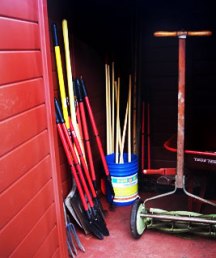
Tools will need to be repaired or replaced

Tools will need to be repaired or replaced

4. Money managing – you may have enough cash and other resources for your launch day, but it’s also wise to think longer term and consider the ongoing costs and expenses that will need to be funded once the garden is up and running. A key issue is the ‘Garden Coordinator’ or lead person. Is she/he a willing volunteer or do you need to find some means of payment, either as member of staff or a small ‘honorarium’ to recognise the regular commitment that will be needed? You’ll also need funds to repair and replace tools (some will inevitably get lost). So have a small fund dedicated to this, though it may be in the first year or two this can be quite small.

Odd items of infrastructure will also need to be replaced, repaired or acquired as the use of the garden develops; e.g. shelving for the greenhouse, tables for potting, and the ongoing supply of compost, grit or whatever else your particular garden needs to keep it operating. All of these ongoing costs need to be budgeted for and ideally a source of funding identified so that major fundraising efforts can be focused on more significant projects. The School Budget may be a source of this funding, but it’s likely that you’ll need to call on the Parents’/Friends’ Association, local charities, company sponsorship etc. to meet at least some of the ongoing expenses.

5. Fundraising – if you’ve decided to phase your project then you’ll need to plan ahead for the funding and other ‘in kind’ support you’ll need to achieve the later elements of the garden. So some sort of fundraising effort is likely to be required on an ongoing basis and it might be sensible to put someone in charge of this, ideally someone with the skills to put together applications for funding to public/ charitable sources as well as ongoing campaigns that can focus on raising cash via the school and local community – local lottery games and fundraising events (quizzes, fireworks, cake sales) for example. Could you also ask parents to make an annual donation to the garden?

Steering Group meetings are essential

Steering Group meetings are essential

6. Steering the project – by now the real movers and shakers behind your project should have identified themselves and these people need to be nurtured into your active committee/steering group for the Garden. Regular, focused meetings to discuss progress and plans will be needed, but avoid these becoming too formal and bureaucratic. You need to ensure that those giving their time to the project feel that they are contributing and are valued, so make your meetings pleasant social events as well as efficient at tackling the business – side of things. It’s also important to keep the garden relevant to the curriculum, so regularly review how it’s being or could be used to enhance the learning at the school and possibly encourage teachers and others to develop their skills through training or attending specific workshops on school gardening.

Plant and produce sales can raise cash for the garden and celebrate its achievements

Plant and produce sales can raise cash for the garden and celebrate its achievements

7. Celebrate – not only should your launch or groundbreaking event be a celebration of what’s been achieved and what’s planned, but it’s important to regularly celebrate the garden as key milestones are reached. Providing food and drink on events is one way of oiling the wheels and making events an enjoyable community gathering (especially if parents and the community don’t have many other opportunities to get together locally). Keeping local media interested in your project is also important as reporting in local newspapers, radio, tv and increasingly the internet all affirm the value of the project. As they say ‘nothing succeeds like success’!

The School website or blog could have regular posts about activity in the garden (maybe you’ll need someone to take responsibility for this aspect of things) and regular email updates to publicise events and fundraising are a must. ‘Sending a note home’ with a child is perhaps notoriously unreliable as a way of communicating with parents, so maybe think of more novel ways of getting the message across – a stall to sell plants and produce from the Garden and present infotrmation about it’s achievements at the School summer fair, or displays  of children’s work in the School which can be seen at parent’s evenings and other events, for example.

So by now the garden should be well into ‘start up’ mode and will be the talk of the School and local area! In the next post in this series I’ll be offering some advice on good practices for developing your School Garden into an effective learning and community resource.
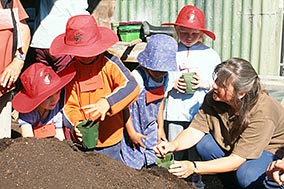
Let's get gardening!

Let’s get gardening!

Other posts in the series:

Growing Children 2: Seven Design tips for your School Garden

Growing Children 1: School Garden start up in Seven Steps

School Gardening – reconnecting children and Nature

Sources & Further information:

How to grow a School Garden’ – Arden Bucklin-Spooner and Rachel Kathleen Pringle, Timber Press Books

School Gardening Club- ideas

Budding Gardeners- lots of advice and info

Garden planner tool

Planning your school garden

Food & Agriculture Organisation School Garden Planner

California School Garden Network Guide to School Gardening

School Gardening Wizard

School garden fundraising

Old School Gardener

If you’ve enjoyed reading this post and others on this blog, why not comment and join others by signing up for automatic updates via email (see side bar, above right ) or through an RSS feed (see top of page)?

Pumpkins at Wisley

‘Over the last 3 years we have reached over 2000 young people and families across woodland days, teenage camp, youth training and leadership programmes, forest schools and family days. Our flagship projects, Call of the Wild and Earthwise, were funded under Natural England’s Access to Nature Grant and MIND’s Ecominds Grant and raised over £160,000 towards creating outdoor opportunities for the most disadvantaged groups in our society. The results show that this kind of work leads to better health and wellbeing, more opportunities, a greater sense of community and respect.’
For more information visit http://www.circleofliferediscovery.com

The Farmhouse Garden at Gressenhall Farm and Workhouse Museum

The Farmhouse Garden at Gressenhall Farm and Workhouse Museum

A variety of gardens awaits the visitor to Union Farm, part of the Gressenhall Farm and Workhouse Museum, Norfolk.

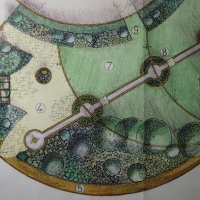
The main Farmhouse Garden sits alongside the Victorian farmhouse and was designed and developed around 10 years ago. It was intended to be a ‘sensory garden’ with aromatic, tactile and other plants including a ‘herb wheel’. It was also intended to demonstrate how planting could be used to control pests. This original purpose has been diluted over the years and the garden now provides a pleasant green foil to the farmhouse building. The garden is domestic in scale with a large area of grass and an irregular series of planted island borders, including raised beds edged with split poles. There are a number of shrubs, including climbing roses on the farmhouse wall, bench seats and a wooden shed in the north-eastern corner which contains garden tools.

The kitchen garden at Union Farm

On another side of the Farmhouse a vegetable growing patch has been developed which is used to demonstrate grow your own techniques and different types of vegetables. To the front of the farmhouse sit two other gardens, one with a range of perennial herbs that would have been used in the farmhouse kitchen and another which houses a wide range of plants that were used in the traditional dyeing of cloth. This garden was slightly rearranged last year with new edges to the borders and with a length of low willow fencing to provide both a sense of enclosure and to discourage visitors from trampling in the beds.  The plants are regualrly used here in demonstrations of traditional dyeing.

One side of the Dyers' Garden

One side of the Dyers’ Garden

Developed in recent years by the volunteer dyers, some of the plants grown here include:

Alcea rosea varieties Helianthus annuus varieties
Alkanna tinctoria Hemerocallis varieties
Amaranthus caudatus Isatis tinctoria
Anthemis tinctoria Lythrum salicaria
Berberis vulgaris Mahonia aquifolium
Buddleja davidii Origanum majorana
Calendula officinalis cultivars Perilla frutescens
Carthamus tinctorius Phytolacca americana
Consolida ajacis Pyracantha angustifolia
Convallaria majalis Reseda luteola
Coreopsis tinctoria Rheum x hybridum
Dahlia varieties Rhus typhina
Datisca cannabina Rosa –climbing varieties
Foeniculum vulgare Rubia tinctorum
Forsythia Rudbeckia triloba
Galium verum Solidago
Genista tinctoria Tagetes patula cultivars

Other posts in this series:

From Grand entrance to Grand Central at Norfolk Museum

Gypsies, tramps and thieves: garden where poor once trod at Norfolk Museum

Cottage Garden recreates 1930’s at Norfolk Museum

Old Workhouse Garden a wildlife oasis at Norfolk Museum

Unique Heritage Gardens at Norfolk Museum

Old School Gardener

If you’ve enjoyed reading this post and others on this blog, why not comment and join others by signing up for automatic updates via email (see side bar, above right ) or through an RSS feed (see top of page)?

PicPost: Help - title needed for this picture- please add your ideas!

Picture taken at Mottisfont Abbey, Hampshire

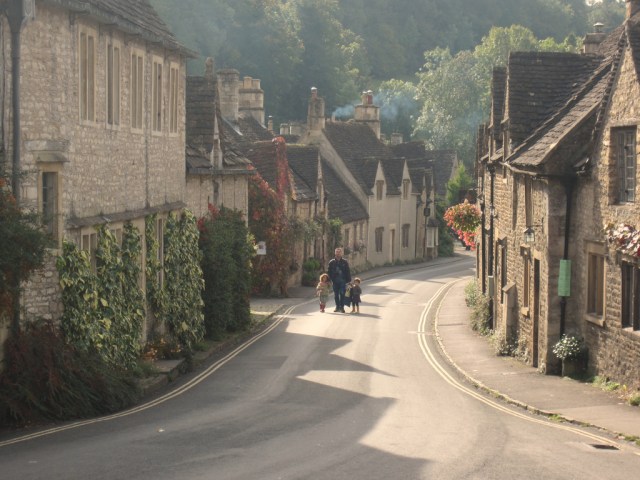
Castle Combe - one of the prettiest villages?

Castle Combe – one of the prettiest villages?

I spent a few days in the south and south-west of England last week. The weather was very sunny and dry – which from my many previous visits to Devon is very unusual (bordering on the unheard of). My wife and I initially stayed near Winchester and then went via Salisbury to Tavistock in Devon. We visited some wonderful places, including two gothic cathedrals (see my PicPost of the roof of Winchester Cathedral) as well as a super garden at Mottisfont Abbey (more pictures and words on this later in the week).

It was on our way to Salisbury that we came across a road sign to Sherfield English. This name conjured up images of a delightful, romantic ‘chocolate box’ English village, complete with thatched cottages, olde worlde pub (complete with Morris dancers), hand- painted village sign, cricket pitch on the village green, village school and a couple of local shops all jostling to be the lead players in a fairytale scene.

As we approached the village, the first signs were not discouraging – a garden nursery and old time garage on the outskirts. But these soon gave way to handfuls of bland bungalows and other modern-looking houses with no apparent ‘plan’ – either God or man made. To be fair I’m not sure we actually found the true centre (if there is one), but in any event my expectations were rudely shattered by an incoherent sprawl that definitely did NOT live up to its name! (apologies residents of Sherfield English, I’m sure it’s a wonderful place).

The hand painted village sign- a must have for choc box aspirants...

The hand painted village sign- a must have for choc box aspirants…

This got me thinking about village names and the sorts of expectations they give us. My theory (in the course of development into an ‘Iron Law’) is that the most interesting names (or rather those that promise to deliver your romantic english village expectations) have at least four syllables and ideally spread over two words (I’ve yet to find one with three or more). We passed  some other lovely examples en route to the west country:

Kingsbury Episcopi (5 syllables – there must be some religious heritage here)

Eyewell Wales (OK, only 3 syllables but such an unusual construction- I wonder what the views must be like with such a name)

Compton Pauncefoot (4 syllables – sounds rather like a home for ageing cats)

In all these cases the main village centres (if there are any) were off the main road, so we couldn’t be sure of their pedigree, but on the strength of our earlier experience my betting is that they’ll be a disappointment. On the other hand, am I seeking after something that never really existed or has long gone? A romantic myth rather than reality, a sort of Holy Grail of rural prettiness and sense of ‘community’?

Another view of the english village...

Another view of the english village…

Midsommer Murders (a modern-day TV crime series set in the sleepy, imaginary, forever – sunny group of ‘Midsommer’ villages) has for one thing given a rather different (if equally unconvincing) view of this ‘rural idyll’-  one where the murder- rate must be something like Chicago – on a good day…

And I guess that post – war changes in travel to work – the birth of the ‘commuter village’ or so-called  ‘bed and breakfast’ communities –  have probably also done for what was left of the ideal ‘village’ and ‘village life’.  To coin a phrase, do most of these modern-day villages enjoy ‘a repose bordering on stagnation’?

In my search for answers (or rather to find at least one example of a ‘pretty village’), whilst in West Devon we set out in search of the beautiful – sounding  Tamerton Foliot on the outskirts of Plymouth (that fact alone should have given me pause for thought). This sun -filled day out saw us driving over Dartmoor (glorious, if in some places the narrow, steep, twisting, pot – holed roads requiring serious concentration) and into Plymouth to enjoy an Ivor Dewdney pasty looking out on Plymouth Sound and the Hoe (very busy with families, out enjoying the sunshine and skating, playing football, trying out new bikes, promenading etc.). Our way home was to be via the ‘back roads’ to Buckland Monachorum (another lovely name whilst I think about it) for afternoon tea at Buckland House (once home to Sir Francis Drake of Armada fame).

Could we find it?

The short answer is no. What we did find was the sprawling suburbs of post – war municipal housing, out of town shopping centres, run down community centres that make up large swathes of the northern edge of Plymouth. These couldn’t have been further from the image of the romantic english village. We eventually found our tea – stop via another route, having abandoned all hope of finding said village. Quizzing locals (in Tavistock that is) about the place did not inspire confidence. It seems it was once a pleasant enough place but it too has succumbed to the encroachments of modern life (though Wikipedia does have some rather nice photos of a fine granite country church).

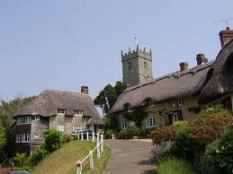
Godshill, Isle Of Wight - one of the few remaning 'chocolate box' villages preserved in aspic...

Godshill, Isle Of Wight – one of the few remaning ‘chocolate box’ villages preserved in aspic…

So, my conclusion is that whilst there are undoubted examples of the ‘chocolate box’ village (at least to look at) it is rather less likely that they will be the close-knit, thriving communities they once were – I invite readers to contradict this rather sweeping conclusion! It’s also got me thinking that there is some sort of inverse law that says the most charming places will not possess the most charming names. Maybe we need some sort of ‘transfer window’ a la Premier League whereby the best names (i.e the two-word, four syllable plus ones) can be traded over to the places that most deserve them, at least in terms of the expectations they set up.

Would Kingsbury Episcopi for example, be out of reach, in the multi-millions (so maybe you could have a season-long loan)?!

Old School Gardener

If you’ve enjoyed reading this post and others on this blog, why not comment and join others by signing up for automatic updates via email (see side bar, above right ) or through an RSS feed (see top of page)?
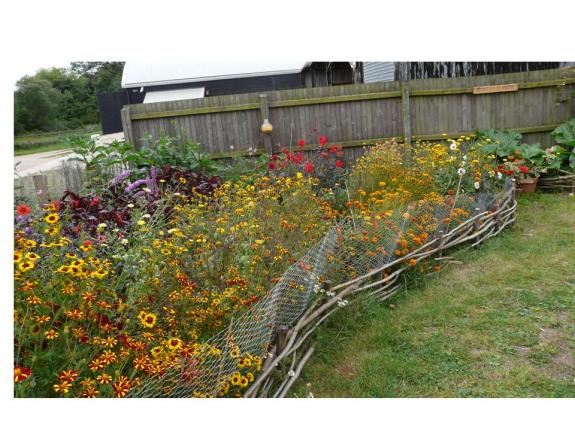
PicPost: Dressed to thrill

PicPost: Ceiling to floor

The nave roof of Winchester Cathedral – photographed upside down

Picpost: Wisteria hysteria

birch

‘Anglesey Abbey is a country house, formerly a priory, in the village of Lode, 512 miles (8.9 km) northeast of Cambridge, England. The house and its grounds are owned by the National Trust and are open to the public as part of the Anglesey Abbey, Garden & Lode Mill property, although some parts remain the private home of the Fairhaven family.

The 98 acres (400,000 m²) of landscaped grounds are divided into a number of walks and gardens, with classical statuary, topiary and flowerbeds. The grounds were laid out in an 18th-century style by the estate’s last private owner, the 1st Baron Fairhaven, in the 1930s. A large pool, the Quarry Pool, is believed to be the site of a 19th-century coprolite mine. Lode Water Mill, dating from the 18th century was restored to working condition in 1982 and now sells flour to visitors.’

Source and further information:

Wikipedia

National Trust website

Finding Nature

Nature Connectedness Research Blog by Prof. Miles Richardson

Norfolk Green Care Network

Connecting People with Nature

Discover WordPress

A daily selection of the best content published on WordPress, collected for you by humans who love to read.

Susan Rushton

Celebrating gardens, photography and a creative life

Unlocking Landscapes

Writing, photography and more by Daniel Greenwood

Alphabet Ravine

Lydia Rae Bush Poetry

TIME GENTS

Australian Pub Project, Established 2013

Vanha Talo Suomi

The Journey from Finnish Rintamamiestalo to Arboretum & Gardens

Marigolds and Gin

Because even in chaos, there’s always gin and a good story …

Bits & Tidbits

RANDOM BITS & MORE TIDBITS

Rambling in the Garden

.....and nurturing my soul

The Interpretation Game

Cultural Heritage and the Digital Economy

pbmGarden

Sense of place, purpose, rejuvenation and joy

SISSINGHURST GARDEN

Notes from the Gardeners...

Deep Green Permaculture

Connecting People to Nature, Empowering People to Live Sustainably

BloominBootiful

A girl and her garden :)