


Waldbodenstück mit Schneeglöckchen, Lauer Josef,1881
Waldbodenstück mit Schneeglöckchen, Lauer Josef,1881
‘In the first of a guest blog series, filmmaker David Bond writes on how being outdoors can remedy the conflicts of family life….’


‘You’ve probably guessed by now that I am a huge fan of outdoor play.
In an age when a complex web of circumstances pressures seem to be keeping our kids indoors more than ever I believe that one of my most important roles as a teacher is to give our kids lots of time for free and unstructured play outdoors.
Here are 10 fellow bloggy types who feel the same way.…..’
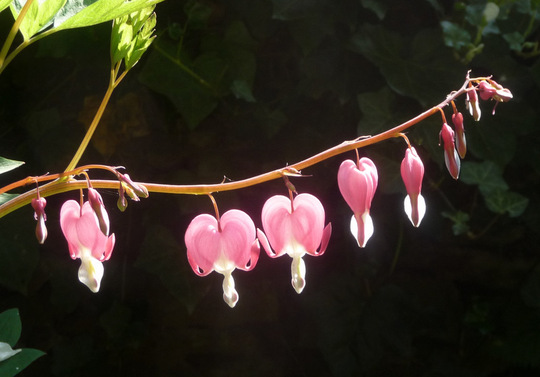 Dicentra is a genus of about 20 annuals and perennials (of which about 8 are perennial) and many cultivars. They are native to both Asia and North America (though possibly an ‘honorary native’ in the latter, dating from colonial times), mainly in woodland habitats.
Their roots vary between rhizomes,tubers or fleshy tap roots. All varieties are reliably hardy. Most are deciduous but some are evergreen and have fern-like, divided foliage, some of a silver – grey colour.
Flowers – which come in shades of red,pink and white – hang as pendents on racemes or panicles and are very distinctive – two outer petals are pouched, giving a heart-shaped outline with the two inner petals forming a hood over the anthers. Not surprisingly this arrangement has led to many descriptive common names such as:
- Bleeding heart (most usually used for D. spectabilis)
- Showy bleeding heart
- Dutchman’s breeches
- Chinaman’s breeches
- Locks and keys
- Lyre flower
- Seal flower
- Old-fashioned bleeding heart
Flowering time is late spring into early summer. The flowers and foliage are useful in flower arrangements, the flowers lasting well in water.

Dicentra canadensis (Squirrel Corn)

Dicentra cucullaria (Dutchman’s breeches)

Dicentra formosa oregona ‘Pearl Drops’

Dicentra formosa
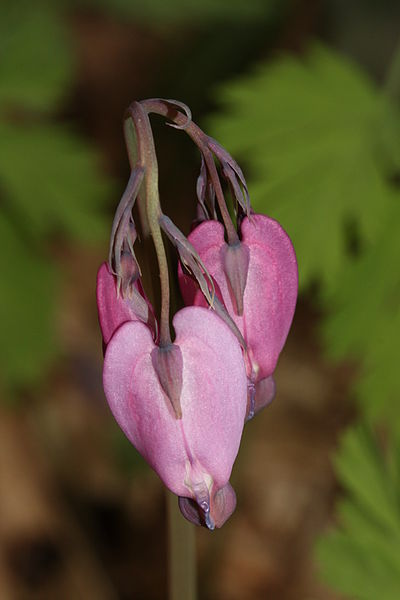
Dicentra formosa – close up of flowers
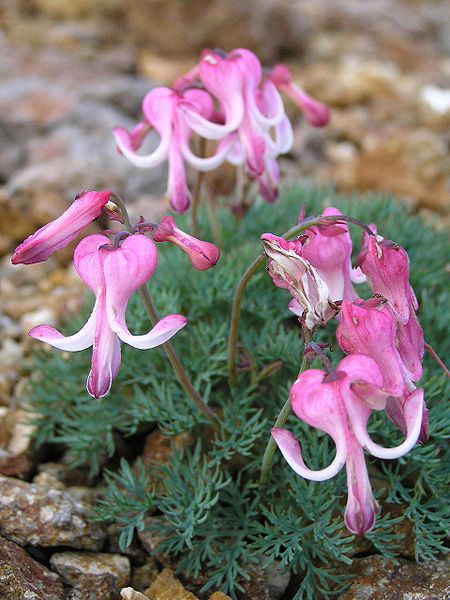
Dicentra peregrina ‘Komakusa’
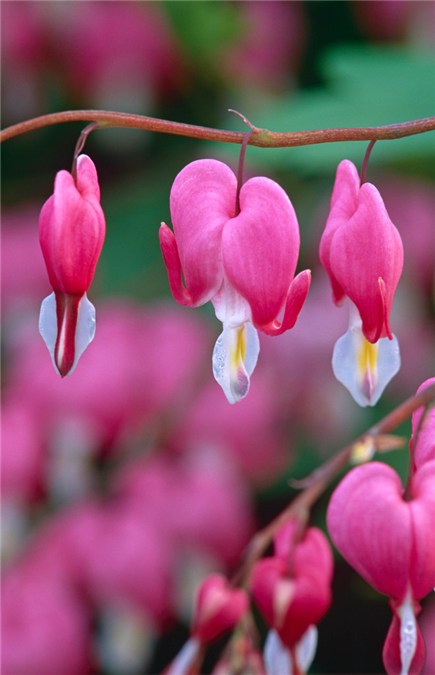
Dicentra spectablis
Most of the perennial Dicentra make good border plants, though a couple are rather invasive (spectabilis and formosa) and are best used in a woodland garden, where seedlings or spreading rhizomes can be allowed to expand or be easily removed. D. spectabilis is not long-lived. All Dicentra are low in allergens, but all parts of the plant are poisonous and a skin irritant.
Further information:
Varieties and growing Dicentra
Dicentra ‘Stuart Boothman’ AGM
If you’ve enjoyed reading this post and others on this blog, why not comment and join others by signing up for automatic updates via email (see side bar, above right ) or through an RSS feed (see top of page)?
Nigel Boldero aka 'Old School Gardener'
 | Nigel Boldero on Fighting to Reduce Climate Cha… |
 | Anonymous on Fighting to Reduce Climate Cha… |
| Anonymous on PicPost: Carrot, my foot! |
| 18 Surprising Hydran… on Plantax 16: Hydrangea the wate… | |
| Nigel Boldero on Poppyland: A Victorian romance… |
| Anonymous on Poppyland: A Victorian romance… |
| Anonymous on Plants to die for… |
 | Isabella Childress on PicPost: Forest, but not as we… |
 | Happiness Factor on Is child-friendly planning a l… |
 | zidane on Top Tip: On a Pedestal- make m… |


Nature Connectedness Research Blog by Prof. Miles Richardson
Connecting People with Nature
A daily selection of the best content published on WordPress, collected for you by humans who love to read.
Celebrating gardens, photography and a creative life
Writing, photography and more by Daniel Greenwood
Lydia Rae Bush Poetry
Australian Pub Project, Established 2013
The Journey from Finnish Rintamamiestalo to Arboretum & Gardens
Because even in chaos, there’s always gin and a good story …
RANDOM BITS & MORE TIDBITS
.....and nurturing my soul
Cultural Heritage and the Digital Economy
Sense of place, purpose, rejuvenation and joy
Notes from the Gardeners...
Connecting People to Nature, Empowering People to Live Sustainably
A girl and her garden :)


 Old School Garden
