Archive for February, 2013


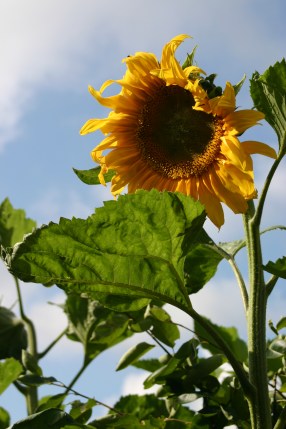
Sunflowers were planted by a local playgroup at the May opening of the garden - with the wet summer they grew to over 2.5 metres tall!

Sunflowers were planted by a local playgroup at the May opening of the garden – with the wet summer they grew to over 2.5 metres tall!

A renovated garden is moving towards maturity in what were once exercise yards for tramps and unmarried mothers at Gressenhall Farm and Workhouse Museum, Norfolk.

The garden occupies what were once two exercise/work yards for inmates of the Victorian Workhouse. The footings of what was once the dividing wall between these two yards can still be seen, emerging as the lawn above is worn away.  In Victorian times these yards joined two blocks of accommodation:

  • for so-called  ‘casuals’ or tramps who used to travel between workhouses earning ‘a night’s board for 2 days hard labour’ – possibly crushing stones for use in road building
  • for unmarried mothers nursing their babies – they wore distinctive uniforms to mark them out from the other workhouse inmates.
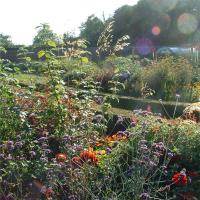
The refurbished 'Education Garden'

The refurbished ‘Education Garden’

These buildings today provide the Museum’s Learning Centre and space for occasional groups and events. Until last year the garden area between the two buildings was kept maintained as grass and a range of mixed borders which is an important picnic/ rest spot as well as being used by school and pre school groups for art and learning activities. In 2012 funding from the Friends of the Museum as well as the Museum itself and donations from a range of local businesses were secured to refurbish and redesign it. A number of design issues were tackled, including:

  • Providing further paved terrace space with new picnic tables and some renovated paving
  • Introducing a number of planting containers to add interest to the paved terraces
  • Realigning paths to follow ‘desire lines’ and make access easier
  • Deepening borders to provide more visual interest and unified planting
  • Creating a new ‘curiosity corner’ to provide a space designed for under 5’s which contains a range of features to encourage children to explore.
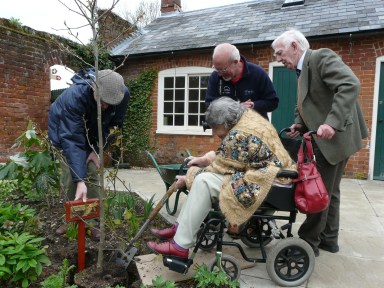
Mary and Derek Manning plant a tree to mark the opening of the garden

Mary and Derek Manning plant a tree to mark the opening of the garden

The newly renovated garden was formally opened on 6th May 2012, and two of the original gardening volunteers, Mary and Derek Manning, planted a ‘Paper Handkerchief Tree‘ to mark the occasion. Local children also played their part and cut ribbons to open ‘Curiosity Corner’.
One of the new residents of the Garden!

One of the new residents of the Garden!

The Curiosity Corner proved to be very popular in its first season last year and included some giant sunflowers planted by a local play group as well as a turf seat; a willow tunnel and arches; hazel wigwam; mirror; ‘fossil slab’; various ‘animals’  hidden away in the planting and a range of different path surfaces and planting. There is also a half barrel filled with stones,water and pond plants, so that youngsters can ‘get up close’ to this watery habitat.
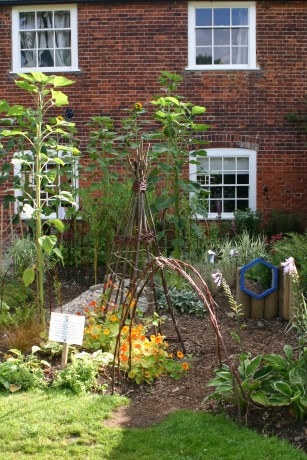
 'Curiosity Corner'

‘Curiosity Corner’

The coming year will see the garden mature further and hopefully there will be sunny days so that visitors can really enjoy this lovely picnic area at its best.

New planters with sweet peas on conical obelisks

New planters with sweet peas on conical obelisks

Quizzicals:

Two more cryptic clues to the names of plants, fruit or veg…

  • The scourge of female chickens
  • Cheap goods in a pile of dung

Old School Gardener

If you’ve enjoyed reading this post and others on this blog, why not comment and also join some other people and sign up for automatic updates via email (see side bar, above right ) or through an RSS feed (see top of page)?

Rob Viens's avatarThe Beagle Project

Darwin did not have much to write about on the 10th, merely stating:

“Removed to a bay North of Orange Bay.” (Feb 10)

So I’ll use the opportunity to continue the story of the southern forests. Today – the story of a little yellow golf-ball shaped fungus that Darwin found growing on the trees. As it bears his name, it only seems fair that he should have the first chance to describe it:

“In the Beech forests, the trees are much diseased: on the rough excrescences vast numbers of yellow balls grow.— These are of the colour of yolk of an egg.— & vary in size from a bullet to a small apple.— in shape globular, but a little produced towards the footstalk or point of attachment. They grow both on the branches & stems in groups…

Sketch of Darwin’s fungus from Voyage of the Beagle:

Cyttaria darwinii

The…

View original post 706 more words

PicPost: Great Garden @ Cambridge Botanic Garden

‘Since its opening in 1846, Cambridge University Botanic Garden has been an inspiration for gardeners, an exciting introduction to the natural world for families and a refreshing oasis for all our visitors. This heritage-listed Garden has been designed for both year-round interest and seasonal inspiration so, whenever you visit, you will find plants to intrigue and enchant.’

Tamara Jare's avatarMy Botanical Garden

8th February is the Slovene Cultural Holiday, named after our biggest poet, Prešeren’s day.At that day the most important cultural achievements and the greatest artists in Slovenia are awarded. This year laureate in category life’s work is illustrator Marlenka Stupica.  Generations of kids grew up with her books, she offered beauty to each childhood. Part of this beauty came from great love for natural detail.My Botanical Garden is expressing, at this occasion, the greatest respect and profound admiration to Ms Marlenka Stupica’s work.Congratulations

View original post

sethsnap's avatarsethsnap

While on a walk the other day, I encountered many unique tree characters.  It seems that at each new turn or bend, I met another strange but beautiful tree creature.  I made sure to document my findings and have provided them for you below.  What tree creatures live in your neck of the woods?

Visit my store.

View original post

PicPost: Great Garden @ The Old Vicarage

The Old Vicarage – East Ruston, Norfolk

“Throughout the garden you will see many rare and unusual plants growing…. Our garden lies 1½ miles from the North Sea in an exposed prairie landscape containing large arable fields. Many of the wildlife habitats have long been swept away and we have endeavoured throughout the garden to replace these by the planting of mixed hedgerows, banks, wildflower areas and ponds.

The soil here is of excellent quality, a light sandy loam with a neutral pH. Due to the maritime influence the garden suffers little in the way of serious frost damage and we have planted large shelter belts of Pinus radiata, the Monterey Pine, Alnus cordata, the Italian alder and many Eucalyptus. This enhances the garden’s unique microclimate which enables us to grow such a huge range of plants.”

Source : Old Vicarage website

Old School Gardener

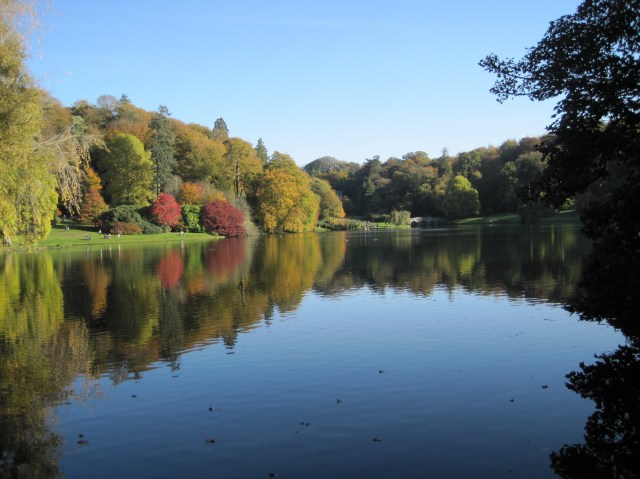
 “The Genius of the Place

The gardens at Stourhead, Wiltshire were designed by Henry Hoare II and laid out between 1741 and 1780 in a classical 18th-century design set around a large lake, achieved by damming a small stream. The inspiration behind their creation were the painters Claud Lorrain, Poussin, and, in particular, Gaspar Dughet, who painted Utopian-type views of Italian landscapes. It is similar in style to the landscape gardens at Stowe.

Included in the garden are a number of temples inspired by scenes of the Grand Tour of Europe. On one hill overlooking the gardens there stands an obelisk and King Alfred’s Tower, a 50-metre-tall, brick folly designed by Henry Flitcroft in 1772; on another hill the temple of Apollo  provides a vantage point to survey the magnificent rhododendrons, water, cascades and temples..

The lake is artificially created. Following a path around the lake is meant to evoke a journey similar to that of Aeneas’s descent in to the underworld…..The plantings in the garden were arranged in a manner that would evoke different moods, drawing visitors through realms of thought. According to Henry Hoare, ‘The greens should be ranged together in large masses as the shades are in painting: to contrast the dark masses with the light ones, and to relieve each dark mass itself with little sprinklings of lighter greens here and there.’”

Source: Wikipedia

Old School Gardener

Finding Nature

Nature Connectedness Research Blog by Prof. Miles Richardson

Norfolk Green Care Network

Connecting People with Nature

Discover WordPress

A daily selection of the best content published on WordPress, collected for you by humans who love to read.

Susan Rushton

Celebrating gardens, photography and a creative life

Unlocking Landscapes

Writing, photography and more by Daniel Greenwood

Alphabet Ravine

Lydia Rae Bush Poetry

TIME GENTS

Australian Pub Project, Established 2013

Vanha Talo Suomi

The Journey from Finnish Rintamamiestalo to Arboretum & Gardens

Marigolds and Gin

Because even in chaos, there’s always gin and a good story …

Bits & Tidbits

RANDOM BITS & MORE TIDBITS

Rambling in the Garden

.....and nurturing my soul

The Interpretation Game

Cultural Heritage and the Digital Economy

pbmGarden

Sense of place, purpose, rejuvenation and joy

SISSINGHURST GARDEN

Notes from the Gardeners...

Deep Green Permaculture

Connecting People to Nature, Empowering People to Live Sustainably

BloominBootiful

A girl and her garden :)