
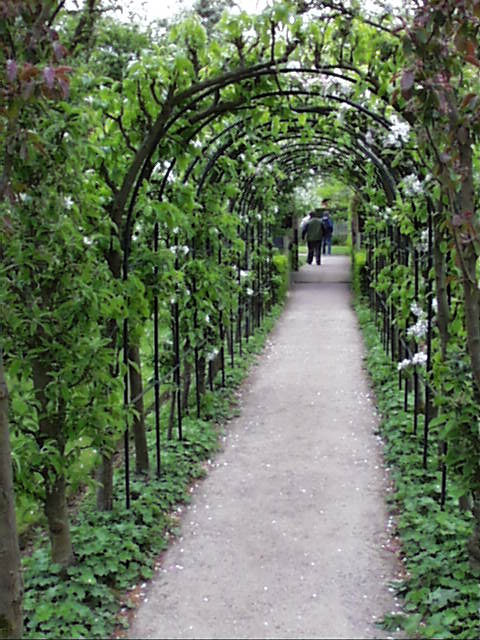

‘Since its opening in 1846, Cambridge University Botanic Garden has been an inspiration for gardeners, an exciting introduction to the natural world for families and a refreshing oasis for all our visitors. This heritage-listed Garden has been designed for both year-round interest and seasonal inspiration so, whenever you visit, you will find plants to intrigue and enchant.’

The Old Vicarage – East Ruston, Norfolk
“Throughout the garden you will see many rare and unusual plants growing…. Our garden lies 1½ miles from the North Sea in an exposed prairie landscape containing large arable fields. Many of the wildlife habitats have long been swept away and we have endeavoured throughout the garden to replace these by the planting of mixed hedgerows, banks, wildflower areas and ponds.
The soil here is of excellent quality, a light sandy loam with a neutral pH. Due to the maritime influence the garden suffers little in the way of serious frost damage and we have planted large shelter belts of Pinus radiata, the Monterey Pine, Alnus cordata, the Italian alder and many Eucalyptus. This enhances the garden’s unique microclimate which enables us to grow such a huge range of plants.”
Source : Old Vicarage website
Old School Gardener
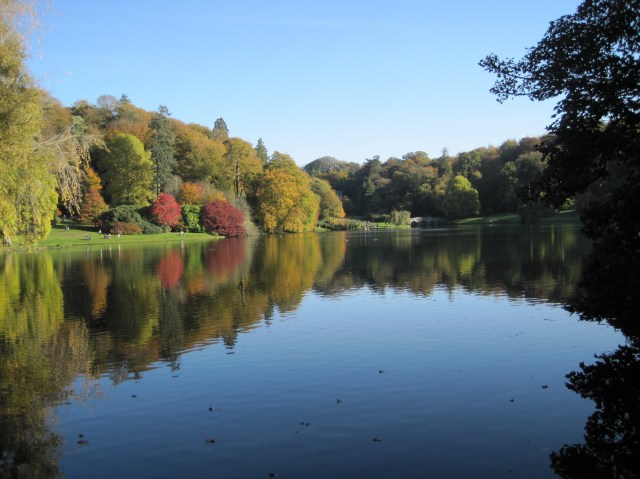
“The Genius of the Place
The gardens at Stourhead, Wiltshire were designed by Henry Hoare II and laid out between 1741 and 1780 in a classical 18th-century design set around a large lake, achieved by damming a small stream. The inspiration behind their creation were the painters Claud Lorrain, Poussin, and, in particular, Gaspar Dughet, who painted Utopian-type views of Italian landscapes. It is similar in style to the landscape gardens at Stowe.
Included in the garden are a number of temples inspired by scenes of the Grand Tour of Europe. On one hill overlooking the gardens there stands an obelisk and King Alfred’s Tower, a 50-metre-tall, brick folly designed by Henry Flitcroft in 1772; on another hill the temple of Apollo provides a vantage point to survey the magnificent rhododendrons, water, cascades and temples..
The lake is artificially created. Following a path around the lake is meant to evoke a journey similar to that of Aeneas’s descent in to the underworld…..The plantings in the garden were arranged in a manner that would evoke different moods, drawing visitors through realms of thought. According to Henry Hoare, ‘The greens should be ranged together in large masses as the shades are in painting: to contrast the dark masses with the light ones, and to relieve each dark mass itself with little sprinklings of lighter greens here and there.’”
Source: Wikipedia
Old School Gardener


‘After decades behind virtually closed doors, its treasures overgrown and largely unknown, English Heritage is reviving one of Britain’s largest and most important ‘secret gardens’ – Wrest Park in Bedfordshire.
This is a wonderful 90-acre historic landscape and French-style mansion which will take its rightful place amongst the country’s great garden attractions – and give locals and visitors to Bedfordshire a superb new day out.
Stroll in the recently restored Italian and Rose Gardens. Enjoy miles of reinstated historic pathways as you discover the garden buildings, pavilion and statues. Find out more about the garden and the people that shaped it, in our new exhibitions in the house and garden buildings.’
Source: Wrest Park website
Old School Gardener

‘The Garden House is the elegant former home of the vicars of Buckland Monachorum..(near Tavistock, Devon)…
The present building dates from the early 19th century and now accommodates the tearooms and conference centre. The history of this 8-acre garden is closely entwined with that of Buckland Abbey and the local church. In 1305 the Bishop instructed the Abbot to build a house for the parish priest and this site was chosen. At the dissolution of the monasteries, the abbot became the vicar of Buckland Monachorum and by the early 1700s, the vicarage consisted of a substantial 3-storey dwelling. The remains of this building, a tower with spiral staircase and a thatched barn, formerly the kitchen, are now the romantic ruins in the Walled Garden.
A modern vicarage was built in the 1920s and The Garden House was sold as a private dwelling. The house came onto the market again just after the Second World War and was purchased and given its present name by Lionel Fortescue, a retiring master at Eton, and his wife Katharine. Lionel was the son of a Newlyn school painter and had a good eye for colour as well as being an exacting plantsman. Lionel and Katharine immediately set about renovating and developing their garden whilst running a thriving market garden business, providing stock plants for growers in the Tamar Valley, and managing a herd of Jersey dairy cattle.
Over nearly 40 years, the Fortescues created a garden viewed as one of the finest in Britain. By 1961, they had established the Fortescue Garden Trust, an independent registered charity to which they bequeathed the house and garden to ensure the survival of this beautiful place for future generations. After their deaths in the early 1980s, ownership passed to the charity which to this day maintains the Fortescue’s lovely legacy.
The second phase of development took place under Keith Wiley who was appointed by Lionel and spent 25 years as Head Gardener. Keith took the 6 acres of paddocks to the far side of the road into cultivation from 1990, creating a series of gardens that take their inspiration from the natural world. Keith left in 2003 to concentrate on writing and creating his own nursery, Wildside Plants.
Matt Bishop is the present Head Gardener and he is particularly well-known for his expertise on snowdrops and bulbs. Matt’s brief is to care for and respect the legacies of his predecessors whilst ensuring, just as they did, that The Garden House remains a crucible of new ideas and new plants, at the cutting edge of horticultural excellence and innovation. He has undertaken a major refurbishment of the original Fortescue garden as well as ongoing maintenance in other areas to ensure a long opening season of glorious colour and variety. This has been an excellent opportunity to introduce many new plants whilst continuing Lionel’s principle of using only the best forms and cultivars avaialble.
Matt has two horticultural students under training here and a small team of dedicated staff and volunteers who care for the garden.’
Source: The Garden House website
Old School Gardener
 Caging our children- a price worth paying to beat the vandals? what are your views on childrens’ play?
Old School Gardener

‘Whenever I want to escape the hustle and bustle of Lisbon, and don’t want to travel far, I retreat to the gardens of the Calouste Gulbenkian Museum.
Covering roughly 17 acres, this beautifully landscaped garden contains a wide variety of well-established tropical as well as indigenous plants and trees that shelter subtly-appointed benches and seats. In the last few months a network of new, flat, winding paths has been opened through the garden.
There are picnic tables situated next to a lake where you can sit on bright winter days and soak up the sun, or watch the ducks with their fleets of ducklings enjoying the water in spring. At the weekends the gardens come alive with the sound of kids playing in the sunshine.
In the summer months, it is nice to disappear into this garden down one of the maze-like paths that snake through the shrubbery and to feel as if you are the only person in the world, surrounded only by birds scurrying around in the undergrowth or flitting in the trees. Somehow, the vast tree canopies manage to dull the sound of Lisbon traffic to the point you forget it is there and will also shelter you from the heat of the day.
The garden contains an open-air amphitheater where, during the summer, a programme of films or music events takes place in the evenings.
Whether on a hot, sultry summer evening or a bright, sunny winter day this garden is the perfect place to be and feel completely relaxed.’
Old School Gardener

On the outskirts of Harlow, Essex there is a garden full of beauty, peace and tranquillity – The Gibberd Garden. It is a wonderful place to stroll and be inspired. Every turn reveals another aspect or a work of art, for this garden was created by Sir Frederick Gibberd, the planner of Harlow New Town, who designed the garden and filled the grounds with sculptures, ceramic pots and architectural salvage from 1972 till his death in 1984.
The garden has many aspects – formal lawns, flower beds, a brookside walk with a waterfall, a wild garden with a tangle of paths where children love to hide, a gazebo with a formal pond, an island fort to defend with a drawbridge onto it, an arboretum of young trees, and, at the end of a fascinating and memorable tour, a tearoom with mouth-watering cakes, ice creams and refreshments.


 Old School Garden