Latest Entries »

Everyday is a play day

Picpost: Bucket Shop

‘Students at Armstrong School in Newcastle have been creating more storage solutions for their shed with Sarah Carrie (Schools Advisor for the North East).
As well as their brilliant welly rack (post from 28 June), they have made this smart tool holder to keep long handled tool handles upright and neat.
To make it they:
Used 4 old plastic plant pots
Cut the bottoms off 2 of them
Screwed these 2 pots onto the shed wall
Fixed the other 2 plant pots below the others onto the floor.’

via RHS Campaign for School Gardening


Grey mould on strawberries

Grey mould on strawberries

Do you spray your strawberries against fungal infections?

An innovative development at the East Malling research centre in Kent may make this a thing of the past, At least if you keep bees that is. Scientists have designed a dispenser to fit into bee hives that the bees move through on their way out of the hive to forage for nectar. As they do so, they pick up a tiny amount of biofungicide, Gliocladium catenulatum ( a fungus which suppresses the growth of grey mould). The sunbstance sticks to their legs and bodies and as they move among the strawberry plants a small amount is deposited on each bloom, preventing grey mould being carried onto developing fruit. And tests have shown that the bees’ control was just as good as when the crops were sprayed – and there was the bonus that fungicide residue on the fruit was reduced. Sounds like a brilliant development that will probably benefit commercial strawberry production, but maybe a kit will also be produced for the serious home strawberry grower- bee keeper!

This ‘bioweapon’ isn’t the only one being reported at present. It seems that the invasive Harlequin Ladybird (Harmonia axyridis) is also armed with its own ‘bioweapon’ which is helping them to out compete native ladybirds.

Harmonia axyridis, the Harlequin Ladybird

Harmonia axyridis, the Harlequin Ladybird

German scientists have found  that the Harlequins carry a fungal parasite in their blood that they can tolerate, but which is fatal to other types of ladybird. There’s some uncertainty about how the natives become infected,, but it seems likely that their habit of eating other ladybirds’ offspring may be to blame. Seven native types of ladybird in the UK have declined in numbers by up to 44 per cent since the arrival of the Harlequin in 2004. Originally introduced from China as a way to control aphids, the Harlequins do not so far seem to have affected the numbers of Seven Spot ladybirds.

Another, more positive finding from the research is that the fungal parasite carried by the Harlequins seems to kill the bacterium responsible for tuberculosis and the malaria parasite, so there may be the possibility of developing medicines that can help to cure these important human illnesses.

Source: ‘The Garden’- RHS Journal August 2013

Old School Gardener

If you’ve enjoyed reading this post and others on this blog, why not comment and join others by signing up for automatic updates via email (see side bar, above right ) or through an RSS feed (see top of page)?

PicPost: Snail Trailed

Picpost: High Life

via Growveg

PicPost: Varmint Free

http://ww38.tucsongardener.com/Year09/varmintraisedbeds.htm

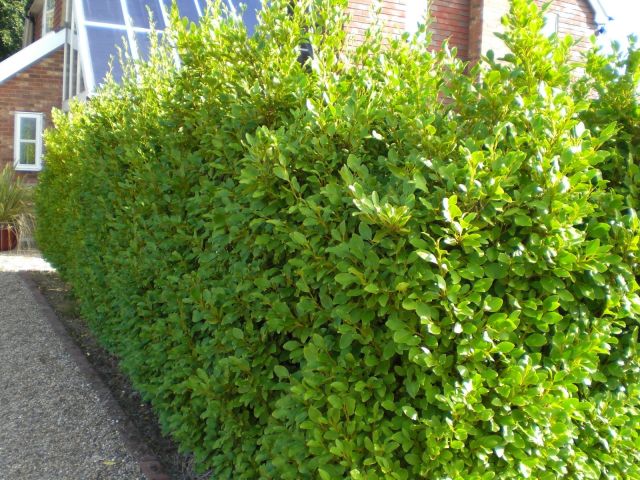
Griselina littoralis- a good seaside hedge

Griselina littoralis- a good seaside hedge

I’ve had a few queries about hedges recently and this one, from Robert Galbraith is my choice for this week’s GQT:

‘We live in a bungalow near the seashore in Sussex, where the soil is rather sandy. Could you suggest some suitable hedging plants to give our garden a bit of privacy, please?’

There is quite a wide choice of suitable plants Robert. You could go for Grisselina littoralis which has thick yellowish – green leaves forming a dense, solid hedge if formally clipped and will grow in most soils. Escallonia ‘Langleyensis’, with red flowers in June – July is often grown in seaside locations and has glossy evergreen foliage. Other varieties are E. macrantha with deep red flowers in June – September and E. ‘Slieve Donard’ with large pink flowers in June- August.

Sea Buckthorn (Hippophae rhamnoides) has silvery grey foliage and orange berries (if both male and female forms are grown). Tamarisk pentandra has feathery flowers in August whilst the form T. tetranda is May – flowering.

Euonymus japonicus, with evergreen shiny leaves is also available in variegated forms which can withstand close clipping as does the shrubby honeysuckle Lonicera nitida with small golden – green leaves.

More generally, and not necessarily suitable for a seaside home, the best ornamental evergeen hedges for formal training and clipping are Yew and Holly. Box is also suitable, but is very slow growing and expensive so is best kept as low hedging (up to about 1 metre tall) or feature, perhaps topiarised, bushes. Hedges of Cypress and Cherry Laurel are also good for an evergreen barrier and Privet, provided it is trained correctly from planting, will supply a satisfactory semi-evergreen barrier.

Cherry Laurel

Cherry Laurel

Old School Gardener

If you’ve enjoyed reading this post and others on this blog, why not comment and join others by signing up for automatic updates via email (see side bar, above right ) or through an RSS feed (see top of page)?

PicPost: Fish out of water

PicPost: Potty

delphiniumsDelphinium is a genus of around 300 species of flowering perennial, biennial and annual plants that are native throughout the Northern Hemisphere and also on the high mountains of tropical Africa.

The name “delphinium” derives from the Latin for “dolphin”, referring to the shape of the nectary, though there is also a story that in ancient Rome men were pursuing a dolphin for commercial exploitation so Neptune turned it into the Delphinium!

The common name “larkspur” (referring to the bird’s claw shape of the flower), is shared between perennial Delphinium species and annual species of the genus Consolida. The famous 16th century herbalist, John Gerard gives ‘delphinium’ as an alternative name for Consolida, says that there is little written about any medicinal uses other than as an antidote to scorpion stings. He mentions the idea of laying delphiniums in the path of a scorpion tol render it totally incapable of movement until the plant is removed but says this is just one of many ‘trifling toyes’ that are not worth reading! The town of Larkspur in Colorado was given its name by Elizabeth Hunt, wife of the governor, in 1871 because of the abundance of delphiniums growing in the area

Delphinium nuttallianum

Delphinium nuttallianum

Species names of Delphinium include:

D. ajacis = possibly based on the marks at the base of the united petals which were compared to the letters AIAI

D. cardinale = scarlet

D. consolida = joined in one

D. elatum = tall

D.formosum = beautiful

D. grandiflorum = large flowered

D. nudicaule = naked stemmed

D. sulphureum = sulphur – yellow

D. tatsiense = of Tatsien, China

D. triste = sad, the dull blue of the flowers

D. zalil = native Afghanistan name.

D. 'Blue Nile'

D. ‘Blue Nile’

Delphinium_cv2

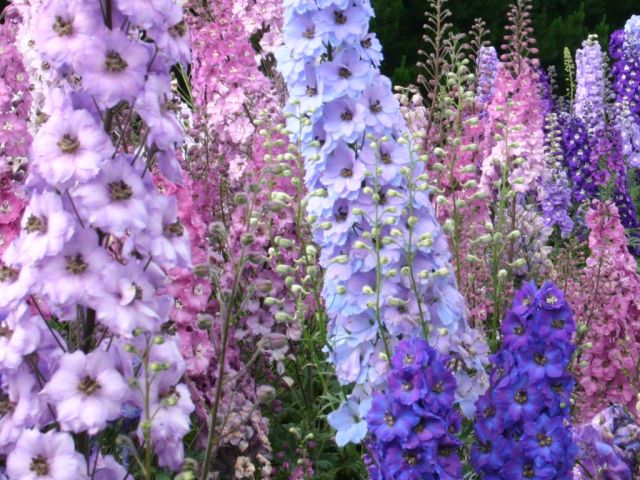
The delphinium is much admired, particularly in the cottage garden setting. Delphiniums are tall, majestic plants with showy open flowers on branching spikes. Each flower has 5 petal-like sepals with 2 or 4 true petals in the centre called a bee. Delphinium species include all three primary colours, blue, red, and yellow. Hybridisation of delphiniums has resulted in many new colours and attractive flower forms and growing heights. Most garden Delphiniums are of the hybirds raised from species such as elatum, formosum, grandiflorum and sulphureum. Flower colours range in shades of blue from palest sky, through to gentian and indigo; rich purple, lavender, pink to purest white.  In England Blackmore and Langdon, nurserymen and leading breeders of Delphiniums, were producing hybrids from early in the 20th century, producing named varieties of large well-formed delphiniums. Others have also added their skills and developed the most dramatic and eye-catching plants to grace our gardens.

This slideshow requires JavaScript.


Sources and further information:

The Delphinium Society

RHS- Delphiniums

How to grow Delphiniums- Sarah Raven

Gallery of Delphiniums

The Poison Garden – Delphiniums

Quizzicals: answers to the two clues given in Plantax 13…

  • Bovine stumble – cowslip
  • Simpler tombola – rafflesia

..and 2 more cryptic clues to the names of plants, fruit or veg…

  • Cold yearning
  • How Jack Charlton refers to brother Bobby

Special thanks to Les Palmer, whose new book ‘How to Win your Pub Quiz’ was published recently. A great celebration of the British Pub Quiz!

Old School Gardener

If you’ve enjoyed reading this post and others on this blog, why not comment and join others by signing up for automatic updates via email (see side bar, above right ) or through an RSS feed (see top of page)?

Finding Nature

Nature Connectedness Research Blog by Prof. Miles Richardson

Norfolk Green Care Network

Connecting People with Nature

Discover WordPress

A daily selection of the best content published on WordPress, collected for you by humans who love to read.

Susan Rushton

Celebrating gardens, photography and a creative life

Unlocking Landscapes

Writing, photography and more by Daniel Greenwood

Alphabet Ravine

Lydia Rae Bush Poetry

TIME GENTS

Australian Pub Project, Established 2013

Vanha Talo Suomi

The Journey from Finnish Rintamamiestalo to Arboretum & Gardens

Marigolds and Gin

Because even in chaos, there’s always gin and a good story …

Bits & Tidbits

RANDOM BITS & MORE TIDBITS

Rambling in the Garden

.....and nurturing my soul

The Interpretation Game

Cultural Heritage and the Digital Economy

pbmGarden

Sense of place, purpose, rejuvenation and joy

SISSINGHURST GARDEN

Notes from the Gardeners...

Deep Green Permaculture

Connecting People to Nature, Empowering People to Live Sustainably

BloominBootiful

A girl and her garden :)