Latest Entries »

PicPost: Iris my case

Ox Eye Daisies and Cornflowers make a wonderful display at Myddelton House

Ox Eye Daisies and Cornflowers make a wonderful display at Myddelton House

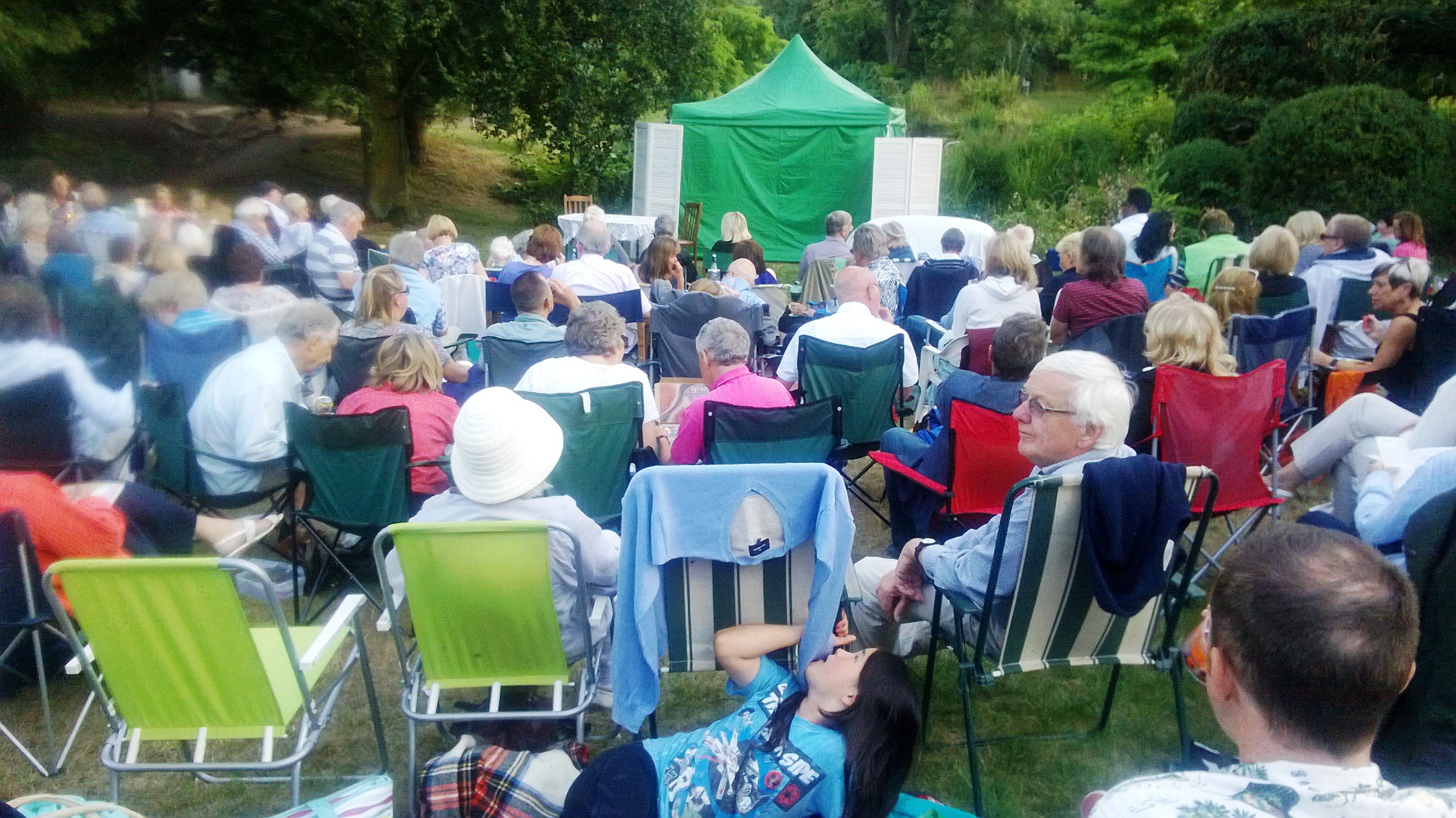
A visit to the open air theatre is always a treat, and last weekend proved no exception. We joined our good friends Dave and Jenny for a performance of ‘Lady Windermere’s Fan’, Oscar Wilde’s comic drama ‘with a message’. The symmetry of the plot coupled with showy 19th century language and costume were well echoed in the gardens of the venue, Myddelton House, in Enfield, Middlesex. Before the performance started I had a chance to look around this recently restored Victorian plot whose most famous former resident was the renowned self – taught gardener, artist and expert botanist, E.A. Bowles. In the late evening summer sun it was a joy. More of its key features later, but first, here’s a little background on the place.

Covering eight acres Myddelton House Gardens were occupied by Edward Augustus Bowles from 1865 to 1954. He dedicated himself to transforming the gardens with unusual and exotic plants. Originally built circa 1812, and completed in 1818, the House was built by Henry Carrington Bowles, one of five generations of London print and map makers. Bowles built the new house in the then fashionable white brick from Suffolk and named it Myddelton House in honour of Sir Hugh Myddelton, an engineering ‘genius’ who created the New River, a section of which had bisected the garden from 1613 until 1968.

The youngest son of five children to Henry Carrington Bowles and his wife Cornelia was Edward Augustus “Gussie” Bowles, who became one of the great gardeners of the 20th century. He originally trained for the church, but family tragedies caused him to change course and he remained at Myddelton House and developed the remarkable garden as a self-taught horticulturist. For many years people came from all over the country to visit. He became an expert on many plants, particularly the Crocus and was dubbed “The Crocus King”.

Crocus 'E.A. Bowles'

Crocus ‘E.A. Bowles’

Today’s gardens have an impressive range of flora with something to stimulate the senses each season, from colourful spring crocuses to dazzling summer irises. In spring 2011 a newly restored Myddelton House Gardens were unveiled, following a two year Heritage Lottery Fund enabled project.

The gardens are home to a beautiful carp lake, a Victorian conservatory and a number of historical artefacts collected and treasured by E A Bowles, including pieces from the original St Paul’s Cathedral and the Enfield Market Cross. There’s a 111 year old Wisteria which turns a brilliant blue when it flowers during May. A beautiful newly created Victorian Glasshouse Range retains unique details, such as four climatic zones, a vine house and a sunken glasshouse that would have been used to grow fruit such as melons and cucumbers.

The gardens have been well restored and further work is obviously in hand. It is a typical Victorian pot pourri of different gardens and areas of historical or other interest. I was particularly impressed with the glasshouse area with its clean – cut display of irises in a gravel – covered bed, cutting flower beds in lovely colour combinations and areas of wildflower planting which look like a soft, frothy sea which I was tempted to dive into! The House is the headquarters of the Lea valley Regional Park Authority and apart from the gardens there is a museum about E.A.Bowles. All are open to the public and there’s free entry.

The whole evening, including good company, fun drama and good food and drink was delightful. So, thanks once more, Dave and Jenny!

The audience awaits...

The audience awaits…

Further information:

E.A.Bowles – wikipedia

Myddelton House web site

Old School Gardener

If you’ve enjoyed reading this post and others on this blog, why not comment and join others by signing up for automatic updates via email (see side bar, above right ) or through an RSS feed (see top of page)?

PicPost: Hideaway

One way of hiding that ramshackle old shed!

Tomatoes-on-the-bushA timely question from gardener, D. Light of Little Blight about tomatoes this week:

‘When should I ‘stop’ my tomatoes?’

‘Stopping’ tomatoes refers to the nipping out of the growing point about two leaves above the top flower truss. This concentrates the plants energies into maturing the remaining trusses of fruit before the cold weather comes.

  • Outdoor tomatoes are usually stopped after three trusses in the north of the UK, and about four or five in the south. This probably means about now (early August) or possibly slightly earlier.
  • Indoor tomatoes are stopped after seven or eight trusses– or if they are growing well, you can leave them until there’s no more room in the greenhouse!

It’s also worth remembering to continue to nip out the side shoots that grow between the angle of the leaves and main stem (only on those grown as cordons/climbers and not necessary on bush tomatoes). And as trusses of fruit start to mature from the bottom up, progressively cut off some of the foliage to allow light and air in around the fruit to help ripening and reduce the chances of disease.


Well, that’s ‘stopping’. At this time of year it’s also possible to restart the growth of spring and early summer cabbages.

When you cut the cabbage head, leave the stalk in the ground and cut a shallow cross about 6mm deep on the top of it. Provided the ground is fertile and there’s plenty of moisture, several buds will appear below the cut and develop into cabbage heads by late summer. As many as six new cabbage heads may be produced, crammed tightly together on the old stalk!

Old School Gardener

If you’ve enjoyed reading this post and others on this blog, why not comment and join others by signing up for automatic updates via email (see side bar, above right ) or through an RSS feed (see top of page)?

boots

David Kemp’s ‘Hounds of Geevor’ taking a stroll over Botallack clifftops…These hounds are made from tin miners boots that were left behind in the mines after they closed down. A pack of these hounds have been cast in bronze (mixture of Cornish tin and copper) and stand in Redruth town centre (used to be the mining centre of Cornwall, UK).

From Growveg

WP_20130805_021It’s ‘Play Day’ in England today, so I thought it would be appropriate to report on my recent visit to the new Olympic Park Play Area in Stratford, London.

The ‘Tumbling Bay’ play space has just opened in the north of Queen Elizabeth Olympic Park. Designed by LUC and Erect Architecture, the space is the core social area for this part of the Park, which opens fully next April. It aims to provide a facility of use to both visitors to the area as well as the growing new residential community in the area and local workers.

The naturalistic play space is based on ecological concepts of succession and life cycles and is laid out along a newly created valley, with a new ‘Timber Lodge’ café and community hub at one end. I must say that I was impressed with what I saw.

Given the heavy use this area is likely to see and that it is unsupervised, the designers and builders have done a great job at maximising natural play opportunities in an urban setting. I think children of all ages will be able to get something from it. At one end a climbing structure consisting of natural, rough finish timber bridges, ascents ,plus net walkways and other nooks and crannies is an exciting physical circuit for mainly physical play. The structures here are not so much designed on the drawing board as created on the spot – at least that’s how they look, with rough-hewn timber providing a wonderful variety of opportunities for climbing, clambering, crawling, walking and just sitting around.

This wood- strewn area gives way to an area dominated by a river delta – ilke landscape of gullies, pools and waterways. These are fed by a number of hand pumps and can be dammed at various points. And there are also spots offering a mix of sand and water play. The use of what seems to be blocks of natural (sand?) stone and sculpted landforms (made of composite materials?) conveys a natural look that could have been here for decades. Apparently the sand and water play area was inspired by the history of the River Lea and its industrial past. The arrangement of pumps and dams encourages children to experiment with water flows, work in groups and pump sufficient water to dam and divert water through the natural rock pools, rivulets and channels, filling a series of shallow pools and sand boxes along the way.

Finally, and running up to the cafe, is an area where water gives way to sand – dominated play, featuring a hanging conveyor system using sections of tyre and allowing children to move quantities of sand around the area. There are also a number of chunky wooden and gabion structures that are at different times seats, walkways or climbing features. I particularly liked the use of simple planed timber planking set around in odd places in the floorscape with grooves cut at right angles. I guess these are to provide a varied, grippy surface, but can also be a great little place for the very young to experiment with sand and water and other loose materials.

There are also some young hazel woodland copses where, in due course, children will be able to explore and build dens, hunt for bugs and get their hands dirty. The copses adjoin some ‘pine forest’ areas which run up against the timber play area. The curving form of the play area and its use of planting makes it blend in beautifully with the adjoining parkland landscape, avoiding the problem of all too many play spaces that stand out as colourful, metal-dominated, jarring places amidst surrounding greenery. The lack of fencing, but use of planting, land form and a variety of different log slice/trunk footways to provide barriers and create entrance and exit channels should also encourage children to play in the surrounding grassy and planted areas.

It is free to visit the parklands, cafe and playground. We enjoyed a lovely cup of coffee served by smiling staff at the new social enterprise – run cafe and events centre, which seemed to be doing a steady trade in these early days. I was interested to see that local primary schools have already contributed to displays in the Centre and this sign of community involvement is an early indicator of it becoming a successful community hub.  As you can see from the photographs, we were there early in the day, so only a few children were around. On our way home we passed lots of families with children who looked as though they were on their way to the park and play area.

If you get the chance it’s well worth a visit!

Old School Gardener

If you’ve enjoyed reading this post and others on this blog, why not comment and join others by signing up for automatic updates via email (see side bar, above right ) or through an RSS feed (see top of page)?

sethsnap's avatarsethsnap

We live our lives below the trees, surround by their arms, and shaded by their leaves.  Yet we rarely stop and give much thought to the beauty that is a leaf.

View original post

shinealightproject's avatarShine A Light

By Dayna Woolbright

Fortunately crate 20 didn’t contain any witches but it did contain something equally as mysterious.

Crate 20 contained a lot of textile objects, mainly a selection of rugs and carpets but it also revealed another somewhat larger textile item which was folded into a large square. In its folded state we had no clues about what the item could be but from its size we suspected that once unfurled what ever it was would be huge! Due to the limited processing space in the superstore it was a few weeks before we had a chance to fully look at the object and fortunately this opportunity coincided with a visit from staff working in Norfolk Museums and Archaeology’s textile department, Social History curator Cathy Terry and head of conservation Man-Yee Liu.

Man-Yee assessed the textile and concluded it was in a good condition and stable enough to work…

View original post 1,016 more words

PicPost: Stepping up

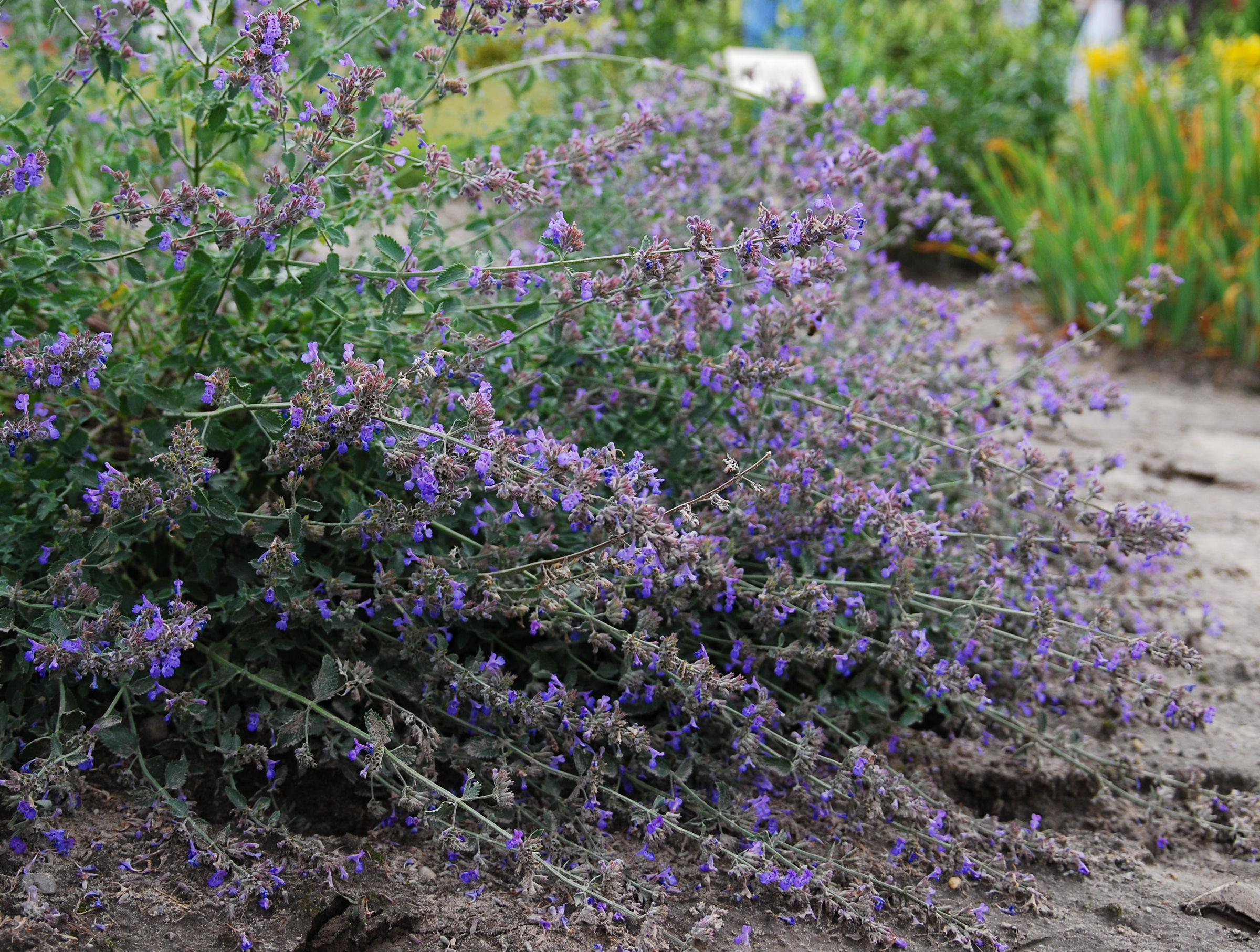
Nepeta- soem varieites are called Catnip or Catmint because cats love them!

Nepeta- some varieites are called Catnip or Catmint because cats love them!

Nepeta is a genus of about 250 species of perennials and a few annuals, native to cool and moist to hot and dry habitats in scrub, grassy banks, stony slopes or in high mountains, in non tropical areas of the northern hemisphere. So as you can see, there’s pretty much a Nepeta to suit every garden situation!

Some members of this group are known as catnip or catmint because of their effect on cats – the nepetalactone contained in some Nepeta species binds to the olfactory receptors of cats, typically resulting in temporary euphoria!

They have sturdy stems with opposite heart-shaped, green to grey-green leaves. Nepeta plants are usually aromatic in foliage and flowers. The tubular flowers can be lavender, blue, white, pink, or lilac, and spotted with tiny lavender-purple dots. The flowers are located in ‘verticillasters’ grouped on spikes; or the verticillasters are arranged in opposite groups – toward the tip of the stems.

Nepeta can be drought tolerant, being able to conserve water. They bloom over a long period from late spring to autumn. Some species also have repellent properties to insect pests, including aphids and squash bugs, when planted in a garden. Nepeta species are used as food plants by the larvae of some butterflies and moths and as nectar sources for pollinators like bees.

Nepeta makea a wonderful sprawling edge to an informal border

Nepeta makes a wonderful sprawling edge to an informal border

Nepeta can be grown in any well drained soil in full sun or partial shade. Some species, like N. govaniana and N. subsessilis prefer moist, cool conditions, whereas N. sibirica likes it fairly dry. There are a few tall growing varieties, like ‘Six Hills Giant’, with a more upright habit. These need staking or support to see them at their best.  Most Nepetas will rebloom if sheared back after their initial flowering (N. x faassenii and N. nervosa for example). Some won’t provide much of a second show, but their foliage will be refreshed and tidied by the shearing.

Nepeta looks wonderful when covered in flower from early summer. The pale, often lavender-blue flowers perfectly complement the hairy, scalloped and wrinkled, silvery, blue-green leaves. The flowers appear as a haze of blue from a distance. It is often used as an informal, low hedge echoing the colours of lavender (and is used as a substitute where lavender isn’t hardy enough). But it has a rather lax form and will spread itself to cover its allotted space (and more!). Nepeta is best planted at the front of the border, edging a path, so that when you brush past it you will catch the full scent from its aromatic leaves. Nepeta is also a classic underplanting for roses. The colours complement and the foliage hides the ugly ‘knees’ of the rose bush.

We have some here at Old School Garden and this year I’m experimenting with it in some raised planters to try to get a cascading effect, as I’ve seen it used effectively this way on top of an old garden wall in Devon, though I suspect some varieties will have longer stems than others so are better suited to this treatment. The pastel blues of Nepeta combine wonderfully well with pinks and yellows, such as day lilies and yarrow (Achillea). It also looks good with Allium cristophii and Zinnia elegans ‘Envy’.

Some suggested varieties:

  • N. nervosa ‘Felix’ – Compact plant with vivid lavender-blue flowers. (12″ H x 24″ W)
  • N. x ‘Six Hills Giant’ – One of the tallest growing Nepetas, with lavender-blue flowers.(36″ H x 30″ W)
  • N. subsessilis ‘Sweet Dreams’ – Pink flowers with burgundy bracts. Likes a bit more water than most Nepetas. (2′ H x 3′ W)
  • N. racemosa ‘Walkers Low’– has 8″ spikes of lavender-blue flowers.  ( 2 H’ x 2′ W)

Nepeta faassenii 'Six Hills Giant'- foliage

Nepeta faassenii ‘Six Hills Giant’- foliage

Nepeta is one of those plants that thrives on neglect. Too much fertilizer will only make it grow lots of flimsy foliage. A lean soil and somewhat dry growing conditions will encourage both flowers and scent. Many of the newer varieties of Nepeta are sterile, producing no viable seeds. This is a plus if you don’t like the weedy, self-seeding habit of older Nepeta varieties, but it means you will need to either buy plants or make plants from divisions or cuttings.  Division is not a requirement, but if you’d like more plants divide it in spring or in autumn. The Royal Horticultural Society have given it their prestigious Award of Garden Merit.

Nepeta longipes

Nepeta longipes

Sources and further information:

Wikipedia

BBC – Catmint

About.com

One plant 3 ways- Nepeta design tips

Old School Gardener

If you’ve enjoyed reading this post and others on this blog, why not comment and join others by signing up for automatic updates via email (see side bar, above right ) or through an RSS feed (see top of page)?

Finding Nature

Nature Connectedness Research Blog by Prof. Miles Richardson

Norfolk Green Care Network

Connecting People with Nature

Discover WordPress

A daily selection of the best content published on WordPress, collected for you by humans who love to read.

Susan Rushton

Celebrating gardens, photography and a creative life

Unlocking Landscapes

Writing, photography and more by Daniel Greenwood

Alphabet Ravine

Lydia Rae Bush Poetry

TIME GENTS

Australian Pub Project, Established 2013

Vanha Talo Suomi

The Journey from Finnish Rintamamiestalo to Arboretum & Gardens

Marigolds and Gin

Because even in chaos, there’s always gin and a good story …

Bits & Tidbits

RANDOM BITS & MORE TIDBITS

Rambling in the Garden

.....and nurturing my soul

The Interpretation Game

Cultural Heritage and the Digital Economy

pbmGarden

Sense of place, purpose, rejuvenation and joy

SISSINGHURST GARDEN

Notes from the Gardeners...

Deep Green Permaculture

Connecting People to Nature, Empowering People to Live Sustainably

BloominBootiful

A girl and her garden :)