Archive for March, 2016

Euphorbia myrsinites
One Billion Hungry: Can We Feed the World?
“As the world stands at a climate crossroads, it is powerful yet humbling to think that our actions today will decide what tomorrow will look like for generations to come.” Saturday 19th March at 08:30pm local time is Earth Hour, a worldwide grassroots movement organised by WWF, which originally began as a lights-off event in Sydney, Australia in 2007. Since then this annual global celebration where people switch off their lights for one hour has become a symbolic display of how much we care for and want to protect the planet. Last year a record number of people from across 172 countries celebrated Earth Hour.
A recent article from WWF outlining climate events of 2015, makes it clear that Earth Hour this year is crucial to continued progress on climate change. Firstly changes in our climate continue to be worrying: 2015 became the official hottest year on record…
View original post 493 more words

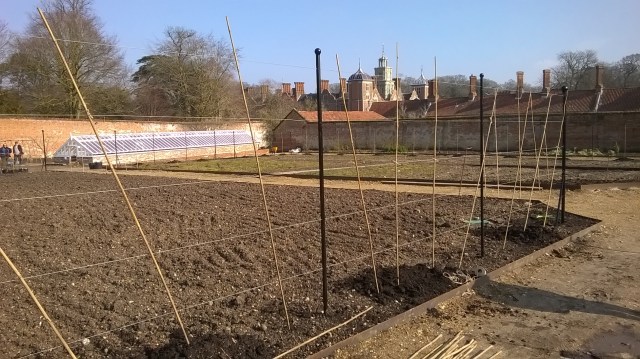
The final solution for the trained fruit trees along the central path?
This week’s session at Blickling was easier- at least to begin with- than the previous few. Norfolk Peter and I were detailed to measure out the positions of the new trained fruit around the edges and across the middle of the Walled Garden.
Placing and tying in canes to mark the planting positions was pretty straightforward around the perimeter- Mike plans for these to be vertically planted and then trained. Then we needed a bit of discussion about the central path, where Mike wants to put in some angled cordons for apples and pears. Putting them all in at 45 degrees and pointing the same way proved problematic; we ended up with plants placed too close to the concrete footings of the metal posts and some cordons would have to wrap around the corners or there would be gaps at the upper sections if we stuck rigidly to the spaces between each post…
After a bit of trial and error we came up with a combination of outwardly angled and a vertical espalier for each complete stretch of the wire and posts; this would mean some cordons growing over the intermediate metal posts and the angle would have to be steeper than 45 degrees. But overall it seemed to be a pleasing arrangement, and after they were in place I could see two other advantages; the design would visually slow you down as you proceeded along the path (rather than being hastened through if they had all be pointing in the same direction) and the angles nicely framed the other central path where these cross.
The rest of the volunteers were off digging over the parterre alongside the Hall, removing dead or dying Catmint and roses and replanting with new stock.
After lunch, having finished off the cane placing, Peter helped Mike measure up the splendid carved oak top trim for the new noticeboard and I barrowed in some soil and manure along the borders in the walled garden in preparation for the planting out of the many new plants that seem to be arriving in time for my next session… so next time it will be more gardening, less construction.
Further Information:
Blickling Hall website
Blickling Hall Facebook page
A 360 degree tour of Blickling Hall
Old School Gardener

Montreal, Canada
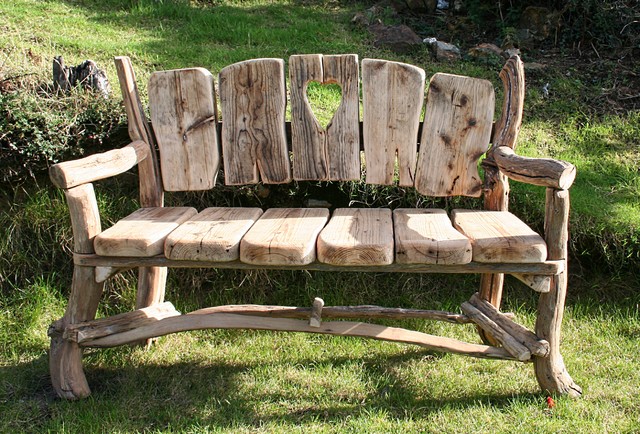
So, my penultimate object in this series symbolises our need (all too often neglected by the busiest gardeners) to sit and enjoy the fruits of our labours- the garden bench. And the one in the featured picture is made from reclaimed wood and, I think, looks rather inviting (especially with the addition of a couple of large cushions?).
Having said this, there are probably not that many garden benches that are frequently used for sitting. Here at Old School Garden, over the years I’ve spread a number of these garden ‘must haves’ around (and have two more to restore/ assemble to place in key positions in my pond garden and to take advantage of the view across the fields to our local church). Apart from one or two used to take summer morning coffee (as an alternative to the rather more comfortable chairs on the terrace), these are not used for sitting. So, where should you position these essential garden objects?
One view is that it’s by a process of elimination, spotting the place where it looks right. However, what looks right, in practice might not feel right. Elizabeth West describes the difficulty in her book Hovel in the Hills:
“The right places to sit in a garden have to be discovered. They cannot be decided in advance. Alan [her husband] once erected a two-seat wooden bench beneath the laburnum tree because it was sheltered from the wind, caught the sun and looked out towards Moel Siabod [a mountain in Snowdonia].
On a few occasions we took out our cups of tea and sat there self-consciously, but it didn’t feel right. We would find ourselves drifting across to a patch on the drive about 10ft away, and we would stand there to finish our tea. So we moved the bench there. It caught all the sun, was not so sheltered and didn’t have quite the same view, but it felt right.”

The classic ‘Lutyens Bench’- one to add a bit of class to your plot?
In a provocative article (see below for link), Antony Howard says:
“Discomfort remains the defining quality of outdoor seating. The goal of meeting the tripartite challenge of comfort, weatherproofing and looks continues to defy designers. Most seats make minimal concession to the fragility of the human frame. Sharp angles, hard edges and an absolute absence of ergonomics abound. Wooden seats promise a coating of green slime. Metal or stone ones freeze the buttocks. Grass or moss are obviously not to be taken seriously.”
He goes on to say that this discomfort doesn’t really matter, for garden benches are not, in general, intended to be sat on. ‘They are present to introduce the idea of repose’, he says, ‘which is perfectly justifiable in a place given over to the peace of mind, body and soul.’ Apart from this, they also have visual value in garden design- brightly painted to provide a focal point or attraction on a garden route, tucked in or under or around a tree to emphasise or frame it.
Either way, the garden bench- in all its manifestations- for me is an essential of gardening. Whether it be just the idea of rest and soaking up the surroundings, or actually sitting down (perhaps mid gardening session) to sip a drink, with clipped conversation tailored to the real wish to watch nature at work.

Hmm, the ultimate in benches designed not to be sat upon?
Further information:
‘The Art of Garden Furniture ‘- Antony Howard in the Daily Telegraph
‘A Short History of Benches’
‘The humble public bench becomes comfortable, inclusive and healthy’
Old School Gardener

Picture: Sally Smith

The Royal Botanic Gardens, Edinburgh saw an impressive increase in visitors last year.
By Elizabeth Henry (from Horticulure Week 7th March 2016)
‘Visitors continue to flock to gardens around the country, according to figures released today by the Association of Leading Visitor Attractions (ALVA).
Among them, the Royal Botanic Gardens, Edinburgh saw a 10 per cent increase to 889,420, adding to a 19 per cent rise in 2014. RBGE credited their Lights programme in the winter months for the increase.
The Eden Project saw an 11 per cent increase to 960,029 visitors, compared to a 1 per cent increase in 2014.
All four RHS gardens had record visitor numbers in 2015, with RHS Garden Hyde Hall in particular up 12.1 per cent to 242,520 visitors. Rosemoor visitor numbers were up by 9.5 per cent, Wisley by 6.1 per cent and Harlow Carr by 5 per cent.
Kew Gardens saw a more modest increase of 3.5 per cent, but Wakehurst Place, which Kew leases from the National Trust, saw visitor figures climb by 14.9 per cent – a strong turnaround from 2014 when the introduction of carparking fees saw a 29 per cent fall in visitor numbers.
Many National Trust properties held steady or saw more modest gains. Standouts include a 15.2 per cent increase in numbers at Bodnant Garden in Wales, 10.3 per cent at Lanhydrock and 17 per cent at Mount Stewart in Northern Ireland.
The UK as a whole saw a 3.2 per cent increase in visitor numbers, while Scottish attractions proved particularly popular, gaining 5.48 per cent overall.
Chester Zoo was the most visited paid-for attraction in England outside London, mainly as a result of the opening ‘Islands’ in June – a recreation of the tropical environments of six South East Asian islands.
The British Museum continued to be the most popular visitor attraction overall for the ninth year running. But visits to many London attractions plummeted following the Paris attacks in November.
Bernard Donoghue, Director of ALVA, commented:
“2015 continued to be a record year mainly due to our members continuing to show how diverse the UK is to both domestic and overseas visitors….The current weakness of the pound to the dollar and Euro is making the UK a more affordable destination and 2016 is on target to be another memorable year for ALVA members.” ‘