Archive for February, 2014


single_red_rose‘It will never rain roses; when we want to have more roses we must plant more trees’

(George Eliot)

So, male readers (73% of those buying flowers for Valentine’s Day are men), with about a week to go to that feast of romance, you may have started to think about a suitable card and flowers for your loved one. Unless, of course, you forget and pay through the nose on the day itself for a sad-looking bouquet as you fill the car’s tank at your local garage (not guilty m’lord!).

The ‘modern’ celebration of St. Valentine’s day seems to have begun in France and England – the first box of chocolates was proffered in the 1800’s but the first card was sent way back in 1415 by the Duke of Orleans to his wife! The first recorded association of Valentine’s Day with romantic love is in  Parlement of Foules (1382) by English poet Geoffrey Chaucer:

For this was on seynt Volantynys day
Whan euery bryd comyth there to chese his make.

[“For this was on Saint Valentine’s Day, when every bird cometh there to choose his mate.”]. And he may have been referring not to February 14th but May 3rd!

Traditionally the Rose and the Cacao are the ‘patron saint plants’ of Valentine’s Day, but have you thought about  how your roses have been grown and where they’ve come from? On the one hand the UK cut flower market is worth around £2 billion per annum, and Valentine’s Day is an important element in that business. Roses account for more than half of the flowers bought for the day.

Why think of an alternative to cut roses?

Antique Valentine - 1909
Antique Valentine – 1909

Dick Skeffington of the Open University says that over 90% of the roses bought for Valentine’s Day are imported – most from Colombia (for the US market) and Kenya (for the UK). The debate about Kenyan roses goes beyond the ‘flower miles’ generated by their import from Africa to Europe. For instance, there’s the carbon released from fossil fuels involved in fertilisation and cultivation. The flowers also need refrigerating  and methane is released from flowers that are rejected and binned.  Some of the other issues to consider are:

  • Lake Naivasha, the complex eco system around which most of the Kenyan rose production is focused, has suffered from pollution and has seen water levels drop due to rose production

  • During 2007-8, following a disputed election in Kenya, it was said that the Army and police turned their attention to protecting the rose industry at the expense of local people – some 100 deaths and the displacement of 300,000 people resulted

  • Rose production may have resulted in significant increases in miscarriages, birth defects and other health problems associated with the toxic chemicals used in rose production

Some Kenyan rose growers have sought to improve things by adopting Fairtrade status which is a mark of a more sustainable production cycle, and one which brings money back into the local workforce as well as subsidising local welfare and community improvements.

So what to do this coming Valentine’s Day?

Dick says:

‘The best advice this St Valentine’s Day is to purchase flowers with a certified Fairtrade logo clearly marked. That way you can be sure that the flower growers receive a premium to invest in their communities, or you could circumvent the ethical minefield and purchase seasonal British flowers. But do beware of mixed bouquets as the flowers in them can come from a range of sources, some of dubious ethical credentials.’

Alternatively, why not think about a lasting plant gift, something that will continue to grow with the love you have for your partner, rather than get wasted after a few days?! So, a new rose bush for the garden, perhaps (and an extra large box of chocs to make up for the lack of immediate flowers) – or maybe some packets of vegetable seeds?

A rose bush for Valentine's Day? She'll be 'Tickled Pink'!
A rose bush for Valentine’s Day? She’ll be ‘Tickled Pink’!

Further information:

Wikipedia

Fun facts about St. Valentine’s Day

Brief history and facts about St. Valentine’s Day

Old School Gardener

If you’ve enjoyed reading this post and others on this blog, why not comment and also join some other people and sign up for automatic updates via email (see side bar, above right ) or through an RSS feed (see top of page)?

PicPost: Mexican Wave

Green wall in Mexico City

PlayGroundology's avatarPlayGroundology

There is much art in the creation of vibrant public play spaces. Their aesthetic, their physicality and their spatial rendering push mind and body to new imaginative experiences. This presents a great opportunity for virtual galleries like PlayGroundology FB to curate news, design, research, advocacy and trends.

FB 1599Click to enlarge

After a couple of years of experimentation, I’ve found the pace that I think I can maintain. Each weekday two new posts are added to the gallery which is purposefully light on words and heavy on visuals. For those looking for story, words can frequently be found via bitly click throughs in the accompanying text.

Each day is a discovery of what is new in the realm of outdoor play and what is informing and inspiring playscapes in a variety of countries around the world. In the past year, growth in page likes has gone from just under 400 to…

View original post 556 more words

shinealightproject's avatarShine A Light

This week’s guest blog is by Megan Dennis, Curator at Gressenhall Farm & Workhouse. Here she explains the significance of museum objects and some of the different ways they can be used.

What makes museum objects special? Why are they important? What can we use them for? These questions are at the heart of how museums operate today. In a world where all public services are being cut back why do museums and their collections continue to be of importance? I believe that one of the answers is that museum collections are important because they inspire people. They have the power to change minds and lives. They have the power to improve mood and outlook. They have the power to inspire new creations.

I know because they have inspired me. When studying Iron Age coins I became fascinated by their intricate designs and beautiful art. I dreamt in dots and…

View original post 732 more words

How to build a Cold Frame

‘Spring is around the corner and it will soon be time to start sowing seeds.

For those of us who haven’t got a greenhouse, (especially a nice warm one like our editor Maddy’s, who has been using her hot bin composter to keep her greenhouse above freezing all winter), the unpredictable weather can have a huge impact on when we start our seeds. With the possibility of late frosts, seeds can be easily damaged, right through to April and May.

So making a cold frame is a great way to start off your seeds in a warmer and more protected environment, until they are strong enough to be planted out in the unpredictable weather……’

Great idea from Permaculture Magazine – click on the title link for further information and other useful links

Old School Gardener

seedlingsIt’s that time of year to get some seeds sown and new growth underway- but how do you ensure your new babies stand the best chance of survival? Here are some ideas for your ‘transfer window’- turning your newly born into successful seedlings…

1. Right pricking out time

For seeds sown in trays or small modules, once the seeds have germinated and you can see growth above the soil, keep a close eye on their leaves. Once the first ‘true’ leaves have formed (these will look more like the final leaf of the plant and follow on from the ‘seed leaves’ that are simpler in shape, like those in the picture above) it’s time to prick out these little seedlings and transplant them, usually into pots or larger modules. If you leave the plants longer they risk becoming spindly and overcrowded as they fight for what little nutrients are left in the seed compost.

2. Right tool

You need some sort of thin implement to tease out the seedlings – I find a chop stick or wooden BBQ skewer is useful. Or use a dibber or pencil – but these might be a bit too thick for some smaller seedlings. Gently prise the individual plants out of the compost so that they bring their roots and possibly a little compost with them.

3. Right handling

Gently take hold of the leaves of the seedling to help it on its way – don’t hold it by the delicate stem as crushing this will deprive the plant of its main channel for water and nutrients. Place your plant into a hole big enough to take the roots comfortably, settle the plant slightly deeper than it was in the original seed tray/module.


watering-vegetable-seedlings
Watering in the transplants

4. Right Pot

Use clean pots and in general a smallish pot (3″ diameter) or modular tray is probably OK for this stage. A guide is that the pot should be about twice as wide as the roots of the plants you’re dealing with. If you want to avoid several potting on stages and you have the room, then go for a bigger size pot/modular tray. Make sure that you clearly label the plants and possibly keep a note of when you transplanted them.

5. Right compost mix

The compost mix you use for potting up needs to have the nutrients the plant is looking for and the right consistency to allow drainage and air around the developing  roots. You can opt for a particular mix for the plants you’re growing but for most I find a general purpose peat free compost (e.g. ‘New Horizon’) is nice and ‘open’. But it can be improved by sieving (to remove bigger bits of organic material), and adding some horticultural grit or ‘perlite’ in the ratio of 1 part grit to 3 parts compost. Or you can make up your own mix.  If you keep your transplants in the same pot for a few weeks you might need to apply some liquid fertiliser to make up for the nutrients that are gradually depleted from the compost.

tall plastic greenhouse
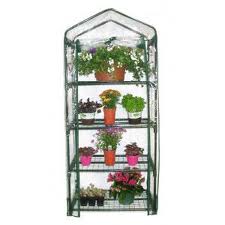
A portable greenhouse like this one can be used to grow on seedlings

6. Right environment

Different plants will have different environmental requirements, but in general they need to be thoroughly watered in to their new pots/modules and moved into a light, cooler place than they were in for germination – but avoiding drafts and direct sunlight. For the first few days, the plants might benefit from covering with plastic to lessen the ‘transplant shock’ they experience. Make sure you keep the plants watered so that the compost is just moist – avoid over watering as this can lead to diseases.  Gently brushing the tops of your transplants with your hand or a wooden stick will help control their height and increase stockiness. Ideal transplants are as wide as they are high. Gradually acclimatise the plants to outside conditions – a cold frame or greenhouse after being in the house, for example. Then give them a couple of hours in the outside each day (as long as it’s not too cold or windy) before they are fully ‘hardened off’.

7. Right potting – on time

Keep an eye on your new fledglings and occasionally look underneath the pots – when you see roots  emerging from the bottom it’s probably time to ‘pot them on’ into larger pots. This is broadly the same procedure as for ‘potting up’ and may mean that some plants are transplanted two or three times before they are finally placed in the garden. ‘Keep them moving’ and don’t allow them to become pot bound.

Further information:

Capel Manor College video on pricking out

Garden of Eaden video etc.

Old School Gardener

If you’ve enjoyed reading this post and others on this blog, why not comment and also join some other people and sign up for automatic updates via email (see side bar, above right ) or through an RSS feed (see top of page)?

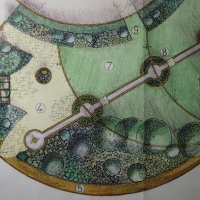
Well here it is, my plan for the kitchen garden here at the Old School. I’ve reviewed last year’s results and have tried to rotate crops as well as introducing more variety and greater successional cropping. This approach will, I hope,  help me to avoid gluts, reduce the overall level of food and waste, while at the same time increasing the range and the ornamental value of the area through introducing more perennial and annual flowers.

I’m also going for some ‘heritage’ varieties- squash, cauliflower, leek, pea, runner beans and beetroot.

What do you think?

kitchen gdn layout 2014

Old School Gardener

Specifier Review's avatarArchitecture, Design & Innovation

by Paul Gilby – Riefa Green Roof

ONE of the paradoxes of the living roof industry is that, for all our evangelical promotion of the environmental agenda, our products have often been surprisingly un-green.

RIEFA2

Living roofs are a case in point. What we hold out as the bright new hope of the inner city frequently requires an onerous quantity of plastic trays, felt bases, and granular linings whose eco-credentials are, to put it kindly, borderline.

Ten years ago, I was introduced to a product which, the German makers claimed, would change that. I was initially dubious about the whole proposition; how was this vorsprung durch organic product going to live up to the remarkable promises made?

A decade on, I am utterly convinced. And I’d like to take the next couple of minutes to explain why, and urge you to test the truth of the Riefa system for yourselves.

Riefa…

View original post 636 more words

ruarkmosaicart's avatarruarkmosaicart

My friend and professional mosaic artist, Jo de Freitas, recently started and completed a very big mural commission for the Greenest Hotel in Africa, Hotel Verde. This environmentally conscious hotel is situated in Cape Town near the Cape Town International Airport. The mural is to be 16 meters high and 4 meters wide. This was a large and challenging project indeed, that kept 5 people permanently busy for 2 solid and exciting mosaic filled months.

Jo and I met taking a smalti class in the Southern Peninsula and we became firm friends united in mosaic enthusiasm for the art form. Jo asked me if I could help out for a few days on her project so I had the privilege of working on the mosaic team for a few short days, where I also gained valuable experience.

Hotel Verde Mosaic in progressMosaic water drop Mosaic mural design

Assisted by her strong team the mosaic quickly progressed on schedule at her studio…

View original post 119 more words

Cuba and Cake in Norfolk

https://i0.wp.com/farm4.staticflickr.com/3671/12319132855_dc77ebcacc_n.jpg

Norfolk Master Gardeners heard about Permaculture in Cuba, celebrated achievements in helping communities, schools and families in growing their own food and planned for the future at a recent event in Norwich. If you’re growing your own food and live in the Breckland area of Norfolk, you could join the team!

Find out more by clicking the title link.

Old School Gardener

Finding Nature

Nature Connectedness Research Blog by Prof. Miles Richardson

Norfolk Green Care Network

Connecting People with Nature

Discover WordPress

A daily selection of the best content published on WordPress, collected for you by humans who love to read.

Susan Rushton

Celebrating gardens, photography and a creative life

Unlocking Landscapes

Writing, photography and more by Daniel Greenwood

Alphabet Ravine

Lydia Rae Bush Poetry

TIME GENTS

Australian Pub Project, Established 2013

Vanha Talo Suomi

The Journey from Finnish Rintamamiestalo to Arboretum & Gardens

Marigolds and Gin

Because even in chaos, there’s always gin and a good story …

Bits & Tidbits

RANDOM BITS & MORE TIDBITS

Rambling in the Garden

.....and nurturing my soul

The Interpretation Game

Cultural Heritage and the Digital Economy

pbmGarden

Sense of place, purpose, rejuvenation and joy

SISSINGHURST GARDEN

Notes from the Gardeners...

Deep Green Permaculture

Connecting People to Nature, Empowering People to Live Sustainably

BloominBootiful

A girl and her garden :)