I thought I’d offer to (try to) answer any gardening queries you have as a regular blog feature on Old School Garden. In the comments on my recent review of the blog, several people mentioned the value of the gardening tips I include in some of my posts, so I thought I’d try out something a bit more focused and regular – a sort of ‘Gardeners’ Question Time’ (or GQT for the initiated!).
I was prompted to do this by a book I came across the other day, whilst rummaging in my local charity shop (a great place to pick up gardening books, I find). Though about 20 years old it still seems to ‘pack a punch’ so I’m going to use it to kick off the GQT series! It’s called ‘1000 Handy Gardening Hints’ and covers a wide range of topics, so hopefully it should be useful to someone out there in blogland!
The first question, as you can see, concerns lawns and ‘top dressing’. Here’s my take on what the ‘Handy Hints’ book says, plus a few thoughts of my own:
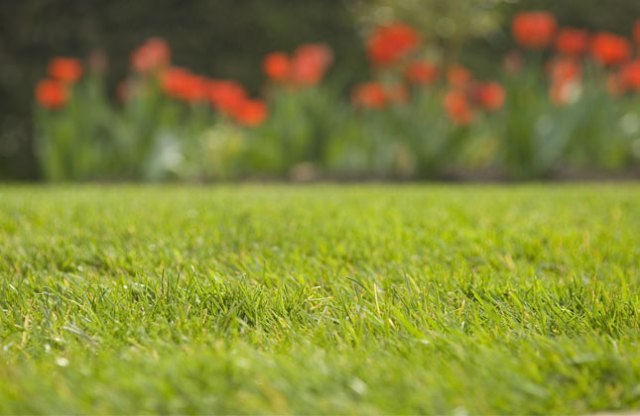
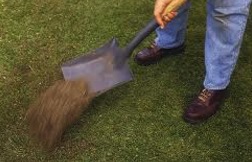
Top dressing usually means applying a fertiliser, particularly a nitrogenous one, to the surface of soil bearing a crop, usually in concentrations of about 18 grams per square metre. In lawn management top-dressing means the application of suitable ‘bulky material’ to the surface of the lawn at the rate of 1 – 3.5 kg per square metre. The material should ideally be a made up or ready-made compost (of 6 parts medium grade, lime free sand to 1 part granulated peat or other organic material and 3 parts topsoil). This should be well worked into the lawn by means of a drag brush or ‘lute’ to make the surface smooth.
I remember my Dad (who was the Green Warden at our local Lawn Bowls Club around 50 years ago) spiking the grass surface before hand to provide some holes into which the top-dressing could be brushed (I also remember helping him to do this as an enthusiastic youngster!). Whilst this fed the grass it also helped to improve aeration and drainage. Top dressing can also help to even out dips in the surface. If you want to get the ‘Bowling Green ‘ effect, now is the ideal time to be applying top-dressing to your lawn!
Here’s a video that you might find helpful.
And you can find out how to make your lawn care more sustainable at Wild About Gardens
So that’s the first session of ‘GQT’ – what did you think?
I’ll try out a regular weekly session, so if you have any questions you’d liked answered then email me and I’ll do my best to feature your question and hopefully provide an answer!
My email address: nbold@btinternet.com, and put ‘GQT question’ in the subject line, please.
Old School Gardener
If you’ve enjoyed reading this post and others on this blog, why not comment and also join some other people and sign up for automatic updates via email (see side bar, above right ) or through an RSS feed (see top of page)?
‘We can create engaging play spaces for young children using easily sourced and low cost (often free!) materials.
It’s easier than you think! Over the next few weeks I’ll show you how, using examples from early childhood settings around the globe. First cab off the rank is the humble tree stump.’
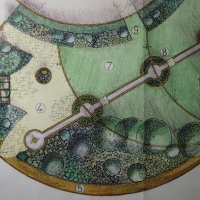
This is the fourth in a series of ‘snippets’ that try to capture the essence of a particular garden style. today, ‘modernist’ gardens – I prefer this term to ‘contemporary’ as it is less laden with connotations of what is deemed to be ‘fashionable’ – so a more neutral term, hopefully!
Modernist gardens are crisp and clean. They rely on scale and proportion to provide a dramatic setting and there is simplicity and an absence of ornamentation or embellishment. They often have a strong geometric layout and are open and uncluttered. Sharp lines – whether straight, angled or curved – reinforce the contrast between verticals and horizontals, which are created by the use of structures (walls, pergolas, arbours, seating etc.) and planting (especially those with strong ‘architectural’ forms). Other key features include:
asymmetry
subtle but clear changes in level
modern materials (e.g. concrete, steel, glass, plastics)
planting in blocks
contemporary furniture
reflective water
Let me know what you think makes a Modernist style garden, and if you have some pictures I’d love to see them!
If you’ve enjoyed reading this post and others on this blog, why not comment and join others by signing up for automatic updates via email (see side bar, above right ) or through an RSS feed (see top of page)?





 Old School Garden