
How to dismantle a wooden pallet

 Whilst on holiday near St. Ives, Cornwall, recently I took the chance to visit the Tate Art Gallery – something of an ‘icon’ of the town – and the Barbara Hepworth Sculpture museum and garden. The Tate is an impressive building, but I found it a little disappointing, mainly because of it’s relatively small display areas. There are plans afoot to expand the place and that should help to further strengthen its impact.
The Hepworth Garden, by contrast was a rich, intense experience and one which, despite many visitors, I was able to enjoy on a beautiful summer’s day. The Tate website provides the following background information:
‘Barbara Hepworth first came to live in Cornwall with her husband Ben Nicholson and their young family at the outbreak of war in 1939. She lived and worked in Trewyn studios – now the Barbara Hepworth Museum – from 1949 until her death in 1975. Following her wish to establish her home and studio as a museum of her work, Trewyn Studio and much of the artist’s work remaining there was given to the nation and placed in the care of the Tate Gallery in 1980.
‘Finding Trewyn Studio was a sort of magic’, wrote Barbara Hepworth. ‘Here was a studio, a yard and garden where I could work in open air and space.’ When she first arrived at Trewyn Studio, Hepworth was still largely preoccupied with stone and wood carving, but during the 1950s she increasingly made sculpture in bronze as well. This led her to create works on a more monumental scale, for which she used the garden as a viewing area. The bronzes now in the garden are seen in the environment for which they were created, and most are in the positions in which the artist herself placed them. The garden itself was laid out by Barbara Hepworth with help from a friend, the composer Priaulx Rainier.’
I particularly liked the way sculpture and planting are treated as complementary, the masses, textures and forms of the plants being used to echo or contrast with those of the sculpture and vice versa. There is also an amazing sense of space in this relatively small garden, achieved by the winding, gently rising and falling path which opens up views across the garden to the sculptures which, together with some impressive trees, bamboos and shrubs provide height which draws your eye away from the boundaries of the garden, themselves clothed in plants.


Further information:
Tate St. Ives and Hepworth Sculpture garden website
If you’ve enjoyed reading this post and others on this blog, why not comment and join others by signing up for automatic updates via email (see side bar, above right ) or through an RSS feed (see top of page)?

photo via Let the Children Play
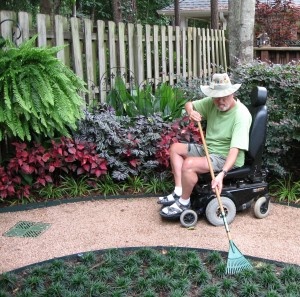 This is the first in a new series of articles aimed at providing some tips on using design successfully in your (or someone else’s) garden.
Do you have a disability? Maybe someone in your family isn’t as mobile as they were? Perhaps normal ageing processes are reducing your ability to garden in the way you once did?

Public parks are making it easier for disabled users
At this point its worth asking – is the disability of an order or kind that means their current garden can be suitably adapted, or do they need to think about moving or perhaps becoming involved in more communal gardening activity which is more in line with their ability and physical strength?

Water features can be important in gardens designed to stimulate the senses

‘Disability’ extends way beyond wheelchair users


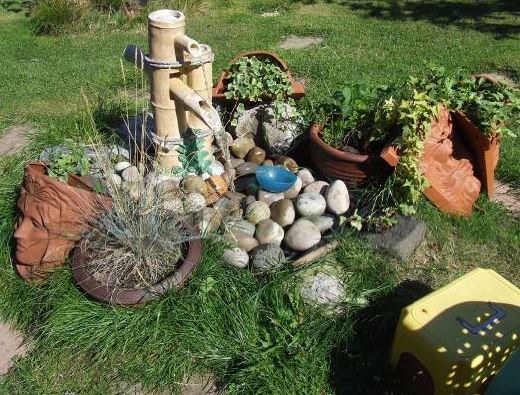
An accessible water feature
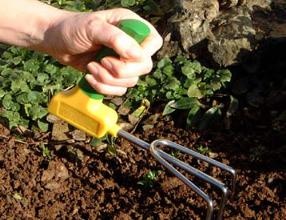
Special tools can be useful for the disabled gardener
If you’ve enjoyed reading this post and others on this blog, why not comment and join others by signing up for automatic updates via email (see side bar, above right ) or through an RSS feed (see top of page)?
Our Rill Garden was beginning to look a little jaded, mostly due to the edging paving sinking and coming loose. In places the level of the edging was uneven and sloping randomly. We decided it needed a revamp. The first job was to take the old edging paving up and clean off the old concrete. It took no time to get up the edging but it took a long time to chip off all the old concrete and chip off each bit until the back of the slabs were clean enough to re-lay.

“Matilda”, our sculptured figure admires our handiwork. She looks satisfied with how we have cleaned up the slabs.
. 
We had to get the plants up so we lifted them pots and all into some of our plastic garden trugs. They need dividing so this proved to be a good opportunity.

After a few days we had…
View original post 67 more words

Hydrangea arborescens ‘Annabelle’
This genus of over 70 species of popular shrubs has delicate heads of flowers in shades of pink, white or blue and pretty autumn colour and leaf shape. The mophead hydrangeas are most well-known for their ability to change colour in different soils. They are native to southern and eastern Asia (China, Japan, Korea, the Himalayas, and Indonesia) and the Americas. By far the greatest species diversity is in eastern Asia, notably China, Japan, and Korea. Most are 1 to 3 meters tall, but some are small trees and other lianas reaching up to 30 m (98 ft) by climbing up trees. They can be either deciduous or evergreen, though the widely cultivated temperate species are all deciduous.

Seed capsules of H. aborescens
The names of some species are:
H. arborescens = tree – like
H. hortensis = literally of gardens, though it is said this name commemorates the wife of a celebrated Parisian clockmaker, Madame Hortense Lepante
H. macrophylla = large- or long-leaved
H. paniculata = panicled, in reference to the flower shape
H. petiolaris = long – petioled (the leaf stalk)
H. vestita = clothed with hairs
Having been introduced to the Azores, H. macrophylla is now very common, particularly on Faial, which is known as the “blue island” due to the vast number of hydrangeas present.


There are two main flower arrangements in hydrangeas. Mophead flowers are large round flower heads resembling pom-poms or, as the name implies, the head of a mop. In contrast, lacecap flowers bear round, flat flower heads with a centre core of subdued, fertile flowers surrounded by outer rings of showy, sterile bract-like flowers.
Hydrangeas are grown mainly for their large flower heads, with H. macrophylla being by far the most widely grown with over 600 named cultivars, many selected to have only large sterile flowers in the flower heads. Some are best pruned on an annual basis when the new leaf buds begin to appear. If not pruned regularly, the bush will become very ‘leggy’, growing upwards until the weight of the stems is greater than their strength, at which point the stems will sag down to the ground and possibly break. Other species only flower on ‘old wood’. Thus new wood resulting from pruning will not produce flowers until the following season.
Hydrangeas are moderately toxic if eaten. H. paniculata is reportedly sometimes smoked as an intoxicant, despite the danger of illness and/or death due to the cyanide!
In Japan, ama-cha meaning ‘sweet tea’, is another tisane made from Hydrangea serrata, whose leaves contain a substance that develops a sweet taste. For the fullest taste, fresh leaves are crumpled, steamed, and dried, yielding dark brown tea leaves. Ama-cha is mainly used for the Buddha bathing ceremony on April 8 every year—the day thought to be Buddha’s birthday in Japan.
The pink hydrangea has risen in popularity all over the world, but especially in Asia. Pink hydrangeas have many different meanings, but they generally mean “You are the beat of my heart”, as described by the celebrated Asian florist Tan Jun Yong, where he was quoted saying, “The light delicate blush of the petals reminds me of a beating heart, while the size could only match the heart of the sender!”


Sources and further information:
Royal Horticultural Society- Hydrangeas
If you’ve enjoyed reading this post and others on this blog, why not comment and join others by signing up for automatic updates via email (see side bar, above right ) or through an RSS feed (see top of page)?

The Oregon Garden, Silverton via Gardening Fans
 I was privileged to be invited to the opening of a ‘new’ glasshouse at Peckover House, Wisbech last week.
You may recall that I spent some time here as a Heritage Gardening Trainee last year, and really learnt a lot from the Gardener in Charge, Allison and her cheerful accomplices, Jenny and Janet. I wrote a lengthier piece about the garden earlier in the year (see link below), and at that time it wasn’t yet certain that the fast – decaying Orangery in this superb Victorian Garden was going to be saved. But thanks to some local fundraising and additional funds and wisdom of the owners, the National Trust, I’m very pleased to say that this focal point in the garden has been saved. Or rather, recreated, as the original was in such a poor condition, that further repairs weren’t possible. The replacement is a faithful rendition of the old structure, with a few minor amendments to make life easier for the gardeners. The former tiled floor, surrounding walls and walled containers with three ancient Orange trees have been retained, now with a new covering made, as was the original, in timber and glass. It includes sash window ventilation and roller blinds to help with temperature and light control.
During the rebuild the 300 year old orange trees were exposed to the elements and what a stroke of luck that we had one of the best summers in recent years, for they have obviously benefitted from that exposure to fresh air and sunshine!
The overall feeling is of a light, colourful and inviting atmosphere. The old Orangery had a typically Victorian air of ‘gothic gloom’ about it, especially as some of the older specimens accompanying the oranges were mature and shaded the interior. I guess the replacement plantings alongside the outer wall will eventually make their mark, but for now I do like the open, bright interior. The inner, sun – facing side of the Orangery is once more populated with a colourful array of terracotta pots containing a wide variety of tender specimens, all laid out on benches ans shelves in the spirit of the Victorian passion for collecting the unusual and exotic. Here are some pictures of the opening event and the new Orangery.


Congratulations National Trust, the Peckover House Gardening team and all those others who contributed to the project!
Related article- ‘Banker’s bonus: Secret Garden Gem’
Nigel Boldero aka 'Old School Gardener'
 | Nigel Boldero on Fighting to Reduce Climate Cha… |
 | Anonymous on Fighting to Reduce Climate Cha… |
| Anonymous on PicPost: Carrot, my foot! |
| 18 Surprising Hydran… on Plantax 16: Hydrangea the wate… | |
| Nigel Boldero on Poppyland: A Victorian romance… |
| Anonymous on Poppyland: A Victorian romance… |
| Anonymous on Plants to die for… |
 | Isabella Childress on PicPost: Forest, but not as we… |
 | Happiness Factor on Is child-friendly planning a l… |
 | zidane on Top Tip: On a Pedestal- make m… |


Nature Connectedness Research Blog by Prof. Miles Richardson
Connecting People with Nature
A daily selection of the best content published on WordPress, collected for you by humans who love to read.
Celebrating gardens, photography and a creative life
Writing, photography and more by Daniel Greenwood
Lydia Rae Bush Poetry
Australian Pub Project, Established 2013
The Journey from Finnish Rintamamiestalo to Arboretum & Gardens
Because even in chaos, there’s always gin and a good story …
RANDOM BITS & MORE TIDBITS
.....and nurturing my soul
Cultural Heritage and the Digital Economy
Sense of place, purpose, rejuvenation and joy
Notes from the Gardeners...
Connecting People to Nature, Empowering People to Live Sustainably
A girl and her garden :)



 Old School Garden