Archive for October, 2013


IMG_7367

Whilst visiting our son (who’s studying at Loughborough University) we took advantage of the ‘Heritage Open Days’ event at nearby Calke Abbey, Derbyshire. Billed by owners, the National Trust as ‘The un-stately home and country estate’ because of its peeling paintwork and overgrown courtyards, Calke Abbey is witness to the wider decline of country house estates all over Britain, especially after the First World War (avid viewers of the latest TV series of ‘Downton Abbey’ can get a taste of some of the issues – death duties, lack of staff, economic downturn).

Whilst some of the House and stables have been restored, there are still many other areas where old furniture, toys and a myriad other ‘heirlooms’ have been left to speak volumes of how the British landed gentry went through a major ‘downsizing’. Admittedly the family who owned Calke did amass a vast collection of curiosities and ‘hidden treasures’- there are fascinating collections of sea shells, rocks and pebbles for example.

The house was delightful and had some very friendly ‘in character’ guides to help tell the story. But the garden was the gem in my eyes. Extensive parkland with a number of beautiful mature trees, deer roaming and typical Victorian curiosities like the fernery give way to a massive walled garden, much of which is now just turned over to grass, but a significant portion of which houses a wonderful kitchen garden (with an access tunnel to ensure the gardeners weren’t seen from the house!). There is also an impressive array of original glasshouses and an orangery in which peaches and other tender fruit and veg are still grown. I particularly liked the Squash Tunnel made of rustic poles and featuring a range of different squashes. Approached by a colourful Dahlia border, there’s also a fascinating ‘Gardeners’ Bothy’, complete with old tools and equipment, seed trays and prize certificates from yesteryear! I was puzzled by one seed drawer, labelled ‘Borecole’. I hadn’t come across this name before and guessed it migth be some local corruption of ‘broccoli’. I now know it’s another term for Kale or a particular variety of Kale!

Walking through the pretty featureless,  grassed over walled garden you suddenly turn a corner and enter a more intimate, warm, walled garden with blocks of bright colours and interesting foliage. An amazing contrast, this formally laid out garden with a range of exotic plants as well as classic bedding, made me draw breath and smile like a Cheshire Cat!

This area has been superbly laid out and the colour, foliage and flower combinations are very impressive. There’s an ‘Auricula Theatre’ currently housing Pelargoniums (see the picture I posted of this earlier in the year) and a pool, all contributing to a peaceful spot where you can (and we did) sit and gaze at the wonder of nature – as coaxed and displayed by man of course! This was a truly inspiring afternoon, so if you get the chance, get along to Calke Abbey (by the way there was never an abbey here).

Further information:

National Trust Website

History- Wikipedia

Old School Gardener

If you’ve enjoyed reading this post and others on this blog, why not comment and join others by signing up for automatic updates via email (see side bar, above right ) or through an RSS feed (see top of page)?

shinealightproject's avatarShine A Light

By Dayna Woolbright

Norwich is well known for its industrial past, manufacturing textiles, shoes and mustard from the famous Colmans mustard factory, but what about chocolate?

The Gressenhall Superstore holds an abundance of social history items that relate to Norwich’s industrial heritage but it was some equipment used in Norwich’s chocolate factory that inspired this weeks blog. I also had a great personal interest in the history of locally produced chocolate as one of my earliest memories of Norwich is seeing the Nestle factory, particularly exciting for a child whose favorite book was Roald Dahl’s ‘Charlie and the chocolate factory!’ So sit back and enjoy a whistle stop tour through all things chocolaty, no golden ticket required…

In 1857 Chemist, Alfred Jarman Caley came to Norwich and founded a chemists shop in London Street. By 1863 Caley was producing mineral waters in a room at the back of his shop as…

View original post 1,194 more words

PicPost: Roots Store

Pest or Pal?

Pest or Pal?

This week’s question is on an issue that I’m in two minds about. Lorne Bowles from Teddington asks:

‘On damp days in Autumn (and Spring) my grass becomes covered with earthworm casts. I’d like to get rid of them somehow. What do you recommend?’

There are many species of earth worms but only 3 of them make casts. Worm casts are a sign that you have a fairly active soil with good aeration and humus content. Earth worms are useful for mixing and aerating soil, but those which cast can create a muddy and uneven surface on grass and can also encourage weeds, as their casts make excellent seed beds!

Charles Darwin spent a lifetime studying worms, and estimated that up to 40 tons of worm casts per acre can be added to the soil (representing between 45 and 170 worms per square metre!). These casts are invariably richer, finer and less acidic than the surrounding soil, and contain around 50 per cent more calcium, nitrogen, phosphorus, potassium and bacteria.

Earthworm activity is encouraged if cuttings are left on the turf. Worms also pull fallen leaves and plant debris into their burrows and, in doing so, they add organic material to the soil, improving its structure as well as its fertility. For borders and beds, if you are short of compost, a mulch of leaves, preferably chopped up, will not only add structure to the soil, but will also dramatically increase the worm population and therefore the health and fertility of your soil. The use of alkaline or organic fertilisers and dressings can also encourage Worms in lawns. Monty Don tells an amusing anecdote about a grass tennis court which demonstrates worms’ love of alkaline soil:

‘A grass tennis court had been laid on acidic soil and marked out with chalk. Over the years, the calcium in the chalk neutralised the acid soil beneath it, making extremely narrow strips that attracted earthworms. Long after the chalk had been washed away, ‘runways’ made by moles attracted by their favourite food – earthworms – followed the line of them, without realising that they were mirroring exactly the original chalk lines of the court!’

This raises the topic of moles in lawns. A real issue for me here at Old School Garden, despite me trying to persuade the ‘little burrowers’ to take themselves next door. If you have moles, as the tennis court story indicates, this is a sure sign that you have worms in your lawn.

worm casts on lawn

Worm casts on a lawn

So what can you do?

Well one approach (but not one I’d recommend myself) is to try to deter the worms from casting using a fungicide. The law does not permit long life residual chemical build up in the soil, so gone are the days when formulations like Chlordane could be used to wipe out the worms (and possibly some gardeners too). However, Carbendazim is a chemical which is primarily used to deal with fungal diseases such as Fusarium but which also appears to interrupt the feeding of worms near the surface, by making the organic matter in which they feed unpalatable. Deeper feeding, non casting worms are apparently unaffected and continue to benefit the soil structure as normal.

Applying the chemical, which has a non hazardous classification, is said to be most beneficial in Spring and Autumn and must be carried out when the soil is already wet as it needs help in dispersing through the soil. However, be aware that whilst Carbendazim is approved for use in the UK and some other countries, some organisations argue that it is a dangerous substance.  Other options exist such as adding sulphur to the lawn, so reducing its alkalinity, and therefore reducing the attractiveness of it to worms. Manufacturer’s of this type of solution claim that this does not harm the worms or the soil.

However, I’d be a little wary of this, and other chemically – based solutions and try a more organic approach.

This does mean, however, that you’ll need to adopt a more relaxed attitude to worm casts (and mole hills, though it pains me to say so…). Worm activity, on the whole, is extremely beneficial to your lawn, so the best way to deal with the casts is to wait for them to dry and then brush them into the surface, spreading evenly with a Besom or similar broom. In doing so, you are adding to your lawn some fine compost and helping to improve its future appearance. There are also a few other things you can try to reduce the problem of casts:

  • Avoid leaving leaves on the lawn surface during the autumn and winter because this warm blanket of organic matter is an ideal ‘restaurant’ for the worms.

  • Do not allow a build up of thatch as again this decaying matter is digested by the worm which leads to casting deposits – so scarify your grass in the autumn and possibly also the spring.

  • Keep the grass at a reasonable height.

  • Avoid unnecessary watering as this attracts more worms. In dry weather the worms will move deeper, and by aerating regularly and ensuring good drainage, you will discourage activity.

If, like me you have a mole problem, I think the only safe, direct (but from experience, not necessarily successful) solution is to trap them, which might involve the services of a mole catcher unless you fancy a go yourself! I’ve found that other ‘solutions’ like noise/ vibration emitting devices seem only to have a temporary effect, if that!

Mole hills on the Old School Garden lawn

Mole hills on the Old School Garden lawn

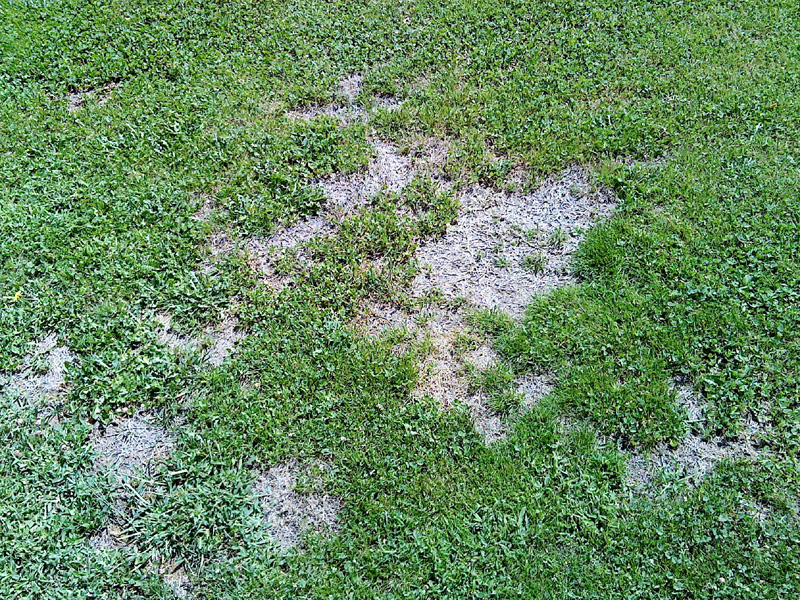
More generally, lawns are not attacked by pests, though you may at some point see the effects of the ‘Leather Jacket’ (the larva of the Crane Fly or ‘Daddy Long Legs’) and Chafer grub.

These can cause damage to the roots and stems of grass resulting in poor, stunted growth and bare patches. When a pest problem like this is suspected, the turf should be examined thoroughly to find the culprit. Pests are often found first in stressed areas, such as the edges of lawns or in shady or wet areas. They are not usually distributed evenly so it is advisable to look for spots that have discoloured, stunted or distorted turf. Insects tend to proceed outward from a central point; therefore they are generally most active on the outside edge. In both cases a lawn insecticide could be applied to kill the grubs/larvae….

Chafer Grub damage to grass

Chafer Grub damage to grass

However, an alternative, organic solution is to wait for heavy rain (or thoroughly watering any yellow patches in the lawn yourself). Then cover the affected areas with black plastic sacks and leave overnight. The Leather Jackets and grubs will come to the surface and can be collected in the morning and disposed of – or left to natural predators such as spiders and garden birds (especially Starlings). You could also use the biological control Steinernema feltiae, which should be applied while the ground is still moist and warm in late Autumn.

Old School Gardener

If you’ve enjoyed reading this post and others on this blog, why not comment and join others by signing up for automatic updates via email (see side bar, above right ) or through an RSS feed (see top of page)?

PicPost: Swedish Reserve

Image via Grow veg

Tamara Jare's avatarMy Botanical Garden

PICT2843PICT2942PICT1821PICT1830PICT1848PICT3062PICT3064PICT3077I guess people in common do have at least slight inclination towards collecting different artefacts. Then I am among the ones who have stronger tendency for collecting. Which makes me happy is not the possession of different items, but the ways they can be arranged in logical categories. From that point of view I could  find ferns interesting items.But I was still surprised to hear about pteridomania, a fern collecting craze in Victorian England. People got crazy collecting different ferns to that extent that some of the ferns got almost extinct! Honestly, I can’t blame them, arranging those photos I’ve almost started collecting ferns!

Pteridomania, meaning Fern Madness or Fern Craze, a compound of Pteridophytes andmania, was coined in 1855 by Charles Kingsley in his book Glaucus, or the Wonders of the Shore:  Your daughters, perhaps, have been seized with the prevailing ‘Pteridomania’…and wrangling over unpronounceable…

View original post 66 more words

Picpost: Shock of the new

Chas Spain's avatarChas Spain

This lovely planting of flannel flowers and white waratah reaches its perfect, but brief, flowering peak in early spring here in a sheltered spot at ‘the workplace’ in Melbourne. 

The luminosity of these flowers in the gold light at the end of the day was superb.

While the great globe heads of the waratah had been bruised by the wind this week, the flannel flowers – which look so delicate and fragile – showed no signs of harm.

The flannel refers to the soft fuzziness of the flowers and leaves, rather than suggesting the plant is somewhat dowdy.

Latin names for those of that ilk are Telopea speciosissima (red waratah) and Actinotus Helianthi (flannel flower)


Other Australian Native flower posts and related blogs you might like:

All flora has significance in indigenous Australia and one of the stories of the waratah is retold on Out of the Blue…

View original post 154 more words

IMG_7215

I recently responded to a challenge from fellow blogger, ‘The Anxious Gardener’, to name my favourite garden. This was a light-hearted way of getting people to enter a competition to win a copy of the recent publication ‘The New English Garden’.

The competition was a ‘name out of the hat’ affair so I stood as much chance as winning as the other 30-odd entrants (and I didn’t win, so there’s another item for the Christmas list). Notwithstanding that, I thought I’d try to do the request justice and thought long and hard about where, if any one ‘where’ stood out in front of the many gardens I’ve visited, read about, seen films and pictures of.

It took some time…

In the end I came up with my nomination and set it out here and the reasons why it came out top. Oh, and I thought I’d share some pics with you too. I hope that you enjoy them.

I’ve visited and seen a few gardens over the years and it’s tricky finding one that I’d call a favourite – some have great borders or other spaces, configurations of plants, superb features and so on. Maybe its because it’s relatively fresh in my mind, but the one that does stand out is Felbrigg walled garden in Norfolk (also a local one to me and so visited quite often).

Why? Well I guess it’s the way the garden team (including volunteers and community gardeners), have managed to create a space that meets so many different needs and in a way that seems to hang together naturally:

* a warm, contained, red brick walled space, with a fountain and dovecote as strong structural elements
* glasshouses with old favourite, traditional exotics and other ‘interesting’ plants
* community food growing in plots that are obviously lovingly cared for
* a children’s gardening area complete with digging pits, tools, washing facilities and novelties such as chickens running free, willow teepees and tunnels
* newer areas set out with mediterranean – style planting, meadows and feature shrubs
* plenty of comfortable seats to entice you to stop, look and soak up the atmosphere
* lots of attractive information about the plants themselves (all the significant ones carefully and attractively labelled) as well as some of the current tasks in the garden and information/quiz sheets for the kids.

All in all a visit to Felbrigg is a tremendously rich experience where the general public, serious gardener and trained horticuluralist (and their children) can come together and have their curiosity tickled, be enthused, amazed and go away feeling regenerated.

Do you have a favourite Garden? I’d love to hear from you!! (no prizes I’m afraid)

Further information: National Trust website

Old School Gardener

If you’ve enjoyed reading this post and others on this blog, why not comment and join others by signing up for automatic updates via email (see side bar, above right ) or through an RSS feed (see top of page)?

Finding Nature

Nature Connectedness Research Blog by Prof. Miles Richardson

Norfolk Green Care Network

Connecting People with Nature

Discover WordPress

A daily selection of the best content published on WordPress, collected for you by humans who love to read.

Susan Rushton

Celebrating gardens, photography and a creative life

Unlocking Landscapes

Writing, photography and more by Daniel Greenwood

Alphabet Ravine

Lydia Rae Bush Poetry

TIME GENTS

Australian Pub Project, Established 2013

Vanha Talo Suomi

The Journey from Finnish Rintamamiestalo to Arboretum & Gardens

Marigolds and Gin

Because even in chaos, there’s always gin and a good story …

Bits & Tidbits

RANDOM BITS & MORE TIDBITS

Rambling in the Garden

.....and nurturing my soul

The Interpretation Game

Cultural Heritage and the Digital Economy

pbmGarden

Sense of place, purpose, rejuvenation and joy

SISSINGHURST GARDEN

Notes from the Gardeners...

Deep Green Permaculture

Connecting People to Nature, Empowering People to Live Sustainably

BloominBootiful

A girl and her garden :)