Archive for June, 2013


HowardJones's avatarOuse Washes: The Heart of the Fens

Heritage Lottery FundThe Fens do not appear in the theatre very often. Not having seen this piece myself just yet, but having heard an interview with the director on the radio recently, I was intrigued: ‘Ours was the Fen Country’ is a dance-theatre piece that uses words, movement, music and lights to conjure up some of the atmospheres of the Fens, some of the heaviness and also the beauty.

For Ours Was the Fen Country, Dan Canham interviewed more than 30 Fenland people, from eel catchers and farmers, to stable owners and people who spent their whole lives there.

This is how the promotional website for this work describes the piece:

For the past two years Dan Canham has been capturing conversations with people of the fens in East Anglia. Eel-catchers, farmers, parish councilors, museum keepers, molly dancers and conservationists have all been interviewed. In this etherealpiece of dance-theatre Dan and his…

View original post 336 more words

PicPost:

‘PROPER see-saws made with a long plank so that you can go very high and have to hold on tight…..you don’t often see such exciting ones now. A missed learning opportunity?’ (Let the Children Play)

‘Seesaws go by several different names around the world. Seesaw, or its variant see-saw, is a direct Anglicisation of the French ci-ça, meaning literally, this-that, seemingly attributable to the back-and-forth motion for which a seesaw is known.

In most of the United States, a seesaw is also called a “teeter-totter”…. the term originates from the Norfolk language word tittermatorter. A “teeter-totter” may also refer to a two-person swing on a swing seat, on which two children sit facing each other and the teeter-totter swings back and forth in a pendulum motion….

In the southeastern New England region of the United States, it is sometimes referred to as a tilt or a tilting board. Makeshift seesaws are used for acrobatics.  Speakers in northeastern Massachusetts, United States, sometimes call them teedle boards. In the Narragansett Bay area the term changes to dandle or dandle board…. “There are almost no “Teeter-” forms in Pennsylvania, and if you go to western West Virginia and down into western North Carolina there is a band of “Ridey-Horse” that heads almost straight south.

This pattern suggests a New England origin or importation of the term that spread down the coast and a separate development in Appalachia, where Scotts-Irish settlers did not come from New England. “Hickey-horse” in the coastal regions of North Carolina is consistent with other linguistic and ethnic variations….

In Korea, one form of the seesaw is known as a Neol (널) and is used for Neolttwigi  (널뛰기) by women and girls, though in South Korea the playground variety, the same as is known elsewhere in the world, is also commonly called a see-so (시소).’

Source: Wikipedia

photo via Precious Childhood

The tobacco plant - Nicotiana tabacum

The tobacco plant – Nicotiana tabacum

Nicotiana is a wonderful garden plant, its highly scented flowers providing a heady scent on warm summer evenings. I grew a large group of N. sylvestris one year which provided both an eye – catching feature and intoxicating fragrance for my younger daughter’s wedding celebration – truly memorable.

I guess ‘intoxicating’ is the right term as the tobacco plant is one of the most important plant discoveries in history, albeit one whose chief product we have come to understand and increasingly reject as a major cause of disease.

Fortunately though, the ‘baby hasn’t been thrown out with the bath water’ and we can still appreciate it as a garden plant, and its one which I grow each year and place in groups around Old School Garden as well as along the main entrance path at Gressenhall Museum where I volunteer.

Indigenous to the Americas, Australia, south west Africa and the South Pacific, there are various Nicotiana species, all commonly referred to as ‘tobacco plants’, though it is N. tabacum that is still grown worldwide for production of tobacco leaf for cigarettes etc. Nicotiana can be annuals, biennials, perennials or shrubs – some 70 species are grown as ornamentals.

Nicotiana sylvestris

Nicotiana sylvestris

N. sylvestris is a stately plant which looks well at the back of a lightly shaded or sunny border, or grown in bold groups. It’s flower heads seem to explode like a graceful firework. The Royal Horticultural Society has given it its prestigious Award of Garden Merit (AGM). There are many variations in size, colour and fragrance between the species and hybrids. Older heirloom species are often identified by their genus and species name.

Nicotiana alata - photo Carl E. Lewis

Nicotiana alata – photo Carl E. Lewis

Its genus name, designated by Linnaeus in 1753, recognizes Frenchman Jean Nicot, ambassador to Portugal from 1559-1561 who brought powdered tobacco to France to cure the Queen’s son of migraine headaches. Leonhart Fuchs (1501-1566) coined the name ‘Nicotiana’. However, Nicot’s credit as the first to bring the plant to Europe is wrong as it was known in the Low Countries after being brought there by Spanish merchants in the 1540s.  Knowledge of the plant by Europeans dates from 1492 when Columbus’s sailors saw it being smoked in Cuba and Haiti.


Many of the species names refer to a characteristic of the plant. Nicotiana alata gets its species name from the Latin word meaning winged, referring to its winged petioles (the stalks attaching the leaf blades to the stem). N. sylvestris, from the Latin sylva, meaning of the forest or woodland, possibly refers to its native habitat. N. langsdorffii was named after G. I. Langsdorf, the Russian Consul in Rio de Janeiro who organized an expedition to explore the inner regions of Brazil in the 1820’s.

Other varieties include:

N. affinis = related to, probably N. alata (= ‘winged’), some use it as a synonym. The ‘Night Scented Tobacco Plant’

N. x sanderae = ‘Sander’s Tobacco’, a group to which most of the newer hybrids belong

N. suaveolens = sweet smelling

Nicotiana can be used as specimen or bedding plants, in borders, woodland gardens or containers. Heights range from less than 1 foot to over 10 feet. They are long-blooming, attractive plants with trumpet-shaped flowers in shades of green, white, red, and pastels. Some species have attractive foliage. They are fairly easy to grow from seed. Contact with the hairy foliage may irritate the skin.

This year I’m growing  N. sylvestris in a border along with Verbena bonariensis and Ammi majus – a new combination for me and I’ll show you the results later in the summer!

Nicotiana x sanderae hybrids

Nicotiana x sanderae hybrids

Sources and further information:

Wikipedia

Growing Nicotiana (USA)

RHS Plant finder

The Poison Garden

Fine Gardening- plant guide

Nicotiana alata ‘Grandiflora’ is the most highly scented tobacco plant you can grow. It has delicate creamy-white flowers which are delicate in bright sunlight, so best planted with a little shade.Nicotiana are a great family of very long-flowering half hardy annuals, many of them with lovely evening and night scent. Nicotiana are moth pollinated, so pour out the fragrance when the moths are around.- See more at: http://www.sarahraven.com/shop/nicotiana-alata-grandiflora.html#sthash.FvJ4Z0Kg.dpuf

Quizzicals: answers to the two clues given in Plantax 11…

  • Where policemen spend their holidays- Copper Beech
  • Feline relative – Catkin

..and 2 more cryptic clues to the names of plants, fruit or veg…

  • Place in Oxfordshire painted a gaudy colour
  • Tie up skinny coward

Special thanks to Les Palmer, whose new book ‘How to Win your Pub Quiz’ was published recently. A great celebration of the British Pub Quiz!

Old School Gardener

If you’ve enjoyed reading this post and others on this blog, why not comment and join others by signing up for automatic updates via email (see side bar, above right ) or through an RSS feed (see top of page)?

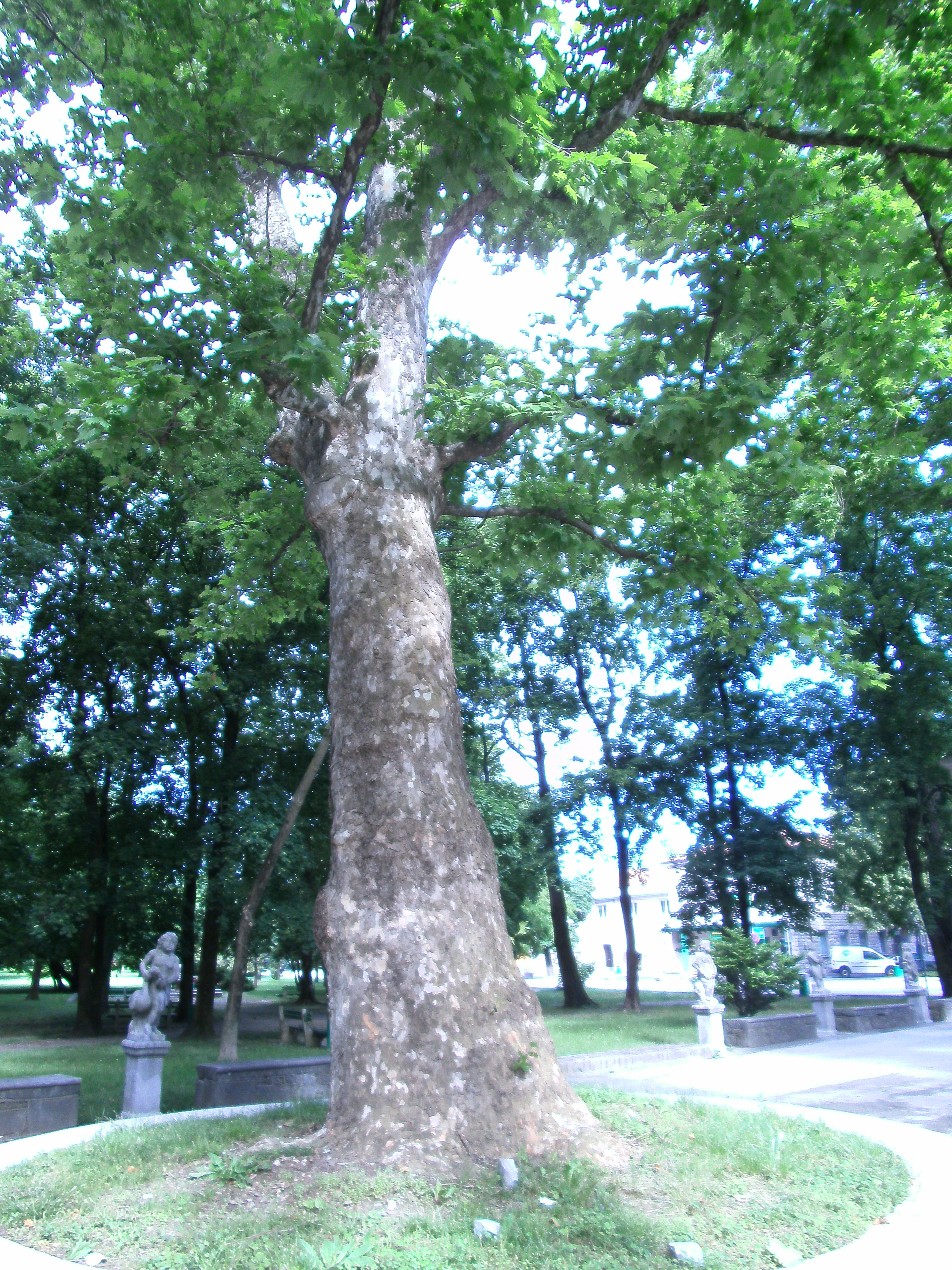
So, what is a putto?

Tamara Jare's avatarMy Botanical Garden

ImageImageImageImageImageImageImageImageImage It was in the middle of winter when Nigel (Old school garden ) was asking me about historical gardens in my country. Dear Nigel, I have not forgotten I only haven’t found the right one My Botanical Garden could present-till now! But this one is just perfect, listen to  the story:

A.D. 1763

Count Lanthieri enters his room, with handful of first cherries from the valley. Crop is good this year, God knows how will the  wine be. Anno Domini 1762 was a good year. Extensive family vineyards, dominating the valley, gave exquisite wine, it was sold to Venice, Rome, Vienna, Luwigana. And the palace was renovated, garden was redesigned, all in baroque manner. Count opens the window overlooking  the garden, his glance slowly glides along the long garden axis. He is expecting guests from Luwigana today. Before they come, he will have a walk down in the garden…

View original post 241 more words

PicPost: Ready to pop

shinealightproject's avatarShine A Light

Trying to choose a topic to write my blog about is sometimes challenging, but at other times it’s a handed to me on a plate….or should I say in a crate! (Bad pun I know…)

Last week we opened crate 22 (number 8 to have been opened)… and we were greeted by lots of cots and commodes! A few weeks ago we also found some pall bearers and a coffin template …which I think neatly encapsulates the cycle of life…and death… and as you can see gave me the idea for this week’s blog title!

After opening the crate and some initial record checking we found that some of the cots and commodes had previously belonged to the workhouse at Pulham Market in Norfolk. Being based in the grounds of Gressenhall Farm & Workhouse (built in 1775), we at the superstore found this is particularly relevant and poignant.

View original post 546 more words

 Close up of strong wind break netting

Close up of strong wind break netting

No, not a reference to too many sprouts, but a serious question from L. Onerf in Somerset:

‘Vegetables are not growing well in my windy garden, but I am reluctant to plant windbreaks of trees or hedges, as they will create shade and take moisture from the soil. What alternatives are there?’

If you want to avoid the costs of installing a fence/trellis with openings to allow the wind to percolate through at an acceptable speed, I think the answer lies in putting in a screen of synthetic wind break material, obtainable from most garden centres or online. The strength and quality of this varies and some is fairly costly, but a 1.5- 1.8 metre high wind break around your plot would give dramatic results. I found a 50 metre x 2 metre roll of knitted net on offer online for around £170 or much the same on Ebay for about £40, and £13 for a 10 metre length. Make sure the posts are anchored firmly in the ground (corner posts may need to be reinforced and they should ideally be bedded in concrete), as the netting takes a tremendous strain in high winds.

On the subject of vegetable or kitchen gardens, is yours laid out for maximum efficiency and growing space?

Traditionally vegetables were grown in large plots, often 6-9 metres wide and as long as the garden allowed. The vegetables were arranged with a lot of wasted space between rows. Today we know that vegetables can be grown far closer together without any adverse effects; indeed, there is a a trend towards abandoning rows and growing vegetables with equal spacing between the plants in each direction, in blocks or patches.

Narrow beds in the Kitchen Garden at Old school Garden

Narrow beds in the Kitchen Garden at Old School Garden

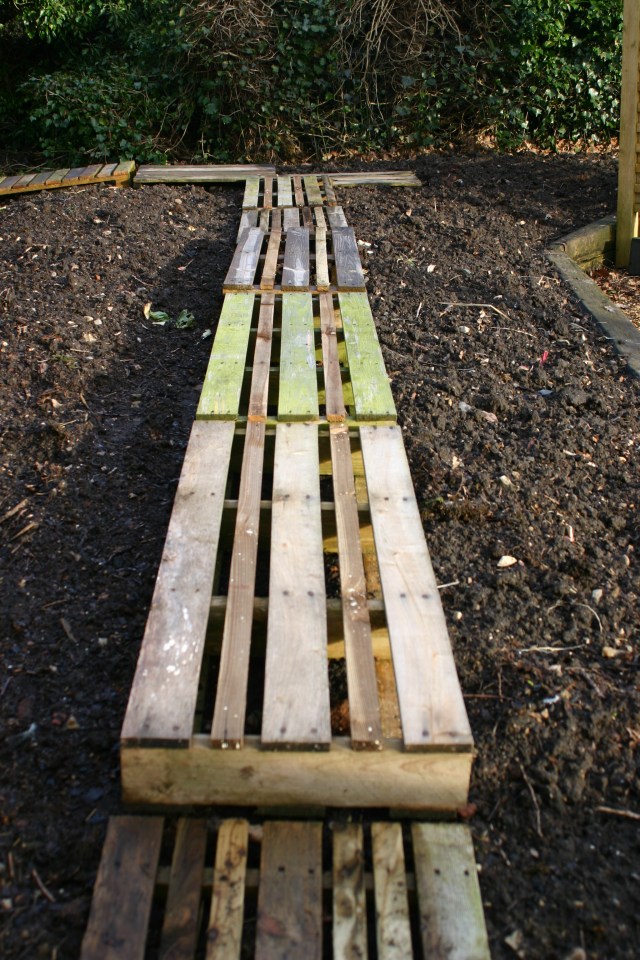
This compactness lends itself to smaller, narrower beds, say 0.9 – 1.5m wide, which can be any length you like. These narrower beds are easier to manage from either side (so avoiding walking on the bed itself and opening up the possibility and benefits of ‘no dig’ cultivation) and the denser planting also helps to crowd out weeds. here at Old School Garden, my kitchen garden ahs been laid out along these lines, though I still have a one large bed which I’ve effectively split into two by creating a ‘boardwalk’ path out of old pallets.

New boardwalk made of old wooden pallets

Boardwalk made of old wooden pallets, used to split a large veg bed into two

Do you have any gardening questions I might help you with? If so, please email me: nbold@btinternet.com

Old School Gardener

If you’ve enjoyed reading this post and others on this blog, why not comment and join others by signing up for automatic updates via email (see side bar, above right ) or through an RSS feed (see top of page)?

PicPost: Never Grow Up

‘We don’t stop playing because we grow old; we grow old because we stop playing.’

photo via Play England

All about the leaves- Fatsia japonica

All about the leaves- Fatsia japonica

This latest  ‘snippet on style’  focuses on leaves. You might think that gardens designed around leaves would be boring. Not a bit of it. Foliage comes in all shapes, sizes and many colours (or shades of green). With the occasional splash of floral colour and other focal points thay can provide a  wonderfully soothing, and sometimes exotic air.  Foliage gardens are typified by the use of leaf and plant texture and shapes as well as subtle variations in leaf colour to provide interest, rather than floral display at different times of the year, which tends to drive other garden styles or at least their planting plans.

Sometimes the whole garden is about foliage, punctuated with flower or other colour (for example The Exotic Garden in Norwich – see link below). Sometimes specific areas in a larger garden are devoted to foliage, with the emphasis on contrasting varieties and plant forms. These gardens are typically organic in shape, with no hard edges and informal in layout and feel. They can also feature items such as sculpture or garden furniture made out of rustic materials and used as focal points set off against the foliage. Other key features of foliage gardens include:

  • Bold foliage

  • Colourful highlights

  • Pools and reflections

  • Containers

  • Locally sourced, rough materials

  • Height and structure

Links:

Other articles in the ‘Style Counsel’ series:

Family Gardens

Productive Gardens

Japanese Gardens

Country Gardens

Modernist Gardens

Formal Gardens

Mediterranean Gardens

Cottage gardens

Old School Gardener

If you’ve enjoyed reading this post and others on this blog, why not comment and join others by signing up for automatic updates via email (see side bar, above right ) or through an RSS feed (see top of page)?

Finding Nature

Nature Connectedness Research Blog by Prof. Miles Richardson

Norfolk Green Care Network

Connecting People with Nature

Discover WordPress

A daily selection of the best content published on WordPress, collected for you by humans who love to read.

Susan Rushton

Celebrating gardens, photography and a creative life

Unlocking Landscapes

Writing, photography and more by Daniel Greenwood

Alphabet Ravine

Lydia Rae Bush Poetry

TIME GENTS

Australian Pub Project, Established 2013

Vanha Talo Suomi

The Journey from Finnish Rintamamiestalo to Arboretum & Gardens

Marigolds and Gin

Because even in chaos, there’s always gin and a good story …

Bits & Tidbits

RANDOM BITS & MORE TIDBITS

Rambling in the Garden

.....and nurturing my soul

The Interpretation Game

Cultural Heritage and the Digital Economy

pbmGarden

Sense of place, purpose, rejuvenation and joy

SISSINGHURST GARDEN

Notes from the Gardeners...

Deep Green Permaculture

Connecting People to Nature, Empowering People to Live Sustainably

BloominBootiful

A girl and her garden :)