Archive for June, 2013


The Kitchen Garden at Old School Garden

The Kitchen Garden at Old School Garden

To Walter Degrasse

Dear Walter,

As I write to you on midsummer day it’s cloudy and rain threatens. We have had some warm spells and even some sunshine, but you get the feeling that ‘proper summer’ has yet to find its way to Norfolk. I know that you’ve had pretty similar weather in your neck of the woods and no doubt you’re as curious as me as to the way the ‘late’ (read almost non-existent) spring has had an impact on the plants. A few pointers from Old School Garden as I write:

  • the Magnolia is still in flower as are the Siberian Wallflowers, Pansies and Violas
  • Sweet Williams are just about coming into flower but the pink Peonies, though with huge fat flower buds, have yet to fully unfurl (having said that the earlier, red varieties have been and gone)
  • Irises are looking good (though last year’s Iris Rust problem has retuned to some)
  • Carrots and Broad beans probably need a further week or two to be fully ready for harvesting
  • Second early (but not first early) potatoes are flowering
  • Lettuces are ready to crop

So it’s a story of some things flowering late and running into other things which is making for some interesting combinations and a few weeks of intense colour; certainly the best show at this time of year I can remember for some time!

Rather than spend a lot of words telling you about my gardening activities in the last month I thought that I’d let ‘the pictures do the talking’ so I’ve included three photo galleries and will give you a few guiding comments for each. The first one is a few pictures of the Gardens at Gressenhall Farm and Workhouse Museum, where the Education Garden I redesigned and with volunteer support, replanted last year is looking superb. A mass of pink and orange oriental poppies along with Salvia ‘Mainacht’  with the billowing leaves of Macleaya in the background, are putting on a wonderful show, remarked on by many visitors, it appears.

There’s a call for me to provide some information on the plants included in the borders, so I’ll have to dig out my original design and plant lists and put together some sort of illustrated guide. Likewise, after a clean out and weed, the Wildlife Garden, and especially the pond and bog areas, are filling out nicely, though there doesn’t appear to be much wildlife evident to date. Monday is going to be something special here as BBC Radio 4’s ‘Gardeners’ Question Time’ is being recorded at the Museum and I’ll be on hand to help guide the audience and provide some information on the gardens. I’m not sure when this is broadcast but I’ll let you know when I’m sure, though I know that you’re a regular listener like me.

My voluntary work at the local Primary school continues with a regular weekly slot working with groups of children of different ages in the School Garden. You may have seen my recent post on the vertical planters we’ve made out of old wooden pallets – these are looking very colourful alongside the playground and I’m pleased to say that the children are being diligent in their watering duties. I’m going over there later today so will have a quick look to see that they’re holding up – I’m not sure the compost will hold in place especially if it gets at all dry. At yesterday’s session we weeded around the various veg beds and cracked open the first pods of Broad Beans which the children eagerly popped into their mouths – once I’d assured them that they would be deliciously sweet and tender – there came  a predictable ‘hmmm, yummy’ in response!

The other crops are all coming along well, and the attention to regular weeding and watering has really paid off this year, so we should be cropping potatoes, onions, cabbages, calabrese, peas, runner and broad beans, turnips and carrots soon! The other big  job was to empty out the wooden compost bins which have been clogged up with grass, sticks and soil over the years and are in real need of starting over once more. Hopefully, we’ll get this finished off today and we can then get more of a systematic approach to adding food peelings etc. from the kitchen as well as ‘green waste’ from the school lunches. The wormery seems to be going well, and the School Cook is pleased that the refuse collectors are now collecting food waste for composting at a local centre, too.

My other Master Gardener activity is picking up a bit. I’m doing stints at the Norfolk Show next week and also an event in a nearby village where some Lottery cash looks like it’s going to make some new adult education classes possible, including something from me on growing your own food or maybe design, depending on the level of interest. I’m going along to an open day on this to gauge interest and promote both Master Gardener and the idea of the courses, so we’ll see if anything comes of that.

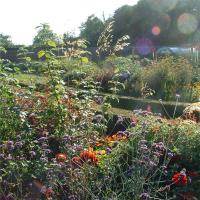
As far as Old School Garden goes, I’ve mentioned the great show we’ve had recently so will let the photographs give you the details! Its been a month of systematic weeding around the different borders, finishing off staking the herbaceous perennials, dead heading and recently planting out the many annuals I’ve een raising from seed to plug gaps etc. I must say I’m pleased with the result, and after visiting a few gardens recently we’ve decided to open ours for charity in mid July. I’ll let you have details in due course, but we hope to make this a lively afternoon with advice from  my friends in the Master Gardener and Master Composter projects and of course plant sales and some delicious tea and cakes!

I hope that you enjoy the picture gallery which shows a few shots of different parts of the garden taken yesterday. As I was walking around I spotted a female blackbird raiding my cold frame and carrying off some poppy seedlings (and compost) in her beak! Having seen her later in the courtyard garden I suspect she’s gathering material for a new nest! We do seem to have had a lot of Blackbirds this year and they seem intent on disturbing the wood chip mulch I put on the long borders in search of food, with the result that sweeping the paths is rapidly becoming a daily chore!

Well,  matey, I hope this little update finds you and your good lady in the best of health. It’s great that you’re now well on the road to recovery and no doubt pleased that you can get outside and dig your patch once more. Did you manage to find any paid garden help? I know that the grass cutting is your biggest nightmare and this is one thing you could do with some help on. Or maybe you might think about turning some of that grass into flowering meadow? I’ve seen some lovely examples of mown paths through long grass recently that must be less maintenance heavy and more wildlife friendly too – worth a thought.

Well, bye for now and I’ll give you a further update next month, though in the mean time I’ll do a post next week about how the recording of ‘GQT’ goes and my experiences at the Norfolk Show.

all the best

Old School Gardener

Other posts in this series:

Dear Walter….letter from Old School Garden, 20th May 2013

Dear Walter….letter from Old School Garden, 18th April May 2013

Dear Walter….letter from Old School Garden, 11th March 2013

Dear Walter… letter from Old School Garden: 15th February 2013

If you’ve enjoyed reading this post and others on this blog, why not comment and join others by signing up for automatic updates via email (see side bar, above right ) or through an RSS feed (see top of page)?
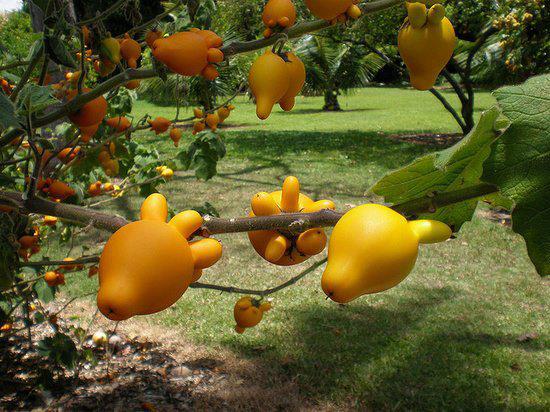
PicPost: Gourd heavens?

Solanum mammosum the ‘ Nipple Fruit’

hedge archwayThis week’s Gardeners’ Question Time looks at how and when to trim hedges. The question comes from Anne Elk who lives in West Devon:

‘I never seem to be able to get an even, level cut on my hedge when I give it its annual trim. How can I achieve a really neat appearance?’

Well Anne, first you need to check on whether in fact your hedge is of a variety that does just need only one clip, or whether it should have several (see below). If it’s the latter, it will be difficult with only one cut to keep it smooth and sharp as so much material will have to be removed, so you should perhaps be trimming it more frequently.

In general though, to get a sharp, level shape when cutting, stretch a string line tightly between two posts along the top, at the height you want the hedge to be, and clip exactly to this level – however, be prepared to repair any accidental cutting of the string! For the sides, put in canes vertically at intervals along the hedge, and sight along these as you cut. Alternatively some people can do this by eye and achieve a satisfactory result, especially if the hedge is fairly low.

Lowish hedges can eb trimmed by eye as long as a good original line has been established

Lowish hedges can be trimmed by eye as long as a good original line has been established

So how and when should you cut different types of hedge?

Established deciduous hedges that are moderately fast growing (e.g. Beech, Hornbeam, Hazel and Tamarisk) should be trimmed once in August – however, if they are growing particularly well, they might need two trims – one in late July the other (lighter trim) in early October.

Deciduous hedges which tend to be fast growing (e.g. Blackthorn, Myrobalan Plum, Hawthorn) will need about three clippings at about six weekly intervals during the summer- this also applies to some fast growing evergreen hedges such as Lonicera and Gorse.

Some slower growing evergeen hedges such as the various Laurels, Elaegnus and Sweet Bay require just one cut in early autumn, though faster growing evergreens such as confiers are best trimmed once in August – or possibly twice if particularly vigourous (once in July and then again in early October). For Yew, trim once a year in the summer.

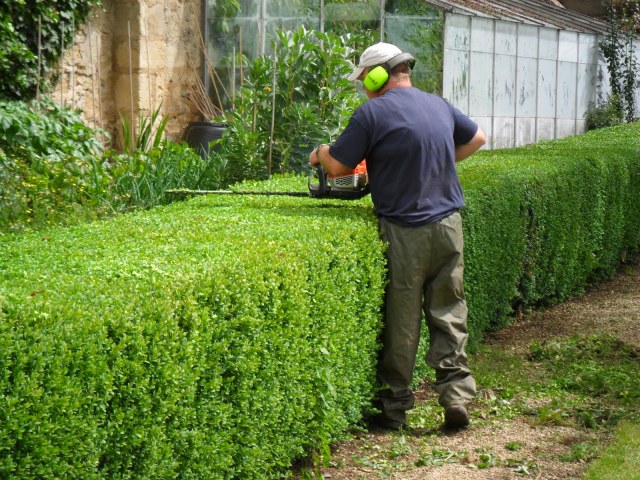
For slow growing, smaller – leaved evergreen hedges such as Box, you should be cutting in early summer (June- July) and again in late summer/early autumn (including topiarised shapes).  Box hedges should be cut in overcast weather as if they are cut in the hot and dry their half cut leaves will desiccate and turn brown. For Privet (Ligustrum) you will need at least two and possibly more cuts in a season to maintain its shape.

Mazes are often created from Yew hedging - usually an annual cut will keep it looking trim

Mazes are often created from Yew hedging – usually an annual cut will keep it looking trim

If you have an informal flowering hedge, in general this should be pruned rather than generally cut over. This is best done in spring if it flowers in between mid summer and autumn and in mid summer if it flowers in the spring or early summer. In both cases take off the shoots which have flowered, thin out the growth if it is crowded and remove completely any old growth which is straggly and flowering badly.

For most hedges try to establish sloping sides with a taper inwards towards the top (known as a ‘batter’) – this encourages growth lower down the hedge which if the sides were vertical (or even worse sloping inwards towards the bottom), would result in thin growth at the base where less light reaches the leaves.

Not all hedges are meant to be level and straight- 'cloud pruned' forms such as this are more a work of art than a geometric challenge!

Not all hedges are meant to be level and straight- ‘cloud pruned’ forms such as this are more a work of art than a geometric challenge!

I hope that you find this of help, and if you have any gardening questions that you think I might help with, then please email me at nbold@btinternet.com

Old School Gardener

If you’ve enjoyed reading this post and others on this blog, why not comment and join others by signing up for automatic updates via email (see side bar, above right ) or through an RSS feed (see top of page)?
Tamara Jare's avatarMy Botanical Garden

“Don’t judge each day by the harvest you reap but by the seeds that you plant.” 

Robert Louis Stevenson

The first botanical garden in Carniola was established in 1781. Its founder,Karl von Zois , an amateur botanist, set it in park of his family estate, Brdo Castle. With help of his brother, Sigmund Zois Freiherr von Edelstein, prominent figure in  Enlightenment Era in the Slovene Lands, he planted not only indigenous plants, but many foreign as well. Plants were collected from Carniola, there was set first alpinum, and others bought from abroad. In 1782 first hyacinths arrived in the garden. Captain Cook sent some plants from his Tahiti expedition to the owner of the garden, yet they arrived in poor condition as Karl sadly wrote in his garden diary

Lack of money and love for botany, as difficult growing conditions for alpinum, all together resulted in Brdo…

View original post 103 more words

PicPost: Urban Farm

Shipping container greenhouse – urban farm unit by Damien Chivialle

What goes on underneath the greenhouse (heating?)?

Does the whole thing rotate on the turntable its standing on?

Well, we had a great day out on Sunday visiting this garden near Fakenham, Norfolk. A Tudor Hall with some fantastic chimneys and gables plus a superbly crafted and well-kept garden. Not normally open to the public, on Sunday the St. John’s Ambulance Brigade were the beneficiaries of the garden day.

Thorpland Hall is a sixteenth century hall set in 6 acres of quintessentially English country gardens.  It is a gem of a place with some very nice touches:

  • grass cut to varying heights to create informal paths and visual interest
  • subtle shrub and plant combinations
  • well stocked, traditional kitchen garden with Broad Beans as well as peas held up by brushwood and interesting intermingling of herbaceous and other perennials
  • A stone flag path with side planting pockets from which various ‘low growers’ soften the edges
  • Use of ‘saved’ architectural features from local churches as well as its own ‘ruined chapel’
  • a vast variety of trees and shrubs all looking mature and well cared for
  • a lily covered lake excavated by the owners, Nigel and Annabel Savory, with a ‘nod to Monet’ in its wooden bridge
  • a delightful ‘shepherds hut’ summer house and ‘his and hers’ rustic chairs.

Well worth a visit, if and when you get the chance!

Tim Gill's avatarRethinking Childhood

Road closed signI have written before about street play, and plugged the Playing Out project, whose community-based approach to opening up streets for play is spreading fast. A couple of weekends ago I witnessed a whole Playing Out session from beginning to end (and you will have the chance to see the edited highlights on primetime TV [Update Weds 3 July 2013: watch a clip from this blog post of mine]). It was a thrilling event, welcomed and enjoyed by people of all ages. But while I shared their enthusiasm, I was left wondering if the sheer energy of the occasion could paradoxically weaken the initiative’s prospects. I’ll come back to that thought later – but first, let’s set the scene.

View original post 1,317 more words

gressenhallfw's avatarGressenhall Farm and Workhouse

Working as a Heritage Gardening Trainee here at Gressenhall Farm & Workhouse means experiencing a lot of variety over the course of my twelve-month contract. Occasionally this is manifested in not spending as much time in the garden as you would expect!

Things have been rather dry of late and so I’ve been taking the opportunity to pop into Cherry Tree Cottage garden at the weekends to do a bit of watering. All the vegetable seeds at Cherry Tree Cottage are direct-sown and require warmth and moisture to germinate properly, hence the extra-curricular efforts. When I do this I am usually wearing ‘civvies’, meaning visitors have no idea I actually work here, and which can lead to a few ‘honest’ assessments. One recent Saturday afternoon I was watering away when a visitor approached and opened the conversation by saying that the garden “didn’t look very good this year. No offence!”

View original post 440 more words

shinealightproject's avatarShine A Light

By Wayne Kett

Whenever we accession new objects into our collection we take a great deal of care to record as much detail as possible. If information is missed at this early stage it might prove difficult to obtain later.

Norwich museums have been collecting objects since 1825, as such our collection is extremely diverse, but it’s also huge in volume. This means that inevitably from time to time we encounter objects that don’t have full records. In some cases by undertaking research it is possible to fill in any gaps in our knowledge, but other times the best we can attempt is an educated guess.

To illustrate this issue I have the perfect object! Whilst auditing box 19 (10 down 14 boxes to go!!) I found this decoupage screen. Decoupage is taken from the French word decouper and simply means to cut things out.

The screen is on a wooden…

View original post 1,127 more words

Finding Nature

Nature Connectedness Research Blog by Prof. Miles Richardson

Norfolk Green Care Network

Connecting People with Nature

Discover WordPress

A daily selection of the best content published on WordPress, collected for you by humans who love to read.

Susan Rushton

Celebrating gardens, photography and a creative life

Unlocking Landscapes

Writing, photography and more by Daniel Greenwood

Alphabet Ravine

Lydia Rae Bush Poetry

TIME GENTS

Australian Pub Project, Established 2013

Vanha Talo Suomi

The Journey from Finnish Rintamamiestalo to Arboretum & Gardens

Marigolds and Gin

Because even in chaos, there’s always gin and a good story …

Bits & Tidbits

RANDOM BITS & MORE TIDBITS

Rambling in the Garden

.....and nurturing my soul

The Interpretation Game

Cultural Heritage and the Digital Economy

pbmGarden

Sense of place, purpose, rejuvenation and joy

SISSINGHURST GARDEN

Notes from the Gardeners...

Deep Green Permaculture

Connecting People to Nature, Empowering People to Live Sustainably

BloominBootiful

A girl and her garden :)