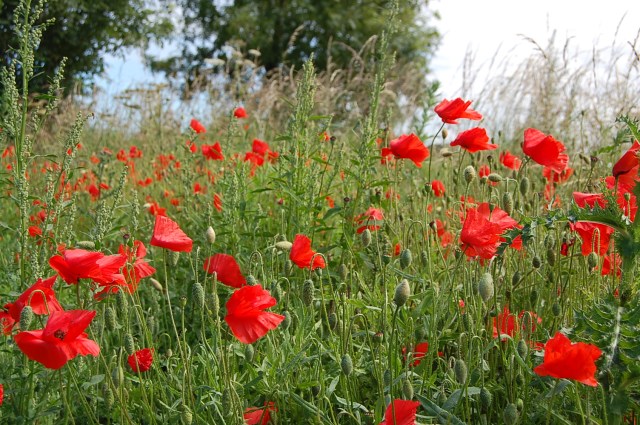
 I love the North Norfolk coast and as it’s only 20 miles away I visit frequently. If you’re a visitor from further afield, you might find a mix of holiday hotels, caravans, mobile homes and retirement bungalows. You might see only the faded charms of Cromer’s Victorian heydays coupled with its ‘kiss me quick’ seaside amusements. Look beyond these modern, man-made novelties to the natural world and the landscape retains it’s exhilarating sweep and historic romance that once drew poets and millionaires.
‘Poppyland’ stretches around the north-east arc of the Norfolk coast and takes in Sheringham, Cromer, Overstrand, Sidestrand and Mundesley. The romantic creation of late 19th century theatre critic, travel writer and minor poet, Clement Scott, ‘Poppyland’ came to embody an area of quiet, rural, fishing backwaters which were soon to change, not least because of Scott’s popularising of the place through his writings as well as the arrival of the railway. This came a few years before his first visit, and the area soon became the ‘must see’ place for the Victorian well (and not so well) to do.

‘Garden of Sleep’ – old postcard

Overstrand Hotel- it slipped over the cliffs in the 1950’s

Poppyland- view from Overstrand Church, an old postcard
Scott’s arrival in Cromer in 1883 was not a promising one. Affronted at the locals lack of recognition of the “dramatic critic of the Daily Telegraph and it’s leading travel writer” he quickly moved on to nearby Overstrand and Sidestrand. Here, he not only found accommodation, but also fell in love with his host’s 19 year old daughter, Louie Jermy. This romantic entanglement seems never to have been fully acknowledged, due to Victorian propriety – Scott was already married. This romantic attraction, coupled with his appreciation of the area’s beauty led him to create ‘’Poppyland’’. He went on to write about Sidestrand’s lonely church tower, teetering on the cliff edge and its churchyard “Garden of Sleep”. The tower eventually toppled over the edge of the cliff in 1916. The main body of the 14th century church (St Michael’s), had been removed (brick by brick), from its previous site to somewhere safer about three years before Scott’s discovery. The tower seems to have been abandoned as a more recent, less important addition to the ancient church.

Clement Scott

Louie Jermy

Mill House- or ‘Poppyland House’ as it became known

The ‘Maid of the Mill’
Staying at the local Mill House with miller Alfred Jermy, his daughter Louie became Scott’s “Maid of the Mill”. Scott had discovered a rural idyll and was to capture its essence in his poem ‘The Garden of Sleep’…
The Garden of Sleep
On the grass of the cliff, at the edge of the steep,
God planted a garden – a garden of sleep!
‘Neath the blue of sky, in the green of the corn,
It is there that the regal red poppies are born!
Brief days of desire, and long dreams of delight,
They are mine when Poppy-Land cometh in sight.
In music of distance, with eyes that are wet,
It is there I remember, and there I forget!
O! heart of my heart! where the poppies are born,
I am waiting for thee, in the hush of the corn.
Sleep! Sleep!
From the Cliff to the Deep!
Sleep, my Poppy-Land,
Sleep!
In my garden of sleep, where red poppies are spread, I wait for the living, alone with the dead!
For a tower in ruins stands guard o’er the deep,
At whose feet are green graves of dear women asleep!
Did they love as I love, when they lived by the sea?
Did they wait as I wait, for the days that may be?
Was it hope or fulfilling that entered each breast,
Ere death gave release, and the poppies gave rest?
O! life of my life! on the cliffs by the sea,
By the graves in the grass, I am waiting for thee! Sleep! Sleep!
In the Dews of the Deep!
Sleep, my Poppy-Land, Sleep!
Scott returned time and again to the forsaken “Garden”, which became the focal point of the ‘Poppyland’ legend. Scott had many London contacts in the theatrical world, and these and his writings led a number of them and others from London society to come to the area. Some had houses built in Overstrand – for a while the village was the place to visit. The Edwardian architect Sir Edwin Lutyens (he of partnership with Gertude Jekyll fame), designed some of these houses, including Overstrand Hall and The Pleasaunce as well as the more modest Methodist Church. A large hotel was also built on the cliff edge, though this slid into the sea in the 1950s! Land slips still affect the cliffs today (and make for an exciting cliff top walk).
A memorial water trough in Cromer bears the inscription: ‘To Clement Scott- who by his pen immortalised PoppyLand’. Though Scott wasn’t a particularly inspired poet, his writing helped to kick-start the Norfolk tourist industry. Today, however, fields of poppies are a rare sight due to modern farming techniques. The railway line which brought the early tourists to Poppyland is still operated as part of the national network as far as Sheringham. Here, an old station has become one end of a heritage line (the North Norfolk Railway) which runs to Holt, and is often referred to as the ‘Poppy Line’.

The memorial Water Trough- now planter – in Cromer
‘Poppyland’ still attracts holidaymakers. Resorts like Cromer still show the faded hallmarks of their Victorian splendour and more recent investment in the Pier, its surrounding promenades and the wider area has reinvigorated the place. Despite this, Scott would probably still recognise the landscape with its wonderful cliff – top and beach – side walks as well as the interesting villages and towns which retain a low – key attractiveness (including a beach top cafe in Overstrand that does a nice line in afternoon tea and cakes).
This is an historic landscape with loads of natural and man-made interest – if you’ve been please let me know your experiences, if not, I hope that you’ll get to visit soon.

Cromer today

Cromer lighthouse- focal point on the cliff top walk

The cliff top walk

Overstrand beach

Cromer pier from the cliff top walk

The Londs, Overstrand

Overstrand Methodist Church- designed by Sir Edwin Lutyens

Overstrand Hall- now an activity centre

Beach top cafe, Overstrand

Weather station, Overstrand

Fishing boats, Overstrand

Crab pots etc. Overstrand

Old time tractors used for pulling the boats up the slipway, Overstrand
Link:
Poppyland and the Jermy Family
Old School Gardener
If you’ve enjoyed reading this post and others on this blog, why not comment and also join some other people and sign up for automatic updates via email (see side bar, above right ) or through an RSS feed (see top of page)?













 Old School Garden