The Thames Barrier Park was opened in November 2000 and provides a new focal point for Newham residents and attraction for visitors to south-east London
How are we doing it?
The riverside area was redeveloped and landscaped with fountains, family areas, flower gardens and tended lawns.
What are the benefits?
The park has helped to significantly regenerate the area.
When is the project happening?
The project started in 1995 and was completed in November 2000.
How can I get involved?
The award-winning Thames Barrier Park is situated in Silvertown on the north bank of the Thames and has stunning views of the flood barrier. Set within 22 acres of greenery, this unique urban oasis features fountains, gardens, wildflower meadows, a children’s play area and a 5-a-side football/basketball court.
The history of the Thames Barrier Park
In 1995 the London Docklands Development Corporation launched an international competition to create a new riverside park. The winning consortium was architect Patel Taylor in collaboration with Group Signers and engineers Ove Aarum.
Lord Mayor of London, the Rt Hon Richard Nichols planted the first tree in January 1998 and the park was opened by the Mayor of London in November 2000.
The Green Dock
One of the park’s most imaginative and attractive features is The Green Dock which was created by renowned horticulturalist Alain Cousseran and Alain Provost.
A 1km circuit of the boundary paths takes you to the Visitor Pavilion Coffee Shop where refreshments are available.
Thames Barrier Park is accessible to those with disabilities.’
Tropaeolum is a genus of about 80 species of annuals and perennials native to South/Central America. The common Nasturtium (Tropaeolum majus) is the most frequently found member of the family.
Nasturtiumis from the latin words meaning literally “nose-twister” or “nose-tweaker” (referring to the pungent smell of some species!). The Tropaeolum Nasturtiums received their common name because they produce an oil that is similar to that produced by watercress (Nasturtium officinale).
Tropaeolum peregrinum
Tropaeolum includes several very popular garden plants, the most commonly grown being T. majus T. peregrinum and T. speciosum. The hardiest species is T. polyphyllum from Chile, the perennial roots of which can survive underground when air temperatures drop as low as −15 °C (5 °F).
Plants in this genus have showy, often intensely bright flowers (in reds, oranges and yellows), and rounded, shield- shaped leaves which vary in colour and include some attractive blue – green tones. Flowers have five petals (sometimes more) and a funnel-shaped nectar tube at the back. The name Tropaeolum is from the Latin tropaeum , meaning ‘trophy’ and was originally chosen by the swedish botanist Carl Linnaeus in the 18th century.
After victory in battle, the Romans used to set up a trophy pole called a tropaeum (from the Greek tropaion, source of the English word ‘trophy’). On this the armour and weapons of the vanquished foe were hung. Linnaeus was reminded of this by the plant as the round leaves resemble shields and the flowers, blood-stained helmets.
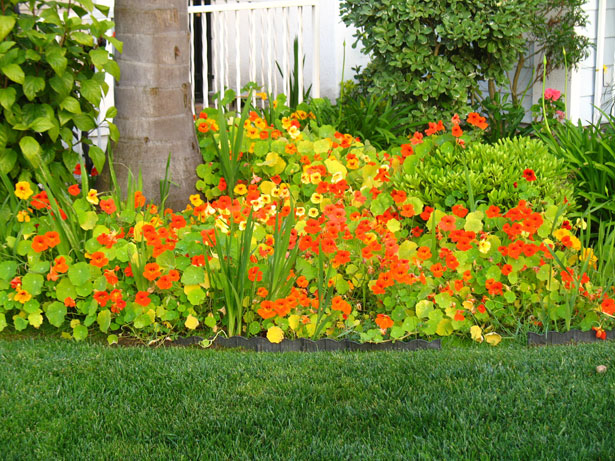
Tropaeolums in a border
Species names of Tropaeolum include:
T. aduncum = hooked (the flowers)
T. canariense = canary – referring to the colour and shape of the flowers (the ‘Canary Creeper’)
T. lobbianum = after Lobb the plant collector
T. majus = great (the Climbing Nasturtium)
T. minus = small (the Dwarf Nasturtium)
T. pentaphyllum = five leaved or divided into five
T. pergrinum = foreign or wandering, probably referring to its straggly growth
T. speciosum = showy
T. tuberosum = tuberous
‘Canary Creeper’ (T. canariense)
Nasturtiums were also known as “Indian cress”. This derived from their use as a salad ingredient and because at that time South/Central America was referred to as ‘the Indies’. The 16th-century herbalist John Gerard called the plant “Lark’s Heel”, referring to the flower’s spur (and similar to Larkspur).
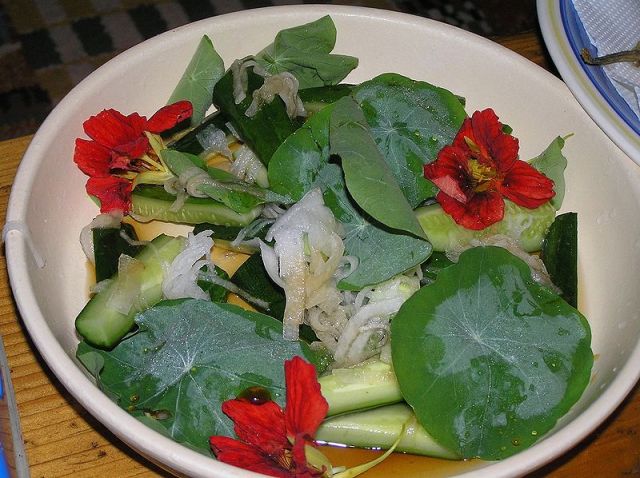
All parts of T. majus are edible. The flower is most often eaten as an ornamental salad ingredient or in a stir fry; it has a slightly peppery taste reminiscent of watercress. The flowers contain about 130 milligrams of Vitamin C per 100 grams or about the same amount as in Parsley. The unripe seed pods can be harvested and dropped into spiced vinegar to produce a condiment and garnish, sometimes used in place of capers.
Tropaeolum leaves and flowers as salad ingredients
Nasturtiums have been used in herbal medicines for their antiseptic and expectorant qualities. They are said to be good for a chest cold and to promote well being by the formation of new blood cells. The common Nasturtium has been used in herbal medicine for respiratory and urinary tract infections.
The bright, quaintly – shaped flowers are usually freely produced on long stalks, and the fast growth of many of the climbers makes the Tropaeolum a very useful, decorative plant. They will spill beautifully over walls and onto paths, when used as edging plants. They also hold up very well in containers. Climbing varieties, such as ‘Canary Creeper’ will amble up and through shrubs. Bushy, ground hugging plants will fill in gaps among complementary – coloured day lilies and roses.
You can use clusters of plants to brighten up the vegetable garden – and to act as ‘sacrificial’ ‘plants to attract caterpillars away from your brassicas!
Quizzicals: two cryptic clues to flower, plant, veg or fruit names –
Bird swearing
Vasectomy for Dad
(thanks to Les Palmer, answers in the next Plantax!)
Old School Gardener
If you’ve enjoyed reading this post and others on this blog, why not comment and join others by signing up for automatic updates via email (see side bar, above right ) or through an RSS feed (see top of page)?
On Monday we made seed tapes with the grade three class that comes to the Ladner Community Garden. We made so many seed tapes that I was getting worried we wouldn’t have the space to plant them. So when the seed tapes were done, I brought them home and laid them out on my dining room table to make sure they dried out from all the glue the children used. Yes, some children were a little zealous with the glue so I hope it doesn’t affect the seed germination. I looked over all the seed tapes and tallied the seeds.
The children used 979 seeds! Wow! Now that’s a lot of food for the food bank. That seemed like a lot of seeds but I sat down last night to see how much space we would need to plant them . If you remember from Mondays post I used…
‘Romantic 16th-century castle with spectacular views
Location has always been the main attraction for the owners and occupiers of Lindisfarne Castle.
From a former fort to the holiday home of a wealthy Edwardian bachelor seeking a quiet retreat from London, the idyllic location of the Castle has intrigued and inspired for centuries.
The renovation by Arts and Crafts architect Edwin Lutyens both hides and emphasises the old fort, all the while overlooking Gertrude Jekyll’s enchanting walled garden and the unexpected grandeur of the Lime Kilns, an imposing and striking reminder of Lindisfarne’s industrial past.
Before visiting please check the tide timetable to see safe crossing times for the Holy Island causeway and the latest opening times for the Castle.’


 Paper is not dead…








 Old School Garden