Archive for January, 2013


sweet-pea-flowerThe ‘Queen of Annuals’ is being billed as the cottage garden favourite for 2013′.

It’s botanical name- Lathyrus odoratus- comes from an ancient greek word (Lathyrus) meaning  pea or vetchling and odoratus meaning ‘fragrant’. The genus Lathyrus contains about 160 species and of the many cultivars of the Sweet Pea, some 52 varieties have been awarded the RHS Award of Garden Merit.  The many varieties of Sweet pea available today come in a wide range of colours, but not yellow!


“The Sweet Pea has a keel that was meant to seek all shores; it has wings that were meant to fly across all continents; it has a standard which is friendly to all nations; and it has a fragrance like the universal gospel, yea, a sweet prophecy of welcome everywhere that has been abundantly fulfilled” – Rev. W. T. Hutchins 1900

Sweet pea cultivation is thought to have begun in the 17th century. The originator of the modern plant naming system, the swedish botanist Linnaeus, carried on using the genus name Lathyrus, which was in common use in the 18th century, but gave the Sweet pea it’s species name odoratus to codify the various names used for it at the time.

sweet-pea-flowers-7Victorian times saw a craze for the plant and a host of new cultivars were created as a result, many beginning their lives as mutations or ‘sports’ of known varieties. The original dwarf sweet pea was found growing in a row of a popular grandiflora variety in California  in the late 19th century. It had similar flowers to its parent but was much shorter and with a spreading habit. Given the name ‘Cupid’, this later became the general name used for dwarf sweet peas. Later crossings of these and other grandifloras produced a wide range of ‘cupids’ and later still these were crossed with the newer ‘Spencer’ sweet peas which resulted in a range of ‘cupids’ with larger flowers.

The large-flowered Spencer sweet pea appears to have arisen in two or three places at around the same time, but perhaps the most famous source was the home of the Spencer family (of Lady Diana fame) in Northamptonshire. The head gardener of Althorp HouseSilas Cole – named this ‘Countess Spencer’, though he seems at the time to have claimed it arose from deliberate cross breeding rather than as an accident of nature!

Sweet peas can be grown in different ways, but perhaps the most common technique is the cordon, introduced in 1911 by Tom Jones of Ruabon. This is used to produce flowers of the highest quality and in effect is a form of pruning and training which channels the plant’s energies into a smaller number of larger blooms. This process involves:

  • The top of a young seedling being pinched out once it has produced several true leaves, which encourages branching
  • One of the resulting side shoots (a strong one emerging near the base of the plant) is retained, and the others removed before they develop
  • The remaining stem is allowed to grow and is tied in, but all of its side shoots are removed as they form, as are any tendrils to prevent them fastening onto the flower stems
  • The fewer flower stems produce larger blooms and once finished these flowers are removed to encourage new ones to form.

Several plants can be grown in this way along a row to produce a sweet pea screen.

Fresh sweet pea flowers in the house have been shown to improve general wellbeing, boost both male and female libido, and lessen the effects of a hangover! However, the seeds of some species of Lathyrus contain a toxic amino acid which if eaten in large quantities can cause the serious disease Lathyrism.

sweet-pea-flowers

Sources and further information:

Lathyrus.info.org

Lathyrus.com

Sweet Pea Flower pictures

Quizzicals: two more cryptic clues to plants, fruit or veg:

  • Has had too much already
  • A country full of automobiles

Old School Gardener

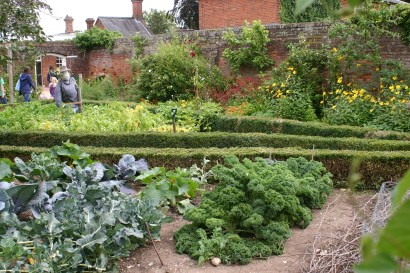
garden pic gressenhallThere are around ten different heritage gardens or other tended spaces at Gressenhall Farm and Workhouse Museum, near Dereham, Norfolk.

I’ve been a garden volunteer here for the last couple of years and spent time as a trainee Heritage Gardener. I plan to explore these spaces in my blog over the coming weeks. Here’s some background information.

References to ‘gardens’ in the Workhouse records (from  late 18th to mid 20th centuries) are relatively few, as most of the spaces within the walls of the former Workhouse were ‘yards’ of various kinds, being used for exercise or work by the inmates (including stone crushing). Records indicate that there were areas of active cultivation, mainly to grow food for the Master, staff and inmates. Major areas of food cultivation (most located just outside the Workhouse walls) no longer exist.

The current workhouse buildings were developed in the late 18th century after an Act of Parliament encouraged ‘Houses of Industry’ to be set up. People unable to look after themselves and/or their families were able to live in the buildings and do work to earn their keep. Before this, from Tudor times, the poor were the responsibility of local parishes and prior to this were looked after by religious orders, or informally by neighbours, friends or family.

The Workhouse meant a harsh, regimented life

The Workhouse meant a harsh, regimented life

1834 saw the Poor Law Reform Act  which converted the House of Industry into The Workhouse. Conditions became much harsher with families split up into different groups – adult males, adult females, boys, girls, unmarried mothers with babies, tramps (or ‘casuals’) etc. Dickens’ novel Oliver Twist conveys the strict regime.

Union Farm showcases historic farming practices with animals and fields

Union Farm showcases historic Norfolk farming practices

Gressenhall and other Norfolk workhouses expanded and reorganised accordingly and this system remained largely the same for the next 100 years. The Poor Law  was eventually abolished just after the 2nd World War and Gressenhall became an old peoples’ home- ‘Beech House’ (named after the magnificent Copper Beech tree in the main courtyard). Finally, in 1979 the old peoples’ home closed and the site was developed as the Norfolk Rural Life Museum, including the acquisition and development of the adjacent Union Farm as a showcase for farming methods and practices of yesteryear.

The historical role of today’s heritage gardens has resulted in most of them being enclosed by the walls of the workhouse buildings, boundary or dividing walls and sometimes, native species hedges or other natural boundaries. These ‘Gressenhall Gardens’ are principally the result of voluntary effort beginning in the 1980’s. The spaces were developed to support the Museum’s role in telling the story of the Workhouse and Farm, Norfolk’s broader landscape and rural life, as well as the more contemporary issues of environmental sustainability and biodiversity.

an aerial view of Gressenhall Farm and Workhouse Museum

An aerial view of Gressenhall Farm and Workhouse Museum, Norfolk

Several of these heritage gardens are domestic in scale and style with mixed planting and other features,  probably due to their clear definition into manageable spaces coupled with the interests and ideas of volunteers and staff. Some of them perform specific roles in helping to interpret this Norfolk museum site and deliver some of it’s messages;

  • Cherry Tree Cottage Garden illustrates a typical Norfolk cottage garden of the 1930’s, using plants and techniques from that time
  • The Wildlife Garden has habitats, planting and other features that are conducive to wildlife. A small border also features ‘useful plants’
  • The Orchards are growing varieties of apple and other fruit native to Norfolk (this is located on the graveyard of the old Workhouse)
  • The Dyers’ Garden features plants used in natural dyeing
Cherry Tree Cottage garden is set out like a typical 1930's cottage garden with vegetable varieties and techniques of the time

Cherry Tree Cottage garden is set out like a typical 1930’s Norfolk cottage garden with vegetable varieties and techniques of the time

A recent development has focused on the ‘Education Garden’, which is an important space used by the Museum’s Learning Team and others, adjoining as it does the Learning Centre. A new ‘Curiosity Corner’  provides an area for children under 5 to explore – it has various natural and other ‘child-size’ features; eg a willow tunnel, turf seat, rock pile, fossils, various metal birds, insects and animals and a hazel ‘wig wam’.

Over the coming weeks I’ll introduce you to some of the more important heritage gardens in this important Norfolk museum.

Further information:

Gressenhall Farm and Workhouse Museum on Facebook

Gressenhall Farm and Workhouse Museum blog

Old School Gardener

Simple natural elements can make a garden special for younger children

Simple natural elements can make a garden special for younger children

Surveys show how playing in parks or their own garden come out tops for children when asked what their favourite activities are. And an expert warns that children are no longer ‘free range’.

Providing simple play pleasures won’t cost parents an arm and a leg either! Thinking about how to make your garden child-play friendly and then spending a little money on creating the right space will repay dividends over  many years.

Start with the idea that the garden for children (and for adults too for that matter) should be a multi-sensory space, with:

  • different surfaces and textures to touch – stones/ gravel/ bark/ brick and plants with interesting leaves such as Stachys byzantina  (‘Lambs’ Ears’),
  • varied smells – from different flowers and leaves,
  • tastes – growing and picking your own strawberries or fresh vegetables,
  • sounds – wind through grasses, chimes, water dripping into a child-proof pool
  • sights– break up the garden into different zones with their own character.
A children's food garden

A children’s food garden

Then talk about the ways you might create this in your garden with your children, focusing on the sorts of play activities they would like…and work up your ideas using these…

Seven tips for garden play:

  1. Natural resources– treat the outdoors differently to the indoors- its special, so create spaces and provide playthings which children can’t get inside; e.g a tree house or a tree for climbing if you have one big enough,  a pit or pile of sand, or if you’re feeling very brave- a mudpool…
  2. Growing children– give children a separate, personal garden where they can ‘grow their own’ food…
  3. Futureproof- think ahead and provide things which will engage children for several years or which can be easily adapted as they grow older – convert a sand pit to a growing area, a swing frame into a hammock frame…
  4. Small and simple– a few odd bits and pieces of wood, boxes, bricks, cloth, plastic pipe etc. can fuel children’s imaginations and creative play, though purchased play equipment does have a place too, if you have the space and cash…
  5. Doubling up– make the most of space – think about garden structures which can play a role in the ‘adult garden’ as well as  providing something for children; e.g wooden arches that can support a swing, sand pits concealed below trap doors in wooden decked terraces, a climbing frame that’s one side of a pergola, varied path surfaces with some in-built pattern (you can even get some with fossils imprinted on them)…
  6. Move the earth– don’t be afraid of creating (even small) hills and hollows in your otherwise flat garden (unless you have these already of course)- children love running up and down slopes and use these for all sorts of creative games. If you like, add in a few rocks and logs (fixed down) for them to clamber over…
  7. Get social– encourage your children to play with other children – invite their friends round and take them to friend’s gardens, play areas and other places where there’s a good chance of meeting other children…

    Play garden using simple materials
    Play garden using simple materials

    Even if your garden is small, you can use your imagination and create a unique and special place for your children.

Further information:

Growing food with children

A children’s food garden

Garden games

Old School Gardener

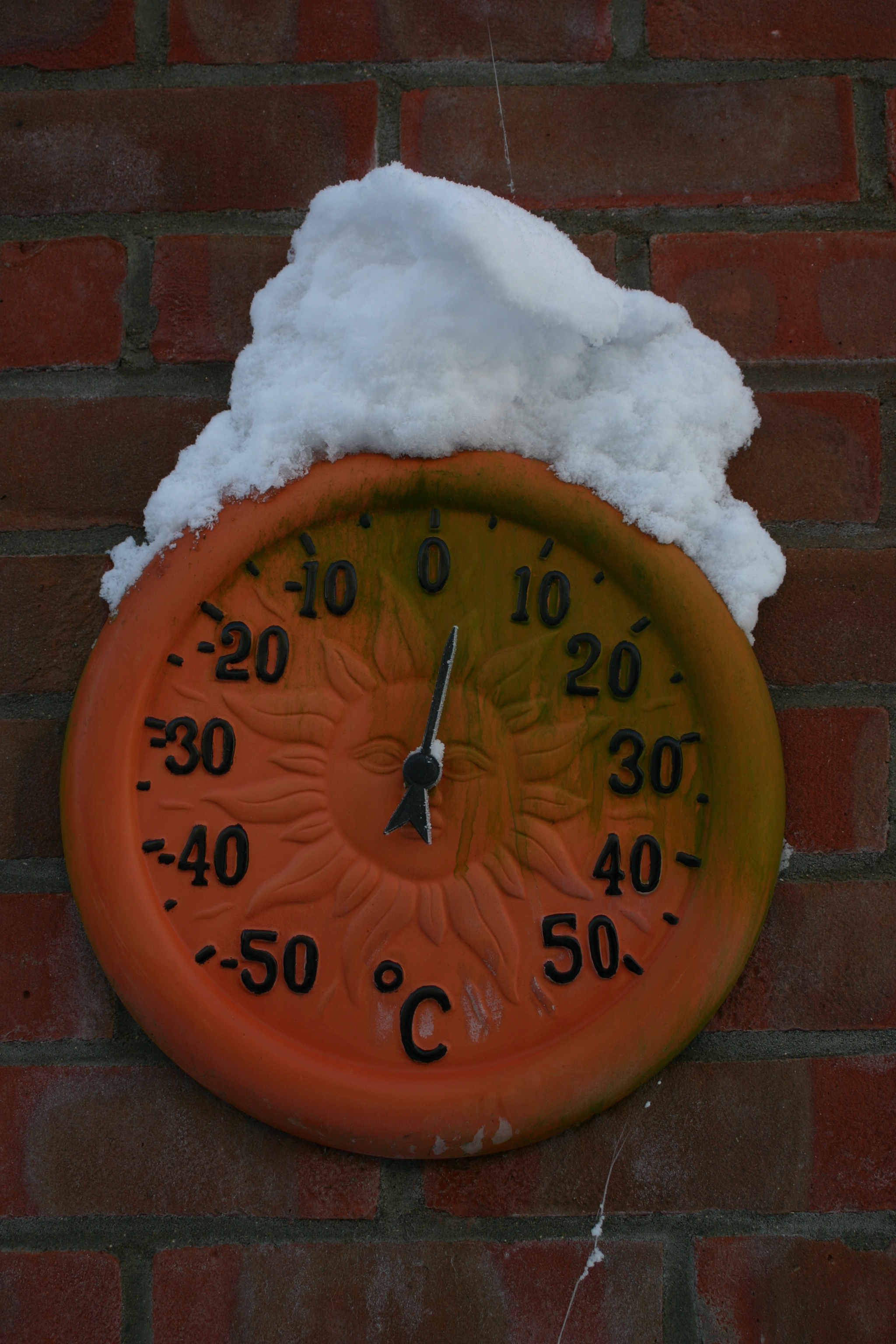
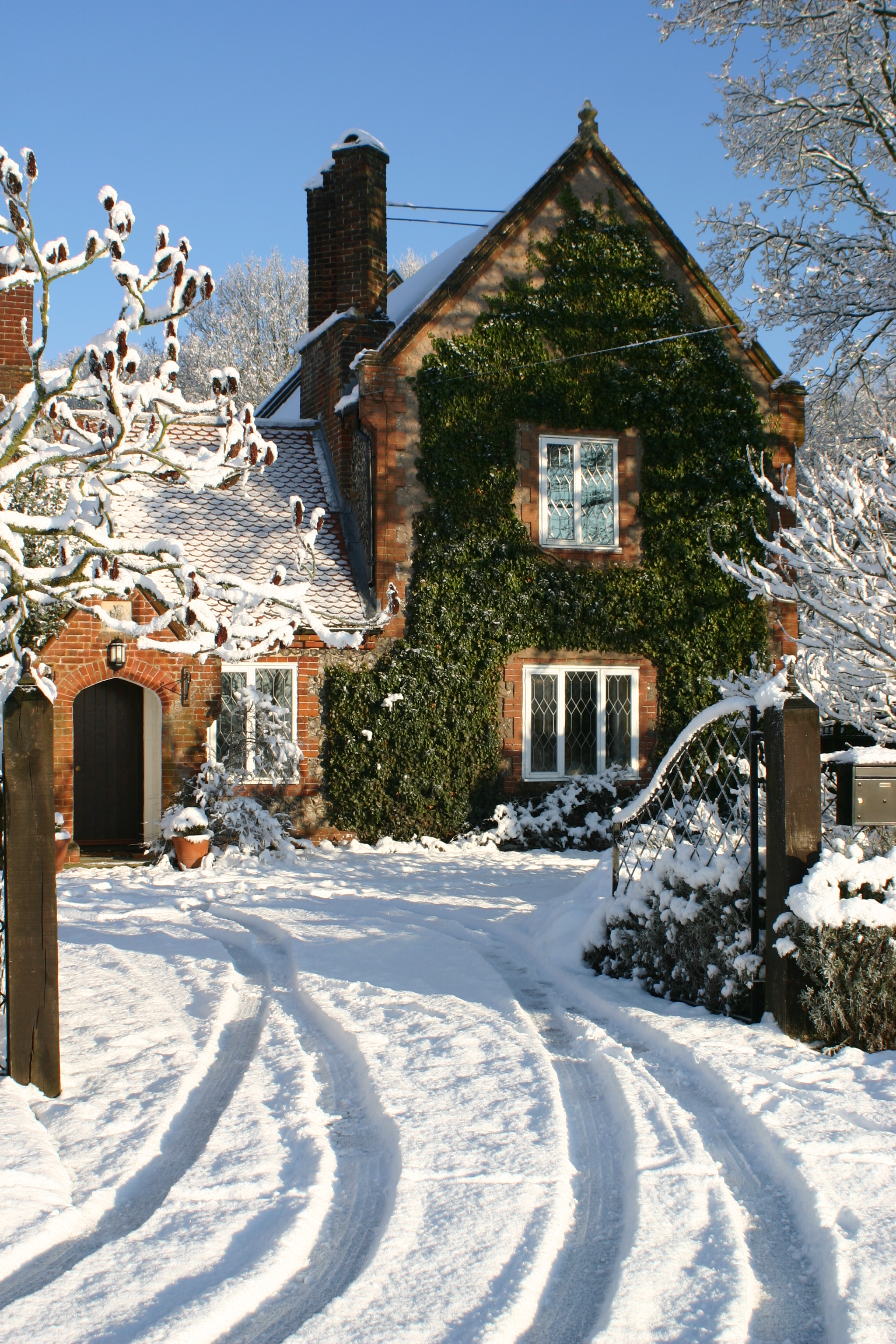
IMG_5170As I sit and look out of my window this cold January day, the snow has started to fall once more- looks like the heaviest fall will be later today. So the firewood has been stacked and fortunately the week’s shopping was done yesterday…

At this time of year you could be forgiven for thinking there’s not much of interest in the garden. We tend to focus on the other seasons when we think about (or impulse-buy) plants. The weather itself isn’t exactly encouraging us to visit the nursery or garden centre. And anyway, they seem to be rather  forlorn places at this time of year, especially the bigger ones that have ‘diversified’ into Christmas tat- the shelves are either emptying to make way for spring gardening stock or they’re full of half price Christmas cards and tinsel…

Well, we should perhaps think about how our garden looks in every part of the year, especially the important views into it from the house, road etc. In the winter, it’s these views that count, as it’ s less likely you’ll want to venture into the wet or cold garden itself.

The choices are significant – yes you can have:

  • beautiful flowers
  • powerful fragrance
  • colourful fruit
  • vibrant stems
  • interesting bark
  • strong  form
  • fascinating  foliage

Here are seven examples of the sorts of plants that can be a winter wonder in your garden.

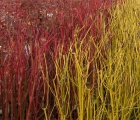
Dogwoods provide wonderful winter stem colour

Dogwoods provide wonderful winter stem colour

1. Dogwoods (Cornus species)- vibrant stem colours make this a winner especially where you can group several plants together and maybe combine them for subtle effects (try C. alba ‘Sibirica’ (red) surrounded with C. sanguinea ‘Midwinter Fire’– amber- orangey red). Prune the stems back to the base of the plants in spring or leave one or two stems to grow taller and then pollard it for extra height (prune ‘Midwinter Fire’ less)- you will also get some lovely autumn leaf colour.

Witch Hazels- magical spidery flowers

Witch Hazels- magical spidery flowers

2. Witch Hazel (Hamamelis in many different varieties)- beautiful spidery-like flowers are magical in woodland edges. Grow as specimens or focal points under trees or in open ground – will grow about 2 metres high and wide over time.

Crab apple 'Red Sentinel'- plum-sized fruits that birds seem to avoid

Crab apple ‘Red Sentinel’- plum-sized fruits that birds seem to avoid

3. Crab apple (Malus species and cultivars – but not the ‘orchard’ apple Malus x domestica)- some of these smallish trees are suitable for smaller gardens with their columnar growth – e.g. M. tschnoskii (which can grow to 12 metres high but only 7 metres across). The main reason for growing them, in my view, is their fruit. Plum – sized apples which seem to be just the right size to not interest birds, so you’ll hopefully be left with a great show throughout winter. I particularly like M. x robusta ‘Red Sentinel’ (can grow to 7 metres high and wide). And Crab apples give great spring flowers and autumn colour too.

Mahonia x media- black fruits follow the flowers

Mahonia x media- black fruits follow the flowers

4. Oregon Grape (Mahonia species and some cultivars)- this is a winner on several counts, but mainly through its winter flowers and foliage. It’s evergreen  leaves (some spiky) will burnish orangey-red if exposed to the sun. My favourite is the hybrid M. x media ‘Charity’ which is an erect evergreen shrub with sharply toothed leaves and dense yellow flowers that cascade from the stems. One ideally for part shade, so a woodland edge is perfect.

Viburnum x bodnantense- wonderful scented flowers

Viburnum x bodnantense- wonderful scented flowers

5. Viburnum x  bodnantense ‘Dawn’ there are many different Viburnums, and they make a wonderful addition to the garden for their flowers, fragrance and foliage at different times of the year. This one is a hybrid and is chiefly grown for its wonderful scented flowers which grace the medium-sized deciduous shrub through winter on bare stems.

Box- small leaves make it ideal for strong  topiary shapes

Box- small leaves make it ideal for strong topiary shapes

6. Box (Buxus sempervirens or if you want a slower growing, more compact form go for the variety ‘Suffruticosa’)- one of the great plants for shaping into strong forms that help to carry your garden’s structure through the winter months. Also, don’t forget that some perennials will add form and structure to your garden through their dead stems and shapes. For Box start growing small and gradually develop your desired form, or buy (at some expense) some of the ‘ready- to – rock’  topiary at nurseries and garden centres. There are some wonderful examples of historic topiary in Britain such as Levens Hall, Cumbria.

320px-Paperbark_Maple_Acer_griseum_Bark_3008px

Paper-bark Maple- bark peels into subtle tones

7. Paper bark Maple  (Acer griseum)- a fantastic, slow growing tree which can reach 10 metres high and broad. Like most Acers it gives great autumn leaf colour, but it’s main attraction is the peeling bark which looks especially magical with low winter sun shining through it.

Further information;

Guardian online

Winter containers

Winter vegetables

Quizzicals:

answers to the last two-

  • Our monarch continues to work hard – Busy Lizzie
  • Nasty spot causing urination problems – Bladderwort

A couple of gardening ditties:

‘Whose sorrel now?’

‘Don’t leaf me this way’

(thanks again to buddie Les for these)

Old School Gardener

The Small Tortoiseshell- under threat

The Small Tortoiseshell- under threat

The latest ‘Wider Countryside Butterfly Survey’ reveals that some butterfly species- notably the Meadow Brown- seem to have benefitted from last year’s wet summer, whereas others- such as the Common Blue and Small Tortoiseshell– were around 50% down on the previous year.

The Small Tortoiseshell was once prolific in Britain’s gardens, but it seems to have been one of the big losers in 2012. Last year’s weather  is only partly to blame, as wider agricultural policies and practices are a key driver behind a longer term decline in butterfly species and numbers and parasitic flies may also be part of the story. Around three quarters of the 59 native British species are now in decline.

So what can gardeners do to arrest this trend?

1. Think about providing year- round sources of food for emerging and mature butterflies. Examples of plants which feed butterfly caterpillars are: Dill, Antirrhinum, Columbine, Berberis, Marigold, Ceanothus, Cercis, Cornus, Foxglove, Wallflower, Ivy, Hop, Holly, Jasmine, Honesty, Ragged Robin, Crab Apple, Oregano, Cowslip, Rudbeckia, Thyme, Nasturtium, Verbascum and Pansy.

Species which are food sources for mature butterflies are: Achillea, Anthemis tinctoria, Bergamot, Buddleja, Columbine, Coreopsis lanceolata, Red Valerian, Ceanothus, Marigold, Echinacea, Globe Thistle, Knautia, Lavender, Tobacco plant and Hop.

2. Try to plant butterfly-attracting plants in groups– butterflies prefer to visit stands of brightly coloured flowers.

3. If you have room, choose a quiet but sunny area of lawn where the grass can be left to grow long – some butterflies such as the Meadow Brown prefer to lay eggs in long grass.

4. Allow a small patch of nettles (Urtica dioica) to grow unfettered– these will provide food for some of the more common butterflies such as Red Admiral, Painted Lady and Milbert’s Tortoiseshell.

5. If you have fruit trees, don’t be too tidy about windfalls– leave some rotting fruit as a source of food for some butterflies.

6. Try to provide a shallow, muddy puddle in a sunny spot– many butterflies love to drink from these and they also provide essential minerals and salts.

7. Avoid using chemical sprays to deal with insect pests and weeds– many will harm beneficial insects and butterflies as well as the pests.

Groups of butterfly- friendly plants such as Bergamot are better than single specimens

Groups of butterfly- friendly plants such as Bergamot are better than single specimens

Sources and further information:

Guardian online

Butterfly Conservation

UK butterflies

‘Wildlife Friendly Plants’- Rosemary Cresser

Quizzicals- two more cryptic clues to plant, fruit or veg names:

  • Our monarch continues to work hard
  • Nasty spot causing urination problems

Old School Gardener

ImageImageIMG_5170 IMG_5172IMG_5178

ImageGarden Design Course in Norfolk

Following the successful pilot of ‘Your Garden- by Design’ last autumn, I’m pleased that Reepham Learning Community have agreed to run an extended version of this course beginning at the end of the month. 8 two-hour sessions (including one garden visit) will use a variety of methods and materials to help those who want to improve their own gardens through design.

Based at Reepham College in central Norfolk, the course is a step-by-step walk through the design process, showing how to apply this to your own garden (big or small) from basic surveying and appraisal techniques, forming ideas about what the garden is for and how it might look, to outline plans and 3-D visions of  different ideas as well as the important things needed to ensure successful delivery of attractive, practical plans.

Group review and discussion of the evolving designs will enable participants to develop a critical and creative approach to garden design and a large number of reference books will be on hand as well as links to other sources of information. Case studies and in-class exercises will help participants to develop their skills.

Green (and its many shades) is one of the most important colours in garden design (arguably it’s a more important feature than the ‘white’ in Vita Sackville-West’s garden at Sissinghurst). Gardens which feature plants with bold, contrasting foliage can be really effective and the Course will introduce colour, texture and form as three key ideas in planting design. The contribution that ‘hard’ landscaping (paths, walls, furniture and built structures) makes to successful garden design will also be covered.

Participants don’t need to have any particular skills- the course and associated support should lead to practical ideas which can be put into action. The eight sessions will cover:

  • Starting out- what do I want from my garden?IMG_4931
  • Surveying and appraising your garden and functional layouts
  • Garden Styles and Forms
  • Structure in your Garden- the third dimension
  • Planting- the fourth dimension
  • Garden visit (day time)
  • Final designs
  • Delivering your Design

Check out the link to the Reepham Learning Community for more information- I’m looking forward to meeting a new group of enthusiastic garden makers!

Quizzicals- answers to the last two:

  • Morrisey’s mother’s mother- Granny Smith
  • Someone who is out get you – Anemone

A couple of gardening ditties for you:

‘Livin’ Dill’

‘Juke Box Chive’

(note to self= must move away from herbs and spices for a while…)

Old School Gardener

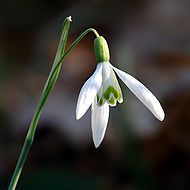
Image‘Hope of spring’, the first  Snowdrop seems to say, as it pops it’s small white flowers above what is pretty much a garden of bare earth and dead stems.

The botanical name for the genus is Galanthus from the greek for ‘milk’ (gala) and ‘flower’ (anthos). It’s a small genus of about 20 species of bulbous herbaceous plants native across much of Europe. Most flower in winter, before the vernal equinox, but certain species flower in early spring and late autumn. This year the mild start to 2013 has encouraged early flowering in some areas.

The Snowdrop is perennial bulb which contains an active substance called Galantamine– this is also found in Narcissi- and is helpful in the treatment of Alzheimer’s disease. The Common Snowdrop also contains another active substance called Galanthus nivalis agglutinin (GNA) which has been used to genetically modify potatoes, but this has caused some controversy. In 1998 a scientist called Pusztai claimed that the modified potatoes caused damage to the intestines and immune systems of rats.

There are numerous single- and double-flowered cultivars of Galanthus nivalis, and also of several other Galanthus species. Some of the better known species are:

  • G. byzantinus- ‘Byzantine’
  • G. plicatus- ‘folded’ referring to the leaves
  • G. elwesii– after ‘Elwes’, a botanist and author
  • G. nivalis– ‘snowy’- the Common Snowdrop

220px-Bank_Hall_Snowdrops_Feb_2009

An important feature which helps to distinguish between different species (and to help to determine the parentage of hybrids) is their ‘vernation’ (the arrangement of the emerging leaves relative to each other). This can be “applanate”, “supervolute” or “explicative”. In applanate vernation the two leaf blades are pressed flat to each other within the bud and as they emerge; explicative leaves are also pressed flat against each other, but the edges of the leaves are folded back or sometimes rolled (as in G. plicatus) ; in supervolute plants one leaf is tightly clasped around the other within the bud and generally remains at the point where the leaves emerge from the soil.

fig_2005_3.jpg.w300h225

‘Snowdrops’ – US miltary style

“Snowdrops” was the nickname that, during the 2nd World War, the British gave to the U.S. Army’s Military Police based in the U.K. – because they wore a white helmet, gloves, gaiters, and belt against their olive drab uniform.

A ‘Galantophile’  is a snowdrop enthusiast, including authors of snowdrop books, cultivators, collectors or those displaying Snowdrops. Well known ‘Galanthophiles’ are the horticulturalist E.A. Bowles and nurseryman James Allen . Modern day Galanthophiles are of all ages and visit the many gardens open to the public which feature large naturalised plantings of Snowdrops.
Sources and other information:

Wikipedia

Royal Horticultural Society

Royal Horticultural Society- book

Galanthus mania

The world’s most expensive Galanthus bulb

IMG_5164

Quizzicals:

Two more crytpic clues to plants, fruit or veg:

  • Morissey’s mother’s mother
  • Someone who is out to get you

Old School Gardener

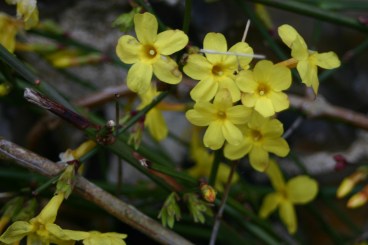
Looking good- Winter Jasmine (Jasminum nudiflorum)

Looking good in Old School Garden at present – Winter Jasmine (Jasminum nudiflorum)

 Planning your crops- to rotate or not to rotate…

Well, I guess that I’m sold on the benefits from rotation. Basically, you reduce the chances of persistent pests and diseases building up (which affect a particular plant or group of plants) and you manage the demands placed on the soil from different crops (and in the case of peas and beans actually stand to replenish, or if not that, then at least not deplete the store of Nitrogen).

Fine in theory, but it’s posed a real challenge to me in planning my crops in the kitchen garden. I’ve survived to date (just) with hasty diagrams on odd scraps of paper and scribbled ideas about what to grow where. To be quite honest, I’ve become muddled about what was previously grown in the different beds, what needs to follow what and whether I should manure, fertilise and/or add lime….sound familiar?  With just the two of us at home to cater for it’s also been a bit difficult avoiding growing either too much or too little of the right things (generally the former).

Part of the problem is that my Kitchen Garden is divided up into a number of raised beds of different sizes and aspects, so it’s a challenge fitting things into the spaces available. I also feel that it’s important to max the growing potential by putting in follow-on crops once early harvests of things like Broad Beans, onions and early potatoes have been ‘garnered in’.

Then there’s the issue of focusing on what we like to eat (sounds simple, eh?). Over recent years we’ve had mixed results:

  • some rather exotic looking French Beans which turned out a pretty yellow on the plant and then went a sort of beige when cooked- not inviting,
  • peas -they seem to involve an awful lot of trouble for not much reward
  • main crop potatoes– they take up a lot of ground and don’t taste that different from a large bag bought for a fiver…

So we’ve started to focus on the crops we like (with a bit of experimenting), things that can be expensive to buy, freezables for the winter months (Courgettes come to mind) and some particular varieties that ‘float our boat’- Mangetout for instance in preference to those whopper peas that pigeons seem to rather enjoy!
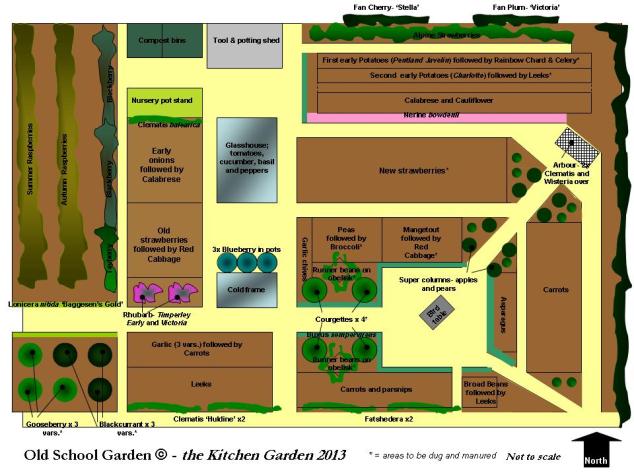
So yesterday (after pruning the apple trees), I spent a couple of hours drawing up a proper diagram of the plot, tried to think through what could go where (once I’ve taken permanent crops like fruit, Rhubarb and Asparagus out of the equation)- and also whether there’s potential for second crops in some areas, too.

I’ve tried to follow the rules on rotation (brassicas following legumes, potatoes following brassicas and onions and roots following potatoes), but I must admit it’s a bit hit and miss, taking all of the other variables into account! What’s your experience and do you have any sure- fire tips to help me?

At last, a cunning plan for food growing in 2013! (I hope)

(click on the image to enlarge and see a panorama video of the garden as it looks today at http://www.youtube.com/watch?v=rZ20lLrTLIc&feature=youtube_gdata_player)

kitchen gdn layout

P.S.  A note on manure:  if you can get some well rotted animal manure it could be good to either dig it into your beds or just lay some on top for the worms to incorporate into the soil. I’d be careful about putting it down everywhere though, as root crops like carrots and parsnips don’t like freshly manured ground (they tend to fork and not grow well in the heavier conditions that are created). However, ‘hungry’ cops like potatoes, brassicas (cabbages, calabrese, cauliflower, broccoli), courgettes, squashes and legumes (peas, beans) would all benefit from some, as would a greenhouse if you’re planning to grow tomatoes. Ideally it needs to be obtained and placed or dug in in the next few weeks in order for the weather to break it down and help to incorporate it into the soil.

Further information: Vegetable Gardening for Beginners: The Complete Guide

Quizzicals: answers to the last two…

  • Private part of a old crooner Periwinkle
  • The organ that enables you to say ‘2 plus 2 = 4’Adder’s Tongue

and just for fun two more ‘gardening ditties’:

‘Pepper’s got a brand new bag’

‘Spice Oddity’ (topical huh?- thanks Les)

Old School Gardener

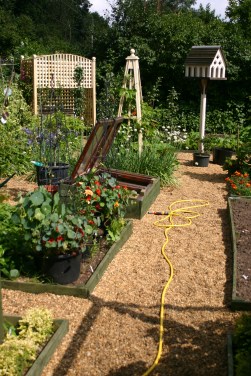
A view of the Kitchen Garden looking west- east (left to right on the diagram)

IMG_5157

So you know how it goes… a good friend says something post-Christmas about a gift they’ve given you, how they hope you liked it etc. and you think-

‘don’t remember getting that…’

It happened to me at the weekend. Friends who had kindly given me a couple of nice garden-related presents referred to some carrot seeds called ‘Nigel’ (my name for those who don’t know me). Somehow I must have missed them (let’s face it a packet of seeds can easily go missing when you’re eagerly ripping off the wrapping paper…).

So, as we missed this week’s bin collection (which happened to be the recycling one with the Christmas wrapping paper in it), I tipped out the (nearly full) contents to see if I could ‘find Nigel’. Well, suffice it to say that I was unsuccessful and came close to serious injury on can edges and other stuff in the process.

So that’s why ‘Nigel’ is plotless on at least two counts for 2013…

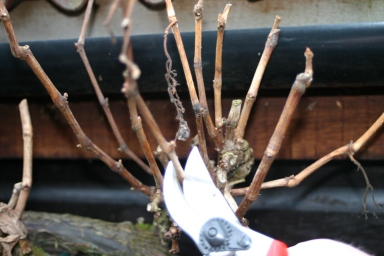
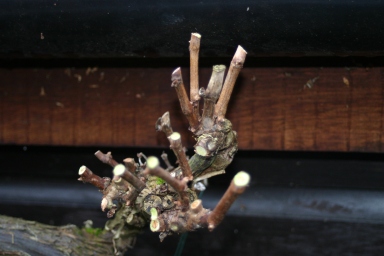
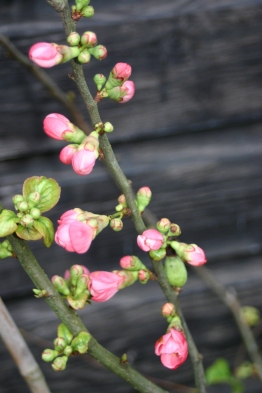
More successfully,  I spent a couple of hours yesterday using another cherished Christmas pressy-a pair of Felco No. 2 secateurs (a joy to use) on the grapevine and a rather overgrown Jasminum beesianum in the Old School courtyard. Here are some  images of that to accompany some of other plants looking good in the garden at present. Also the answers to the last Quizzicals and a couple of new ones…

IMG_5155

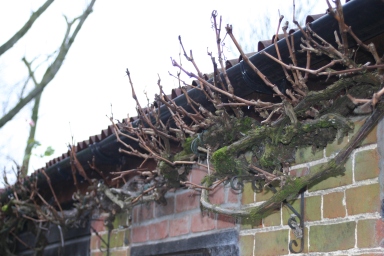
The grapevine grows round the top of three walls in the Old School Garden courtyard. A black variety, it gives a reasonable yield , but lack of sun/ warmth in 2012 led to a dissapointing crop. Let’s hope for better this year…

IMG_5152

Grapevine before pruning- new secateurs poised for action…

IMG_5154

After pruning- stems cut back to one or two buds above the node.

IMG_5158

Quizzical answers

The last two were:

Someone who stalks a 1970s Wimbledon champion-  Virginia Creeper

Four times faster than Roger Bannister- ‘Mile a Minute’

Two more to entertain you (thanks Les):

  • Private part of an old crooner
  • The organ that enables you to say ‘2 plus 2 = 4’
Finding Nature

Nature Connectedness Research Blog by Prof. Miles Richardson

Norfolk Green Care Network

Connecting People with Nature

Discover WordPress

A daily selection of the best content published on WordPress, collected for you by humans who love to read.

Susan Rushton

Celebrating gardens, photography and a creative life

Unlocking Landscapes

Writing, photography and more by Daniel Greenwood

Alphabet Ravine

Lydia Rae Bush Poetry

TIME GENTS

Australian Pub Project, Established 2013

Vanha Talo Suomi

The Journey from Finnish Rintamamiestalo to Arboretum & Gardens

Marigolds and Gin

Because even in chaos, there’s always gin and a good story …

Bits & Tidbits

RANDOM BITS & MORE TIDBITS

Rambling in the Garden

.....and nurturing my soul

The Interpretation Game

Cultural Heritage and the Digital Economy

pbmGarden

Sense of place, purpose, rejuvenation and joy

SISSINGHURST GARDEN

Notes from the Gardeners...

Deep Green Permaculture

Connecting People to Nature, Empowering People to Live Sustainably

BloominBootiful

A girl and her garden :)