Latest Entries »

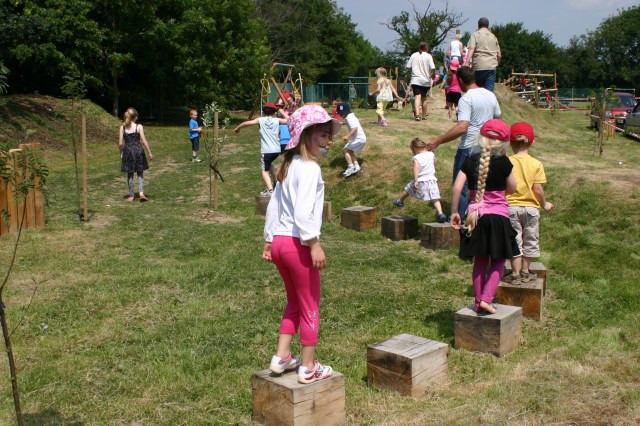
127_2786The play landscape in this Norfolk village was created  to partly replace, as well as enhance an existing fenced play area with wooden and other equipment, which was set wide apart and surrounded by grass. This adjoins an area of the local recreation ground and a small area of woodland/hedgerow.

I was commissioned to provide design and specification plus project management advice. There was an initial budget of £50,000, funded by the Government Playbuilder programme plus contributions from local organisations.

The brief focused on three main objectives:

1. Expanding the play space – using the identified budget and the Design Brief as a starting point, expand and link the existing play space so as to utilise the play opportunities offered by the nearby wood/ hedgerow, allowing for future fundraising and community self-build.

 2. Enhancing Play Value –  increase the number and range of play opportunities for all abilities and ages, focusing on 8-13 year olds and with some provision for toddlers.

 3. Creating an attractive community space – create a welcoming, attractive space for children and adults which is coherent, provides interest through varied height and colour, creates a sense of discovery, uses existing/ donated play equipment (where possible), and landscape features to create play value and enhance the appearance of the space.

The resulting design extends the play area into a larger space (requiring the movement of a football pitch) and integrates this with retained, refurbished play equipment. Old fencing was removed and replaced with shrub planting and trees to indicate boundaries, an existing mound and new grass mounds were created to provide play features and to house a tunnel, wide slide with graded wheelchair access and aerial cableway. There is a wooden climbing feature, plus additional play equipment for toddlers and older children, including a simple wood slice spiral with spring bulbs planted to mark this, a log seating area/ social space, basket swing, spinners, and areas of longer grass. The project was substantially completed by June 2010.

Old School Gardener

If you’ve enjoyed reading this post and others on this blog, why not comment and join others by signing up for automatic updates via email (see side bar, above right ) or through an RSS feed (see top of page)?

sethsnap's avatarsethsnap

Sitting on the edge of downtown and the corner of Over-the-Rhine is Cincinnati’s Washington Park.  Recently refurbished, the park is an oasis for local events, dog walkers and people watching.  With glorious neighbors like Cincinnati’s Music Hall, one can hear the sounds of the symphony and operatic voices in the air.  It’s a place overflowing with Cincinnati.

View original post

Aphids forecast to fly considerably later this year

‘…Dr Susannah Bolton, HGCA Head of Research and KT, said, “Average temperatures in January and February can be used to forecast the first aphid flights. As this winter was colder than the long-term average throughout the country it means that aphid flights are expected to occur much later this year.”

In the southern half of the country, as average temperatures were between 1oC and 2oC below normal, the first aphid flights are expected to be two to four weeks later than average.

In the northern half of the country, as average temperatures were less than 1oC below normal, the first aphid flights are expected to be up to two weeks later than average….’

Latest news from the Home Grown Cereals Board (UK)

Many streets have become car dominated no-go areas for children

How children lost out to cars in the battle for space on our streets

‘It’s a graphic illustration of the changing face of our streets over the second half of the 20th century.

These pictures show how many of the areas around our homes have been transformed from popular play areas for local children to car-dominated no-go areas.

The photographs, dating from the 1940s to the present, paint a stark contrast with children and families enjoying the freedom of the streets in days gone by, and largely banished in the most recent images….’

Sowing peas

See this link for some handy advice on ways of sowing peas from the RHS Campaign for School Gardening

PicPost: Pot Plant Challenge

Chas Spain’s still life of a bromeliad, oranges and things… click the image to go to the blog post

PicPost: Hair raising

PicPost: I'm ready for love

PicPost: Entranced

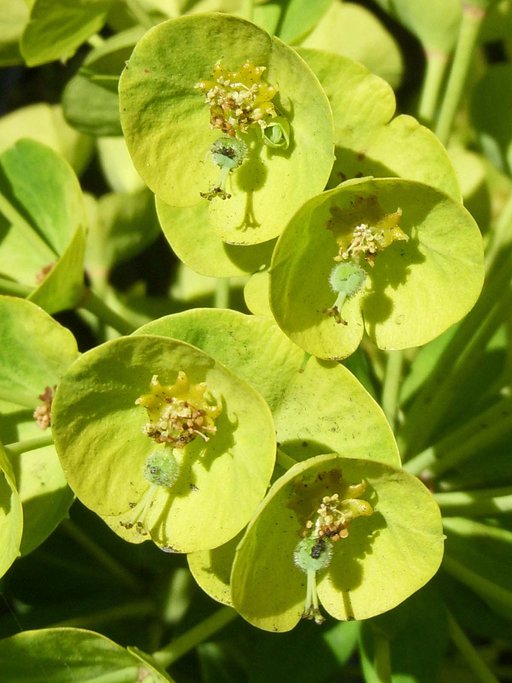
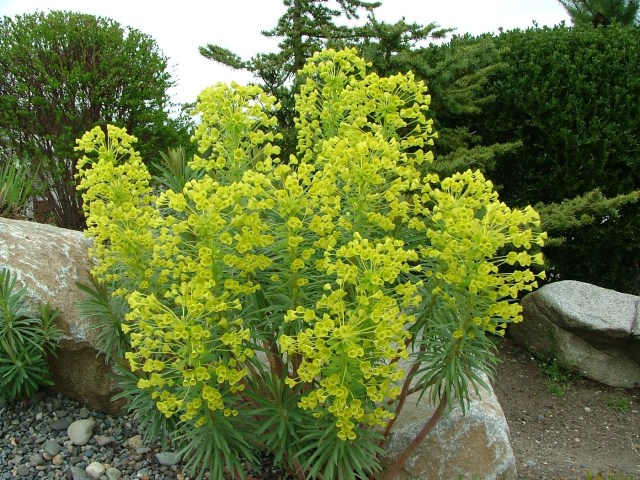
Euphorbia characias sub species 'Wulfenii'

Euphorbia characias sub species wulfenii

A bit like Marmite, gardeners  seem to either love or hate Euphorbia (Spurge) – I love them!

This is a large genus of over 2,000 species, including annuals,perennials as well as shrubs and succulents. They originate from many different parts of the world and as a result their growing requirements differ widely. They include the red-leaved species commonly seen at Christmas, Euphorbia pulcherrima (Poinsettia)

Euphorbia pulcherrima (Poinsettia)

Euphorbia pulcherrima (Poinsettia)

Some are evergreen and hardy, others are semi evergreen or deciduous. Nearly all species have distinctive ‘cyathia‘- small cups of long – lasting bracts that can be green, yellow, red, brown or purple. These are ‘cupping nectaries’ containing insignificant flowers with much reduced parts. In the perennials and shrubs these cyathia are carried in dense clusters. The leaves are very varied  and often are shed quite quickly.

Some species are very invasive and are not really suitable for the garden (e.g. E. cyparissias and E. pseudovirgata) others will self seed prolifically so need to be used with care (e.g. E. lathyris, E. hybernia,E.coralloides and E.wallichii). Some species can be invasive in some climates (e.g. E. myrsinites in parts of the USA) but are less problematic in milder, wetter places.

Euphorbia cyparissias (Cypress Spurge)

Euphorbia cyparissias (Cypress Spurge)

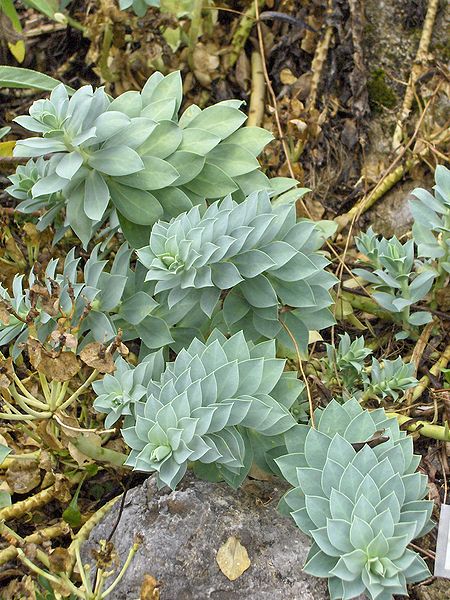
Euphorbia myrsinites

Euphorbia myrsinites

All Euphorbias resent disturbance, so siting them carefully from the start is important for long lasting plants. Euphorbia suit every situation from desert to bog, formal courtyard to wild woodland. With a couple of  exceptions Euphorbia are easy to grow. They are also look great in the garden, the colourful bracts lasting many weeks.

Euphorbia look best if allowed to sprawl at will, but if space is limited, you may need to support the floppier ones.

The evergreens require no routine pruning – simply tidy them up when they start to look untidy. Deciduous ones should be cut down to ground level in autumn. New shoots will emerge from the crown in spring. The biennial forms such as E. characias produce new shoots from the base each year. Cut out dead stems in winter. They are not fussy as to soil, but most prefer good drainage.

The bigger, more sculptural forms look good with architecture – against steps or walls, or in corners of courtyards. E. mellifera is a superb statement plant. E. myrsinites can be used in raised planters to sprawl over the sides. E. griffithii ‘Fireglow’ looks great beside water, with bronzy Rodgersias and red-flushed Astilbes, but will also look good in a hot border, while E. ‘Whistleberry Garnet’ associates well with ferns, Hostas and the dark-patterned leaves of Geranium phaeum.

All parts of Euphorbia are useful in flower arranging either in the fresh or dried state.

However all Euphorbia are poisonous and bleed a skin irritant milky sap, whereas the flowers are highly allergenic, so be careful when cutting or handling these wonderful plants.

Euphorbia polychroma

Euphorbia polychroma

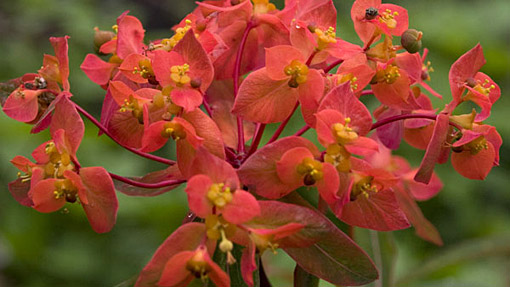
Euphorbia griffithii 'Fireglow'

Euphorbia griffithii ‘Fireglow’

Euphorbia characias sub species 'Wulfenii'

Euphorbia characias sub species wulfenii

Further information:

National Collection of hardy Euphorbias

Growing Euphorbias

Euphorbia pulcherrima (Poinsettia)

Common varieties

Wikipedia

Old School Gardener

If you’ve enjoyed reading this post and others on this blog, why not comment and join others by signing up for automatic updates via email (see side bar, above right ) or through an RSS feed (see top of page)?

Finding Nature

Nature Connectedness Research Blog by Prof. Miles Richardson

Norfolk Green Care Network

Connecting People with Nature

Discover WordPress

A daily selection of the best content published on WordPress, collected for you by humans who love to read.

Susan Rushton

Celebrating gardens, photography and a creative life

Unlocking Landscapes

Writing, photography and more by Daniel Greenwood

Alphabet Ravine

Lydia Rae Bush Poetry

TIME GENTS

Australian Pub Project, Established 2013

Vanha Talo Suomi

The Journey from Finnish Rintamamiestalo to Arboretum & Gardens

Marigolds and Gin

Because even in chaos, there’s always gin and a good story …

Bits & Tidbits

RANDOM BITS & MORE TIDBITS

Rambling in the Garden

.....and nurturing my soul

The Interpretation Game

Cultural Heritage and the Digital Economy

pbmGarden

Sense of place, purpose, rejuvenation and joy

SISSINGHURST GARDEN

Notes from the Gardeners...

Deep Green Permaculture

Connecting People to Nature, Empowering People to Live Sustainably

BloominBootiful

A girl and her garden :)