Latest Entries »

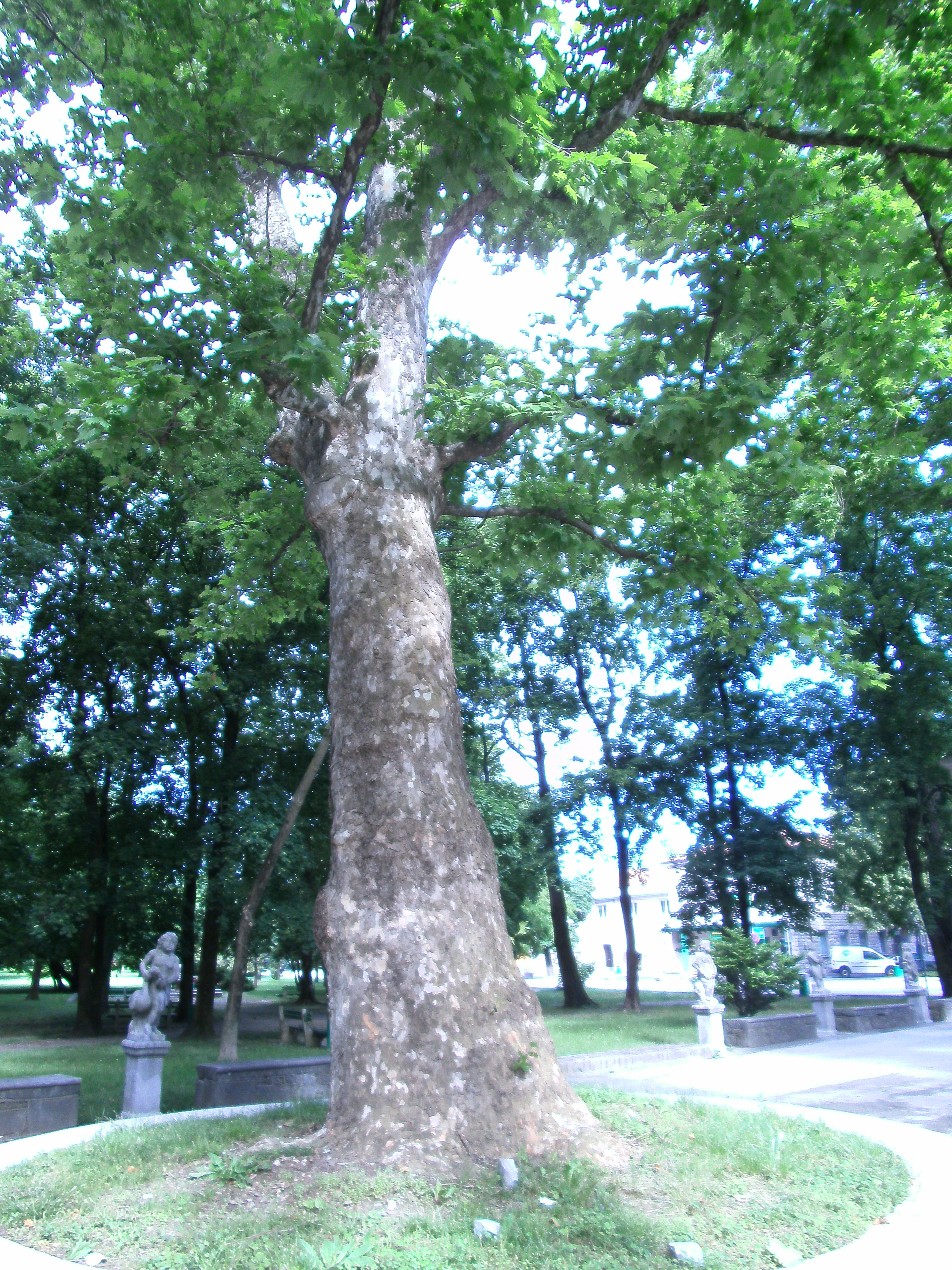
So, what is a putto?

Tamara Jare's avatarMy Botanical Garden

ImageImageImageImageImageImageImageImageImage It was in the middle of winter when Nigel (Old school garden ) was asking me about historical gardens in my country. Dear Nigel, I have not forgotten I only haven’t found the right one My Botanical Garden could present-till now! But this one is just perfect, listen to  the story:

A.D. 1763

Count Lanthieri enters his room, with handful of first cherries from the valley. Crop is good this year, God knows how will the  wine be. Anno Domini 1762 was a good year. Extensive family vineyards, dominating the valley, gave exquisite wine, it was sold to Venice, Rome, Vienna, Luwigana. And the palace was renovated, garden was redesigned, all in baroque manner. Count opens the window overlooking  the garden, his glance slowly glides along the long garden axis. He is expecting guests from Luwigana today. Before they come, he will have a walk down in the garden…

View original post 241 more words

PicPost: Ready to pop

shinealightproject's avatarShine A Light

Trying to choose a topic to write my blog about is sometimes challenging, but at other times it’s a handed to me on a plate….or should I say in a crate! (Bad pun I know…)

Last week we opened crate 22 (number 8 to have been opened)… and we were greeted by lots of cots and commodes! A few weeks ago we also found some pall bearers and a coffin template …which I think neatly encapsulates the cycle of life…and death… and as you can see gave me the idea for this week’s blog title!

After opening the crate and some initial record checking we found that some of the cots and commodes had previously belonged to the workhouse at Pulham Market in Norfolk. Being based in the grounds of Gressenhall Farm & Workhouse (built in 1775), we at the superstore found this is particularly relevant and poignant.

View original post 546 more words

 Close up of strong wind break netting

Close up of strong wind break netting

No, not a reference to too many sprouts, but a serious question from L. Onerf in Somerset:

‘Vegetables are not growing well in my windy garden, but I am reluctant to plant windbreaks of trees or hedges, as they will create shade and take moisture from the soil. What alternatives are there?’

If you want to avoid the costs of installing a fence/trellis with openings to allow the wind to percolate through at an acceptable speed, I think the answer lies in putting in a screen of synthetic wind break material, obtainable from most garden centres or online. The strength and quality of this varies and some is fairly costly, but a 1.5- 1.8 metre high wind break around your plot would give dramatic results. I found a 50 metre x 2 metre roll of knitted net on offer online for around £170 or much the same on Ebay for about £40, and £13 for a 10 metre length. Make sure the posts are anchored firmly in the ground (corner posts may need to be reinforced and they should ideally be bedded in concrete), as the netting takes a tremendous strain in high winds.

On the subject of vegetable or kitchen gardens, is yours laid out for maximum efficiency and growing space?

Traditionally vegetables were grown in large plots, often 6-9 metres wide and as long as the garden allowed. The vegetables were arranged with a lot of wasted space between rows. Today we know that vegetables can be grown far closer together without any adverse effects; indeed, there is a a trend towards abandoning rows and growing vegetables with equal spacing between the plants in each direction, in blocks or patches.

Narrow beds in the Kitchen Garden at Old school Garden

Narrow beds in the Kitchen Garden at Old School Garden

This compactness lends itself to smaller, narrower beds, say 0.9 – 1.5m wide, which can be any length you like. These narrower beds are easier to manage from either side (so avoiding walking on the bed itself and opening up the possibility and benefits of ‘no dig’ cultivation) and the denser planting also helps to crowd out weeds. here at Old School Garden, my kitchen garden ahs been laid out along these lines, though I still have a one large bed which I’ve effectively split into two by creating a ‘boardwalk’ path out of old pallets.
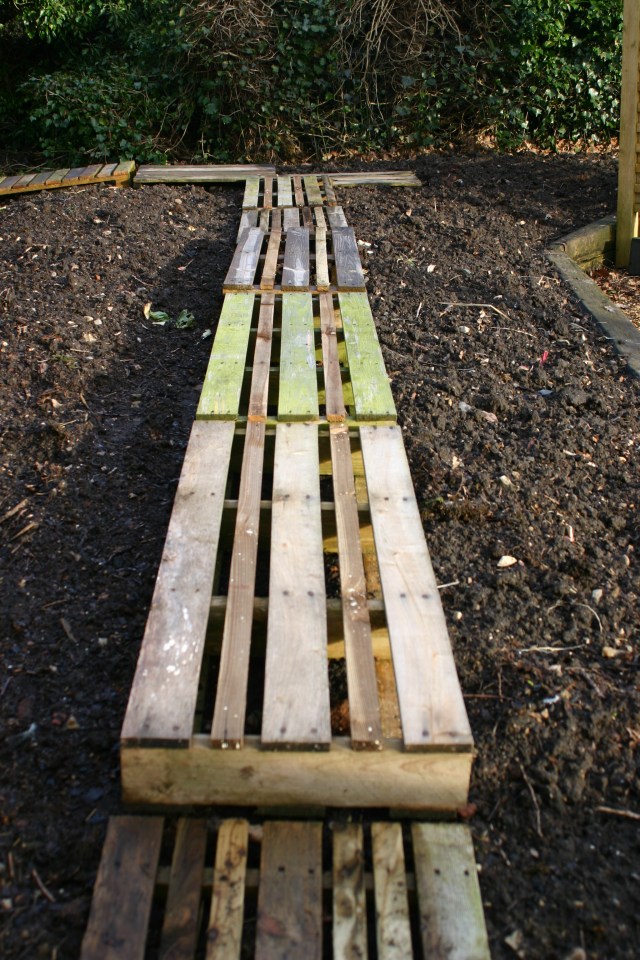
New boardwalk made of old wooden pallets

Boardwalk made of old wooden pallets, used to split a large veg bed into two

Do you have any gardening questions I might help you with? If so, please email me: nbold@btinternet.com

Old School Gardener

If you’ve enjoyed reading this post and others on this blog, why not comment and join others by signing up for automatic updates via email (see side bar, above right ) or through an RSS feed (see top of page)?

PicPost: Never Grow Up

‘We don’t stop playing because we grow old; we grow old because we stop playing.’

photo via Play England

All about the leaves- Fatsia japonica

All about the leaves- Fatsia japonica

This latest  ‘snippet on style’  focuses on leaves. You might think that gardens designed around leaves would be boring. Not a bit of it. Foliage comes in all shapes, sizes and many colours (or shades of green). With the occasional splash of floral colour and other focal points thay can provide a  wonderfully soothing, and sometimes exotic air.  Foliage gardens are typified by the use of leaf and plant texture and shapes as well as subtle variations in leaf colour to provide interest, rather than floral display at different times of the year, which tends to drive other garden styles or at least their planting plans.

Sometimes the whole garden is about foliage, punctuated with flower or other colour (for example The Exotic Garden in Norwich – see link below). Sometimes specific areas in a larger garden are devoted to foliage, with the emphasis on contrasting varieties and plant forms. These gardens are typically organic in shape, with no hard edges and informal in layout and feel. They can also feature items such as sculpture or garden furniture made out of rustic materials and used as focal points set off against the foliage. Other key features of foliage gardens include:

  • Bold foliage

  • Colourful highlights

  • Pools and reflections

  • Containers

  • Locally sourced, rough materials

  • Height and structure

Links:

Other articles in the ‘Style Counsel’ series:

Family Gardens

Productive Gardens

Japanese Gardens

Country Gardens

Modernist Gardens

Formal Gardens

Mediterranean Gardens

Cottage gardens

Old School Gardener

If you’ve enjoyed reading this post and others on this blog, why not comment and join others by signing up for automatic updates via email (see side bar, above right ) or through an RSS feed (see top of page)?

deltagardener's avatarThat Bloomin' Garden

Have you ever created a miniature garden? If not, here is a fun activity you can do with your children over the summer holidays. When I did this project with the grade three class, the teachers said that this was the most fun the children had all year. Creating miniature gardens lets the children use their imaginations. So what is a miniature garden? It is generally one that uses dwarf or miniature plants and replicates a scale model of our own gardens. Miniature gardens can be created in the ground or in containers and can be kept both inside and outside. It just depends on personal taste. This is a good project to teach children about scale.

miniature garden

The photo above is one of my first miniature gardens. I try to create my gardens using found items and thrift shop treasures. You can buy miniature garden kits as well.

miniature gardens

This year…

View original post 878 more words

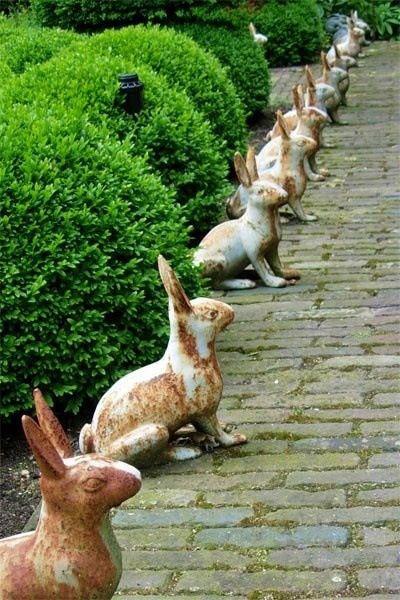
PicPost: Hare Raising

Spring-lawnA grass -free ‘Floral Lawn’ has been opened today in Avondale Park, West London. It’s plants, which include daisies, red-flowering clover, thyme, chamomile, pennyroyal and Corsican mint, create a “pollinator-friendly patchwork” – with 25% more insect life than that found in “traditionally managed grass lawns”.

The Royal Borough of Kensington and Chelsea commissioned the biodiverse floral lawn from Lionel Smith, a Royal Horticultural Society (RHS) sponsored PhD student, and RBKC’s gardening team. It is the first time that a public park has featured this new form of lawn.

Planting a public space with specially selected and researched plants will give Lionel a valuable insight into how the public will react to this non-traditional lawn. Previously all his research has been on experimental plots at Reading University. The idea has prompted questions about ‘just what makes a lawn a lawn’. Lionel says:

“Lawns are normally associated with closely trimmed grass but mine are, I believe, entitled to be called that too. They are not only beautiful and easy to maintain but also environmentally friendly. It will be interesting to see how visitors to Avondale Park, where this public trial sward is to be being planted, will react. I hope to get some feedback as part of my research.”

Traditional grass lawns, if regularly mown,  might look good, but have you thought about:

  • how they provide a pretty sterile living environment for insects and other critters?
  • how demanding they can be in terms of water, fertiliser, weedkiller, and energy use?

What do you think about this? Have you got a traditional grass lawn in your garden or have you turned it (or some of it) over to wild flowers or other uses? Should we turn over more areas of traditional grass lawn in public parks and spaces into grass- free or more diverse habitats? I’d love to hear your views!

Further information:

BBC News report and video

‘Rethinking the traditional grass lawn’ -blog article by Lionel Smith

Old School Gardener

If you’ve enjoyed reading this post and others on this blog, why not comment and join others by signing up for automatic updates via email (see side bar, above right ) or through an RSS feed (see top of page)?

Finding Nature

Nature Connectedness Research Blog by Prof. Miles Richardson

Norfolk Green Care Network

Connecting People with Nature

Discover WordPress

A daily selection of the best content published on WordPress, collected for you by humans who love to read.

Susan Rushton

Celebrating gardens, photography and a creative life

Unlocking Landscapes

Writing, photography and more by Daniel Greenwood

Alphabet Ravine

Lydia Rae Bush Poetry

TIME GENTS

Australian Pub Project, Established 2013

Vanha Talo Suomi

The Journey from Finnish Rintamamiestalo to Arboretum & Gardens

Marigolds and Gin

Because even in chaos, there’s always gin and a good story …

Bits & Tidbits

RANDOM BITS & MORE TIDBITS

Rambling in the Garden

.....and nurturing my soul

The Interpretation Game

Cultural Heritage and the Digital Economy

pbmGarden

Sense of place, purpose, rejuvenation and joy

SISSINGHURST GARDEN

Notes from the Gardeners...

Deep Green Permaculture

Connecting People to Nature, Empowering People to Live Sustainably

BloominBootiful

A girl and her garden :)