Latest Entries »

Liz's avatarGwirrel's Garden

This week’s photo challenge is window… I’ve chosen a photo which symbolises where I wish I was right now. It’s no metaphor for my life, just simply I wish I was somewhere hot and sunny but I have another 9 months to wait.

So where would I rather be? The above photo was taken from the Torre de Belém in Lisbon, a tower built in the 18th century as part of the defence system at the mouth of the Tagus river. This window looks toward the Padrão dos Descobrimentos; Monument to the Discoveries, celebrating the Portuguese “Age of Discovery” during the 15th and 16th centuries.

Copyright 2013 Liz.
All rights reserved. Content created by Liz for Gwirrel’s Garden/a>
View original post

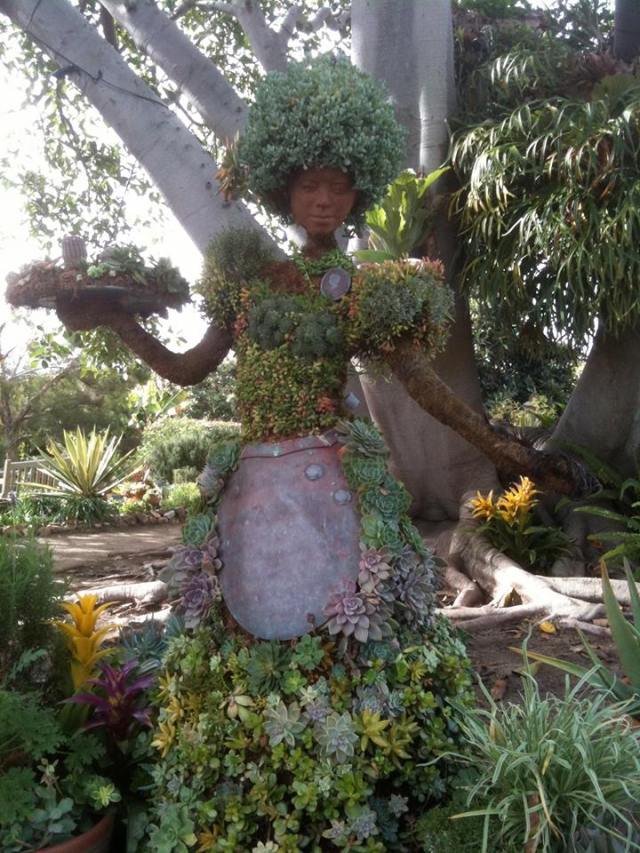
PicPost: Seductive and Succulent

Rethinking Parks

Brooklyn Bridge Park, New York, USA

‘Over the next two years, Nesta, The Heritage Lottery Fund and The Big Lottery Fund will back a small number of pioneering innovations, with a focus on finding the new business models that will enable our parks to thrive for the next century.

For example, what if parks made the most of temporary installations to generate income – like open air cinemas, food festivals or art showcases? What if communities took on the maintenance of parks, or real-time user data from smartphones was used to inform maintenance regimes? 

If you’ve got an idea to reimagine the way your local park is used, maintained or run, we want to hear from you.’

The Garden- man made artifice?

‘Let us, then, begin by defining what a garden is, and what it ought to be. It is a piece of ground fenced off from cattle, and appropriated to the use and pleasure of man: it is or ought to be, cultivated and enriched by art, with such products as are not natural to this country, and consequently, it must be artificial in its treatment, and may, without impropriety, be so in its appearance; yet, there is so much of littleness in art, when compared with nature, that they cannot be well blended; it were, therefore, to be wished, that the exterior of a garden should be made to assimilate with park scenery, of the landscape of nature; the interior may then be laid out with all the variety, contrast, and even whim, that can produce pleasing objects to the eye.’

Humphry Repton- ‘Observations on the Theory and Practice of Landscape Gardening’, 1803

Hmmm. what do you think? Repton’s advice about blending the edges of a garden with it’s surrounding landscape has become a tenet of garden design, but what about his words on making the garden itself a clearly ‘man made’ feature? Is the phrase ‘natural garden’ a contradiction in terms?

Old School Gardener

PicPost: Plant Pallette

Brigid Jackson's avatararistonorganic

In keeping with the organic gardening concept, it is always preferable to seek natural solutions to garden problems such as pests and common diseases.. Should you have any ideas to share on this topic please send them to us for passing on to others.

Please also note that dish-washing liquid is called for in most of these ‘recipes’. It serves as a ‘wetter’ enabling the liquid solution to adhere to the plant for maximum effect. The environmentally friendly non-toxic dish-washing liquid is ideal for this purpose. snail

Insect Spray Concentrate

This is an all-purpose natural insecticide.

  • · 3 unpeeled garlic cloves 1 tablespoon dish-washing liquid
  • · 3 teaspoons of liquid paraffin 2 cups of hot water

In a small bowl, crush garlic heads and add paraffin. Leave to stand for 24 hours then add the dish-washing liquid to the mixture.

Sieve the mixture, discard the solid bits and store the liquid…

View original post 354 more words

Verbascum 'Kynaston'

Verbascum ‘Kynaston’

A genus of over 350 species, Verbascums are native to Europe, North Africa and Asia. Most of the species are biennial, though there are some annuals, perennials and sub shrubs and a few evergreens.

The perennials are often short-lived, dying after flowering, though they (like all species) are prolific self seeders. Verbascums mostly grow on open scrubland or dry hillsides, though some are found in open woodland. They like a sunny position with sharply drained soil.

Verbascums generally form a basal clump or rosette of leaves, these usually being large, soft and simple in shape, some with lobed or toothed edges. They produce one or a few spikes of flowers- these are densely packed and with saucer-shaped flowers. The flowers are individually short-lived, but are borne successively over along growing season. Flowers on hybrid cultivars are larger and showier.

Many Verbascums (or ‘mulleins’) grow quite tall (up to 3 metres) and need to be staked. Seedlings of named varieties will not grow true to their host, so these should be deadheaded before shedding their seed if you want to avoid a mixture of flower colours. The cultivars  ‘Gainsborough’, ‘Letitia and ‘Pink Domino’ have gained the Royal Horticultural Society’s ‘Award of Garden Merit’. Since the year 2000, a number of new hybrid cultivars have come out that have increased flower size, shorter heights, and a tendency to be longer-lived plants and a number have colour ranges not typical of the species.

Larger species can be left to naturalise in gravel or wild gardens, where they make impressive architectural plants, and will benefit from the support of adjacent plants. Smaller types are good in rock gardens, screes, or even walls. All Mulleins can be prone to mildew.

Vita Sackville-West wrote in 1936 that her Verbascums looked as though “a colony of tiny buff butterflies had settled all over them”. She described the colourings as “dusty, fusty, musty”. Verbascums have not changed much since then. The Cotswold Group about which she was writing are still grown, and there are others – for example ‘Megan’s Mauve’, and the new variety, ‘June Johnson’ – in which purple and apricot have become interwoven.

Verbascums make good partners for old roses (which they succeed in flower); in groups of plants with rounded or vase-shaped form to provide a contrast; or (where they are white-flowered) placed in front of softly coloured Hydrangeas.

Apart from propagation by seed, replacement plants can easily be grown from root cuttings. In March, scrape soil away from the roots area, take a knife and sever two or three fat, strong roots. Cut these into 4cm lengths and set them upright, individually, in small pots of potting soil with plenty of perlite mixed in. After three months in a frame and kept watered, each will have grown into a new plant.

Sources and further information:

Wikipedia

Verbascum.org

Growing Verbascums- Daily Telegraph

Plant guide- Fine Gardens

Rosy Hardy’s blogspot

Verbascum dumulosum- Kew Gardens

Old School Gardener

Tim Gill's avatarRethinking Childhood

Gate locked with chain Public play facilities have suffered huge cuts in the last 3 years. New data shows that spending by English local authorities fell by nearly 40 per cent between 2010 and 2013. Revenue spending has been even more badly hit, falling by over 60 per cent. As a result, almost one in three councils have closed at least one play facility.

View original post 680 more words

Finding Nature

Nature Connectedness Research Blog by Prof. Miles Richardson

Norfolk Green Care Network

Connecting People with Nature

Discover WordPress

A daily selection of the best content published on WordPress, collected for you by humans who love to read.

Susan Rushton

Celebrating gardens, photography and a creative life

Unlocking Landscapes

Writing, photography and more by Daniel Greenwood

Alphabet Ravine

Lydia Rae Bush Poetry

TIME GENTS

Australian Pub Project, Established 2013

Vanha Talo Suomi

The Journey from Finnish Rintamamiestalo to Arboretum & Gardens

Marigolds and Gin

Because even in chaos, there’s always gin and a good story …

Bits & Tidbits

RANDOM BITS & MORE TIDBITS

Rambling in the Garden

.....and nurturing my soul

The Interpretation Game

Cultural Heritage and the Digital Economy

pbmGarden

Sense of place, purpose, rejuvenation and joy

SISSINGHURST GARDEN

Notes from the Gardeners...

Deep Green Permaculture

Connecting People to Nature, Empowering People to Live Sustainably

BloominBootiful

A girl and her garden :)