Latest Entries »

Seasons

A fascinating photo log of an elderly couple standing in the same position in their cottage garden through the seasons…. and with a touching end pic….

Old School Gardener

A beautiful video of the world’s varied landscapes and life forms.

Brigid Jackson's avatararistonorganic

View original post

HowardJones's avatarOuse Washes: The Heart of the Fens

LogosAn exciting event is coming your way soon: On Sunday 6 April will see the Ouse Washes Experience.

This is a brand new event, which will be held in the heart of the Ouse Washes Landscape Partnership scheme area.

The Ouse Washes Experience: a sponsored run or cycle ride

This event is organised by the Ely Hereward Rotary Club, in close co-operation with the OWLP scheme, Cambridgeshire ACRE, Mepal Outdoor Centre, RSPB, Environment Agency, Cambridgeshire County Council and Cambridgeshire Police.

The idea is that all participants will either run or cyclealong the Ouse Washes between Mepal and Welney, for either 4 or 9.6 miles (6.4 or 15 km), that is from Mepal until the Welches Dam/RSPB Ouse Washes reserve, or until the end in Welney village.

New Picture (11)

See the Ouse Washes close up – all abilities are welcome

Cyclist and runners of all ages and abilities…

View original post 563 more words

close up of Xerochrysum bracteatumAs you might guess there aren’t that many plants beginning with ‘X’, but Xerochrysum is an interesting genus of around 6 or 7 species of short- lived perennials and annuals which are native to open grassland and scrub in Australia.

The stemless lance – like leaves are hairy. The flowers are dasiy like with papery white, yellow or pink bracts and a central disc of, often, yellow florets. The perennials can be used to fill in gaps in herbaceous borders and low – growing cultivars are suitable as edging or for containers.

The name Xerochrysum comes from Greek xeros meaning “dry” and chrysos meaning “gold” (this refers to the common yellow papery bracts that occur within the genus).

X. bracteatum is often grown for its cut and dried flowers and it self seeds freely. Also known as the “Golden Everlasting”, this is one of the best known of the “paper daisies” as it is a very widespread species occurring in both annual and perennial forms. It varies in habit from prostrate to a shrubby plant of about 1m in height. The leaves are usually large (up to 100mm long) and green to grey-green in colour. The individual flowers are very small but are formed into a large cluster surrounded by large papery bracts. The overall appearance is that of a large, single “flower” with the bracts as the “petals”. However, well over a hundred true flowers occur inside the ring of bracts.

The ‘golden everlasting’ has been cultivated for many years and a number of forms have been selected for cultivation. These include several which have resulted from both chance and deliberate hybridisation. Some examples are:

  • “Diamond Head” – perennial; green foliage, 0.2m x 0.5m. Yellow flowers

  • “Dargan Hill Monarch” – perennial; grey leaves, 0.8m x 1m. Yellow flowers

  • “Cockatoo” – perennial; similar to “Dargan Hill Monarch”, pale yellow bracts around a head of small orange flowers

  • “Princess of Wales” – perennial; similar to “Dargan Hill Monarch” but more compact (0.6m x 0.6m). Yellow flowers

  • “Kimberley Sunset” – perennial; grey leaves, 0.8m x 1m. Pink flowers

In addition, breeding work in Europe and Australia has produced annual forms with an outstanding range of colours – yellow, red, purple, orange. These are excellent for a massed, colourful display. Most forms are suited to cultivation in many areas. The annual forms can be purchased in packets from a number of commercial suppliers and established as instructed on the packs.

Perennial forms are usually quick growing in a sunny, well drained position. They benefit from a regular light pruning annually to encourage branching and a greater number of flowers. Severe pruning to overcome “legginess” may be successful but only as a last resort.

Golden everlasting responds well to annual fertilising, usually with a slow-release type and appreciates an assured water supply. The plants vary in their ability to withstand frost but most are at least moderately frost resistant.

Propagation of X.bracteatum from seed is easy; no pretreatment is required. Propagation from cuttings is also fairly easy and is the only way that named cultivars should be propagated.

Xerochrysum is half hardy to frost hardy and should be grown in moderately fertile, moist but well-drained soil in full sun. Those cultivars which reach 90 cms or more need staking. They can be propagated from seed in the spring. they might susceptible to downy mildew.

These very popular plants bring long-lasting colour and warmth into the garden. There are many cultivars available in nurseries with flowers varying from white through cream, lemon, canary yellow, gold and bronze. Many of the pink varieties are the result of plant breeding, most probably using South African species as this colour is very uncommon in Australian plants.

They will keep producing flowers particularly if spent flowers are continually removed. Butterflies and other insects love them and will flock to your garden adding another layer of interest. They are also excellent as dried flowers keeping their shape and colour well for years – just hang a bunch up-side-down in a dark airy place and let them dry for a few weeks.

Sources and further information:

Australian Native Plants Society

Wikipedia

Growing Xerochrysum bracteatum-RHS

Old School Gardener

Open Ended Spaces

‘Loose parts play’ is a well known term to describe play that is not prescribed, but enables children to use ‘stuff’ to make their own play world. This interesting blog extends that concept into ‘open ended spaces’, where the design is ambiguous, but full of play possibilities. I try to include such spaces when designing playful landscapes – click on the ‘playful landscapes’ category on the right for some examples.

Old School Gardener

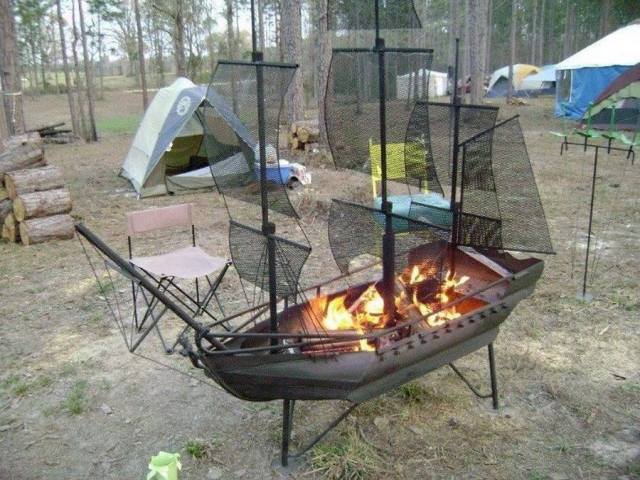
PicPost: Fire Ship

How about this for a garden fireplace, or maybe a centre piece in a natural play setting?

Old School Gardener

canwefeedtheworld's avatarOne Billion Hungry: Can We Feed the World?

ID-10035220When discussing global food security, the issues of access and availability commonly come up.  As One Billion Hungry examines, we currently produce enough food to feed the world, although demand is rapidly outpacing supply as populations and incomes rise and as the impacts of climate change escalate, and yet almost 900 million people do not get enough food to eat. Increasing food production, while critical, is unlikely to solve hunger and malnutrition alone. A new report by the Global Harvest Initiative highlights the importance of trade to food security, examining how our global trade systems can and must change to serve the whole of the population.

Coming at a particularly relevant time, following the success of the Bali trade talks and with negotiations for several bilateral trade agreements underway, the report, International Trade and Agriculture: Supporting Value Chains to Deliver Development and Food Security, was developed by GHI in…

View original post 499 more words

Hedgehog Survey- Can You help?

photo by Hedgehog Champion Mark Sant

‘2014 Hibernation Survey

We need your help to collect hedgehog records from 1st February until 31st August 2014.

Simply tell us every time you see a hedgehog, noting its location and whether it is alive or dead…..’

Click on the link above for more information

Old School Gardener

Finding Nature

Nature Connectedness Research Blog by Prof. Miles Richardson

Norfolk Green Care Network

Connecting People with Nature

Discover WordPress

A daily selection of the best content published on WordPress, collected for you by humans who love to read.

Susan Rushton

Celebrating gardens, photography and a creative life

Unlocking Landscapes

Writing, photography and more by Daniel Greenwood

Alphabet Ravine

Lydia Rae Bush Poetry

TIME GENTS

Australian Pub Project, Established 2013

Vanha Talo Suomi

The Journey from Finnish Rintamamiestalo to Arboretum & Gardens

Marigolds and Gin

Because even in chaos, there’s always gin and a good story …

Bits & Tidbits

RANDOM BITS & MORE TIDBITS

Rambling in the Garden

.....and nurturing my soul

The Interpretation Game

Cultural Heritage and the Digital Economy

pbmGarden

Sense of place, purpose, rejuvenation and joy

SISSINGHURST GARDEN

Notes from the Gardeners...

Deep Green Permaculture

Connecting People to Nature, Empowering People to Live Sustainably

BloominBootiful

A girl and her garden :)