
Latest Entries »
 After leaving Emmetts Garden on our way home from Sussex last week, we also stopped off to see a place that I’ve wanted to visit for a long time- Red House, in Bexleyheath, London. The house and garden designed by Philip Webb with fellow Arts and Crafts man William Morris, is a wonderful monument to all that exuberant artistic endeavour of the mid and later 19th centuries.We had a stimulating guided tour of this lovely house and garden that has been a major influence on English architecture and garden design.
Part reaction to the impact of industrialisation, part a response to its social consequences, William Morris and the movement- which had close ties to the Pre Raphaelite Brotherhood and early socialist thinkers- have perhaps become most closely associated with floral prints in wallpaper and fabric. I hold my hands up- we are definite fans and have some Morris designs in the Old School.

Southover Grange Gardens, Lewes, Sussex, recently
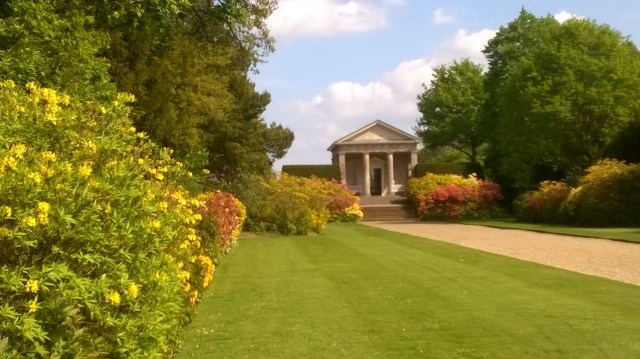 I think it must be three weeks since I was last at Blickling. I got a chance to look around at the end of my working session and there were several highlights I hadn’t seen before, most notably the Azaleas round the Temple, the wall-trained Wisterias, the masses of Forget-me-Nots and Honesty in the Dell and some of the colour combinations in the double borders; especially the Tulip ‘Queen of Night’ and the black foliage of Mongo Grass and Black Elders.

The double borders….


My fellow volunteers were bit thin on the ground this week, and the gardening team pretty much seemed to be tied up in interviews all day, so we were left to our own devices! But the task was simple, weeding in the rose borders in the main Parterres. I went to work with my hoe (I really enjoy this task) and though the borders were pretty clear, there were a few odd weeds (including patches of Oxalis which the other volunteers dug up) and some edging of the grass to be done.

The Parterres and…

rose borders with Nepeta
The session was punctuated with chats to vistors who were very complimentary about the gardens. One couple from Bury St. Edmunds envied us the light soil we have in this area- they have to tackle thick clay.
Head Gardener Paul informed us that the National Trust Gardens advisor had recently visited and was full of praise for the gardens and what the whole team had achieved; that was good to hear.
Work in the Walled Garden has continued with the hard core for the main paths being laid and consolidated. The next job is installing 800 metres of metal edging- I don’t envy the Team that job!
Further Information:
Blickling Hall website
Blickling Hall Facebook page
A 360 degree tour of Blickling Hall
Old School Gardener

The chalk cliffs at Rottingdean, recently.
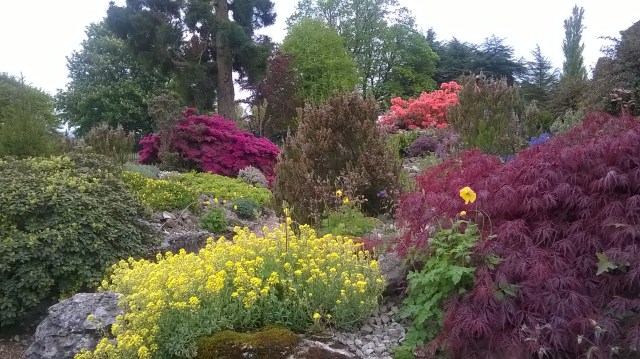 On our way home from Sussex last week, we manged to call in on two other National Trust properties. The first was Emmetts Garden, near Sevenoaks, Kent.
Though situated in a commanding hillside location, the garden is tucked away a bit, but we eventually found it after some tortuous lanes and slippery hill climbs! Our stay was short,but the garden didn’t disappoint- masses of spring interest, including a very attractive rockery with plenty of alpines on display. The Rhododendrons, Azaleas and Bluebells were also looking superb in the bright sunshine.
Wikipedia describes the gardens:
‘Emmetts Garden was open farmland until 1860 when the present house was built. The name ’emmett’ is a local word for ant and refers to the giant anthills that covered the area until the 1950s. The house and land was purchased in 1890 by Frederic Lubbock, a banker and passionate plantsman. Lubbock’s elder brother was John Lubbock, 1st Baron Avebury, coincidentally a world expert on ants, which may have influenced his decision to purchase the property.
The gardens were initially laid out between 1893 and 1895 under the influence of Lubbock’s friend William Robinson in the fashionable Edwardian style popularised by Gertrude Jekyll. The shrub garden was added later in 1900-1908.
After Lubbock’s death (1927), the estate was acquired by an American geologist Charles Watson Boise. He made various alterations to both house and garden but retained the original character of the gardens…
The garden, which covers an area of about six acres (approximately 2.5 hectares), occupies a commanding site on a 600-foot (180 m) sandstone ridge, overlooking the Weald. One of the highest points in Kent, it offers expansive views towards the North Downs.
It is mainly planted with trees and shrubs in the form of an arboretum; a magnificent 100-foot (30 m) Wellingtonia fortunately survived the Great Storm. There is also a rose garden located next to the Victorian house to which the gardens once belonged.’
Further information: National Trust website
Old School Gardener

Four gulls on a groyne, Rottingdean, recently.
 Another trip out and another chance to visit some interesting and inspiring gardens last week. We travelled to see friends in Sussex and our lunch time stop was Knole near Sevenoaks, Kent, a large estate still owned by the Sackville family (of Vita fame) and part run by the National Trust. We were very lucky because we tipped up on a Tuesday, when the private Sackville gardens are open to the public, and we availed ourselves of a very engaging guided tour…
Beginning in the classical orangery, the tour wound its way around a fascinating garden, with some highlights to savour; the longest Wisteria on a wall outside China; the longest ‘Green Alley’ circumnavigating the walls of the garden; a champion fastigiate Oak tree and some wonderful azaleas with eye popping colour.
The house- a splendid mix of architectural styles- is undergoing some major alterations, but the grounds and gardens are breathtaking. Wikipedia describes the estate:
‘a 1,000-acre (4.0 km2) park, within which the house is situated. Knole is one of England’s largest houses, the National Trust attribute a possibility of its having at some point been a calendar house which had 365 rooms, 52 staircases, 12 entrances and 7 courtyards. Its grade I listing reflects its mix of Elizabethan to late Stuart structures, particularly in the case of the central façade and state rooms. The surrounding deer park has also survived with little having changed in the 400 years since 1600 although its formerly dense woodland has not fully recovered from the loss of over 70% of its trees in the Great Storm of 1987….
As a walled garden, Knole’s is very large, at 26 acres (11 ha) (30 including the ‘footprint’ of the house) and as such is large enough to have the very unusual — and essentially medieval feature of a smaller walled garden inside itself (Hortus Conclusus). It contains many other features from earlier ages which have been wiped away in most country-house gardens: like the house, various landscapers have been employed to elaborate the design of its large gardens with distinctive features. These features include clair-voies, a patte d’oie, two avenues, and bosquet hedges.‘
 Further information: National Trust website
Old School Gardener
 My friend Les sent me this link to an item on BBC News, which makes for interesting, if not surprising and worrying reading…
Old School Gardener

Fishermen on a groyne at Rottingdean, Sussex recently…
 Here’s a link to a nice little film about this project which my Master Gardener friend Steve has helped to set up and develop. A great example of the generations working with each other.
Steve has run many growing sessions that bring together old and young members of the community for their mutual benefit. He played a key role in establishing the Project in autumn 2011 with children from Catton Grove Primary School, older volunteers from Age UK, and staff from Mile Cross library, Norwich.
As well as learning about growing food in a sustainable manner, the project helps older people enhance their social contact and sense of purpose, and provides children with mentoring and adult role models. Steve recalls,
“I delivered a presentation at Catton Grove School for the kids (yrs 4 and 5), teachers, and residents from sheltered housing close to the Library. There were 30-40 kids present and 7 potential volunteers. From that we got a few design ideas and a list of vegetables, herbs and flowers that they’d most like to grow.”






 Old School Garden