Archive for April, 2016


lal304195When choosing a tree for a garden, take care; a large tree in a small garden will lead to problems in years to come. It will dominate the garden and put it in shade. So, unless you have a large garden, avoid large ornamentals, such as Cedars, the Tulip Tree (Liriodendron tulipifera) or Prunus ‘Kanzan’, and woodland trees, such as Oak, Beech and Horse Chestnut.

Of course you may ‘inherit’ trees planted some time ago, or as here at Old School Garden, ‘allowed to grow’. We had to have some serious tree surgery done to a huge Black Poplar that was getting too big for its boots a couple of years ago. I have an aerial photo of the house and garden taken in 1965 in which you can see the young tree just starting on its life journey. After having its crown and sides trimmed it must still be 45 feet tall and about as broad. I’m also contemplating some more surgery (possibly completely felling) two Oaks that have grown up on our boundary with our neighbours and throw a lot of shade which is causing a lot of moss growth on one roof slope of the house.

Even when you choose a tree that’s suitable in terms of it’s above ground size, don’t forget the impact that the roots might have.

If tree roots are a potential problem, restrict their growth by using thick polythene or a polypropylene membrane, which can be trenched into the soil to act as a physical barrier (or ‘root barrier’) and will prevent the roots growing where they are not wanted. New pipes and drains can also be wrapped in the material to prevent roots seeking moisture from them.

Trees planted in areas that are paved or covered in another solid surface (e.g. tarmac) can cause the surface to lift with time. To combat this, the same types of thick membrane can be used to line the hole at planting time to encourage the roots to grow down, and not along the surface. There are a number of types of root barrier available which can be installed either at planting or to help control roots down the line; here’s one example.

Old School Gardener

We left Castle Vale last week, an undoubtedly troubled estate, damaged by the construction flaws specific to much system-built housing of the sixties and beset by the social problems affecting estates across the country as a traditional working-class economy collapsed and council housing itself became increasingly allocated to the most vulnerable of our community. Something […]

via The Castle Vale Estate, Birmingham, Part II: ‘a dignified low-rise estate’ — Municipal Dreams

Picture by Gina Gray

Picture by Gina Gray

Hyacinth 'Blue Jacket' putting on a show- and fragrance

Hyacinth ‘Blue Jacket’ putting on a show- and fragrance

Another Wednesday session this week at Blickling, and, you guessed it, more spade work!

It was a showery day, so the waterproof was never far away…at one point we had an almost horizontal driving shower of hail to contend with. Anyway, my first job in the Walled Garden was to dig a trench (and half) with my fellow volunteers to provide a temporary home for a rather large number of Black Mongo Grass (Ophiopogon) plants which had been removed from the Black Garden.

I’d noticed a digger hard at work in this important area near the Double borders; I’m pleased to say that the grass (or rather mud) surface of this area was being replaced with gravel and a slight remodelling was underway too. This area is heavily trafficked and the grass surface soon cuts up over the season, so something tougher is required.

The Mongo Grass provide an important ‘floor’ to the planting here which features spring tulips and summer Black Elder amongst other ‘black’ plants. It is also home to a large bench which provides one of the best views at Blickling across the parterre, towards the Hall and the Lake beyond.

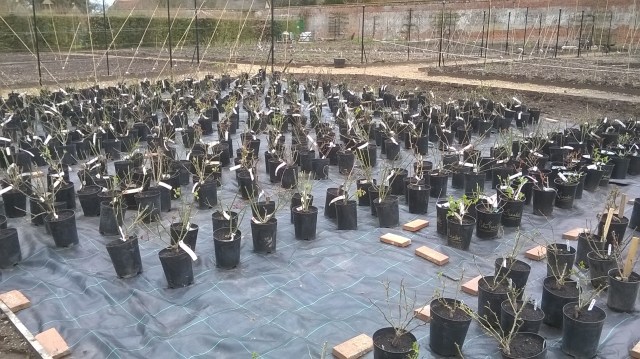
There were plenty of plants to place out and some of the other volunteers helped Gardener Rebecca pot some up for sale. I’d also noticed a large number of potted Roses, recently delivered and waiting placing out to fill gaps in the Rose Garden.

Plenty of roses waiting to be planted out in the Rose Garden

Plenty of roses waiting to be planted out in the Rose Garden

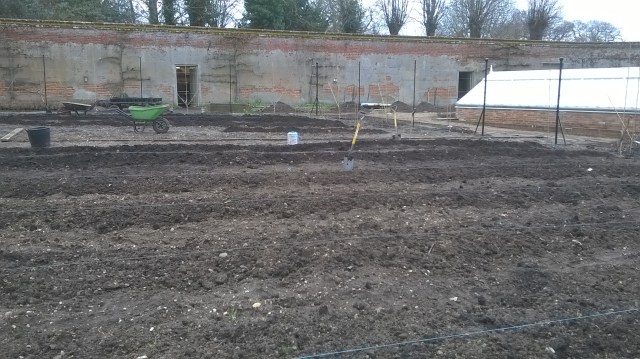
After this work- the plants didn’t require any special watering in as the rain came and went- we turned our attention to preparing the ground for the raspberries, blackcurrants, redcurrants and gooseberries that will occupy a quarter of the walled garden.

All is mucked in... forked over lines for soft fruit in the Walled Garden

All is mucked in… forked over lines for soft fruit in the Walled Garden

So having moved the piles of muck from the other side of the garden a few weeks ago, we now moved it (again) along lines that Mike had set out; to finish off we incorporated this into the top soil and so the ground is ready for planting. A digger had already been here to deep dig the soil, so, though I was still digging and forking this week, I managed to avoid yet more double digging!

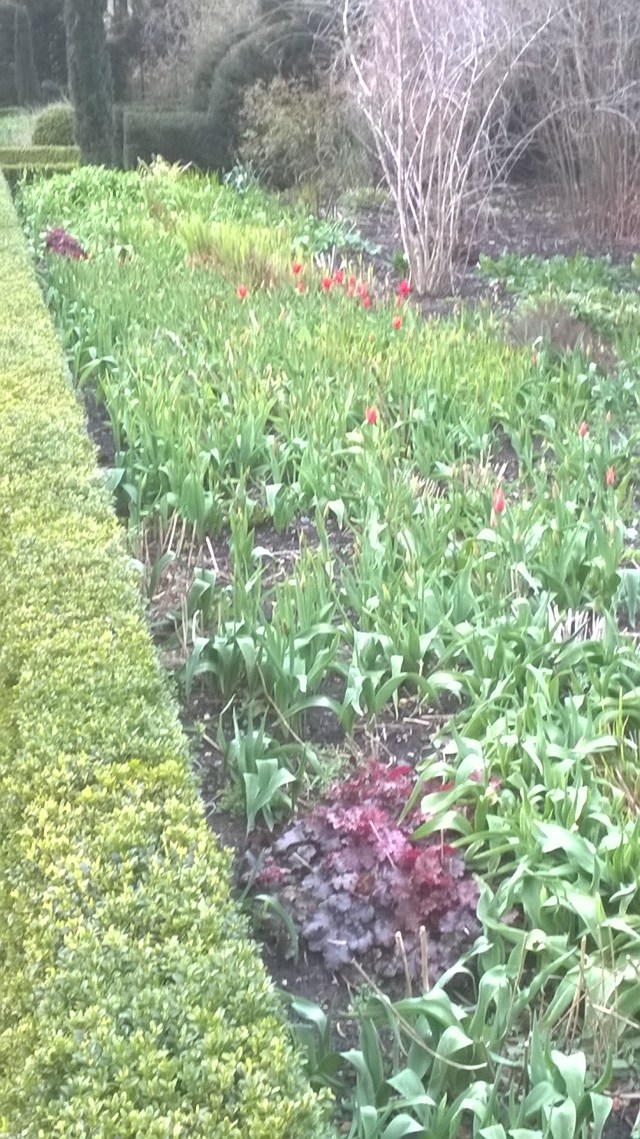
The first Tulips are starting to show in the double borders

The first Tulips are starting to show in the double borders

Further Information:

Blickling Hall website

Blickling Hall Facebook page

A 360 degree tour of Blickling Hall

Old School Gardener


Ed’s note – I’m a fan of Glasgow-based City of Play. I’m a sucker for cable spools and other playcycled materials. Though I’m born and bred in Canada, my roots are from Scotland’s west coast. Having had the good fortune to visit and stay with family on several occasions as a young boy, I have […]

via ​Amsterdam’s Wild West: Nature Play at Woeste Westen — PlayGroundology

Hmm... a suitable case for treatment?

Hmm… a suitable case for treatment?

You can extend the life of a freestanding garden brick wall, provided it is still safe.

First, cap the wall top with a coping of engineering bricks, which are water resistant. alternatively use tiles laid on the slant, so that water easily runs off.

Next, cover nearby plants with plastic sheeting, then rake out loose areas of mortar using a wire brush.

Repoint the wall where necessary using a ready-made mortar mix to save time using your own. If the walllooks like (it is probably worth trying to match the mortar to the colour of the existing if you can, so for an old wall it might mean using lime mortar).

Finish off by painting on a silicone sealer to extend the wall’s life and stop algal growth on shady walls. To finish off you can apply two coats of masonry paint- there are plenty of colours available…maybe black or dark green to show off those nice foliage plants and flowers you’ll plant in front?

This approach can be used on freestanding walls, such as those used as garden boundaries. But if your wall forms part of the house and it’s exposed to the elements, then it’s wise to avoid coating it as it needs to ‘breathe’; repointing is the best method of  repair here.

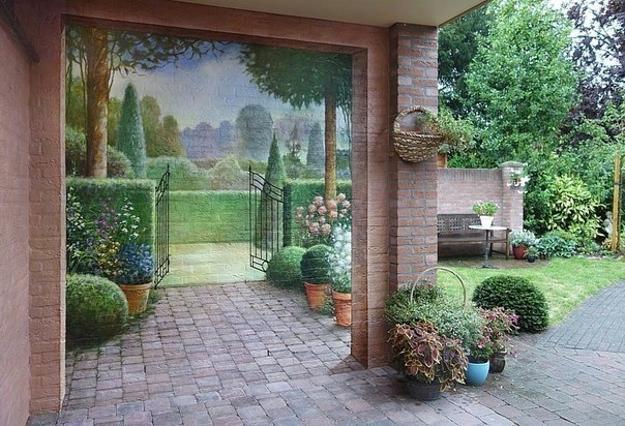
The ultimate in painted walls- extend your garden with a 'Tromp l'oeil'!

The ultimate in painted walls- extend your garden with a ‘Tromp d’oeiul’!

Source: ‘Short Cuts to Great Gardens’- Reader’s Digest 1999

Old School Gardener


Spring has arrived and what better way to brighten up your day than by taking a walk to see the bluebells across National Trust places. There is something magical about bluebells. With their sudden, mystical takeover of ancient woodlands the flowers have long been linked to the fairy-world. Get the family together and discover the […]

via Discover a sea of bluebells with the National Trust — National Trust Press Office

Poppies by Darlusz Langrzyk

Poppies by Darlusz Langrzyk

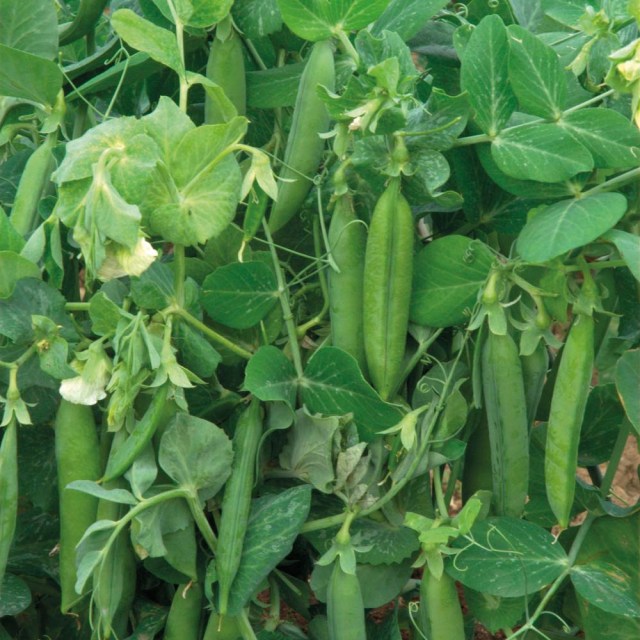
The 'Alderman' Pea- a heritage or heirloom variety

The ‘Alderman’ Pea- a heritage or heirloom variety

So, we made it to number 12. And what’s left to capture the essence of gardening? Well, I think I must put something in about legacy. So I’ve chosen an example of the humble pea, but not just any- an heirloom or heritage variety called ‘Alderman’.

In an interesting article about the heirloom or heritage varieties of pea held at the John Innes Centre in nearby Norwich, Mike Ambrose describes how the number of varieties of pea mentioned in seed catalogues increased over the 19th century, though in truth probably many were not ‘new’ varieties but thought to be such by their discoverers.

‘Peas were one of the most highly prized vegetables not just because of their nutritional qualities but also for their ease of cultivation and the range of varieties that ensured a succession of fresh produce over an extended season from May to October. Seed catalogues from the 1800’s contained many pages of descriptions of the varieties and in many, peas were placed at the front of the list. The Suttons catalogue of Vegetable seeds lists 53 varieties of peas compared to 14 broad beans whereas EW King & Co catalogue lists 49 peas to only 8 broad beans. Arthur Sutton in his paper on the progress of vegetable cultivation during Queen Victoria’s reign, interestingly also starts with peas which he refers to as the ‘Prince of Vegetables’.

The highly inbreeding nature of peas means that once fixed, particular variants or lines were particularly easy to maintain and it is clear from descriptions and illustrations as far back as the late 1500’s that peas such as parchmentless and fascinated types merited their own description and attributes (Gerard’s Herbal 1597). Prior to the rediscovery of Mendel’s work on the basis of inheritance in the early years of the 1900’s, there are clear references in the literature to selections being made from existing varieties as well as crossings between lines from which multiple forms were derived. In the absence of an understanding as to the underlying mechanism, the work was largely very largely empirical and selections in segregating populations resulting from crosses would have been only fixed for major characters leaving plenty of scope for further selection in subsequent generations.

Such was the clamour for improved varieties from growers in a market where there was no restriction in seed marketing and references can be found that openly refer to the prolific development of synonyms. Sherwood in 1898 noted the anomaly that, “while the number of listed varieties in catalogues was falling, the number of names of peas were ever increasing as more and more new varieties were being announced or shall I say old friends with new names”.

This was a brave statement of what was a widespread practise and he goes on to say “I need hardly say that they may easily be reduced to one fourth that number (150) as so many are only synonyms well known to those who test them each year: but it is not my intention to apply the pruning-knife, as I should most likely bring about my head a hornet’s nest of protests from those who do not agree with me.” This from someone who was involved with the growing of nearly 700 rows of different marketed peas for comparison in 1898 in his trial grounds in Essex…’

So my last object captures the way gardeners and breeders have taken natural processes of hybridisation among plants and developed varieties with new chracteristics- whether in foliage, flower, fruit or other ways. This legacy has added to nature’s own bounty and given us as gardeners ever more choice. But of course nature (and the growth in plant breeder’s rights) can also destroy or limit this variety. So it’s great to see initiatives like the conservation work of the NCCPG, Garden Organic’s Heritage Seed Library and the Svalbard Global Seed Vault- which both attempt to collect, and in Garden Organic’s case, promote the growing of, varieties that are in danger of being lost

…I leave to another place the debate over whether ever-increasing new varieties and the growing control of the varieties available commercially are ultimately ‘good’ things and of course the even more controversial topic of how genetic modification can even further extend our control of nature…

For us more modest gardeners, legacy may not be about breeding or discovering new varieties of plant and then finding a name for them (often of a cherished loved one, or for the more narcissistic, choosing one’s own name). Rather, it will be in leaving what we have created in our gardens and quite possibly what we pass on to sons, daughters and others (e.g. in school or community growing projects) by way of our skills and knowledge gained over many seasons.

I hope that you’ve enjoyed reading this and the previous posts in the series. You can access all of them via  ‘The Essence of Gardening in 12 Objects’ in the ‘My articles classified’ list on the right- but as a ready reference I’ll list out all 12 below:

1: Compost Heap– looking after our soil and feeding plants

2: Plant Label– propagation by seed and nurturing plants

3: Wardian Case– the expansion of plant choice through importation and creation of micro climates

4: Hand fork– weeding and soil care

5: Topiary– cutting plant stems to control shape and propagate

6: NGS Booklet– sharing our gardens and learning from them

7: Compass and compasses– positioning plants and design

8: Half Moon– constructing and shaping the garden and lunar phase gardening

9: Weather Satellite– watching and responding to the weather and further technological developments to aid the gardener

10: Trug– growing plants to eat

11: Garden Bench– sitting and enjoying the garden

12: Heirloom Pea – legacy through hybridisation and passing on our skills and knowledge to the next generation

Further information:

Garden Organic’s Heritage Seed Library

‘Seed Sense’- The Guardian

Svalbard Global Seed Vault

NCCPG Plant Heritage

EU Seed Law update and why grow Heritage seeds- Permaculture Magazine

 Old School Gardener

Finding Nature

Nature Connectedness Research Blog by Prof. Miles Richardson

Norfolk Green Care Network

Connecting People with Nature

Discover WordPress

A daily selection of the best content published on WordPress, collected for you by humans who love to read.

Susan Rushton

Celebrating gardens, photography and a creative life

Unlocking Landscapes

Writing, photography and more by Daniel Greenwood

Alphabet Ravine

Lydia Rae Bush Poetry

TIME GENTS

Australian Pub Project, Established 2013

Vanha Talo Suomi

The Journey from Finnish Rintamamiestalo to Arboretum & Gardens

Marigolds and Gin

Because even in chaos, there’s always gin and a good story …

Bits & Tidbits

RANDOM BITS & MORE TIDBITS

Rambling in the Garden

.....and nurturing my soul

The Interpretation Game

Cultural Heritage and the Digital Economy

pbmGarden

Sense of place, purpose, rejuvenation and joy

SISSINGHURST GARDEN

Notes from the Gardeners...

Deep Green Permaculture

Connecting People to Nature, Empowering People to Live Sustainably

BloominBootiful

A girl and her garden :)