Archive for February, 2016


We are thrilled to have recently awarded a Community Heritage Fund small grant to the Welney Residents Rec and Green Spaces Users Group (RUG), to create a community heritage orchard at the exciting Sandgate Corner Community Park and Meadow in Welney. The bio-diverse park will be suitable for all ages and will meet the particular needs of children, […]

Source: First trees planted at new Welney community heritage orchard

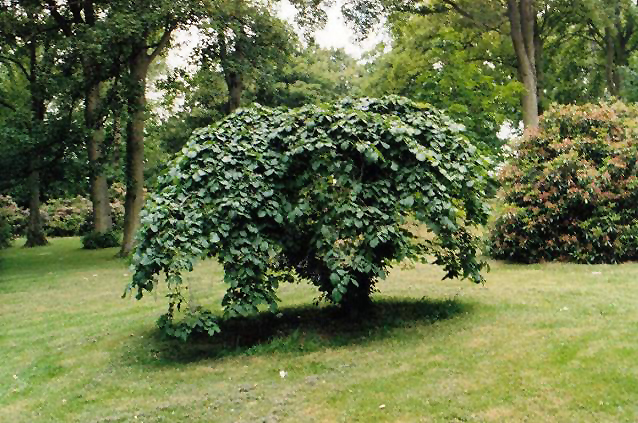
Camperdown Elm in Leamington, Ontario, Canada. Picture: jim5870

Camperdown Elm in Leamington, Ontario, Canada. Picture: jim5870

As we come to the end of this A-Z the options open become rather constrained; so today I’ve chosen a neat and compact variety of the Wych Elm, which can also be resistant to Dutch Elm disease.

Common name:  Camperdown Elm

Native areas: Ulmus glabra (Wych elm or Scots elm), the parent of this variety, has the widest range of the European elm species, from Ireland eastwards to the Urals, and from the Arctic Circle south to the mountains of Greece; it is also found in Iran. The tree was by far the most common elm in the north and west of the British Isles and is now acknowledged as the only indisputably British native elm species.
The original sport in Camperdown Park, Dundee. Picture: Peter Bourne

The original sport in Camperdown Park, Dundee. Picture: Peter Bourne

Historical notes: About 1835–1840, the Earl of Camperdown’s head forester, David Taylor, discovered a young contorted elm tree (a sport) growing in the forest at Camperdown House, in Dundee, Scotland. The young tree was lifted and replanted within the gardens Camperdown House where it still remains to this day. The original tree is less than 3 m tall, with a dramatic weeping habit and contorted branch structure and grows on its own roots. The earl’s gardener is said to have produced the first of what are commonly recognised as Camperdown elms by grafting it to the trunk of a Wych Elm (Ulmus glabra). Every ‘Camperdownii’ is descended (as cuttings taken from that original sport) and usually grafted on a Wych elm trunk.  Other grafting stock has been used. In Dundee, Scotland, there are two well established Camperdownii Elms at the gated entrance to a private residence on Constitution Terrace. Both trees have grown so they intertwine with each other and create the illusion of one tree in the summer months. The tree is likely to have been cultivated around 1850, the same age as the Victorian mansion situated in the grounds which was built around 1850. 

Ulmus_glabra_Camperdownii in Québec-Coulonges. Picture: Gilbert Bochenek

Features: The grafted Camperdown Elm slowly develops a broad, flat head that may eventually build as high as 4 m (13 feet) and an incommensurately wide crown with a contorted, weeping habit. The tree is often confused with the much taller ‘Horizontalis’ (Weeping Wych elm) owing to both being given the epithet ‘Pendula’ at some stage. It does not reproduce from seed. Neat and compact, it produces clusters of attractive hop-like flowers in the spring and its lustrous leaves add to its overall effect.

Uses:   Camperdown Elms satisfied a mid-Victorian passion for curiosities in the ‘Gardenesque’ gardens then in vogue. Many examples were planted, as ‘rarities’, in Britain and America, wherever elite gardens were extensive enough for tree collections. There are many on university campuses, often planted as memorials. Camperdown Elms are used in stately landscaping of American university campuses and others feature in townscapes. A small weeping tree with a dome shaped head, it looks good growing  as a specimen in a lawn in parks and gardens.

Growing conditions:  Camperdown Elm is cold hardy, suffering more from summer drought than winter cold. ‘Camperdownii’ can be susceptible to Dutch Elm disease, however there are still many examples to be found in parks and gardens across the British Isles as it often avoids detection by the Scolytae beetle (a major vector of Dutch Elm Disease) because of its diminutive height. Grow in average, medium moisture, well-drained soils in full sun. Tolerant of light shade. Prefers rich, moist loams. Adapts to both wet and dry sites. Generally tolerant of urban conditions. Non-suckering. 

Further information:

Wikipedia

Ulmus glabra ‘Camperdownii’– Missouri Botanical Garden

Old School Gardener

Primula vialli- pic by John Aspley

Primula vialli- pic by John Aspley

Blickling Hall and The Parterre looking splendid in a low winter sun

Blickling Hall and The Parterre looking splendid in a low winter sun

I worked with the ladies away from the Walled Garden in my latest Blickling session. The Dell was our target- a bit of ‘TLC’ with light weeding and clearing dead stems and leaves to reveal the wonderful Snowdrops and Hellebores.

Head Gardener, Paul tells me that the slopes here are not conducive to the Hellebores rooting, so its an annual task to plant up new ones. Paul says some terracing is needed. I think this would need to be done quite subtly, as it could spoil the natural look of the space.

We worked around the sloping sides of the Dell – well I kept to the top path and the slightly less pernickety areas. The lady volunteers seem to have the finger skills and eyesight needed to tease out the weeds from around the plants and at one stage looked like (in the nicest possible way), a herd of mountain goats stretched up the slope. I contented myself with the more straightforward leaf raking, limited weeding and path clearing work above, as well as emptying weed-full trugs into the waiting trailer.

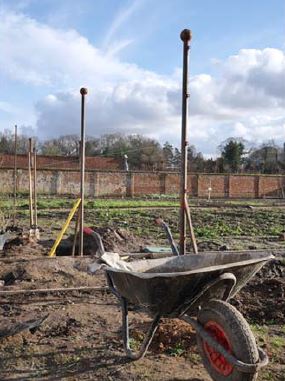
A major milestone has been reached this week in the walled garden. Project Manager Mike reports that all of the metal posts (76 of them in total) have now been installed, so we now wait on wires going in and then fruit tree planting in a few weeks time.

Posts all in- 76 have been set into concrete around the walled garden. Picture Blickling Estate

Posts all in- 76 have been set into concrete around the walled garden. Picture Blickling Estate

Oh, and my wife and I paid a visit to the gardens on Sunday, where we indulged in one of the restaurant’s special Valentine’s Day Cake Platters…

WP_20160214_15_32_46_ProFurther Information:

Blickling Hall website

Blickling Hall Facebook page

A 360 degree tour of Blickling Hall

Old School Gardener


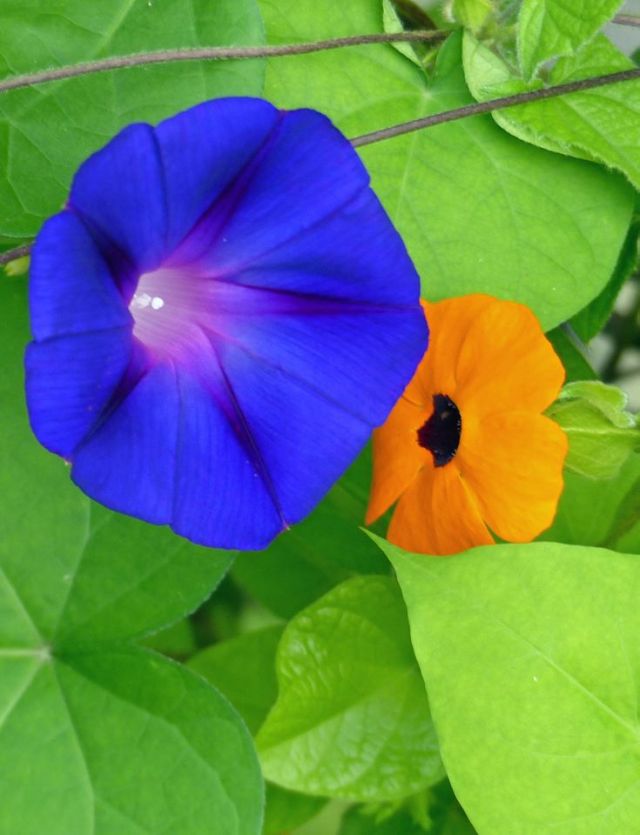
Morning Glory and Black Eyed Susan- pic by Ellen Zillin

Morning Glory and Black Eyed Susan- pic by Ellen Zillin

image1My friends Jen and Dave paid a visit to the wonderful gardens at Nymans in Sussex, recently. Jen says:

‘On a cold (4 degrees),damp and very grey day we went to Nymans, a National Trust property, for a long muddy walk in their woods.
The gardens are well known for several different types of snowdrops but it was the variety of winter colour which shone through. The C
amellias have been coming out early and there were even a couple of Rhododendrons in flower.’

Thanks for the pictures, Jen!

Old School Gardener


Hellebore- pic by Ann Stochaj

Hellebore- pic by Ann Stochaj

‘Weather watching’, or rather using forecasts of it and then responding so as to maximise plant growth and health, is a central task for most gardeners, especially those growing food. So my next object (no it’s not a weather vane), marks the massive progress there’s been in forecasting over the last 50 or so years; it’s one of the first satellites to be launched with the aim of improving meteorological forecasting, the TIROS-1.

Artist's impression of the TIROS 1. Picture by NASA Kennedy Space Center

Artist’s impression of the TIROS 1. Picture by NASA Kennedy Space Center

Launched way back in 1960, the TIROS Program (Television Infrared Observation Satellite) was NASA’s first experimental step to determine if satellites could be useful in the study of the Earth. At that time, the effectiveness of satellite observations was still unproven. Since satellites were a new technology, the TIROS Program also tested various design issues for spacecraft: instruments, data and operational parameters. The goal was to improve satellite applications for Earth-bound decisions, such as “should we evacuate the coast because of the hurricane?”. The TIROS Program’s first priority was the development of a meteorological satellite information system. Weather forecasting was deemed the most promising application of space-based observations.

TIROS proved extremely successful, providing the first accurate weather forecasts based on data gathered from space. TIROS began continuous coverage of the Earth’s weather in 1962, and was used by meteorologists worldwide. The program’s success with many instrument types and orbital configurations lead to the development of more sophisticated meteorological observation satellites. Read more here.

We gardeners have benefitted enormously from improvements in both long and short-term weather forecasting; I especially like the three-day forecasts broadcast on the BBC here in the UK, which usually turn out to be pretty accurate. Of course, with climate change affecting weather patterns, leading, it seems, to ever-increasing ‘unusual’ weather events, the future challenges for gardeners and growers (as well as the general population) are perhaps greater than they were. The worst effects of extremes of wet, dry, wind, hot and cold can be ameliorated with physical changes to the layouts of our gardens to create ‘micro climates’ and we need to be ready to supply extra water and perhaps food for plants in times of drought.

And in these days of ‘big data’ it is also interesting to see how further technological developments could help to improve farming (and in due course gardening?) practices. So called ‘Cloud Farming’ is being trialled in Kenya, Africa to help small holders monitor and manage key elements of their plots in ‘real time’. As a recent blog post on ‘Can We feed the World?’ says:

‘Although a sophisticated technology relying on expensive high-tech equipment, and thus not practical for the average smallholder farmer, cloud farming is increasing our knowledge of what happens on a farm scale, knowledge which could be useful in providing technical assistance on a broader scale. IBM’s EZ-Farm project, which is currently being piloted in Kenya, aims to explore how advanced data collection and analytics can help farmers monitor farming conditions on their smallholdings. Around the farm, sensors and infra-red cameras are strategically placed to monitor water tank levels, the amount of moisture in the soil, the performance of irrigation equipment, and rates of photosynthesis. This data is then streamed wirelessly to the IBM Cloud and can be accessed by the farmer via a smartphone app. The hope is that with access to such information, farmers can modify their practices and make their farms more productive…’

6928926222_9304a04498_zSo, while a weather satellite might seem a bit removed from the essence of gardening, I think it symbolises both gardeners’ historic need to monitor and forecast the weather (perhaps with something as basic as a weather vane), and our continuing need to do this, using technology to arm us with the information we need in more unpredictable times.

 Old School Gardener

Finding Nature

Nature Connectedness Research Blog by Prof. Miles Richardson

Norfolk Green Care Network

Connecting People with Nature

Discover WordPress

A daily selection of the best content published on WordPress, collected for you by humans who love to read.

Susan Rushton

Celebrating gardens, photography and a creative life

Unlocking Landscapes

Writing, photography and more by Daniel Greenwood

Alphabet Ravine

Lydia Rae Bush Poetry

TIME GENTS

Australian Pub Project, Established 2013

Vanha Talo Suomi

The Journey from Finnish Rintamamiestalo to Arboretum & Gardens

Marigolds and Gin

Because even in chaos, there’s always gin and a good story …

Bits & Tidbits

RANDOM BITS & MORE TIDBITS

Rambling in the Garden

.....and nurturing my soul

The Interpretation Game

Cultural Heritage and the Digital Economy

pbmGarden

Sense of place, purpose, rejuvenation and joy

SISSINGHURST GARDEN

Notes from the Gardeners...

Deep Green Permaculture

Connecting People to Nature, Empowering People to Live Sustainably

BloominBootiful

A girl and her garden :)