Archive for December, 2015


The third object in this series is of historic importance. The Wardian Case, originally designed by Nathaniel Bagshaw Ward in 1829.
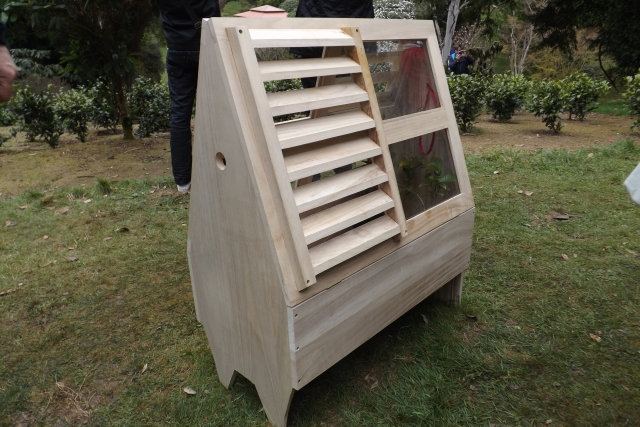
A modern reproduction of a Wardian Case at Tregothnan Gardens, Cornwall. Picture by Rosie Reeve

A modern reproduction of a Wardian Case at Tregothnan Gardens, Cornwall

It became a vital tool for those intrepid plant hunters of the 19th century. Without it, many of the exotic plants that now thrive in the U.K. would not have survived even half their journey from the far corners of the world.

Early plant hunters had been actively searching the world for new exotic plants from the end of the 16th century. But transporting their discoveries as seeds and dry roots because of the dehydrating sea air and a substantial lack of fresh water caused many plants to perish. The Wardian Case provided protection from the salty wind, created a mini greenhouse where the plants could use sunlight and produce their own water through condensation.

And the Case is not only of historic importance in explaining the wide range of plants now available in the U.K. It also symbolises the ways in which gardeners try to create micro climates to nurture an exotic plant or even a range of plants. They do this by growing them under glass (and a few years after Ward’s invention an explosion in greenhouse manufacture began), sheltering them from the excesses of sun, wind and rain or creating plant colonies which support each other, possibly altering the soil too.

 Old School Gardener

stream of consciousness

I’ve surprised myself. I think I’ve managed to track down the six remaining plant pictures my friend Jen sent me from Vietnam. So here’s the next three wonderful pictures in this ‘select flora’…

First the evergreen shrub, Ixora coccinea or the ‘Jungle Geranium’ or ‘Flame of the Woods’.

Ixora coccinea

Ixora coccinea

Second, the national flower of Laos, the Champon flower, or Plumeria rubra. This fragrant relative of Oleander is also known as ‘Frangipani’.

Plumeria rubra

Plumeria rubra

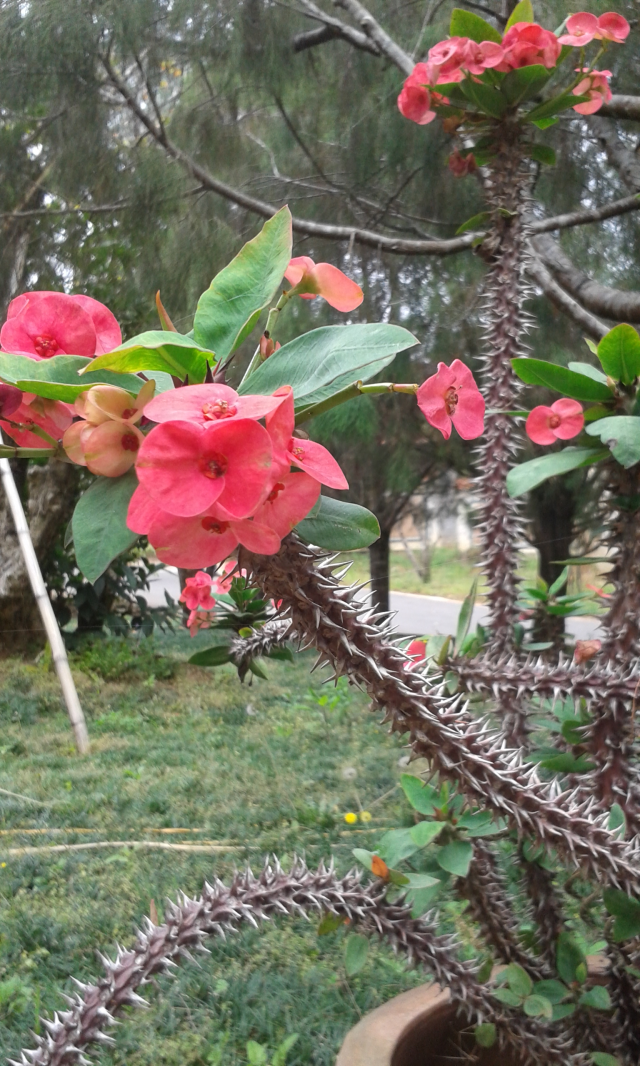
Finally, a rather spiky Euphorbia originally from Madagascar, named after a former Governor of the Island of Reunion  (Baron Milius) who introduced it to France in 1821, Euphorbia milii, or the ‘Crown of Thorns’.

Euphorbia milii

Euphorbia milii

My final three plants in a few days time…

Old School Gardener

Euphorbia milii

Winter visitors

North York Moors National Park's avatarThe official blog for the North York Moors National Park

Kate Bailey – Conservation Graduate Trainee

As winter approaches, avian visitors arrive from the north and east to spend winter in the British Isles where the climate is milder and food is more abundant. These visiting birds will then leave our shores to head for their breeding grounds in springtime.

Two well-known and widespread winter visitors to the North York Moors, and across the UK, are the winter thrushes – Redwing and Fieldfare. Flocks are a well-known sight in our British countryside with hundreds of birds arriving each year looking for food.

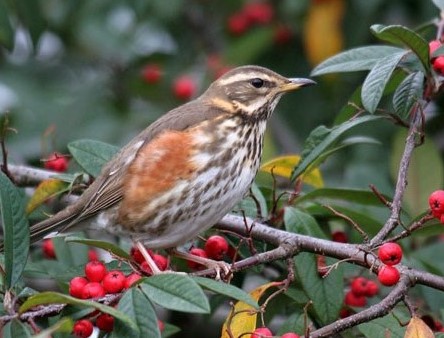
Redwings Turdus iliacus

Redwing - http://www.bbc.co.uk/staticarchive/ce3cd0beac24186666bee91e279da9ecaecd0321.jpg

Redwings tend to arrive from Iceland and Scandinavia to winter in the UK before heading south to breed come springtime. Although a very small number have been known to breed in the far north of Scotland. These small thrushes are dark brown above and white below, with a black-streaked breast and orange-red flanks and underwing. The…

View original post 288 more words

water path

Appalachian Red Oaks-picture Jason Hollinger

Appalachian Red Oaks-picture Jason Hollinger

There can’t be many trees with a botanical name beginning with Q, but the Oaks provide plenty of variety and what for the U.K. (or maybe just England?) is probably the ‘people’s choice’ as our national tree (Quercus robur).

I’ve chosen a rather large variety, which will not fit easily into smaller gardens, but I just love it, especially for its autumn foliage…

Common name: Red Oak, American Red Oak, Northern Red Oak or Champion Oak

Native areas: North America, in the eastern and central U.S. and southeast and south-central Canada.

Red Oak early in the year

Red Oak early in the year

Historical notes: The Red Oak is one of the most important oaks for timber production in North America. Quality red oak is of high value as lumber and veneer, while defective logs are used as firewood. It’s bark is also rich in tannin, making it valuable in tanning leather. It was introduced to the U.K. in 1724 and has won the R.H.S. Award of Garden Merit in 2002 (and before this in 1971). There are 3 well known, very old specimens in the U.S.:

  • Ashford Oak – A very large Northern Red Oak in Ashford, Connecticut. The tree has suffered falling limbs because of its great age. However, this tree is still a sight to behold; the trunk is 8 m (26 ft) in circumference and the root-knees are also particularly impressive.

  • Chase Creek Red Oak – This forest tree is located on a very rich steep slope in Anne Arundel County, Maryland. The circumference at breast height is 6.7 m (22 ft), the height 41.5 m (136 ft) and the spread 29.9 m (98 ft)

  • Shera-Blair Red Oak – This majestic red oak tree is located in the South Frankfort neighbourhood of Frankling County, Kentucky. The circumference at breast height is 6.4 m (21 ft), with the trunk reaching higher than 40 feet before the branches begin and an estimated height of 130 feet.

Red Oak specimen Tortorth Arboretum. Picture by Velela

Red Oak specimen Tortorth Arboretum. Picture by Velela

Features: A large, broadly oval tree which does best in deep fertile soils, but tolerates most others. Under optimal conditions, Red Oak is fast growing and a 10-year-old tree can be 5–6 m (16–20 ft) tall. Trees may live up to 500 years and a living example of 326 years was noted in 2001. Red oak is easy to recognize by its bark, which features bark ridges that appear to have shiny stripes down the centre.  Young growth emerges almost yellow in the spring befoe expanding into large, broad green and lobed leaves by May. It’s autumn foliage is a rich red, turning dark reddish grey brown before falling. The acorns mature in about 18 months after pollination. Its kernel is white and very bitter. Despite this bitterness, they are eaten by deer, squirrels and birds. It appears to tolerate polluted air well.

Uses:  As a large tree the Red Oak is best used in parks and large gardens as specimen tree.

Growing conditions:  Red Oak is not planted as often as the closely related Pin Oak as it develops a taproot and quickly becomes difficult to transplant. Acorns should either be sown in the location where the tree is intended to be planted or else moved to their permanent location within the seedling’s first year. As the tree gets older, the taproot gradually shrinks and the lateral root network expands. Red Oak is easy to start from seed, however the acorns must be protected from animal predation over the winter months. As with other oaks, germination takes place in late spring when all frost danger has passed. The seedling grows rapidly for its first month, then pauses for another month, and sends out more new shoots until September when growth stops for the year. If the weather stays favorable, a third burst of growth may occur.

Mature Red Oak, autumn foliage

Mature Red Oak, autumn foliage

Further information:

Wikipedia

RHS- Quercus rubra

Barcham trees directory- Quercus rubra

Old School Gardener

yin yang

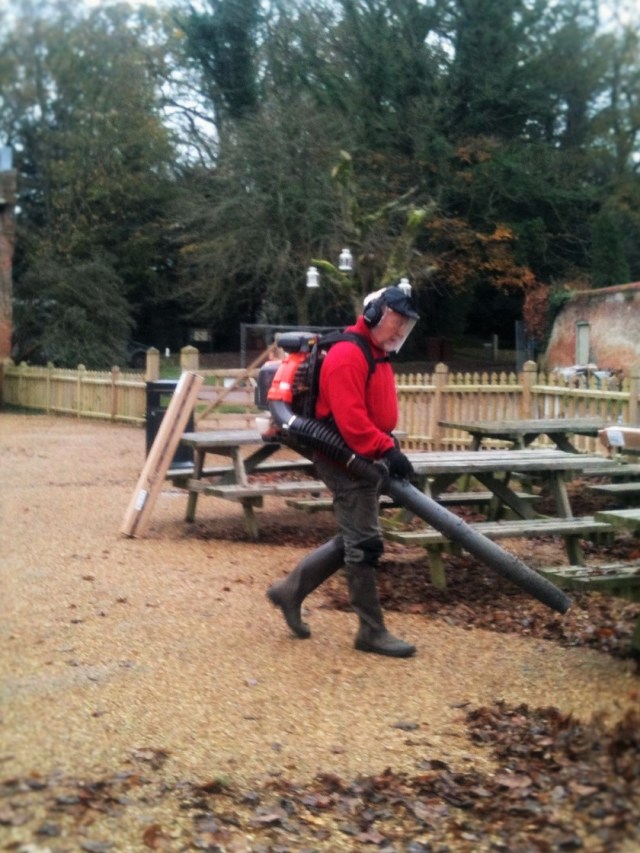
IMG-20151203-WA0002O.K. it’s me in there (captured by my wife on one of her walks)…and yes, it isn’t Ghostbusting (as my daughter suggested), but rather leaf blowing at Blickling this week!

The ladies were put to work helping the tidy up before the big Christmas events here at the Hall, and Peter, Ed and I were set to clearing the main roads and verges of some rather wet and in some places, deeply laying leaves. With the Oaks still holding on to their foliage it will be some weeks before all the leaf litter is down and can be cleared away for another year. But it was well worth doing this little bit of work to protect the grass and help to tidy up the paths and roads around the Hall.

WP_20151203_10_41_45_ProEd took me through the machine for the day – a very powerful petrol-powered back pack blower which was a bit on the heavy side, especially after a couple of hours! But, moving in a line, Peter, Ed (who had an even more powerful trolley blower) and I managed to get the leaves ready for Ed to bring round the tractor with a powerful vacuum cleaner attachment to suck up and shred the leaves ready for dumping on the leaf mould pile.


I know the use of this sort of powered leaf collection is not very environmentally friendly, but the sheer scale of the job here at Blickling (as with so many of the gardening tasks) requires this sort of kit to get anywhere in a reasonable amount of time. Still, I salved my conscience a day or two later with some manual leaf raking and dumping in my newly created leaf mould bay at Old School Garden!

WP_20151203_15_47_48_ProThe run up to Christmas with Blickling  ‘Putting on the Glitz’ is starting to come together, and we also helped lift furniture in the courtyard where a fire pit, lanterns and other features look set to create wonderful centre piece. Staff and volunteers have been out decorating the Acorn Yews in the Parterre Garden and the traditional avenue of illuminated Christmas Trees looks wonderful once more. This year there is even a ‘Christmas Tree’ alight on the island in the lake.


Further Information:

Blickling Hall website

Blickling Hall Facebook page

A 360 degree tour of Blickling Hall

Old School Gardener


A Tree Troll by Kim Beaton, inspired by her father from Montana!

A Tree Troll by Kim Beaton, inspired by her father from Montana!

canwefeedtheworld's avatarOne Billion Hungry: Can We Feed the World?

Originally posted on: 4th December 2015, Grantham Institute 

As we mark World Soil Day, and with COP21 well into its first week, Dr Katrin Glatzel of Agriculture for Impacttakes a look at how good soil and land management practices can help us achieve important climate and development goals.  

Soil matters. The decision made at the Rio+20 conference to develop a set of Sustainable Development Goals (SDGs) and the agreement ‘to strive to achieve a land degradation neutral world in the context of sustainable development’ gave momentum to discussions on the role of soils in the global sustainable development agenda. This is now, at least partially, reflected and anchored in SDG goal #15, ‘Sustainably manage forests, combat desertification, halt and reverse land degradation, halt biodiversity loss.’

In addition to this, earlier this year the French Government launched its “4 per 1000” initiative, aimed at making…

View original post 675 more words

Finding Nature

Nature Connectedness Research Blog by Prof. Miles Richardson

Norfolk Green Care Network

Connecting People with Nature

Discover WordPress

A daily selection of the best content published on WordPress, collected for you by humans who love to read.

Susan Rushton

Celebrating gardens, photography and a creative life

Unlocking Landscapes

Writing, photography and more by Daniel Greenwood

Alphabet Ravine

Lydia Rae Bush Poetry

TIME GENTS

Australian Pub Project, Established 2013

Vanha Talo Suomi

The Journey from Finnish Rintamamiestalo to Arboretum & Gardens

Marigolds and Gin

Because even in chaos, there’s always gin and a good story …

Bits & Tidbits

RANDOM BITS & MORE TIDBITS

Rambling in the Garden

.....and nurturing my soul

The Interpretation Game

Cultural Heritage and the Digital Economy

pbmGarden

Sense of place, purpose, rejuvenation and joy

SISSINGHURST GARDEN

Notes from the Gardeners...

Deep Green Permaculture

Connecting People to Nature, Empowering People to Live Sustainably

BloominBootiful

A girl and her garden :)