
Archive for March, 2015
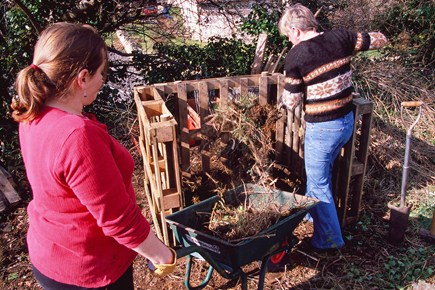 From BBC Gardener’s World: As the growing season gets underway, so does the green waste that can be composted. So why not make DIY bin, using an old pallet?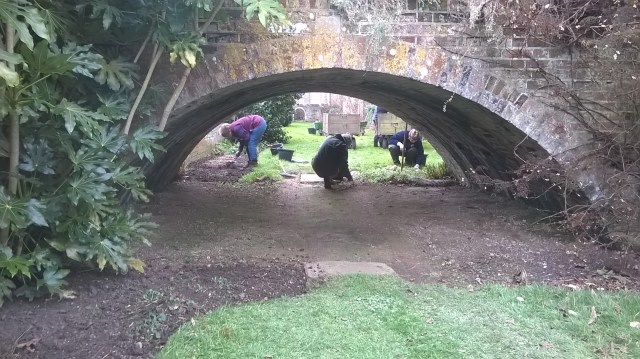
Tidying up in the Moat
Trusted, that’s how I felt. Assistant Head Gardener, Steve told me that the Head Gardener wanted me to prune some shrubs in the double borders at Blickling.
Buddleja, Fuchsia, Black Elder and also Pawlonia were the target, following on from the start I made a couple of weeks ago. Pruning Pawlonia always worries me; as you may know they can be left unpruned and will produce purple flowers. But they are mainly grown to create wonderful foliage and so quite hard pruning- involving some saw work- is needed. I came across some quite thick stems that on the face of it look substantial, but as you cut in their hollow insides give way easily and you feel slightly less of a vandal.

The Double Borders

Pruning underway in the double borders

Pawlonia tomentosa foliage

Pawlonia flowers
I didn’t spend any time in the walled garden, but you might be interested to listen to a 15 minute interview that BBC Radio Norfolk did with the Project Manager, Mike. Here’s a link to it.
This wasn’t my first visit to Blickling this week. I also attended a lively and stimulating induction day for new staff and volunteers. We had a tour of the house and park. Our guides were really enthusiastic and knowledgeable. Some interesting facts about Blickling that we uncovered:
- The Manor has been owned by two kings- first Harold (he with the arrow in the eye problem) and subsequently by his successor William the Conqueror
- There have been three houses on the site, the current one (which began building in 1619), built within the moat of the older houses
- Anne Boleyn (Henry VIII’s second wife and with the ‘neck ache’) was probably born at Blickling in around 1501
- The designer of the current house was Robert Lyminge, a well know Dutch architect who had previously designed Hatfield House- he was paid the princely sum of 2 shillings and sixpence (‘Half a Crown’) a day
- King Charles II visited the house in 1671 and knighted the owner, Henry Hobart
- Blickling Estate today employs around 40 staff and has some 450 volunteers!

Walled Garden Project Manager,Mike explaining his plans to the staff and volunteers induction group

Head Ranger Dave Bryant describing the layout of Blickling Park
After the pruning – where I was engaged in conversation with several visitors- I joined the other volunteers in the moat for some general tidying up. We managed to complete the two remaining sides (of three) within a couple of hours and it did look satisfyingly neat. Paul, the Head Gardener came round to thank us for our efforts and was very complementary about my pruning; it’s nice to feel valued!

In the Moat…

Apart from various pieces of masonry that had fallen off of the moat walls, I also discovered a metal object (see picture)- any guesses as to what it might be?
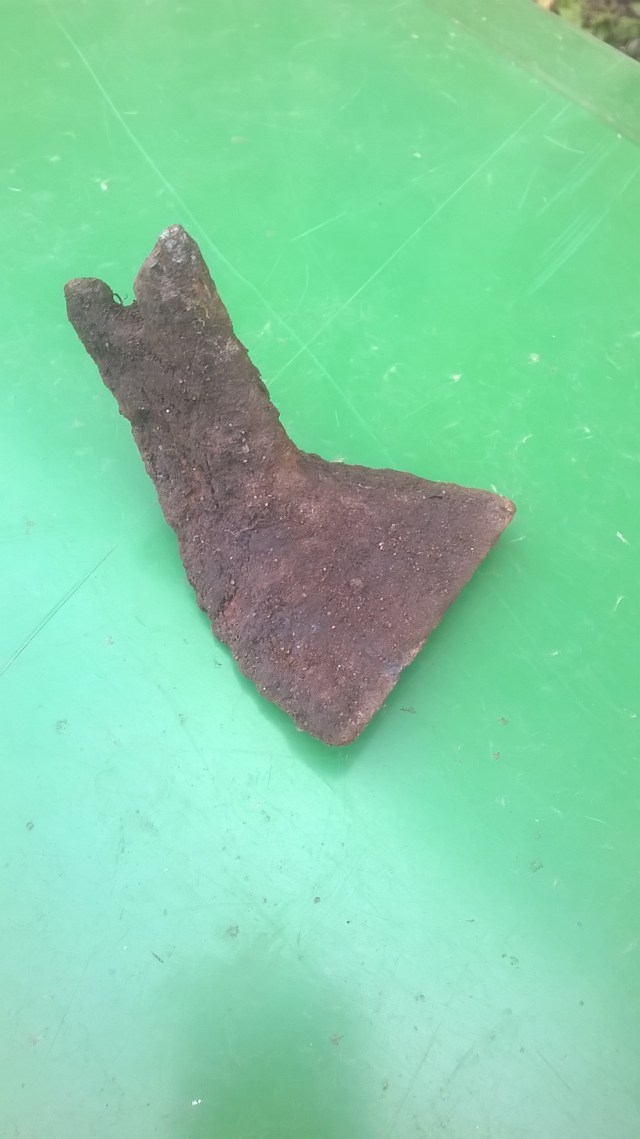
This week’s mystery object.. any ideas?
Further Information:
Blickling Hall website
Blickling Hall Facebook page
A 360 degree tour of Blickling Hall
Old School Gardener

Dogtooth violet (Erythronium americanum) via Mariani Landscape Blog
-
 Do choose drought resistant plants
 -
Do conserve moisture by mulching in spring when the soil is moist
-
Do mulch problem problem soils- too dry, sandy or chalky- twice a year, in spring and autumn
-
Do build a deep no-dig bed if you want to grow fruit and vegetables
-
Don’t try to grow a conventional lawn. Instead, create patches of green with a herb lawn using thyme or chamomile.
Source: ‘Short Cuts to Great Gardens’- Readers Digest
Also- see this great article:
No Dig Gardening Demystified: Embracing the Magic of Natural Garden Nurturing
Old School Gardener

Picture by Eva Kovacs
 A few more clippings from a book I bought in a charity shop last summer ….
Mesh Maxim:
The best-laid schemes of mice and gardeners aft a-gley, especially where cats and kids are concerned. It’s one thing to install a cat-proof, child-proof seedling net. It’s another thing to prove to the cats or children that they can’t get through it.
Bamboo Laws:
1. Stakes to support floppy plants are used by children to break the floppy plants they supported.
2. Bamboo canes make more realistic spears than those sold in the toy shop.
The Cat Trap:
The only way for a cat hater to keep cats out of his garden is to get a moggy of his own.
Laws of Attraction and Repulsion:
1. Where dogs, cats and children are concerned, seedbeds and wet concrete have irrestible magnetic propoerties.
2. If you lay a path to protect the lawn and the flowerbeds you are simultaneously creating a force field which prevents children and animals from using it.
Kidology
Children are always on their pest behaviour in the garden.
 From : ‘Mrs. Murphy’s Laws of Gardening’ – Faith Hines (Temple House books, 1992)
Old School Gardener

Picture by Barrie Lambert

Anthemic tinctoria ‘E.C. Buxton’- suitable for the ‘Chelsea Chop’
Maintenance-
Avoid the need for staking by growing compact versions of tall perennials or plant them close together so that they support each other. You can also cut back later flowering perennials in late spring by pinching out or cutting back stems by about a half- the so called ‘Chelsea Chop’- this will promote more compact and later flowering plants that do not need staking. Also, select flowering plants with weather-resistant blooms which stand up to wind and rain and that don’t need regular deadheading for continuous flowering.
Further information:
Plants for Gardening in a rainier Britain- Daily Telegraph
Rain- proof flowers
Pruning perennial and annual plants- BBC
Dwarf perennials- Guardian Garden Centre
Source: ‘Short Cuts to Great Gardens’ (Reader’s Digest 1999)
Old School Gardener

Picture by Mike Smith
‘Sow Endive, Succory, Chervil, Sellerie, purselan (which you may also continue sowing all the summer to have tender) leeks, Beetes, parsneps, salsifix, skirrits, Turneps &c. and now Cherish and Earth-up your flowers, and set stakes to the tallest: sow also lettuce.’
Grow lettuce- on a fence!
John Evelyn 1686 (published 1932)
OK, who knows what a skirrit is?!
Old School Gardener






 Old School Garden